
Clinical Research Project Manager Salary Trends: Complete 2025 Guide
Clinical research project managers (CRPMs) sit where timelines, budgets, sites, vendors, and data all collide. Yet salary bands for this role remain opaque, and many former coordinators or CRAs walk into project-management offers without knowing how far they can push. This guide breaks down how much CRPMs are really earning in 2025, which levers move you into higher bands, and how AI-driven trials will reshape compensation. You’ll see exactly how to read offers, use market data, and design a career that keeps you at the top of the range rather than stuck at the floor.

1. What Clinical Research Project Managers Actually Earn in 2025
Across North America, experienced clinical research project managers typically earn $105k–$145k base, with high-cost hubs and complex portfolios stretching into the $150k–$175k range when bonuses, equity, and retention incentives are included. Former CRAs who move into project oversight at large CROs often see their first PM offers benchmarked against data similar to the CRA salary report, but with uplift for budget accountability and sponsor-facing ownership. You can contrast these bands with upper-tier roles in the clinical research salary report and top-paying jobs list to see where CRPMs sit.
Project managers embedded at academic medical centers or hospital networks—often coordinating multi-site investigator-initiated studies drawn from institutions in the top hospitals directory—tend to earn less cash but receive richer benefits, retirement contributions, and tuition support. Their salary ceilings may plateau around $120k–$135k, yet their proximity to cutting-edge investigator pipelines and fellowships listed in the academic medical centers list often leads to strategic sideways moves into regulatory, QA, or compliance where compensation structures look more like the clinical quality auditor and compliance officer roadmaps.
In emerging regions, the job title “project manager” can hide coordinator-level responsibilities with PM-style expectations. That’s where directories such as the CRO vendors guide, trial site mega-lists, and patient-recruitment companies list become powerful: they show which employers treat CRPMs as genuine owners of scope, risk, and delivery—and pay accordingly. When the role has real authority over vendor selection, data platforms, and recruitment budget, compensation aligns with high-stakes ownership rather than glorified scheduling.
2. Global Salary Patterns by Region, Employer Type, and Trial Model
Regional salary differences for CRPMs mirror the patterns mapped in the clinical research salary report, but with sharper peaks at the top end because project managers concentrate responsibility. In North America, global program managers overseeing oncology, rare disease, or cell-therapy portfolios routinely match or exceed upper-tier roles highlighted in the pharmacovigilance specialist salary guide, particularly when they also own vendor selection from lists like the CRO buyers guide and EDC platform directory.
In Europe, PM salaries are shaped by regulatory complexity and cross-border coordination. Project managers who can navigate post-Brexit research environments, EU CTR implementation, and country-level ethics nuances become disproportionately valuable. Many sponsors base pan-European project-management hubs in countries with strong language pools, then rely on networks of trial sites such as those mapped across top hospitals and academic centers. CRPMs who can align local sites, remote vendors, and centralized data teams in these ecosystems often progress more quickly to program-director-level compensation.
Growth markets—particularly Africa and Asia—show a different pattern. Salaries may start below Western benchmarks, yet the steepest raises often occur where sponsors aggressively expand into regions highlighted in predictions like Africa as the next trial frontier and China’s potential dominance. Here, CRPMs who already understand remote monitoring technologies from guides on remote-monitoring tools and recruitment vendors from the patient-recruitment mega-list can become linchpins in multinational programs, reaching compensation levels that rival Western peers despite starting from lower local baselines.
Even within a single employer category, trial model influences pay. CRPMs leading decentralized and hybrid programs—which draw heavily on innovations described in AI-powered trials, wearable-tech studies, and drone-enabled medication delivery—often receive higher base and bonus targets than peers focused on traditional single-country site networks. The reason is simple: decentralized trials compress timelines and multiply risk nodes; organizations pay more for people who can orchestrate that complexity without exploding budgets or inspection findings.
3. Levers That Push Your CRPM Salary into the Top Bands
You don’t move into top salary bands by “being busy.” You move by owning levers that sponsors and executives actually care about—risk, cost, and time. One of the fastest ways to differentiate yourself is to become the project manager who understands why trials fail, not just how to run status meetings. Dive into analyses on predicting trial failures, AI-based retention models, and emerging AI audit tools. If you can anticipate which metrics will wobble six months out and renegotiate vendor scope or add recruitment channels early—pulling from the recruitment vendors list—you justify a premium.
A second high-impact lever is cross-functional fluency. CRPMs who understand safety workflows from the pharmacovigilance salaries and growth report, regulatory expectations from the regulatory affairs specialist roadmap, and compliance pressures from clinical compliance officer guides can negotiate timelines grounded in what each function can actually deliver. That ability protects portfolios from chronic “optimism bias” and late re-forecasts, which is exactly what senior leadership rewards with larger bonuses and accelerated promotions.
A third lever is your track record of inspection readiness. When regulators walk into a study you manage—and walk out without major findings—you permanently change how your name shows up in promotion discussions. Align yourself with QA specialists using frameworks from QA career roadmaps and clinical quality auditor pathways. Build dashboards that link operational metrics (query aging, protocol deviations, consent errors) with risk signals. When you can show that your programs consistently finish audits in better shape than portfolios led by peers, you have concrete justification to push for pay aligned with higher-tier roles mapped across the top-paying jobs list.
Finally, formal training and certification remain underrated salary levers. Many project managers were promoted from CRA or coordinator roles without structured project-management education. That leaves a gap you can exploit by completing advanced training, test-prep programs, and focused courses using techniques from exam strategy guides and study-environment optimization. Employers treat certified PMs who can still speak the language of sites, CRAs, and safety as rare assets—and they pay accordingly.
What’s Your Biggest Challenge in Growing Your Clinical Research Project Manager Salary?
4. Future Outlook: How AI, DCTs, and New Entrants Will Reshape CRPM Pay
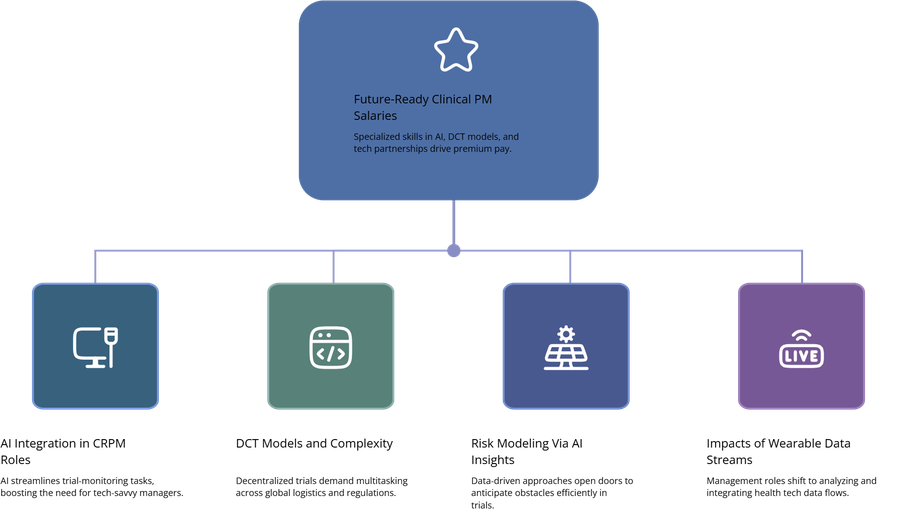
Clinical research project manager salaries will be pulled upward by complexity at the same time automation squeezes the middle. On one side, AI-driven tools described in AI-powered trial forecasts, clinical-trial failure prediction, and remote AI audits are taking over routine monitoring and query-tracking tasks. On the other, decentralized and hybrid models—projected to eliminate many traditional sites in DCT disruption analyses—are multiplying vendor interfaces, logistics nodes, and regulatory touchpoints.
CRPMs who treat AI as a co-pilot rather than a threat will capture the upside. If you can interpret AI-generated risk scores, understand wearable-tech data streams, and orchestrate novel interventions such as smart pills and digital biomarkers or VR/AR-based visit models, you become the linchpin translating cutting-edge science into inspection-ready execution. Employers will reserve their top pay brackets for PMs operating at this interface, not for those coordinating standard site-visit calendars.
Competitive pressure will also come from outside traditional pharma. Analyses of Amazon and Google’s entry into trials show how tech companies bring aggressive timelines, data science, and consumer-grade UX expectations into the ecosystem. These organizations recruit project managers fluent in both clinical regulations and product-style execution. If you already understand classical GCP from resources aligned with certification prep and have worked on digital-health pilot programs, you’ll be well positioned when tech-driven sponsors start matching compensation patterns from the highest rungs of the clinical research jobs list.
In short, the future CRPM salary curve will split. Generalist project managers who avoid technology, data, and global complexity will see slower growth and more competition from AI-assisted roles forecasted in pieces like AI replacing some research jobs. Specialists who embrace data-driven risk modeling, decentralized operation, and cross-functional leadership will increasingly command director-level compensation while still holding “project manager” titles on paper.
5. Roadmap: Positioning Yourself for Higher Compensation as a CRPM
To systematically climb the salary ladder, treat your career like a program with clear milestones. First, ensure your foundational knowledge is airtight. If your route into project management came through CRA or CRC promotions, revisit GCP and operational fundamentals using exam-oriented resources such as test-taking strategy guides, exam-anxiety playbooks, and articles on building effective study environments. This lets you credibly sponsor junior staff and frame yourself as the “operational adult” in cross-functional discussions.
Next, deliberately seek portfolios that stretch your skill set: multi-country oncology or rare-disease programs, DCT pilots using technologies from the EDC platform guide, or collaborations with vendors from the remote-monitoring tools list. When you interview, ask to see how the organization selects vendors—do they rely on structured buyers guides and performance data, or purely on legacy relationships? High-performing employers that think analytically about vendors usually reward project managers who bring that same analytical rigor to budgeting, re-forecasting, and risk control.
Third, cultivate a portfolio narrative framed in executive language. Instead of telling leadership “I ran three phase II oncology studies,” quantify impact: reduced database-lock timelines versus initial plan; re-negotiated CRO scope to stay within margin; deployed additional recruitment vendors referencing the patient-recruitment mega-list; avoided protocol amendments by integrating early feedback from key sites pulled from the trial sites directory. That language mirrors how senior leaders read portfolio dashboards—and it’s the language that unlocks higher bonus targets and retention offers.
Finally, be intentional about pivot options. Some CRPMs gain more salary traction by stepping sideways into specialized roles mapped in the regulatory affairs specialist roadmap, clinical regulatory specialist pathway, or pharmacovigilance training programs list. Those pivots often lead back into senior program leadership once you’ve built deep expertise in one critical function. Treat each move as a strategic investment: will this role make me the person executives call when timelines slip, regulators knock, or AI tools flag high risk? If the answer is yes, the salary curve usually follows.
6. Clinical Research Project Manager Salary FAQs
-
In mature markets such as the US and Western Europe, mid-level CRPMs overseeing multi-site phase II/III trials can reasonably target $120k–$140k or regional equivalents, depending on cost of living and employer type. To refine your target, triangulate ranges from the clinical research salary report, CRA salary data, and senior roles highlighted in the top-paying jobs list. If your responsibilities include budget ownership, vendor governance, and inspection readiness, you should be at or above the top of local CRA bands.
-
Project manager compensation is competitive with mid-senior roles across regulatory, QA, and PV, but the mix differs. Regulators and QA specialists described in the regulatory affairs career roadmap and QA career guide often enjoy more stable hours but slightly lower bonus upside. Pharmacovigilance leaders in organizations featured in the PV salary report can match or exceed CRPM pay, particularly when they manage global safety case workflows. If you enjoy orchestrating many moving parts and negotiating with vendors, CRPM roles usually offer the best blend of pay, influence, and path toward program-director positions.
-
Yes—when that experience is real, not just a buzzword on your CV. Employers running decentralized programs aligned with trends in DCT disruption forecasts and AI-powered studies pay premiums for CRPMs who can coordinate home-health vendors, wearable-data platforms, drone logistics, and remote monitoring tools described in the remote-monitoring guide. Demonstrated success in these models signals that you can handle the future state of trials, not just legacy designs, which is exactly what sponsors reward with higher bands and faster promotion.
-
Arrive with a mini “inspection file” on your own performance. Include on-time FPI and database-lock metrics, budget adherence, scope-change control, inspection outcomes alongside QA teams, and measurable recruitment or retention improvements achieved using vendors from the patient-recruitment mega-list. Cross-reference your achievements with external benchmarks like the clinical research salary report and role comparisons in the top-paying jobs guide. This reframes negotiation from “I’d like more money” to “Here’s the quantifiable value I already deliver compared with market norms.”
-
It’s common but not ideal. Many organizations treat the first PM title as a trial run and keep salaries close to upper CRA bands described in the CRA salary report. The key is to avoid getting stuck there. Use your first year to build a portfolio that clearly demonstrates ownership of budget, risk, and cross-functional delivery; then leverage both internal performance reviews and external market data to renegotiate. If your employer remains reluctant, you can credibly pursue PM roles at CROs, sponsors, or academic centers listed in the trial site directories, where compensation better matches responsibilities.
-
AI will compress pay for administrative project managers whose value lies in chasing timelines and updating spreadsheets. Articles forecasting AI replacing some research jobs make that clear. However, CRPMs who become orchestrators of AI-driven insights—using predictions from failure-forecasting tools, dropout-risk models, and remote-audit platforms—will move into strategic, portfolio-shaping roles. Those positions are more likely to see rising, not falling, compensation.
