
Good Clinical Practice (GCP) Certified Professional Salaries: Global Trends 2025
Clinical research is in an arms race for people who actually understand Good Clinical Practice, not just as theory but as daily behavior. In 2025, sponsors and CROs quietly reward GCP-certified professionals with higher salaries, faster promotions, and access to the most future-proof roles. This guide translates that into numbers and actions: what GCP-certified individuals earn across regions, which roles benefit most, and how to turn a certificate into a pay-raising career strategy. We’ll connect it with data-backed insights from CCRPS salary reports, technology trends, and employer directories so you can negotiate from evidence, not guesswork.

1. Why GCP-Certified Professionals Are Earning More in 2025
Employers are under intense pressure to keep trials inspection-ready while deploying new technologies like AI, wearables, and decentralized models. That makes GCP literacy a hard requirement, not a “nice-to-have.” Teams that once relied on a handful of experts now expect every coordinator, CRA, pharmacovigilance specialist, and data manager to execute ICH-GCP correctly. Professionals who validate their knowledge through structured GCP-focused training and exams—supported by resources such as proven test-taking strategies, exam anxiety playbooks, and optimized study environments—therefore become lower-risk hires.
Salary trends described in the Clinical Research Salary Report 2025 show a clear pattern: professionals in high-compliance roles (CRAs, QA specialists, PV staff) and those who work at inspection-facing organizations earn more than peers with similar tenure but weaker GCP grounding. That’s also visible in specialized paths such as pharmacovigilance careers, quality assurance roadmaps, and clinical compliance officer roles. When regulators expect flawless documentation across global portfolios, managers pay more for people who can prevent audit findings rather than just react to them.
2. Global Salary Benchmarks for GCP-Certified Roles in 2025
The first place to look for pay patterns is role-based salary data. Broad analyses like the Clinical Research Salary Report 2025, CRA worldwide salary guide, and CRC compensation trends show consistent premiums wherever GCP certification is common. Entry-level staff who validate their knowledge often start closer to the midpoint of bands, while non-certified peers linger near the minimum.
In the US, GCP-certified CRAs and site leads frequently land in the $90k–$120k range earlier in their careers, especially at sponsors or high-performing sites listed in directories like top clinical trial hospitals and SMO mega-lists. In Europe, where salary bands are narrower, the difference shows up more in promotion timing and access to regional lead jobs. APAC hubs such as Singapore and Japan, identified as growth centers in clinical research frontier analyses and market dominance forecasts, increasingly make GCP certification a prerequisite for senior CRA and QA posts that match Western pay levels.
Higher-paying specialist roles also reward GCP strength. Pharmacovigilance specialists, regulatory affairs professionals, and clinical quality auditors are effectively paid to “think GCP” all day. As a result, employers treat certification as proof that you can interpret guidelines, not just memorize them, which is one reason these roles appear repeatedly on lists of highest-paying clinical research jobs.
3. Key Factors That Push GCP Salaries Into the Top Bands
The first differentiator is how close you sit to inspection risk. Professionals embedded in roles such as clinical compliance officer or QA specialist routinely lead mock audits, vendor assessments, and CAPA design. When these individuals also hold GCP certification, organizations see a direct line between their work and successful regulatory outcomes, justifying top-band salaries. The same is true for CRAs overseeing high-risk portfolios or decentralized models covered in pieces like remote monitoring tools and AI-led audits.
A second driver is the ability to combine GCP expertise with domain specialization. GCP-certified professionals who also understand immuno-oncology, rare disease, or cell and gene therapy often appear in high-paying roles in directories such as top pharma & biotech PV employers and clinical data platform buyers’ guides. Add familiarity with technology-heavy models—like wearable-driven trials or digital biomarkers—and your salary trajectory starts to resemble that of specialists featured in AI-powered clinical trial forecasts.
Finally, compensation accelerates when you can connect GCP to business metrics. Leaders care about recruitment speed, retention, and inspection readiness; they read the same trend pieces on patient recruitment vendors, SMOs, and contract research platforms. GCP-certified professionals who can show how their decisions prevented findings, avoided rework, or allowed clean database locks give employers a measurable ROI, which is exactly what supports upper-quartile raises and bonuses.
What’s Your Biggest Challenge in Turning GCP Certification Into Higher Pay?
4. How to Use GCP Certification to Negotiate Better Offers
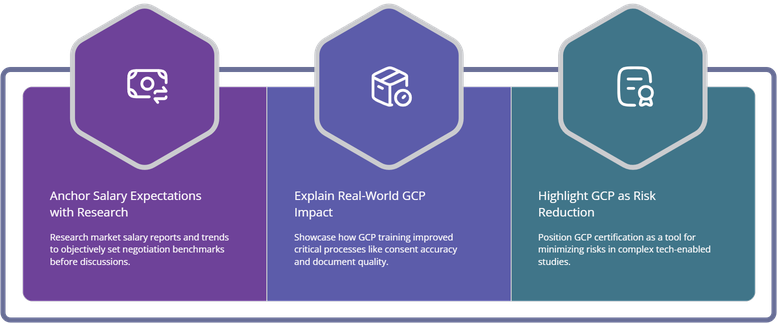
A certificate alone doesn’t raise your salary; how you package it does. Start by anchoring your expectations using objective data: pull ranges from the 2025 salary report, compare them with role-specific guides such as CRA salaries worldwide, and cross-check with lists of high-paying clinical research roles. Then clearly explain how your GCP training allowed you to implement better consent processes, cleaner source documentation, or more robust monitoring plans that align with expectations in AI-enabled oversight articles.
Next, frame your certification as a risk reducer in technology-heavy or geographically complex studies. Point to trends like decentralized trial expansion, AI prediction of trial failures, and new entrants such as Amazon and Google in clinical trials. Explain that maintaining GCP standards in such environments requires more judgment, which your certification and exam preparation—supported by resources like exam anxiety strategies and structured test-taking systems—helped you build.
Finally, use GCP certification as leverage when changing employer type. If you are moving from a low-paying academic or single-site environment into sponsors, CROs, or tech-enabled vendors featured in clinical vendor buyers’ guides and EDC platform lists, present your credential as proof that you can operate at global standards from day one. That gives hiring managers justification to slot you at or above the midpoint of the band instead of starting at the minimum.
5. Future Trends: AI, Decentralized Trials, and New Markets
In the next five years, GCP-certified professionals who understand emerging models will see the steepest salary growth. Articles on AI-powered clinical trials, robot-driven monitoring, and predictive patient dropout tools suggest that manual, checklist-style roles will shrink. But people who can interpret algorithm outputs, validate them against GCP, and explain them to regulators will effectively become “AI translators” for sponsors, a capability that sits in the highest pay bands across operations, PV, and quality.
Decentralized and hybrid studies add another layer of opportunity. Managing safety when using drone-delivered medications, immersive VR trials, or AR-driven protocols requires people who can reinterpret GCP principles for entirely new risk landscapes. Salary reports already show that decentralized trial specialists often match or exceed traditional field monitors, especially when based in growth regions like Africa, Asia, and the Middle East discussed in frontier-market forecasts and Brexit impact analyses.
Finally, as sponsor–vendor ecosystems grow more complex, employers lean heavily on curated directories such as top remote monitoring platforms, patient recruitment companies, and pharmacovigilance training programs to build their stack. GCP-certified professionals who can evaluate these vendors, write compliant SOPs, and integrate technology within regulatory boundaries will remain at the center of strategic decision-making—and compensation will follow.
6. FAQs: GCP-Certified Professional Salaries and Career Growth
-
For purely administrative roles, the impact may be modest. But for positions close to inspections, AI tools, or decentralized models, GCP certification becomes a risk-management asset. Salary patterns in guides like the 2025 clinical research salary report, CRA global data, and PV industry analyses consistently show 5–15% premiums or faster promotion timelines for certified staff—especially in QA, PV, regulatory, and senior monitoring positions.
-
The biggest jumps appear in inspection-facing or technology-heavy jobs: senior CRAs managing complex portfolios, clinical quality auditors, clinical compliance officers, PV specialists in global safety hubs, and leads within decentralized or AI-enabled trials described in remote monitoring and AI-trial articles. In these roles, the certificate is often mandatory, and the professionals who combine it with therapeutic expertise frequently occupy the top of the band.
-
Use it to reframe your responsibilities. After completing training and exam preparation—ideally using structured resources such as test-taking strategy guides and exam-anxiety tools—start leading initiatives that directly affect compliance: consent checklist redesigns, source-document templates, deviation prevention projects. Document measurable improvements and bring them to performance reviews along with benchmarks from the CRC salary guide and CRA salary data to argue for a move into higher-paying titles or steps within your band.
-
Yes—arguably more than ever. Articles like “Meet Your New Boss: How AI Will Replace Clinical Research Jobs” and AI audit forecasts predict automation of repetitive tasks, not of judgment. AI-generated risk signals still need humans who understand GCP to decide which findings matter, how to document them, and how to respond in a regulator-proof way. Professionals who combine strong GCP knowledge with comfort using AI, wearables, and digital biomarkers covered in technology-focused guides will occupy higher-paying “human-in-the-loop” roles instead of being automated away.
-
Location still shapes absolute pay, but certification helps you break out of local ceilings. US and Swiss hubs regularly top salary charts in the clinical research salary report, while emerging markets such as Africa and parts of Asia, discussed in frontier predictions, offer rapid growth but lower starting pay. GCP certification is particularly valuable when you’re seeking remote roles with sponsors, CROs, or vendors from directories like top clinical data platforms and patient recruitment companies, because it demonstrates that you operate at global standards, not just local norms.
-
Yes. Salary acceleration is strongest when GCP is the foundation for another high-value niche: pharmacovigilance, regulatory affairs, quality, data science, or decentralized operations. Combining GCP with structured PV training from lists like top PV programs, or with regulatory career roadmaps such as clinical regulatory specialist guides, positions you for leadership roles that control sponsor risk. That’s where compensation begins to resemble the top-tier packages highlighted in high-paying job roundups rather than entry-level bands.
