
Global clinical trial regulations are entering a critical transition period. The European Union is expanding its ICH E6(R3) framework, Australia faces a major GCP transition deadline, Canada is preparing comprehensive clinical trial reforms, and regulators worldwide are tightening expectations for digital evidence, sponsor oversight, and participant protection. For sponsors, CROs, investigators, and regulatory affairs professionals, these developments create significant operational and compliance challenges.
This 2027–2028 regulatory landscape report examines confirmed requirements, scheduled implementation milestones, proposed reforms, and practical actions organizations should take to maintain inspection readiness across international clinical research programs.

1. Global Clinical Trial Regulations in 2027–2028: What Is Actually Changing?
The most significant development for 2027–2028 is the continued implementation of ICH E6(R3) Good Clinical Practice, alongside jurisdiction-specific reforms affecting trial authorization, decentralized research, safety reporting, and data governance.
As of November 2026, several major implementation milestones have been confirmed:
January 13, 2027: Australia's transition period for ICH E6(R3) Principles and Annex 1 ends.
January 15, 2027: The EU's ICH E6(R3) Annex 2 and consolidated guideline become legally effective.
March 2027: The European Commission faces a scheduled deadline to adopt important European Health Data Space implementing acts.
Spring 2027: Health Canada anticipates publishing its finalized modernized Clinical Trials Regulations.
Spring 2028: Canada's proposed regulatory framework is anticipated to come into force, subject to final publication and implementation arrangements.
These milestones carry different levels of regulatory certainty. EU and Australian dates are published implementation requirements. Canada's dates represent announced regulatory plans that may change before the final rules are issued.
Organizations must therefore distinguish enacted regulatory requirements, scheduled implementation dates, proposals under development, and anticipated operational trends.
This distinction is particularly important for professionals managing global clinical trial timelines, regulatory compliance responsibilities, clinical research quality management, and investigator GCP obligations.
ICH E6(R3): The central international regulatory development
ICH E6(R3) places greater emphasis on designing clinical trials around their critical-to-quality factors, applying proportionate controls, and ensuring that study processes and data systems remain fit for their intended purpose.
Its implications extend across protocol development, vendor selection, monitoring, electronic systems, data governance, and sponsor oversight.
For example, a sponsor operating a multinational oncology trial may rely on electronic patient-reported outcomes, local laboratory testing, and remote monitoring.
The sponsor must determine which data are critical to participant safety and primary endpoint reliability, identify the associated risks, and establish appropriate controls.
This requires an integrated approach to clinical trial data integrity, risk-based monitoring, medical safety oversight, and clinical trial site operations.
The compliance challenge: Organizations may already possess GCP training certificates while continuing to use procedures, technology systems, and oversight practices designed around earlier requirements.
An effective transition requires a documented assessment of actual operational practices, relevant regulatory requirements, and the evidence demonstrating that updated controls work.
Regional differences make global compliance more complicated
The United States finalized its FDA E6(R3) guidance in September 2025. The European Union implemented the Principles and Annex 1 in July 2025, with Annex 2 scheduled for January 2027.
The United Kingdom's revised clinical trial regulations entered into force on April 28, 2026. China introduced an updated GCP framework in 2026, while Japan has been working toward incorporating ICH E6(R3) into its domestic regulatory framework.
These developments illustrate how internationally harmonized principles can coexist with different local implementation dates, legal requirements, and oversight systems.
A multinational sponsor should maintain jurisdiction-specific regulatory mappings rather than assume that adoption of the same ICH guidance creates identical local procedures.
This is especially relevant to sponsor oversight responsibilities, clinical research project leadership, trial logistics coordination, and clinical research ethics and compliance resources.
A useful regulatory monitoring system should record the jurisdiction, applicable trial type, legal or guidance status, implementation date, operational impact, responsible owner, and evidence of compliance.
| Jurisdiction / Requirement | Date and Regulatory Status | Operational Impact | Required Readiness Action |
|---|---|---|---|
| 1. EU — ICH E6(R3) Principles | Effective July 23, 2025 | Quality by design, proportionate oversight and critical-to-quality factors. | Review trial quality management and risk documentation. |
| 2. EU — ICH E6(R3) Annex 2 | Effective January 15, 2027 | Additional GCP considerations for pragmatic, decentralized and real-world-data trial designs. | Assess nontraditional data sources and oversight. |
| 3. EU — Consolidated E6(R3) | Effective January 15, 2027 | Consolidates Principles, Annex 1 and Annex 2 for operational interpretation. | Update training materials and controlled procedures. |
| 4. EU — Clinical Trials Regulation | Fully transitioned January 31, 2025 | Clinical trials fall under Regulation (EU) 536/2014 and CTIS processes. | Verify authorization records by Member State. |
| 5. EU — CTIS Transparency | Revised rules applied from June 18, 2024 | Earlier publication of selected documents and revised commercial confidentiality controls. | Check publication accuracy and redactions. |
| 6. EU — CTIS Lifecycle Management | Ongoing CTR obligation | Submission updates, substantial modifications, trial status and results-related responsibilities. | Assign submission milestone owners. |
| 7. EU — European Health Data Space | Key implementing acts due March 2027 | Technical and procedural groundwork for future regulated health-data use. | Map data provenance and access controls. |
| 8. EU — EHDS Research Data Access | Major secondary-use provisions generally start in 2029 | Later changes to access and permitted secondary uses of health data. | Prepare future research governance assessments. |
| 9. EU — European Biotech Act | Proposal; implementation timing unconfirmed | Potential clinical trial authorization and biotechnology framework reforms. | Scenario-plan approval timelines; monitor final legislation. |
| 10. UK — Clinical Trials Reform | Effective April 28, 2026 | Updated authorization, transparency, GCP and trial management framework. | Perform procedural gap analysis. |
| 11. UK — Notifiable Trials | Introduced under 2026 reform | Eligible lower-risk trials may use a simplified notification route. | Document eligibility and authorization requirements. |
| 12. UK — Modification Framework | Effective April 2026 | Updated classification and authorization processes for changes to approved studies. | Revise protocol change controls. |
| 13. UK — GCP and Helsinki Principles | Regulatory framework in force since April 2026 | Requirements incorporate ICH GCP principles and Declaration of Helsinki considerations. | Update ethics and GCP procedures. |
| 14. UK — Safety Reporting | Revised guidance effective 2026 | Updated expectations for AE, SAE, SUSAR and safety oversight workflows. | Reconcile safety reporting processes. |
| 15. UK — Phase 1 Review Acceleration | Stepwise 2026–2027 program | Targeted 14-day first assessment for eligible Phase 1 applications. | Verify program criteria before changing startup forecasts. |
| 16. US — FDA E6(R3) Guidance | Final guidance issued September 2025 | Greater emphasis on flexible, risk-based GCP and modern trial approaches. | Update monitoring approaches. |
| 17. US — Decentralized Clinical Trials | Final FDA guidance September 2024 | Recommendations address remote visits, home activities and local providers. | Define remote-visit responsibilities. |
| 18. US — Clinical Trial Participation | Final FDA guidance December 2025 | Recommendations address eligibility, enrollment practices and representative study populations. | Review feasibility and recruitment. |
| 19. US — Electronic Records | Standing applicable electronic record requirements | Electronic records, signatures and validated controls remain central to oversight. | Verify audit trails and system controls. |
| 20. US — ICH E2D(R1) | Final FDA guidance March 2026 | Updated post-approval safety case guidance, including newer information sources. | Review pharmacovigilance intake processes. |
| 21. US — Sponsor Oversight | Ongoing obligations; guidance modernization | Documented supervision of delegated trial activities remains important. | Strengthen vendor quality oversight. |
| 22. Canada — Clinical Trial Interim Policy | Issued September 14, 2026 | Facilitates coordinated ethics review, qualified investigator flexibility and documented consent approaches. | Review investigator and consent workflows. |
| 23. Canada — Decentralized Trial Guidance | Published October 2026 | Addresses remote trial elements, digital systems, product handling and oversight. | Assess decentralized trial logistics. |
| 24. Canada — Final Clinical Trial Regulations | Expected spring 2027; planned | Proposed modernization of drug clinical trial authorization and oversight. | Prepare a draft-to-final gap register. |
| 25. Canada — Anticipated Implementation | Approximately spring 2028; provisional | Expected one-year implementation period following final publication. | Reserve transition milestones without assuming a fixed date. |
| 26. Australia — ICH E6(R3) Transition | Transition ends January 13, 2027 | E6(R3) Principles and Annex 1 replace the alternative R2 transition option. | Finish GCP retraining and procedure updates. |
| 27. Australia — ICH E6(R3) Annex 2 | Adoption targeted for January 2027; pending | Potential Australian adoption of additional guidance for modern study designs. | Monitor TGA confirmation and assess data-source controls. |
| 28. Australia — Device Trials / ISO 14155 | Transition ends March 31, 2027 | ISO 14155:2026 becomes the relevant current GCP standard following transition. | Update device-specific monitoring procedures. |
| 29. Japan — ICH E6(R3) Alignment | Domestic incorporation planned within FY2026 | Expected updates to Japanese GCP implementation and related guidance. | Monitor final PMDA/MHLW publications and E6(R3) alignment. |
| 30. China — Updated Drug GCP | Revised domestic framework in 2026 | Stronger E6(R3) alignment, including data governance and proportionate quality principles. | Check local data governance requirements. |
| 31. Brazil — ANVISA RDC 945/2024 | Effective January 1, 2025 | Updated regulatory framework for relevant medicinal product clinical trials. | Maintain Brazil-specific regulatory mappings. |
| 32. Brazil — Optimized Review / Reliance | Framework in operation; 2026 clarification | Risk and complexity criteria influence eligible regulatory review pathways. | Verify eligibility before updating approval forecasts. |
| 33. India — Clinical Trial Authorization | 2019 framework continues; 2026 clarifications | CDSCO and registered ethics committee requirements remain important for applicable trials. | Review approval and investigator records. |
| 34. South Africa — SAHPRA Guidance | Revised guidance effective during 2026 | Updated expectations include clinical trial review and participant compensation considerations. | Verify local participant protections. |
| 35. Global — WHO Clinical Trial Best Practices | Guidance published September 2024 | Encourages stronger trial design, capacity, coordination and useful research evidence. | Incorporate quality-by-design principles into global planning. |
2. Regional Regulatory Changes: United States, European Union, UK, Canada, and Asia-Pacific
European Union: Annex 2 creates a major January 2027 implementation milestone
The European Medicines Agency has established January 15, 2027, as the effective date for ICH E6(R3) Annex 2 and the consolidated guideline.
Annex 2 addresses additional considerations for clinical trials incorporating decentralized elements, pragmatic designs, and real-world data sources.
Consider a cardiovascular study that combines hospital encounters, wearable-device measurements, pharmacy data, and electronic health records.
The sponsor must establish which information supports critical endpoints, evaluate potential data quality limitations, and determine whether participant safety can be appropriately monitored across the selected methods.
These activities require stronger coordination between clinical data integrity teams, risk-based monitoring functions, medical safety oversight personnel, and clinical project management teams.
Priority action: Complete an Annex 2 impact assessment covering data sources, vendor responsibilities, protocol assumptions, remote activities, and evidence of appropriate quality controls.
The EU Clinical Trials Regulation and CTIS framework also require sustained attention. The transition from the previous directive concluded in January 2025, and revised CTIS transparency rules have applied since June 2024.
For 2027–2028 programs, sponsors should focus on the quality of submissions, public disclosure controls, substantial modification management, and completeness of trial records.
Review trial milestone coordination, protocol management, clinical quality controls, and study close-out procedures when designing these workflows.
United States: FDA modernization emphasizes practical risk-based controls
The FDA's September 2025 E6(R3) final guidance supports modern clinical trial design and conduct through risk-based, fit-for-purpose approaches.
Its September 2024 decentralized clinical trial guidance provides recommendations for studies incorporating telehealth, home visits, local healthcare providers, and other activities performed away from conventional trial sites.
The operational difficulty comes from defining responsibilities when data and procedures originate from multiple locations.
For example, if a home healthcare provider performs a protocol-required assessment, the sponsor and investigator need appropriate arrangements for delegation, training, data collection, escalation, and oversight.
The study must preserve investigator accountability, protocol adherence, participant safety reporting, and data reliability.
The FDA also finalized guidance in December 2025 addressing clinical trial participation through eligibility criteria, enrollment practices, and trial designs.
Sponsors planning 2027–2028 trials should evaluate whether exclusion criteria unnecessarily restrict participation and whether recruitment practices realistically reach the population relevant to the intended use.
An effective assessment integrates clinical trial site feasibility, patient education resources, ethical recruitment principles, and recruitment milestone management.
United Kingdom: The April 2026 reforms shape operational practice through 2028
The UK's revised clinical trial regulations entered into force on April 28, 2026.
The updated framework includes changes to approvals, modifications, transparency, GCP, and pharmacovigilance.
It also introduces a notifiable route for eligible lower-risk trials and supports streamlined review processes.
For 2027–2028 planning, organizations should focus on implementing the established requirements rather than treating the 2026 reforms as future legislation.
A particularly important challenge is determining the applicable transitional arrangements for studies authorized under previous rules.
Sponsors must evaluate how the classification of a study affects its authorization, modification, safety reporting, and documentation responsibilities.
This requires coordination between regulatory compliance teams, clinical trial project managers, pharmacovigilance professionals, and investigator site operations.
The MHRA has also been developing accelerated assessment arrangements for eligible Phase 1 applications.
Priority action: Validate eligibility for accelerated pathways before including shortened regulatory review assumptions in the project baseline. An ineligible application can create costly downstream delays if activation plans depend on an accelerated timeline.
Canada: The largest anticipated 2028 regulatory transition
Health Canada's proposed Clinical Trials Regulations represent an especially important development because the regulator expects final publication in spring 2027, followed by approximately one year before implementation.
The proposed reforms seek to modernize drug clinical trial regulation through more flexible oversight, updated authorization processes, and approaches suited to contemporary study designs.
Canada introduced an interim modernization policy in September 2026 addressing coordinated ethics review, qualified investigator arrangements, and documented informed consent.
Additional decentralized clinical trial guidance followed in October 2026.
For multinational sponsors, the immediate priority is ensuring that new Canadian studies can meet existing requirements while remaining adaptable to the final framework.
This includes reviewing informed consent procedures, investigator oversight, decentralized trial logistics, and clinical quality management.
Priority action: Maintain separate tracking for current Canadian law, interim policies, proposed regulations, and final implementation guidance.
Avoid assigning a guaranteed spring 2028 compliance date until the final regulation and its commencement provisions are confirmed.
Australia, Japan, China, and emerging clinical trial markets
Australia's January 13, 2027, GCP transition deadline has direct implications for sponsors and sites operating through the Clinical Trial Notification and Clinical Trial Approval schemes.
Organizations should demonstrate that required training, procedures, and applicable documentation align with E6(R3).
Australian medical device trials face a separate transition involving ISO 14155:2026, with the published transition ending March 31, 2027.
These requirements affect clinical monitoring methods, quality management systems, investigator responsibilities, and research team training.
Japan has announced plans to incorporate E6(R3) into its regulatory framework during fiscal year 2026. Sponsors should confirm the final domestic measures and relevant commencement details before relying on a specific compliance date.
China's 2026 GCP updates reinforce the importance of local data governance and E6(R3) alignment.
Brazil's ANVISA framework, including RDC 945/2024, has been operational since January 2025 and includes processes relevant to regulatory reliance and risk-based review.
India continues to apply its established clinical trial authorization framework alongside subsequent regulatory clarifications.
Across these markets, the central challenge is integrating local legal requirements into multinational trial oversight plans, sponsor quality processes, regulatory documentation controls, and global trial schedules.
3. Five Regulatory Risks That Could Disrupt Multinational Clinical Trials in 2027–2028
Risk 1: Applying a single global GCP procedure without accounting for local requirements
ICH harmonization provides a common framework, but sponsors must still comply with applicable national laws and regional guidance.
A global procedure stating that electronic consent is acceptable may be insufficient when particular jurisdictions impose additional requirements concerning identification, documentation, ethics approval, or participant access.
The solution is a controlled global-to-local regulatory requirements matrix.
For every critical study activity, document the global standard, local rule, applicable trial category, responsible function, and evidence required for compliance.
Include investigator GCP requirements, research ethics obligations, protocol adherence procedures, and regulatory compliance resources.
A country-specific requirement should also be linked to its effective date and the document version containing the obligation.
Risk 2: Decentralized trial vendors operating without adequate oversight
Remote clinical trial activities can increase convenience while introducing additional operational dependencies.
A study using home nursing, wearable sensors, electronic consent, and remote laboratory collection may involve several vendors contributing information to the same endpoint.
Sponsors need clear agreements regarding data quality, system accessibility, safety escalation, staff qualifications, and incident management.
Consider an external wearable-device provider that changes its data-processing algorithm midway through a study.
The sponsor should evaluate whether the change affects measurement consistency, endpoint interpretation, participant monitoring, or the reliability of previously collected information.
This assessment draws on clinical trial data integrity controls, risk-based monitoring, project quality management, and trial logistics coordination.
Practical control: Require vendors to disclose material system changes, support impact assessments, preserve relevant records, and participate in documented corrective action when needed.
Risk 3: Confusing digital data access reform with permission to reuse clinical information
The European Health Data Space Regulation introduces a phased framework for health-data access and secondary use.
Its March 2027 milestone concerns key implementing acts. The main secondary-use provisions for many health-data categories are scheduled to begin in March 2029.
A sponsor preparing a 2028 observational study should therefore avoid assuming that future EHDS permissions already provide a legal basis for accessing identifiable patient information.
Data-use arrangements must satisfy requirements applicable at the time of processing, including relevant privacy, confidentiality, research ethics, and other legal obligations.
A credible data-governance plan should identify the origin of each dataset, permitted purposes, lawful access arrangements, technical safeguards, and procedures for validating the information's suitability.
These activities connect clinical research data integrity, ethical research conduct, quality assurance, and clinical data assessment.
Risk 4: Inconsistent safety reporting across trial and post-marketing systems
Multinational research programs often operate alongside pharmacovigilance activities covering different products, jurisdictions, and regulatory stages.
Safety reporting requirements vary according to whether the information concerns an investigational trial, an authorized product, or another regulated activity.
The FDA finalized ICH E2D(R1) guidance in March 2026 to modernize aspects of post-approval individual case safety reporting, including information received from newer sources.
Clinical trial safety reporting continues to require careful application of the relevant investigational safety obligations.
For example, a suspected unexpected serious adverse reaction in a clinical trial must be assessed under applicable trial safety rules. A report involving an authorized product received through a patient-support program may fall under different post-marketing requirements.
Organizations should avoid applying a single reporting rule to every situation.
Effective preparation incorporates adverse event reporting procedures, medical monitoring responsibilities, pharmacovigilance inspection practices, and safety data review techniques.
Risk 5: Using AI-assisted clinical research systems without appropriate control over their outputs
Artificial intelligence can support document classification, safety case intake, monitoring analytics, and operational forecasting.
The regulatory risk arises when organizations cannot explain how an automated output was produced, reviewed, corrected, or incorporated into a regulated decision.
Consider an AI-assisted monitoring system that identifies a potential anomaly in primary endpoint data.
The sponsor should establish whether the system is suitable for its intended use, whether appropriate human review occurs, and how significant findings are escalated and documented.
Important safeguards include documented intended use, appropriate validation or assurance activities, access controls, change management, auditability, and oversight of automated decisions.
The level of assurance should reflect the system's actual risks and the applicable regulatory framework.
Review clinical trial data integrity requirements, risk-based monitoring procedures, clinical quality management, and medical safety assessment responsibilities.
For 2027–2028 planning, organizations should monitor AI-related regulatory developments without treating every proposed rule as an enacted clinical trial obligation.
4. What the 2027–2028 Regulatory Changes Mean for Clinical Research Professionals
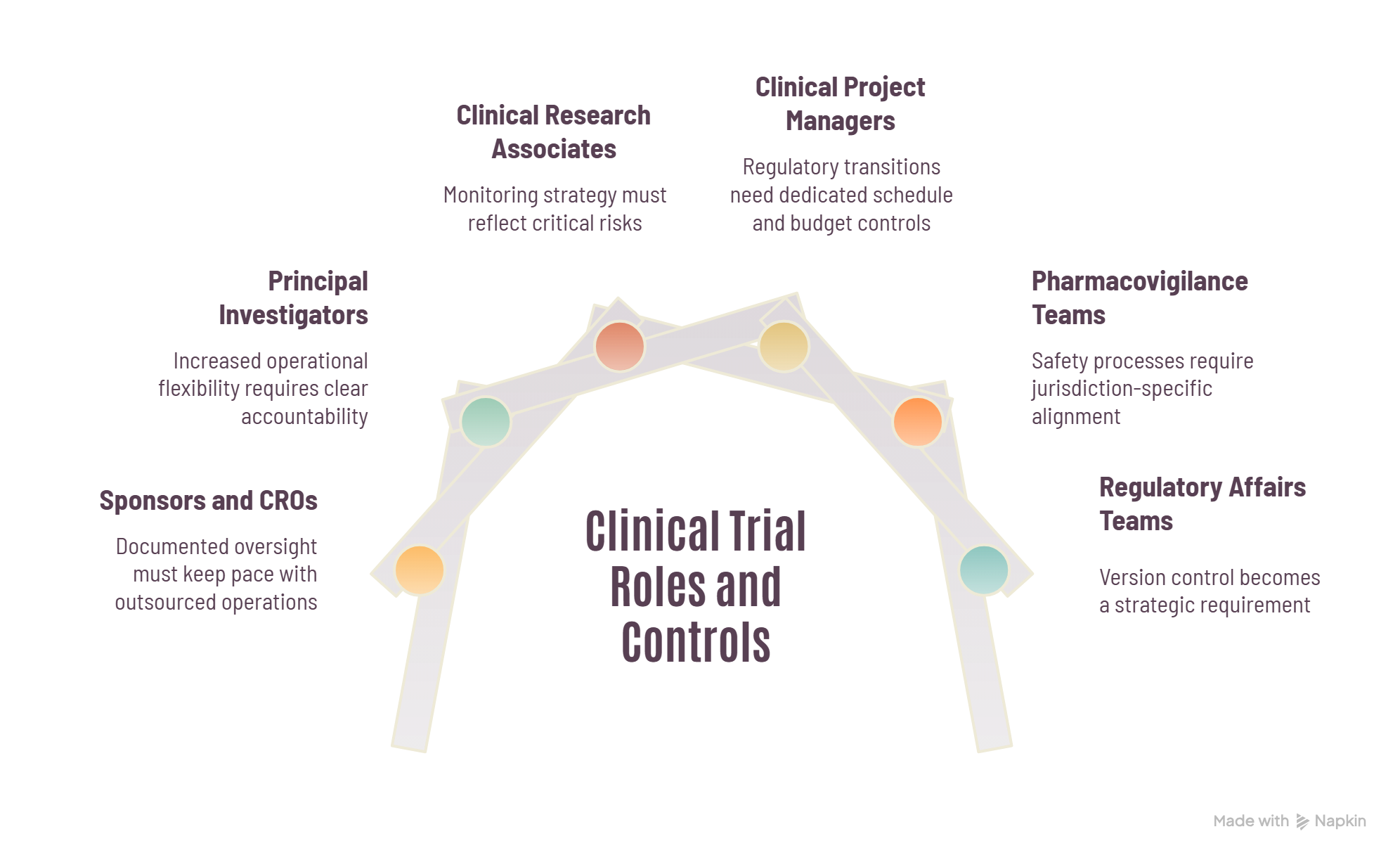
Sponsors and CROs: Documented oversight must keep pace with outsourced operations
Sponsors coordinating multinational clinical trials should maintain a clear record of which activities are delegated, who performs them, how performance is evaluated, and when unresolved problems must be escalated.
For example, a sponsor may outsource monitoring to a CRO, electronic data capture to a technology provider, and central laboratory testing to another vendor.
If critical data transfers repeatedly fail, the sponsor should be able to demonstrate that the problem was recognized, its impact assessed, the responsible parties engaged, and appropriate corrective action implemented.
An effective oversight file includes vendor qualification evidence, contractual responsibilities, critical performance measures, escalation records, and documented resolution.
These practices build on clinical trial quality management, project leadership responsibilities, clinical data integrity, and inspection readiness techniques.
Recommended control: Establish an oversight register linking every critical outsourced activity to its responsible sponsor function, vendor owner, quality indicator, and supporting evidence.
Principal Investigators: Increased operational flexibility requires clear accountability
Modern trial models may allow activities to be conducted through local healthcare providers, remote platforms, or appropriately delegated personnel.
Investigators must still understand their responsibilities for trial conduct, participant protection, appropriate delegation, and the reliability of information collected under their oversight.
A decentralized trial might involve a local clinician conducting an assessment while the principal investigator remains responsible for overall investigator oversight within the applicable regulatory framework.
The study should document the delegated activity, relevant qualifications, training, communication arrangements, and procedures for reporting safety concerns.
These responsibilities connect investigator GCP requirements, clinical trial site operations, protocol adherence, and ethical participant protection.
Recommended control: Review delegation logs, training records, remote provider agreements, and safety escalation procedures whenever a trial adopts new decentralized elements.
Clinical Research Associates: Monitoring strategy must reflect critical risks
CRAs should expect increasing emphasis on monitoring that addresses important risks to participant safety and reliable trial results.
Monitoring activities may incorporate centralized data review, targeted source data verification, remote monitoring, and focused site visits.
A CRA reviewing an unusual pattern of missing endpoint assessments should assess its significance, communicate the concern, and follow the established escalation process.
The monitoring strategy should recognize how the issue affects the study's critical data and participant protection requirements.
Professional development should therefore emphasize on-site and remote monitoring, clinical data integrity, protocol deviation management, safety reporting, and CRA career development.
Recommended control: Ensure monitoring reports demonstrate the significance of findings, the required follow-up, and the status of unresolved critical issues.
Clinical Project Managers: Regulatory transitions need dedicated schedule and budget controls
A project manager should translate regulatory requirements into operational deliverables with clear ownership and realistic completion dates.
Consider a study expected to begin in Canada during 2028.
Its project plan should include monitoring of the finalized Canadian regulations, evaluation of transitional provisions, required procedure changes, staff training, and any potential effects on study startup.
The schedule should distinguish confirmed requirements from assumptions.
A sensible project budget may also include contingency resources for system configuration, regulatory document revisions, and additional vendor training.
These activities require clinical trial timeline management, budget planning, risk-based quality controls, cross-functional leadership, and clinical project management competencies.
Recommended control: Add regulatory change monitoring to the project risk register and require formal impact assessment before accepting substantial schedule changes.
Pharmacovigilance and Medical Monitoring Teams: Safety processes require jurisdiction-specific alignment
Drug safety professionals should distinguish obligations arising from clinical trial legislation, pharmacovigilance legislation, and applicable ICH guidance.
The modernization of post-approval safety reporting under ICH E2D(R1) is relevant to pharmacovigilance teams, while trial safety functions must continue applying the requirements appropriate to investigational products and studies.
A reliable safety governance model should identify which information triggers escalation, who performs medical assessment, how case data are transferred, and which reporting requirements apply.
It should also establish procedures for safety information received outside normal working hours.
Strengthen these capabilities through pharmacovigilance audit techniques, adverse event reporting guidance, medical monitoring plans, medical safety assessments, and drug safety professional training.
Recommended control: Conduct periodic safety reporting simulations involving site staff, medical monitors, sponsors, and outsourced pharmacovigilance providers.
Regulatory Affairs and Data Management Teams: Version control becomes a strategic requirement
A multinational trial may operate under several regulatory frameworks while generating data through different technologies.
Regulatory affairs teams should maintain a controlled register covering each jurisdiction's applicable rules, current version, effective date, transitional provisions, and responsible study personnel.
Data management teams should document the origin, processing, transfer, correction, and retention of critical information.
If a technology vendor changes an electronic system, the organization should determine whether its intended use, validation or assurance documentation, user training, and data traceability remain appropriate.
These capabilities support regulatory compliance, clinical data integrity, quality management, research documentation training, and clinical study close-out.
Recommended control: Assign one accountable regulatory owner for each jurisdiction and one system owner for every critical electronic data workflow.
5. A 90-Day Regulatory Readiness Plan for 2027–2028 Clinical Trials
A regulatory change management program should produce measurable improvements in compliance readiness. Organizations should be able to show which requirements were reviewed, which gaps were found, how risks were prioritized, and whether corrective measures were effective.
The following 90-day framework is intended for sponsors, CROs, and clinical research organizations operating across multiple regulatory jurisdictions.
Days 1–15: Establish the regulatory baseline
Begin by identifying every active and planned clinical study, the countries involved, relevant investigational products, applicable trial classifications, and expected study dates.
Create a controlled register of regulatory requirements using five status categories:
In force: The requirement currently applies.
Adopted, future effective: The requirement has a published implementation date.
Transitional: Existing and revised arrangements operate under defined conditions.
Proposed: A regulator or legislative body has published a proposal that has yet to become final.
Anticipated: A regulator has communicated an expected future action without establishing a binding implementation date.
Assign a regulatory owner and a verification date to each entry.
For a global portfolio, prioritize the EU E6(R3) Annex 2 deadline, Australian transition requirements, the UK's operational reforms, and the evolving Canadian framework.
Link these obligations to trial milestones, GCP requirements, regulatory compliance oversight, and research ethics responsibilities.
Deliverable: A dated regulatory inventory with identified owners and reliable implementation-status classifications.
Days 16–30: Conduct a risk-based compliance gap assessment
Compare current procedures against the requirements affecting each study.
Focus on participant safety, informed consent, delegation, vendor oversight, critical data sources, risk management, monitoring, and regulatory submissions.
Use a weighted risk model that considers the potential impact of noncompliance, likelihood of a control failure, ability to detect the problem, and proximity to the applicable deadline.
For example, an outdated training slide may have a different risk profile from an unvalidated system used to collect primary endpoint data.
The assessment should connect quality management requirements, risk-based monitoring procedures, clinical trial data integrity, medical safety oversight, and investigator responsibilities.
Deliverable: A prioritized gap register documenting each deficiency, affected study, risk rating, corrective action, owner, and target date.
Days 31–45: Update procedures and vendor controls
Revise controlled procedures according to the approved change management process.
Priority documents may include the clinical quality management plan, monitoring plan, data management plan, vendor oversight plan, safety management procedures, consent processes, and regulatory submission instructions.
For outsourced activities, verify that contracts and quality agreements identify the responsibilities, escalation processes, and supporting documentation necessary for effective oversight.
Avoid treating training completion as sufficient evidence that an operational control works.
A revised monitoring procedure should be supported by appropriate implementation evidence, such as actual monitoring documentation or a representative workflow test.
This work should incorporate trial quality controls, medical monitoring plans, pharmacovigilance audit practices, and study leadership responsibilities.
Deliverable: Approved procedures, revised vendor responsibility records, and a documented implementation plan.
Days 46–60: Deliver role-specific training and competency assessments
Training should focus on how regulatory changes alter a person's actual responsibilities.
CRAs may require updated risk-based monitoring scenarios. Investigators may need training on delegated remote activities. Data managers may require additional system change-control exercises.
Pharmacovigilance teams may need scenario-based review of safety intake and reporting responsibilities.
Clinical project managers should understand the regulatory dependencies affecting timelines, budgets, and site activation.
Assess competency using case studies rather than relying exclusively on attendance records.
Useful supporting materials include investigator GCP responsibilities, research assistant training requirements, clinical monitoring techniques, medical safety assessments, and clinical project management preparation.
Deliverable: Role-specific training records and competency evidence demonstrating the ability to apply updated procedures.
Days 61–75: Conduct an inspection-readiness simulation
Select a representative study involving multiple sites, electronic systems, or outsourced service providers.
Trace important trial processes from beginning to end.
For example, select a serious adverse event and determine whether the original report, medical assessment, sponsor notification, required regulatory reporting, and follow-up information can be reconstructed.
For a protocol deviation, verify that the records demonstrate discovery, impact assessment, appropriate escalation, root-cause investigation where necessary, and corrective action.
For a critical electronic data system, examine its intended use, relevant validation or assurance evidence, user access, audit trails, and vendor oversight records.
These assessments draw on inspection preparation techniques, protocol adherence, data integrity requirements, and clinical study quality management.
Deliverable: A documented mock inspection report identifying critical evidence gaps, assigned actions, and verification requirements.
Days 76–90: Verify corrective action and establish ongoing regulatory monitoring
Close identified gaps only when sufficient evidence demonstrates that the required actions have been completed.
Where appropriate, verify that corrective measures address the underlying problem and are functioning as intended.
Establish a monthly regulatory review covering confirmed changes, newly published guidance, consultations, implementation dates, and potential effects on active trials.
Increase the frequency of review when a major deadline approaches or a significant regulatory proposal is expected to become final.
For Canada, this monitoring should include final regulatory publication and the confirmed coming-into-force arrangements.
For the EU, it should include E6(R3) Annex 2 implementation and developments affecting the European Biotech Act and European Health Data Space.
For the UK and Australia, track updated regulator guidance and country-specific interpretations as applicable.
This ongoing process should be integrated with clinical trial milestone management, risk management strategies, cross-functional coordination, and project close-out procedures.
Deliverable: An approved regulatory change control register, documented effectiveness checks, and a recurring governance review schedule.
6. FAQs About Global Clinical Trial Regulatory Changes in 2027–2028
-
One of the most significant confirmed milestones is the implementation of ICH E6(R3) Annex 2 in the European Union on January 15, 2027.
The annex provides additional GCP considerations for decentralized trials, pragmatic study designs, and studies incorporating real-world data sources.
Australia also reaches the end of its E6(R3) Principles and Annex 1 transition period on January 13, 2027.
These developments increase the importance of ICH E6(R3) competency development, risk-based monitoring, clinical trial data integrity, and clinical research quality management.
Organizations should evaluate their procedures and operational controls against the requirements applicable in each country.
-
ICH E6(R3) is an internationally harmonized guideline adopted or implemented through individual regulatory jurisdictions.
Its legal and regulatory status depends on the requirements of each country.
The EU has published implementation dates for Annex 2, Australia has established a transition deadline, and the United States issued final FDA E6(R3) guidance in September 2025.
Other jurisdictions follow their own adoption processes and domestic regulatory frameworks.
Sponsors should therefore assess investigator GCP responsibilities, clinical monitoring obligations, regulatory compliance requirements, and quality management expectations according to the applicable local implementation.
-
Health Canada anticipates finalizing its modernized Clinical Trials Regulations in spring 2027, followed by approximately one year before implementation.
This indicates a potential spring 2028 transition, subject to the finalized regulations and commencement arrangements.
The proposed framework seeks to modernize clinical trial oversight and accommodate evolving study designs.
Health Canada's September 2026 interim policy and October 2026 decentralized trial guidance already provide important operational developments.
Organizations should prepare by reviewing clinical research ethics procedures, investigator qualifications and responsibilities, remote trial logistics, and risk-based quality controls.
-
The January 2027 implementation of ICH E6(R3) Annex 2 in the EU provides additional considerations for clinical trials using decentralized elements and diverse data sources.
Sponsors should assess the reliability of remote measurements, qualifications of delegated providers, informed consent arrangements, data transfer processes, and safety escalation systems.
Existing FDA decentralized clinical trial guidance and Canadian regulatory developments also provide relevant expectations.
A decentralized study should have appropriately controlled procedures and clear oversight responsibilities for activities conducted outside traditional research sites.
Important preparation areas include trial logistics management, investigator oversight, clinical data integrity, and remote monitoring techniques.
-
The European Health Data Space Regulation entered into force in March 2025 and follows a phased implementation schedule.
March 2027 is an important deadline for the adoption of specified implementing acts.
Major provisions governing secondary use of many categories of health data are scheduled to begin applying in March 2029.
Organizations planning studies for 2027–2028 must therefore continue satisfying the legal and ethical requirements applicable when the data are accessed or processed.
Clinical research teams should strengthen data provenance controls, research ethics compliance, quality management procedures, and clinical data review capabilities.
-
AI-related regulatory developments are likely to remain an important area of regulatory monitoring during 2027–2028.
The applicable obligations depend on the jurisdiction, the system's intended purpose, the type of clinical research activity, and whether the technology falls within relevant medical device, data protection, or other regulatory frameworks.
For AI-assisted clinical trial systems, sponsors should evaluate data quality, system performance, change control, auditability, human oversight, and potential consequences for participant safety.
These controls are particularly important when automated outputs influence critical trial decisions.
Professionals should strengthen their knowledge of AI exposure in clinical research roles, clinical trial data integrity, risk-based monitoring, and quality oversight.
