
Regulatory Compliance for Medical Science Liaisons & Medical Monitors
Regulatory compliance for medical science liaisons and medical monitors lives at the exact point where science, safety, evidence, and communication can either protect a trial or expose it. MSLs must keep scientific exchange accurate, balanced, documented, and non-promotional, while medical monitors must protect participants through disciplined safety review, escalation, and benefit-risk judgment. This guide gives both roles a practical compliance framework tied to GCP expectations, pharmacovigilance safety monitoring, medical monitor AE review, and scientific communication standards. ICH GCP frames clinical trial conduct around participant protection and credible data, while FDA clinical trial guidance and EMA GVP resources reinforce the regulatory weight behind safety reporting, oversight, and pharmacovigilance systems.
1. Why MSL and Medical Monitor Compliance Breaks When Roles Become Blurry
The compliance risk starts when teams treat Medical Science Liaisons and Medical Monitors as interchangeable scientific experts. They both use medical judgment, but their risk zones differ. MSLs usually handle external scientific exchange, KOL engagement, education, insights, and field medical documentation. Medical monitors support trial safety, eligibility interpretation, adverse event assessment, protocol questions, and medical oversight. The cleanest teams define those lanes through KOL engagement standards, scientific presentation discipline, medical monitor adverse event review, GCP investigator responsibilities, and clinical trial sponsor responsibilities.
MSL compliance depends on controlled scientific exchange. A strong MSL can explain mechanism, data limitations, disease context, unmet need, trial design, safety themes, and publication findings while staying aligned with approved materials, local rules, company policy, and documentation expectations. The risk grows when a discussion slides into promotional framing, unsupported comparisons, selective data use, off-label encouragement, unrecorded HCP requests, or casual safety intake. Strong MSLs anchor every exchange in scientific communication best practices, clinical research journals and publications, clinical research ethics resources, and effective stakeholder communication.
Medical monitor compliance depends on timely, traceable medical oversight. The monitor’s work must show why a safety signal was reviewed, how causality or seriousness was considered, when escalation happened, and whether protocol action was required. The weakest medical monitoring files usually have the same painful pattern: strong medical thinking happened, but the decision trail is thin. That creates audit exposure across SAE reporting procedures, drug safety reporting timelines, aggregate pharmacovigilance reports, clinical trial safety oversight, and patient safety oversight.
| Compliance Area | Applies Most To | Common Failure Mode | Best Control | Internal Resource |
|---|---|---|---|---|
| Role boundary | MSL + Medical Monitor | Scientific, promotional, safety, and protocol responsibilities blur during urgent discussions. | Define escalation lanes before field or study activity begins. | Sponsor responsibilities |
| Scientific exchange | MSL | Conversation becomes selective, overly persuasive, or unsupported by balanced evidence. | Use approved scientific response frameworks and document the request. | MSL communication |
| KOL engagement | MSL | KOL conversations become relationship-driven with weak documentation of purpose and insight value. | Record objective, topic, insight, follow-up, and compliance-sensitive comments. | KOL engagement |
| Off-label response | MSL | Unsolicited scientific questions receive broad discussion beyond the actual request. | Answer narrowly, scientifically, and through approved medical information pathways. | Ethics resources |
| Promotional separation | MSL | Field medical conversations start supporting sales messaging or product positioning. | Separate medical objectives, materials, systems, and documentation from commercial activity. | Scientific presentations |
| Publication discussion | MSL | Single study results get presented without design limitations or safety context. | Discuss methodology, endpoints, population, limitations, and competing evidence. | Research journals |
| Adverse event intake | MSL + Medical Monitor | Safety information mentioned during a scientific discussion fails to enter the PV process. | Recognize minimum AE information and report through the required channel immediately. | AE reporting |
| Serious adverse events | Medical Monitor | Hospitalization, life-threatening event, death, disability, or congenital anomaly escalation is delayed. | Use seriousness criteria and awareness-date controls. | SAE procedures |
| Causality assessment | Medical Monitor | Causality reasoning stays verbal and cannot be reconstructed during audit. | Document temporal relationship, alternative causes, dechallenge, rechallenge, and medical rationale. | AE reviews |
| Expectedness review | Medical Monitor | Events are assessed without checking IB, label, protocol, or safety reference information. | Use the correct safety reference document and preserve version evidence. | Safety timelines |
| Protocol eligibility | Medical Monitor | Site asks for eligibility interpretation without adequate source or medical history detail. | Request missing facts before giving a medical view. | Protocol management |
| Protocol deviations | Medical Monitor | Medical impact of a deviation is discussed but never documented. | Record participant impact, risk level, corrective action, and follow-up need. | Deviation actions |
| Safety signal escalation | Medical Monitor | Repeated similar events look isolated because no trend review is triggered. | Escalate clusters, severity shifts, and unexpected patterns into signal review. | Aggregate reporting |
| Data review | Medical Monitor | Safety narratives, labs, conmeds, and EDC fields conflict. | Review source-linked safety data across systems before closing decisions. | Data review |
| Medical coding | Medical Monitor | Event coding masks clinically important patterns. | Check narrative, verbatim term, coded term, seriousness, and outcome alignment. | Safety monitoring |
| Investigator communication | Medical Monitor | Site receives medical guidance without clear documentation or follow-up ownership. | Summarize question, facts, recommendation, responsible party, and timing. | Investigator responsibilities |
| Participant safety | Medical Monitor | Operational pressure overrides safety review before continuation, rechallenge, or dosing. | Prioritize medical review before study continuation decisions. | Patient safety |
| Regulatory submissions | Medical Monitor + PV | Safety, medical, and regulatory teams use inconsistent language in submission documents. | Align case narrative, medical assessment, and regulatory rationale before submission. | PV submissions |
| IND context | Medical Monitor | Medical team misses how IND obligations shape safety reporting and trial oversight. | Connect safety assessment to IND and protocol governance expectations. | IND guide |
| Audit readiness | MSL + Medical Monitor | Compliant work exists, but supporting evidence is scattered across email, CRM, EDC, and PV systems. | Maintain inspection-ready records with clear ownership and date trails. | Audit preparation |
| Training records | MSL + Medical Monitor | Staff perform high-risk activities before role-specific training is complete. | Track training by task, study, system, SOP, and protocol version. | GCP training |
| Confidentiality | MSL + Medical Monitor | Patient identifiers, unpublished data, or sponsor-sensitive information move through informal channels. | Use approved systems and minimum necessary disclosure. | Research compliance |
| Remote communication | MSL + Medical Monitor | Virtual meetings create weak attendance, consent, follow-up, or document trails. | Predefine agenda, approved materials, meeting purpose, and follow-up documentation. | Remote monitoring |
| Vendor involvement | Medical Monitor | CRO, safety vendor, or medical review vendor responsibilities are assumed instead of governed. | Confirm responsibility matrices, escalation timelines, and oversight evidence. | Vendor management |
| Global variation | MSL + Medical Monitor | One global process misses local regulatory, privacy, PV, or medical affairs requirements. | Use country-specific review before external scientific or safety actions. | Regulatory guidelines |
| Benefit-risk documentation | Medical Monitor | Benefit-risk thinking occurs during meetings but never appears in the formal record. | Document safety trend, clinical relevance, action threshold, and decision rationale. | Aggregate PV reports |
| Internal handoff | MSL + Medical Monitor | Medical insights, safety observations, and protocol questions travel without structured ownership. | Use written handoff fields for issue, risk, owner, deadline, and required evidence. | Stakeholder communication |
| Inspection interviews | MSL + Medical Monitor | Staff describe compliant intent but cannot explain the actual controlled process. | Train teams to explain role, system, escalation, and record location clearly. | Inspection readiness |
| Corrective action | MSL + Medical Monitor | Recurring failures get retraining only, even when the system design caused the problem. | Correct root cause through workflow, ownership, system control, and evidence review. | Quality management |
| Closeout evidence | Medical Monitor | Medical decisions, unresolved safety questions, and final reviews remain fragmented at study close. | Reconcile medical review evidence before final archive. | Close-out procedures |
2. MSL Compliance: How to Keep Scientific Exchange Clean, Balanced, and Defensible
MSL compliance begins with the quality of the question. A compliant MSL asks what the HCP wants to know, why the question matters clinically, what disease or patient population is being discussed, and whether the answer requires approved medical information support. That discipline prevents broad, wandering answers that create promotional risk. The best MSL conversations can be reconstructed from documentation: request, response, source, limitation, follow-up, and insight. This is where MSL scientific communication, KOL engagement mastery, clinical research publications, and clinical research ethics resources become practical controls.
A high-risk MSL interaction often starts with a harmless-sounding request: “How does your therapy compare with another option?” “Can I use it in this population?” “What are you seeing in real-world practice?” “Can you send me the slide from that advisory board?” Each question may carry labeling, promotional, privacy, publication, or safety implications. Strong MSLs answer through evidence hierarchy, approved response pathways, and balanced context. They avoid selective emphasis and document insight patterns that can help medical strategy without turning the exchange into hidden promotion. That protects scientific presentation standards, stakeholder communication, clinical research compliance, and global regulatory guidance awareness.
The MSL also needs sharp safety awareness. If an HCP mentions a patient event, product exposure concern, pregnancy, hospitalization, unexpected reaction, lack of effect, medication error, or possible quality complaint, the MSL should recognize that the conversation has crossed into reportable territory. The MSL does not need to solve the case; the MSL must capture and route the minimum information through the required pharmacovigilance channel. That single habit links field medical work to adverse event reporting, drug safety reporting timelines, pharmacovigilance safety monitoring, and regulatory submissions in PV. EMA describes GVP as measures that support pharmacovigilance performance across medicines authorized centrally and nationally in the EU, which reinforces why safety information intake must stay disciplined even outside the clinical operations team.
MSL documentation should read like scientific accountability rather than a sales note. “Discussed mechanism” is weak. “Responded to unsolicited HCP question about biomarker-defined subgroup using approved medical response document; explained study population, endpoint limitation, safety findings, and publication reference; no patient-specific AE reported; HCP requested follow-up article” is stronger. That level of specificity protects the MSL, the company, and the scientific exchange record while connecting daily activity to medical affairs communication, KOL documentation, audit readiness, and clinical research professional standards.
3. Medical Monitor Compliance: The Safety Review Trail Has to Survive Audit Pressure
Medical monitors carry a different kind of compliance burden because their decisions can affect whether a participant continues, pauses, discontinues, receives additional evaluation, or triggers urgent reporting. Their review should show seriousness, severity, causality, expectedness, clinical course, relevant history, concomitant medication context, protocol impact, and follow-up needs. FDA clinical trial guidance pages describe FDA guidance as the agency’s current thinking on clinical trial conduct, GCP, and human subject protection, and that matters because medical monitoring decisions often sit directly in the human-subject protection lane.
The weak point in many safety processes is the gap between medical judgment and written evidence. A medical monitor may know exactly why an event is unrelated, why rechallenge is unsafe, why a lab trend requires follow-up, or why a protocol deviation has no participant impact. Audit teams, sponsors, investigators, and regulators need the trail. The record should connect source data, case narrative, clinical reasoning, action taken, and follow-up owner. That is why medical monitors need disciplined alignment with AE review guidance, SAE reporting procedures, clinical trial safety monitoring, aggregate report preparation, and GCP oversight expectations.
The best medical monitoring files have structured reasoning. For causality, they consider temporal association, underlying disease, alternative etiology, dose relationship, dechallenge, rechallenge, known safety profile, biologic plausibility, and confounding medications. For seriousness, they use defined seriousness criteria rather than emotional language. For expectedness, they check the correct safety reference document. For actionability, they document whether the event affects dosing, continuation, eligibility, protocol compliance, or participant follow-up. This approach strengthens patient safety oversight, drug safety reporting timelines, medical monitor responsibilities, and regulatory affairs mastery.
Medical monitors also need to protect protocol interpretation. Sites often ask urgent questions with incomplete context: a borderline lab, a new medication, a missed dose, a late visit, a hospitalization, or a participant who wants to continue despite worsening symptoms. A compliant monitor asks for the missing facts before giving medical input and documents the basis of the decision. That turns pressure into control. It also supports protocol deviation management, clinical trial protocol responsibilities, investigator responsibilities, and clinical trial data integrity. ICH E6(R3) emphasizes modern GCP expectations around sponsor, investigator, oversight, participant safety, and reliable data, making traceable medical decisions central to credible trial conduct.
4. The Documentation System That Protects Both Roles
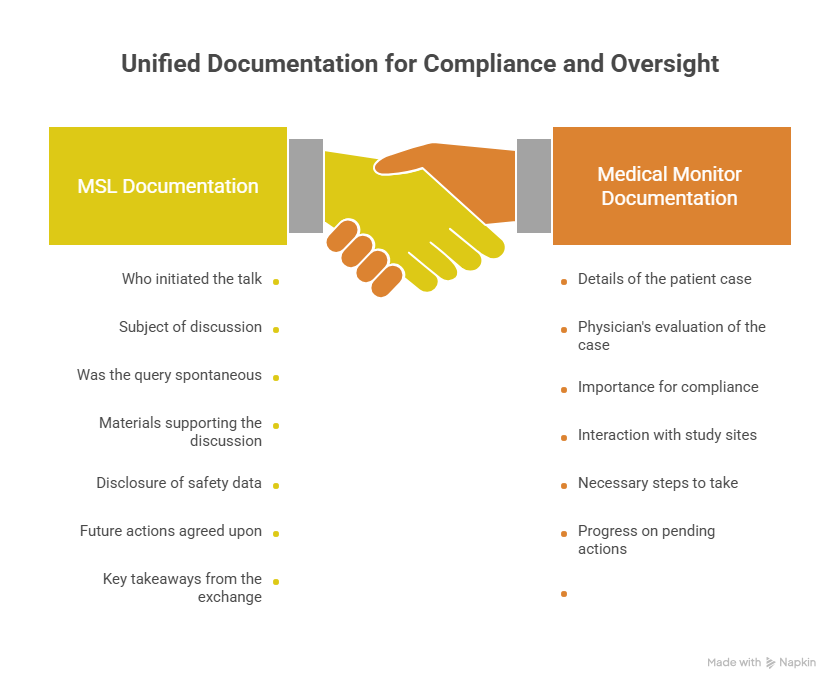
A strong documentation system makes compliant work visible. For MSLs, the record should show who requested the discussion, the scientific topic, whether the question was unsolicited, which materials or references were used, whether safety information appeared, what follow-up was promised, and which insights were captured. For medical monitors, the record should show case facts, medical assessment, regulatory relevance, site communication, action required, and follow-up status. Together, these controls connect MSL presentation standards, medical monitor AE review, drug safety reporting requirements, and audit preparation.
The documentation pain point is usually timing. People document after travel, after back-to-back calls, after database cleanup, after protocol meetings, or after a safety case has already moved forward. That delay weakens precision. A clean system uses same-day notes, required fields, standardized safety prompts, controlled templates, and escalation timestamps. It also creates a defensible bridge between stakeholder communication, clinical trial data review, remote monitoring controls, and clinical trial quality management.
For MSLs, one of the most useful documentation checks is the “would this look educational under review?” test. The note should reflect a legitimate scientific purpose, balanced content, clear request, accurate source base, and appropriate handling of safety or off-label elements. For medical monitors, the parallel test is “could another qualified physician understand the decision without calling me?” The answer should be visible through medical facts, reasoning, safety classification, protocol implications, and next steps. These habits make the record stronger across KOL engagement, clinical trial safety monitoring, patient safety oversight, and inspection readiness.
The most mature organizations also connect systems. CRM insights, medical information requests, PV cases, EDC safety data, lab trends, protocol deviations, and monitor communications should have clear handoff logic. A disconnected system creates hidden compliance debt: one team sees a pattern, another team sees a case, another team sees a site issue, and nobody sees the full risk. The fix is structured escalation ownership across vendor management, clinical trial resource allocation, leadership and team management, and regulatory submissions.
5. Building a Practical Compliance Workflow for MSLs and Medical Monitors
The first workflow control is role-specific onboarding. MSLs need training in scientific exchange, approved materials, off-label response handling, congress behavior, advisory board boundaries, safety intake, privacy, and documentation quality. Medical monitors need protocol-specific safety training, SAE assessment expectations, eligibility escalation pathways, coding review, lab trend review, signal escalation, investigator communication, and decision documentation. This onboarding should connect directly to GCP training requirements, research compliance and ethics, medical monitor AE management, and MSL communication best practices.
The second control is escalation design. Every MSL should know exactly where to send AE information, product complaints, pregnancy exposure reports, privacy concerns, off-label requests, and requests for unpublished data. Every medical monitor should know exactly how site questions arrive, what facts must be present, who owns follow-up, and which issues require sponsor, PV, regulatory, or investigator escalation. That system protects adverse event reporting compliance, SAE reporting procedures, regulatory affairs submissions, and clinical trial stakeholder communication.
The third control is routine quality review. MSL notes should be sampled for scientific balance, approved material usage, safety intake recognition, and documented purpose. Medical monitor reviews should be sampled for timeliness, completeness, medical reasoning, safety classification, and follow-up closure. This review should feel like risk prevention rather than punishment. The goal is to catch weak patterns before they become repeated audit findings across handling clinical trial audits, quality management strategies, clinical trial documentation management, and pharmacovigilance inspections.
The fourth control is recurring scenario training. Compliance improves fastest when professionals practice realpressure moments: the HCP asks about unapproved use, the KOL mentions a patient death casually, the site asks whether a subject can continue after abnormal labs, the investigator wants immediate advice with incomplete information, or a case narrative conflicts with EDC. Scenario drills make rules usable. They reinforce KOL engagement mastery, patient safety oversight, clinical trial data integrity, and GCP monitoring techniques.
The final control is leadership accountability. Leaders should review whether MSLs have clean scientific lanes, whether medical monitors have adequate time to document, whether PV handoffs are reliable, whether global teams understand local rules, and whether vendors meet expected timelines. Compliance fails when skilled people are placed inside rushed systems with weak ownership. Strong leaders build visible control through clinical trial leadership, vendor oversight, global regulatory compliance, and project close-out procedures.
6. FAQs
-
An MSL mainly manages compliant scientific exchange, KOL engagement, insights, education, and safety information recognition during field medical activity. A medical monitor mainly manages medical oversight inside clinical research, including safety review, SAE assessment, protocol interpretation, eligibility questions, and participant protection. Both roles need strong documentation, but their evidence trails differ. MSLs should focus on scientific communication, KOL engagement, and ethics resources, while monitors should focus on AE review, SAE reporting, and patient safety oversight.
-
MSLs may handle unsolicited scientific questions through approved company processes, balanced evidence, and properly controlled medical information pathways. The safest response stays narrow to the question, avoids promotional framing, includes limitations, and documents the exchange. This is where MSL presentation standards, clinical research publications, research ethics resources, and global regulatory guidance become essential.
-
The MSL should capture the required safety information available, avoid medical speculation, and send the information through the company’s pharmacovigilance channel within the required timeline. The MSL’s job is recognition and routing, not case adjudication. This control directly supports adverse event reporting techniques, drug safety reporting timelines, clinical trial safety monitoring, and regulatory submissions in pharmacovigilance.
-
An audit-ready review shows the event facts, seriousness assessment, causality rationale, expectedness check, source references, participant impact, protocol action, communication trail, and follow-up owner. The decision should make sense to another qualified reviewer without relying on memory. This protects medical monitor adverse event review, SAE reporting procedures, clinical trial data review, and clinical trial audit readiness.
-
The monitor should request the missing medical and protocol facts before giving a final view. For example, eligibility, continuation, rechallenge, lab abnormality, and SAE questions often require source details, conmeds, medical history, timing, severity, and protocol section review. This approach supports protocol management, protocol deviation corrective actions, investigator responsibilities, and GCP compliance.
-
MSLs need training in scientific exchange, approved materials, off-label response handling, adverse event intake, privacy, documentation, congress activity, and KOL engagement. Medical monitors need training in protocol-specific safety review, SAE assessment, causality, expectedness, eligibility escalation, medical coding review, and audit-ready documentation. Role-specific training should connect to GCP training requirements, pharmacovigilance audits, medical monitor AE management, and MSL scientific communication.
