
Medical Monitor vs Medical Science Liaison: Reddit Career Experiences, Qualifications, Pay & Which Path Fits Clinicians
Medical Monitor and Medical Science Liaison careers both let clinicians move into biopharma while keeping scientific work at the center, yet the daily jobs diverge quickly. Medical Monitors sit closer to clinical trial safety oversight, protocol decisions, investigators, eligibility, and emerging patient data. MSLs sit closer to external scientific exchange, therapeutic-area strategy, and Medical Affairs compliance. For physicians, PharmDs, NPs, PAs, and other clinicians, choosing well requires comparing far more than salary or travel.

1. Medical Monitor vs Medical Science Liaison: What Each Career Actually Does
A Medical Monitor works primarily inside the clinical-development machine. The role centers on the medical oversight of one or more clinical trials: interpreting emerging safety information, addressing medical questions from investigators, reviewing eligibility concerns, evaluating adverse events, supporting protocol development, reviewing clinically important data, and helping the study team decide when an issue requires escalation. That makes strong knowledge of clinical trial safety oversight, investigator responsibilities under GCP, protocol adherence, and adverse-event reporting central to the job.
The title itself can mislead applicants. In a June 2026 clinical-research discussion, industry professionals explained that similar responsibilities may appear under Medical Director, Project Physician, Medical Reviewer, Therapeutic Medical Advisor, Medical Lead, or Clinical Development Medical Director rather than “Medical Monitor.” Contributors described work involving protocol input, investigator communication, eligibility and safety review, laboratory and medical-record review, and study-team medical training.
That matters during a job search. A physician searching only “Medical Monitor” may miss positions that sit directly beside clinical development operations, clinical data integrity, trial quality management, and site-level safety processes.
An MSL occupies a different part of the organization. The position usually sits in Medical Affairs and is field-facing. Its core work includes scientific exchange with healthcare professionals and opinion leaders, discussing clinical evidence, collecting medical insights, supporting congress activity, maintaining therapeutic-area expertise, identifying research opportunities, and connecting external experts with relevant internal scientific teams.
A current Amgen MSL posting illustrates that model clearly: the role is field-based, spends most of its time on peer-to-peer scientific activities, supports investigator engagement and evidence generation, communicates balanced scientific information, gathers field insights, and requires substantial territory travel. The posting estimates 60–70% travel. Those responsibilities overlap with MSL regulatory compliance, scientific collaboration, clinical trial data interpretation, and ethical scientific communication.
The practical difference is easiest to understand through the direction of responsibility.
A Medical Monitor asks:
Is this patient medically appropriate for the study?
Does this adverse event alter our safety assessment?
Does the investigator need guidance?
Does the protocol need clarification or amendment?
Is this emerging pattern clinically meaningful?
Can the study continue safely as designed?
An MSL asks:
What scientific questions are clinicians asking?
Which evidence gaps are influencing treatment decisions?
What does this expert think about the new data?
Which insights should Medical Affairs bring back internally?
What research opportunities are emerging?
How should complicated evidence be explained accurately and compliantly?
Both roles reward strong clinical judgment, regulatory literacy, scientific communication, and understanding of clinical research quality. The Medical Monitor usually carries more direct responsibility for the medical conduct of trials; the MSL carries more responsibility for scientific relationships and external medical engagement.
2. Medical Monitor vs MSL Qualifications: Which Clinicians Can Realistically Enter Each Path?
The qualification gap between these careers is one of the most important differences.
Medical Monitoring is generally the more physician-dependent route. A current 2026 Clinical Development Medical Monitor opening requires a board-certified MD or MD/PhD or equivalent, relevant medical experience, at least three years of clinical-development experience, direct clinical-trial execution and monitoring experience, and knowledge of GCP and major regulatory frameworks. Another 2026 U.S. Medical Monitor posting listed an MD and professional license as its education requirements.
That requirement makes sense when the professional may need to interpret a participant's evolving clinical picture, discuss serious adverse events directly with investigators, assess trial safety signals, interpret protocol eligibility, and contribute to decisions where investigator oversight intersects with sponsor medical responsibility.
Clinical experience therefore carries unusual weight.
A physician who spent several years treating oncology patients may offer immediate value on an oncology development program because they understand disease progression, treatment sequencing, laboratory abnormalities, competing explanations for symptoms, expected toxicities, supportive care, and the clinical significance of small changes in patient status. Those capabilities complement clinical data integrity, GCP monitoring, site operations, and quality management.
An MSL hiring funnel is wider educationally.
A current Amgen MSL role lists a doctorate as one basic qualification route, but also accepts a master's degree plus three years of Medical Affairs experience or a bachelor's degree plus five years of Medical Affairs experience. Preferred credentials include PharmD, PhD, MD, and DO. This creates viable pathways for professionals who have built strong Medical Affairs experience, clinical research expertise, scientific communication skills, and therapeutic-area knowledge.
This is especially important for PharmDs.
A PharmD is highly aligned with the MSL market because drug knowledge, evidence interpretation, clinical communication, literature evaluation, and therapeutic reasoning transfer naturally into field Medical Affairs. A PharmD interested in clinical trial execution may still build a strong career in clinical development, safety, or clinical science, yet physician-level medical monitoring positions can remain inaccessible when the employer specifically requires a licensed physician.
PhDs face a similar distinction. Their research depth, experimental design, publications, and scientific expertise can make them excellent MSL candidates. Clinical Development teams also employ Clinical Scientists who work closely with Medical Directors and Medical Monitors, particularly around protocol development, data interpretation, and study management. The physician usually remains responsible for medical decisions requiring medical training.
For NPs and PAs, MSL is generally the more accessible of these two specific paths. Deep specialty practice, publications, research participation, and HCP relationships can strengthen an MSL application significantly. Those professionals should target roles aligned with their existing disease expertise while strengthening regulatory communication, clinical research literacy, patient-safety knowledge, and investigator-facing communication.
3. Medical Monitor vs MSL Pay: Compare the Same Seniority Before You Compare the Numbers
Salary comparisons become unreliable quickly because the Medical Monitor title covers multiple organizational levels.
A CRO may employ a physician under “Medical Monitor.” A sponsor may advertise functionally similar work as Medical Director, Clinical Development Medical Director, Project Physician, or Senior Medical Director. That title inflation changes reported salary datasets dramatically.
For MSLs, current U.S. employer postings provide useful real-world anchors. Amgen's September 2026 Inflammation MSL posting lists $156,998 to $212,410 in base salary. Current Sanofi MSL postings list $146,250 to $211,250, while a 2026 LEO Pharma MSL role advertises $175,000 to $235,000. Another current Novartis autoimmune CAR-T MSL listing shows a broad $160,300 to $297,700 range plus equity.
Those figures help explain why experienced clinicians are attracted to field Medical Affairs. Yet salary alone should be evaluated alongside territory size, bonus, equity, company car or allowance, travel burden, therapeutic-area scarcity, geographic cost, and the candidate's experience.
Medical Monitor compensation requires more caution.
One 2026 Reddit discussion among physicians cited an anecdotal U.S. CRO range of roughly $240,000–$280,000 base plus 15–20% bonus for an MD Medical Monitor entering industry, with senior Medical Director compensation potentially substantially higher. That came from an individual industry discussion rather than a standardized compensation survey, so it should be treated as a market anecdote rather than a guaranteed benchmark.
Current Clinical Development Medical Director postings show why physician compensation can climb quickly once the role becomes strategic. September 2026 remote listings included senior clinical-development Medical Director ranges around $283,000–$402,000, $330,000–$370,000, and above $300,000 for senior roles. Those jobs usually require considerably more experience than a first MSL seat and therefore should not be compared directly with entry MSL compensation.
A Canadian 2026 Medical Monitor role requiring a board-certified gastroenterologist advertised CAD 170,000–185,000, illustrating how strongly country, employer type, and role scope influence compensation.
For clinicians comparing career economics, look beyond year-one salary. Medical Monitoring can lead into Clinical Development Medical Director, Senior Medical Director, Executive Medical Director, therapeutic-area leadership, and broader development leadership. That pathway compounds clinical development expertise, regulatory knowledge, trial safety leadership, and quality oversight.
MSLs can progress toward Senior MSL, Principal MSL, Field Medical leadership, Medical Affairs Director, Medical Strategy, launch leadership, and other Medical Affairs positions. The career compounds external scientific influence, Medical Affairs compliance, research collaboration, and therapeutic-area credibility.
The higher-paying path at age 35 may therefore differ from the higher-paying path at age 50. The best comparison is career architecture, not one salary screenshot.
4. Reddit Career Experiences: The Lifestyle Difference Is Bigger Than Many Clinicians Expect
Reddit discussions are particularly useful here because job descriptions tend to sanitize the annoying parts of both careers.
For Medical Monitoring, the appealing part is obvious to many physicians: you remain close to medicine and clinical development without running a clinic, taking hospital call, or maintaining a full patient panel. You can apply medical judgment to trial safety, protocol interpretation, adverse-event assessment, and investigator questions.
The hidden frustration is that clinical-development work can involve far more listing review, laboratory review, eligibility checking, documentation, protocol details, and repetitive safety review than physicians imagine.
A June 2026 Reddit discussion captured both sides. Some contributors described Medical Directors as deeply involved in protocol design, safety review, investigator communication, and clinical-development strategy. Another sponsor-side physician emphasized that routine Medical Monitoring can include large amounts of safety-listing review, eligibility review, adverse-event surveillance, laboratory review, and compliance checking.
That is important for clinicians leaving practice because they are tired of documentation. Industry medicine still contains documentation. The documents simply change.
A CRO Medical Director explained in another June 2026 discussion that daily responsibilities can include medical training of the study team, communicating with sponsors about medical and safety issues, reviewing subject eligibility, reviewing patient data medically, and answering protocol-related questions from sites and CRAs. Those tasks demand comfort with site communication, GCP monitoring, protocol deviations, and data quality.
MSL frustration looks completely different.
A September 2026 PharmD MSL described considering a move toward clinical research because the MSL role had begun to feel too close to medical marketing, with much of the work revolving around external interaction, insight gathering, and securing access to healthcare professionals. The poster found trial adherence and clinical-research execution more attractive.
That experience exposes a pain point many aspiring MSLs underestimate.
The MSL role may be non-promotional, yet the job still requires you to get other busy professionals to spend time with you. You may manage a large territory, request meetings, follow up repeatedly, compete for clinician attention, attend conferences, maintain CRM activity, and demonstrate that your field interactions create useful medical insights. Understanding Medical Affairs compliance does not remove the need for persistence, relationship skills, and territory planning.
Another September 2026 Reddit discussion came from a Senior CRA considering an MSL move partly for higher earnings. The poster liked the flexibility of clinical operations but specifically worried about cold outreach and whether providers would be receptive. That concern is worth testing before making a career switch because someone who dislikes initiating relationships may find clinical trial operations, quality oversight, monitoring, or safety work more satisfying than field Medical Affairs.
A good MSL experience depends heavily on enjoying human interaction itself.
A June 2026 discussion from a clinician/KOL emphasized valuing MSLs who helped connect researchers with the right internal people and genuinely advanced scientific ideas rather than simply repeating information the clinician already knew. That describes high-quality MSL work well: becoming useful to experts through scientific context, access, collaboration, and insight rather than simply delivering a slide deck.
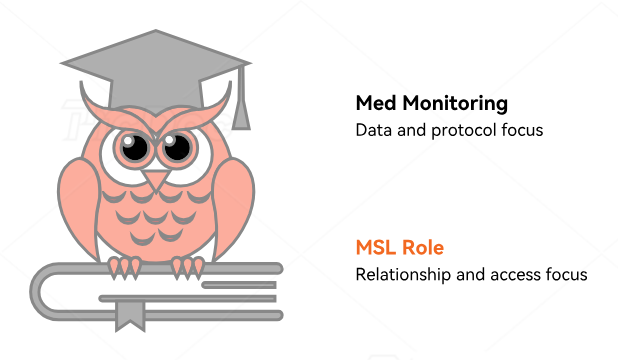
The career decision therefore comes down to the kind of friction you prefer.
Medical Monitoring friction is data, protocol, medical responsibility, study execution, and detail.
MSL friction is access, relationships, travel, communication, influence, and field execution.
5. Which Path Fits Physicians, PharmDs, NPs, PAs and Other Clinicians Best?
For a practicing physician, Medical Monitoring often provides the cleanest transfer of existing skills.
Years of diagnosing disease, interpreting laboratory results, assessing causality, balancing risks, reviewing medications, communicating with specialists, and making decisions under uncertainty translate directly into clinical trial safety oversight, adverse-event assessment, protocol interpretation, and investigator communication.
Specialty alignment can make the transition especially strong. An oncologist monitoring oncology trials, a gastroenterologist overseeing inflammatory bowel disease studies, or a neurologist working on CNS development programs brings context that cannot be learned from a short certification course.
Physicians who prefer teaching, networking, conferences, and broader scientific conversations may enjoy MSL work more. Their clinical credibility can be powerful during discussions with specialists, while their therapeutic experience supports scientific exchange, patient-safety discussions, research collaboration, and Medical Affairs compliance.
For PharmDs, MSL is typically the more natural direct target. Pharmacology, therapeutics, literature evaluation, evidence communication, and medication expertise align closely with field Medical Affairs. A May 2026 Reddit success story from a clinical PharmD who landed an MSL role emphasized ATS-friendly résumé design, role-specific keywords, referrals, serious interview preparation, and presentation readiness. PharmDs interested in development can also consider Clinical Scientist, Safety Scientist, Medical Affairs, pharmacovigilance, and other roles that use their clinical background without requiring physician-level Medical Monitoring credentials.
NPs and PAs should examine MSL opportunities aligned tightly with their clinical specialties. Their experience managing real patients, discussing treatment decisions, educating clinicians, interpreting data, and understanding care pathways can support strong therapeutic-area credibility, particularly when combined with clinical research exposure, scientific presentation skills, and regulatory knowledge.
Experienced CRAs and CRCs face another interesting choice.
A CRA already understands site monitoring, protocol adherence, trial logistics, and sponsor-site communication. With an appropriate advanced scientific degree, the transition toward Medical Affairs may be realistic. Moving toward physician Medical Monitoring generally still depends on medical credentials.
A physician entering industry should also search more broadly than the title “Medical Monitor.” Relevant searches can include:
Medical Director Clinical Development, Associate Medical Director, Project Physician, Clinical Development Physician, Therapeutic Medical Advisor, Medical Lead, Safety Physician, Medical Reviewer, and Study Physician.
That search strategy is supported by 2026 industry discussions in which professionals specifically warned that the work is frequently advertised under different titles.
Finally, compare the five-year version of yourself in each path.
A strong Medical Monitor may become the physician who understands how to take an asset from protocol concept through execution, safety review, regulatory submission, quality oversight, and eventually development strategy.
A strong MSL may become the medical professional who understands external experts, scientific communication, treatment landscapes, field strategy, evidence gaps, investigator collaboration, Medical Affairs governance, and how field intelligence shapes medical strategy.
Choose the expertise you want to compound.
6. FAQs About Medical Monitor vs Medical Science Liaison Careers
-
A Medical Monitor focuses primarily on the medical oversight of clinical trials, while an MSL focuses primarily on external scientific engagement within Medical Affairs.
The Medical Monitor may review patient safety data, interpret protocol requirements, discuss medical questions with investigators, and contribute to clinical-development decisions.
The MSL spends more time building relationships with medical experts, conducting scientific exchange, gathering insights, participating in congresses, supporting research relationships, and working within Medical Affairs compliance requirements.
-
Many traditional Medical Monitor and Clinical Development Medical Director positions require an MD, DO, or equivalent medical degree, and some prefer or require board certification and clinical-practice experience.
A current 2026 Clinical Development Medical Monitor role specifically requires a board-certified MD or MD/PhD or equivalent plus relevant development experience. That requirement reflects the role's involvement in medical safety decisions, adverse-event review, investigator support, and protocol interpretation.
Related Clinical Scientist, Safety Scientist, or clinical-development roles may accept other advanced scientific degrees.
-
A PharmD can work in clinical development, pharmacovigilance, Medical Affairs, safety, and Clinical Scientist roles, while many physician Medical Monitor positions specifically require an MD or equivalent medical degree.
For PharmDs choosing between these two exact careers, MSL is usually the more directly accessible route because current MSL hiring commonly accepts PharmD credentials. Amgen's current MSL posting specifically lists PharmD among its preferred advanced degrees.
PharmDs can further strengthen themselves through clinical research experience, Medical Affairs compliance knowledge, patient-safety expertise, and scientific communication.
-
Physician Clinical Development roles can have a higher compensation ceiling, especially when Medical Monitoring sits within a Medical Director or Senior Medical Director position. Current senior Clinical Development Medical Director listings can exceed $300,000 in base compensation.
Current U.S. MSL postings also pay strongly. Amgen lists approximately $157,000–$212,000 for a September 2026 role, while LEO Pharma lists $175,000–$235,000 for another current position.
Compare equivalent seniority, geography, therapeutic area, bonus, equity, and employer type. Someone moving from CRA work into an MSL role faces a different pay comparison from a board-certified physician entering Clinical Development leadership.
-
MSL usually involves substantially more field travel.
Amgen's current MSL role lists approximately 60–70% travel for territory engagement, conferences, workshops, and company meetings. Other MSL territories may be smaller or more virtual, yet frequent external engagement remains fundamental.
Medical Monitor positions can often be remote or office-based because much of the work involves trial data review, safety oversight, protocol questions, and collaboration with clinical operations teams.
-
A physician who wants to continue applying diagnostic reasoning, medical judgment, patient-level interpretation, and specialty expertise may find Medical Monitoring or Clinical Development especially natural.
A physician who enjoys networking, presenting, conferences, teaching, scientific discussion, and relationship building may prefer MSL work.
Both paths benefit from clinical expertise, GCP knowledge, regulatory understanding, and clinical research literacy. The deciding factor should be the type of work the physician wants to perform repeatedly.
