
CRO vs Sponsor CRA Jobs: Reddit Experiences on Pay, Workload, Training, Stability & Promotion Speed
A CRO and a pharmaceutical sponsor can hire people with the same CRA title while giving them dramatically different careers. Your exposure to GCP monitoring, site operations, clinical trial timelines, and protocol adherence can differ substantially depending on who owns the study, who sells the monitoring service, and how performance is measured. For CRAs choosing between offers, the decisive questions concern workload architecture, total compensation, training quality, promotion mechanics, and what can actually cause your position to disappear.

1. CRO vs Sponsor CRA Jobs in 2026: Understand Who You Actually Work For
The first mistake is treating “CRO CRA” and “sponsor CRA” as two versions of the same employment model.
A full-service CRO CRA works for a contract research organization hired to execute some or most clinical-development activities for sponsors. Monitoring becomes a service delivered under contractual budgets, timelines, staffing assumptions, and performance expectations. Your job may therefore combine site monitoring responsibilities, clinical trial logistics, protocol-compliance oversight, and internal operational metrics designed to keep projects deliverable and commercially viable.
A direct sponsor CRA is employed by the pharmaceutical, biotechnology, or medical-device company responsible for the development program. The CRA can therefore sit closer to the asset, clinical strategy, study leadership, and internal decision-making chain. That proximity can increase exposure to quality-management decisions, investigator oversight, clinical trial data integrity, and cross-functional study discussions extending beyond visit execution.
Then there is the category that creates the most confusion: FSP or sponsor-dedicated employment.
An FSP CRA may be employed and paid by a CRO while operating almost entirely inside one sponsor's processes, systems, studies, training, and team structure. IQVIA, for example, currently advertises sponsor-dedicated CRA positions separately from its full-service and biotech monitoring roles.
That distinction matters because a candidate can say, “I work sponsor-side,” while their legal employer, redeployment options, compensation architecture, and employment risk remain CRO-based.
The practical question therefore becomes:
Who pays you, who assigns your studies, who sets your metrics, who controls your promotion, and what happens when the study or client relationship ends?
Those five answers tell you more than the logo on your laptop.
Reddit discussions in 2026 repeatedly show why sweeping conclusions fail. In a March thread specifically asking CRAs who had moved between CROs and sponsors, experienced contributors described CRO work as generally more metric- and timesheet-driven, while sponsor structures varied according to company size, study model, and internal organization. Some also argued that CROs can provide more formal titles and departments, while sponsors may combine responsibilities under broader roles.
That can materially affect someone building clinical research career experience. A CRA who needs more exposure to monitoring techniques, multiple therapeutic areas, different sponsor systems, research protocol deviations, and varied site problems may benefit from a strong CRO environment. Someone already technically mature may place greater value on sponsor ownership, strategic depth, trial-quality management, or movement toward study management.
The smartest comparison therefore begins with career stage, not company type.
2. CRO vs Sponsor CRA Pay: Compare Total Compensation Instead of Base Salary Alone
“Does sponsor pay more?” is the wrong first question.
The useful equation is:
True CRA compensation = base salary + target bonus + equity + travel incentives + retirement value + healthcare value + paid leave + car/travel benefits + promotion probability.
Current job postings show substantial overlap.
A direct-sponsor AbbVie CRA II posting in Phoenix lists a base-pay range of $82,500–$157,500 and states that the role is eligible for short-term incentives. AbbVie search results also show CRA II ranges of $78,500–$141,000 in Richmond and $84,500–$162,000 in Seattle.
On the CRO side, a current IQVIA Biotech CRA posting shows a potential annualized base range of $71,900–$169,300, while a sponsor-dedicated IQVIA posting shows $87,200–$182,000. Another IQVIA early-development CRA II posting lists $90,200–$150,400.
ICON currently has a U.S. CRA listing at $73,864–$92,330 requiring at least 18 months of prior monitoring experience, while another monitoring posting lists $110,520–$138,150.
Those ranges immediately destroy the simplistic “sponsors pay more” rule.
A CRA's market value depends on monitoring experience, therapeutic-area depth, geography, protocol-management skill, study complexity, level, travel burden, and the employer's internal compensation architecture. Someone with oncology, early-phase, device, or difficult safety-oversight experience may sit in a very different market from a newly independent monitor.
The more interesting Reddit signal concerns total package.
In an August 2026 discussion about CRO employers, one contributor reported initially finding sponsor base salary unimpressive but later valuing benefits, company bonuses, and performance incentives enough to change the overall comparison. Another recent discussion advised comparing bonus, retirement contribution, equity, healthcare, travel perks, and workload when CRO and sponsor salary offers looked similar. These are individual accounts, but they identify exactly where candidates frequently misprice offers.
Suppose Offer A pays $120,000 at a CRO and Offer B pays $113,000 at a sponsor.
The $7,000 difference tells you almost nothing until you know whether one provides an 8% or 12% bonus, stock awards, stronger retirement matching, additional PTO, lower healthcare premiums, a vehicle benefit, fewer unpaid travel-adjacent hours, or a clearer promotion path.
Likewise, a CRO travel bonus can materially alter effective compensation for a high-DOS CRA. Medpace currently advertises travel bonuses, equity or stock options, training-completion and retention bonuses, annual merit increases, 401(k) matching, airline-club reimbursement, and a defined CRA growth ladder in its U.S. CRA postings.
Candidates comparing CRA career pathways should therefore ask HR for target compensation, not merely base salary. Clarify bonus target, last year's payout mechanics, equity eligibility, vesting, travel incentives, merit cycle, career-development expectations, and whether promotion requires an open requisition.
The pain point is simple: a “higher-paying” CRA job can become the lower-value job once 70% travel, nights away, report backlog, weaker benefits, and a stalled promotion ladder are priced in.
3. CRO vs Sponsor CRA Workload: Measure Site Complexity, Metrics and Travel Together
Workload comparisons become useless when candidates ask only, “How many sites will I have?”
Ten inactive or low-enrolling sites can require less effort than four high-enrolling, high-risk sites with repeated protocol deviations, unresolved clinical data-integrity problems, difficult investigators, complex adverse-event reporting, investigational-product reconciliation, and aggressive database-lock timelines.
Use this workload equation instead:
CRA burden = active sites × enrollment intensity × protocol complexity × monitoring frequency + travel fragmentation + report burden + issue backlog + internal metrics.
This exposes one of the clearest differences reported by experienced CRAs.
CROs frequently operate in environments where utilization, billable activity, monitoring-day expectations, report timeliness, visit scheduling, and contracted deliverables matter intensely because the CRO is delivering a service to a client. A March 2026 Reddit discussion from people who had worked on both sides specifically described CRO work as more metric and timesheet driven.
Direct sponsors can still run extremely demanding operations. Database locks, enrollment pushes, inspection preparation, first-patient-in milestones, site-quality problems, safety escalation, and program deadlines can create brutal periods. Sponsor employment should therefore never be interpreted as a guarantee of an easy schedule.
An April 2026 Reddit thread illustrates the variance. The sponsor CRA who started the discussion reported having four sites across two protocols and still feeling overloaded. One CRO CRA responded that they had been assigned 29 sites across seven protocols, although many were inactive or non-enrolling. That anecdote cannot establish typical workloads, but it shows why raw site counts need context.
Travel deserves the same scrutiny.
Current ICON postings frequently require around 60% travel, while Medpace's U.S. CRA opportunities specify approximately 60–70% nationwide travel.
Someone evaluating remote and on-site monitoring should ask how that percentage translates operationally.
Ask:
How many DOS per month did the team actually average during the last quarter?
How many hotel nights does a typical CRA spend away?
Are sites regionally concentrated?
How often are Monday or Sunday travel days required?
How quickly must monitoring reports be finalized?
How many protocols are assigned simultaneously?
How many sites are actively enrolling?
What percentage of visits are remote?
Who owns query follow-up between visits?
Who handles regulatory-document chasing?
Are CRAs expected to support trial start-up and close-out simultaneously?
This is where many attractive CRA offers collapse under scrutiny.
A recruiter may describe “eight DOS” as manageable. Eight days on site can create positioning flights, delayed monitoring reports, evening email triage, expense reports, site follow-up, protocol-compliance actions, regulatory-document review, and weekend preparation.
Candidates who want sustainable clinical trial careers should therefore interview the workload model as aggressively as the employer interviews them.
4. CRO vs Sponsor CRA Training and Promotion: Choose the Employer That Builds Your Next Role
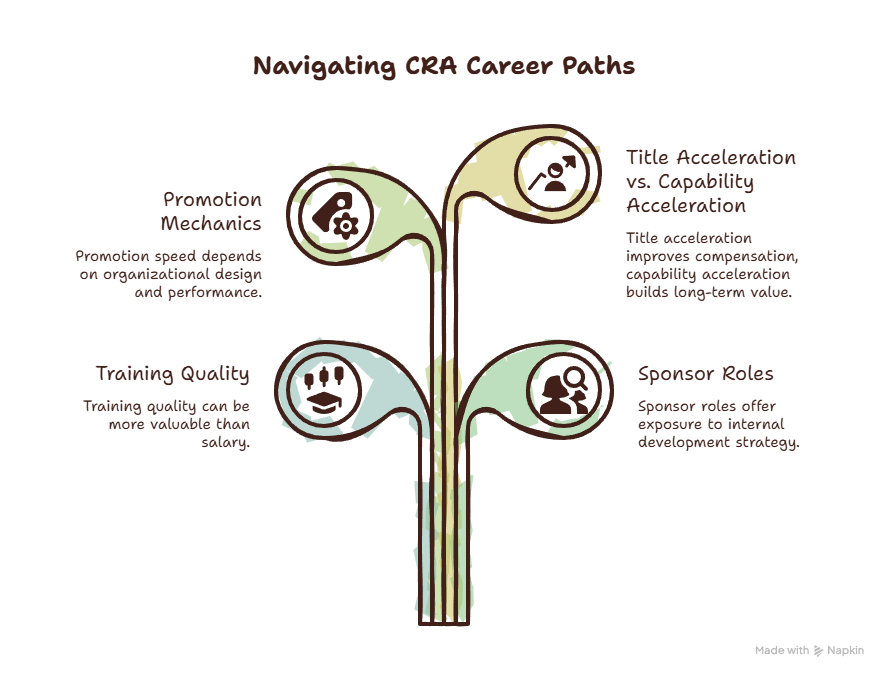
For an early-career CRA, training quality can be worth more than an immediate salary difference.
CROs have a structural reason to develop monitoring talent because monitoring is a core commercial capability. Some therefore maintain formal CRA academies, standardized levels, co-monitoring requirements, competency assessments, therapeutic-area training, and defined ladders.
Medpace provides a current example. Its entry-level Cincinnati CRA posting says prior research experience is unnecessary and describes its PACE training program, hands-on exercises, departmental rotations, ongoing therapeutic training, and a defined CRA promotion ladder. A separate program recruits candidates with at least two years of CRC experience and trains them into CRA responsibilities.
That type of infrastructure can be extremely valuable for candidates navigating the CRC-to-CRA transition, particularly when they need formal exposure to site monitoring, protocol deviations, investigator responsibilities, and adverse-event review.
Direct sponsor roles may become particularly powerful later.
An experienced CRA who already knows how to execute qualification, initiation, interim, and close-out visits may gain more incremental value from exposure to the sponsor's internal development strategy, cross-functional decision-making, vendor oversight, clinical quality management, study timelines, and eventual movement toward clinical trial management.
The hidden tradeoff is promotion mechanics.
A large CRO may have CRA I, CRA II, Senior CRA, Principal CRA, Lead CRA, line management, CTM, training, quality, feasibility, start-up, and project-management functions. That creates numerous titles and potential lateral exits.
A sponsor may have fewer CRAs and fewer title bands. When the next level requires a budgeted position, a strong performer can remain stuck longer despite excellent reviews.
A March 2026 Reddit thread came from a CRA I who had spent almost three years at a large sponsor, reported positive performance feedback, yet saw no clear path to CRA II. The person was considering a CRO offer carrying a CRA II title and approximately 15% more pay.
This exposes a major career rule:
Promotion speed depends on organizational design as much as personal performance.
Before accepting either job, ask:
“How many people on this exact team moved from my level to the next level in the last 12 months?”
Then ask where they went.
If the manager responds with vague language about “lots of opportunities,” push for examples.
A good career path should demonstrate progression into stronger monitoring responsibilities, quality-management work, clinical-trial leadership, and eventually project-management responsibilities.
Candidates should also distinguish title acceleration from capability acceleration.
Moving from CRA I to CRA II quickly can improve compensation and marketability. Spending two years working across several indications, conducting every major visit type, handling complex data-integrity problems, managing difficult protocol-compliance issues, and supporting trial close-out may create far greater long-term value than receiving a title while doing narrow work.
Your employer should increase both scope and credibility.
5. CRO vs Sponsor CRA Stability: Follow the Revenue and the Pipeline Before You Follow the Logo
“Which is safer?” sounds like a straightforward question until you examine how each business can lose work.
A CRO depends on sponsors awarding and continuing outsourced work. A full-service organization with multiple clients and therapeutic areas may have opportunities to redeploy CRAs when one project ends. That diversification can be valuable.
The risk appears when utilization falls, a major client withdraws work, projects are cancelled, headcount exceeds awarded business, or the CRA's experience does not match available studies.
An FSP arrangement adds another layer. If the assigned sponsor reduces the program, ends the contract, insources monitoring, or changes vendors, your employment continuity can depend on whether the CRO can rapidly find another assignment.
A direct sponsor has different exposure.
Your employer controls the development pipeline, yet pharmaceutical and biotechnology pipelines can change rapidly. A failed program, strategic reprioritization, merger, acquisition, cost-reduction initiative, patent-pressure response, or clinical-development restructuring can affect clinical operations teams even when an individual CRA has performed well.
This is why sponsor employment should not automatically be treated as permanent shelter from layoffs.
A 2026 Reddit discussion about choosing between CRO and sponsor positions captured the uncertainty well: contributors generally favored sponsor opportunities, while several specifically warned that the answer depended on the sponsor and that a candidate could be trading some long-term security for improved working conditions.
The broader 2026 clinical-research employment discussion also contains reports of CRO layoffs and difficult re-entry into the market. Those are individual accounts rather than a complete industry dataset, yet they reinforce the importance of evaluating employer-specific risk instead of relying on category stereotypes.
Use a four-layer stability audit before changing jobs.
Layer 1: Employer stability.
How diversified is the organization? Is revenue concentrated? Has the company repeatedly restructured clinical operations?
Layer 2: Role stability.
Is the CRA position permanent, contract, FSP, project-specific, or tied to a single client?
Layer 3: Portfolio stability.
How many programs could realistically use your therapeutic-area experience if the current assignment disappeared?
Layer 4: Personal employability.
Are you building portable skills in GCP monitoring, data integrity, regulatory compliance, patient safety, and multiple visit types?
The fourth layer is frequently ignored.
A company can become unstable while your career remains resilient if you have portable evidence across qualification, initiation, monitoring, close-out, risk evaluation, investigational-product accountability, adverse-event assessment, sponsor communication, and investigator oversight.
That should influence the final CRO-versus-sponsor decision.
Choose the CRO when it gives you materially stronger training, broader monitoring exposure, a credible promotion ladder, manageable geography, valuable therapeutic experience, or faster movement from CRC-level work into independent monitoring.
Choose the direct sponsor when it gives you better total compensation, sustainable workload, strong benefits, closer asset ownership, meaningful clinical trial quality exposure, and a credible path into the role you want after CRA.
Treat an FSP offer as its own category and inspect who controls assignment, promotion, redundancy, training, and redeployment.
The logo matters far less than the operating model you will live inside every Monday morning.
6. FAQs About CRO vs Sponsor CRA Jobs
-
The stronger option depends on your career bottleneck.
Early-career CRAs can benefit substantially from a CRO with structured CRA monitoring training, varied protocols, clear CRA levels, strong trial-logistics exposure, and frequent site experience.
Experienced CRAs may gain more from sponsor roles offering deeper asset ownership, quality-management exposure, internal study strategy, better benefits, or progression into clinical trial leadership.
Compare the specific jobs rather than choosing solely by employer category.
-
Current U.S. postings show substantial salary overlap. AbbVie sponsor CRA II roles currently display broad six-figure-capable ranges, while IQVIA and ICON CRO roles also span wide ranges depending on level, geography, specialty, and employment model.
Compare base salary alongside bonus, equity, retirement, healthcare, travel incentives, PTO, and progression. A CRA with advanced monitoring experience, protocol expertise, and safety experience may command very different compensation from someone newly independent.
-
Many Reddit contributors who have worked in both environments report preferring sponsor-side workload or describing CRO environments as more metric-driven. Recent discussions repeatedly mention DOS, timesheets, billability, and workload pressure as CRO pain points.
Sponsor teams can still face demanding database-lock timelines, site-quality problems, protocol deviations, and safety escalations. Investigate the specific program rather than relying on reputation.
-
A CRO with a genuine CRA academy or structured development program can be especially valuable.
Medpace currently advertises an entry-level CRA pathway where prior research experience is unnecessary, alongside another program designed for candidates with CRC experience. Both describe structured CRA training and development.
Candidates trying to become a CRA without conventional experience should prioritize programs that provide supervised GCP monitoring, source review, protocol-adherence training, and actual visit qualification.
-
CROs often have more standardized CRA levels and larger clinical-monitoring departments, which can create more promotion opportunities. Promotion speed still depends on business demand, performance, geography, therapeutic-area needs, and headcount.
Sponsor teams may have fewer levels or positions. A March 2026 Reddit discussion involved a CRA I at a large sponsor who had spent almost three years in the role without a clear CRA II pathway despite positive performance reviews.
Ask for evidence of recent promotions and compare whether the role expands your monitoring responsibilities, quality skills, and trial-management exposure.
-
A direct sponsor CRA is employed by the pharmaceutical, biotechnology, or device sponsor.
A sponsor-dedicated or FSP CRA is generally employed by a CRO and assigned to work within one sponsor's program. IQVIA currently advertises sponsor-dedicated CRA roles under this type of model.
The distinction affects compensation, promotion ownership, benefits, redeployment, employment risk, and potentially clinical operations career mobility.
