
Clinical Research Coordinator Jobs With No Experience: Reddit Success Stories, Resume Proof & What Sites Screen For
Landing a Clinical Research Coordinator job without direct research experience is difficult in 2026, yet recent hires show that sites still take chances on beginners when the evidence is strong enough. The winning profile combines protocol discipline, patient communication, research-team coordination, clinical data accuracy, and evidence that you can learn regulated workflows quickly. Reddit success stories reveal something important: sites hire inexperienced CRCs when their previous work already reduces the risks that worry coordinators, investigators, and hiring managers.

1. CRC Jobs With No Experience Exist, but Sites Screen for Operational Risk
Several 2026 Reddit stories directly challenge the idea that prior clinical research employment is universally required for a CRC job.
In April, a biology graduate who had been working in retail reported applying to roughly 80 CRC and CRC-assistant positions. The candidate had almost no formal research experience outside college laboratory projects and only limited hospital exposure from an earlier internship. A smaller expanding research site brought the applicant through three interviews and hired them.
A May 2026 poster described a different route. After working in pharmacy for years and repeatedly applying for coordinator positions, the candidate secured an entry-level CRC job at a hospital despite having essentially zero direct clinical research experience. Community discussion focused on how pharmacy experience could transfer into medication review, adverse-event awareness, and provider communication.
By July, another recent undergraduate reported accepting a CRC position with no previous clinical research employment. A March example went even further: a journalism graduate with no scientific background reported being hired as a Clinical Research Coordinator at a hospital.
These stories are anecdotal rather than statistical hiring data, yet together they expose how sites actually think. A candidate may lack the title “Clinical Research Coordinator” while already possessing behaviors relevant to research protocol adherence, participant retention, adverse-event escalation, clinical trial logistics, and site operations.
The hiring question becomes how much uncertainty surrounds your ability to perform the work safely and reliably.
O*NET's updated 2026 Clinical Research Coordinator profile shows why sites are cautious. CRC tasks include scheduling participants according to protocol, assessing eligibility, preparing study documentation, recording adverse events, maintaining regulatory documents, communicating with participants and investigators, monitoring compliance, and collecting clinical data. A mistake can become a protocol deviation, damage clinical trial data integrity, delay a site monitoring visit, weaken patient retention, or create a safety-reporting problem.
That is why “entry level” rarely means employers disregard all previous evidence.
ACRP's entry-level CRC hiring guidelines were created specifically to help sites assess candidates through competencies predictive of success, instead of relying solely on previous CRC titles. The guidelines are designed to reduce turnover and improve selection of entry-level coordinators.
ACRP's broader 2026 career guidance also emphasizes that no FDA regulation establishes a universal degree, license, or professional certification as the qualification floor for a coordinator. Employers establish their own requirements, and assistant, regulatory, clinical, laboratory, and site-based routes can provide the experience that later supports a coordinator career.
This creates a useful opening for career changers. A nurse may already understand clinical safety oversight, a pharmacy technician may understand medication accountability and pharmacovigilance principles, a medical assistant may already handle patient-facing coordination, and a laboratory technician may have years of controlled-procedure discipline.
A coordinator opening therefore needs to be evaluated through task overlap, rather than through title matching alone.
| 30 Signals Clinical Research Sites Can Use to Screen a First-Time CRC Candidate | |||||
|---|---|---|---|---|---|
| Background / Signal | CRC Transferability | What It Can Prove | What the Site Still Needs to Know | Best Resume Evidence | Interview Angle |
| Medical assistant | Very strong | Patient contact, vitals, scheduling, documentation | Ability to follow a study protocol | Connect experience to participant coordination | Explain how you handled time-sensitive patient workflows |
| Registered nurse | Very strong | Clinical judgment, documentation, escalation | Research-specific regulatory knowledge | Show safety escalation and patient assessment | Discuss how you identify and communicate clinical change |
| Pharmacy technician | Strong | Medication accuracy, controlled workflows | Participant and protocol ownership | Emphasize drug-safety awareness | Discuss medication reconciliation and accountability |
| Pharmacist | Strong | Medication expertise and clinical communication | Study coordination breadth | Show clinical safety reasoning | Connect medication knowledge to protocol requirements |
| Medical scribe | Strong | Medical terminology and documentation precision | Independent coordination ability | Connect records to source-data accuracy | Explain how you prevent documentation errors |
| Phlebotomist | Strong | Patient procedures, specimen handling | Regulatory and data breadth | Show specimen logistics | Discuss timed collections and chain of custody |
| Laboratory technician | Strong | SOP discipline, specimens, traceability | Human-subject interaction | Demonstrate quality control | Explain deviations and corrective action |
| Biology graduate | Moderate | Scientific literacy and experimental discipline | Real-world patient workflow | Translate projects into protocol execution | Discuss written procedures and data quality |
| Psychology graduate | Moderate | Behavioral research, participant interaction | Clinical and regulatory exposure | Show ethical research and participant protection | Discuss consent, interviews, and confidentiality |
| Public-health graduate | Moderate | Research methods, populations, data | Trial execution experience | Emphasize recruitment and retention strategy | Discuss population-level recruitment barriers |
| Academic research assistant | Strong | Research procedures and documentation | GCP and site systems | Connect work to research-assistant competencies | Explain personal ownership rather than lab reputation |
| University research volunteer | Moderate | Motivation and research exposure | Accountability under paid responsibility | Specify actual protocol tasks | Discuss what you personally executed |
| Patient scheduler | Strong | Time-sensitive appointment coordination | Visit-window reasoning | Connect experience to timeline management | Explain how you recovered missed or conflicting appointments |
| Patient navigator | Very strong | Follow-up, barriers, provider coordination | Protocol and regulatory knowledge | Show retention work | Discuss difficult follow-up and continuity |
| Hospital administrator | Moderate–Strong | Institutional workflow and records | Clinical research execution | Highlight cross-functional coordination | Discuss competing deadlines and stakeholders |
| Project coordinator | Strong | Milestones, dependencies, communication | Patient-facing competence | Map work to clinical trial milestones | Show how you managed delays and escalation |
| Regulatory administrator | Very strong | Controlled submissions and document management | Participant-facing execution | Show regulatory-document literacy | Discuss approval tracking and version control |
| IRB office experience | Very strong | Human-subject compliance | Protocol ownership at site level | Link duties to ethical research conduct | Explain amendment and review workflows |
| Data-entry experience | Moderate | Accuracy and processing volume | Clinical interpretation | Quantify data-quality performance | Discuss discrepancy detection |
| Health-information / medical records | Strong | Confidentiality, chart review, documentation | Protocol-specific abstraction | Connect work to clinical data verification | Explain how you resolve incomplete records |
| REDCap experience | Strong | Structured research-data handling | Commercial EDC familiarity | Show database volume and data integrity | Discuss validation and reconciliation |
| Quality-assurance experience | Strong | SOPs, deviations, CAPA, audit thinking | Patient and site workflow | Translate duties into clinical quality management | Discuss how you prevented recurrence |
| GMP-regulated work | Strong | Controlled processes and records | GCP-specific knowledge | Connect SOP behavior to protocol adherence | Explain deviation escalation |
| Clinical billing experience | Moderate–Strong | Healthcare systems and financial accuracy | Participant and data operations | Show familiarity with trial budget logic | Discuss reconciliation and documentation |
| Customer-service experience | Moderate | Communication, follow-up, conflict management | Regulated-work discipline | Connect communication to participant retention | Discuss difficult interactions and escalation |
| Recruitment experience | Strong | Screening, outreach, conversion | Protocol eligibility discipline | Show recruitment and retention metrics | Explain ethical pre-screening |
| Strong GCP training | Useful baseline | Knowledge of trial-quality principles | Real application under pressure | Connect concepts to GCP operations | Use scenarios instead of definitions |
| Mock CRC portfolio | Useful differentiator | Applied reasoning and preparation | Real-world accountability | Create exercises around deviation management | Explain decisions and escalation points |
| Employee referral | Strong access signal | Someone credible is willing to vouch for you | Actual CRC capability | Support referral with role-specific evidence | Be ready to justify the recommendation |
| Quantified tailored résumé | Critical | Scale, ownership, and role alignment | Whether examples survive questioning | Anchor bullets in site-relevant responsibilities | Prepare STAR examples for every major claim |
2. Translate Your Existing Experience Into the Proof a CRC Hiring Manager Actually Needs
A candidate's previous title can hide highly relevant evidence.
Consider a medical assistant who writes:
Scheduled patients, obtained vitals, updated charts, and assisted physicians.
A CRC hiring manager has to perform all the translation.
A stronger résumé exposes the behaviors directly:
Coordinated 45–60 weekly patient visits across multiple providers, maintained time-sensitive clinical documentation, obtained and recorded protocol-like assessments including vital signs, reconciled missing chart information, and escalated clinically significant changes to licensed staff.
The second version gives the site evidence relevant to participant scheduling, clinical documentation, safety escalation, research-team communication, and clinical data integrity.
Lead With Behaviors That Reduce Site Risk
For every previous position, identify six categories:
1. Procedures followed.
Sites need people who can execute written instructions consistently. Laboratory SOPs, medication procedures, healthcare protocols, quality systems, and standardized administrative workflows can support a story around research protocol adherence, clinical quality management, GCP responsibilities, and site compliance.
2. Records maintained.
A CRC spends enormous amounts of time making sure records are accurate, traceable, complete, and available. Medical records, medication logs, laboratory records, billing files, audit documentation, controlled forms, and project trackers all become useful evidence when connected to clinical trial data verification, data integrity, monitoring preparation, and research quality.
3. Deadlines controlled.
CRC work contains appointment windows, laboratory timelines, reporting deadlines, IRB dates, monitoring follow-up, startup milestones, and sponsor requests. A scheduling, operations, or project-management background can translate directly into clinical trial timeline management, trial logistics, site monitoring readiness, and study closeout discipline.
4. People coordinated.
Sites need CRCs who can communicate with participants, investigators, nurses, pharmacy, laboratories, sponsors, monitors, regulatory teams, and other coordinators. Patient navigation, customer service, medical-office work, and project coordination become more valuable when expressed through clinical research communication, patient retention, investigator meeting coordination, and site operations.
5. Risks escalated.
A CRC does not need to possess the investigator's medical authority. The coordinator does need enough awareness to recognize when something must reach the appropriate person. Experience escalating medication errors, abnormal observations, missing documents, specimen failures, complaints, data anomalies, or safety concerns supports future work in adverse-event reporting, clinical safety monitoring, protocol-deviation management, and quality management.
6. Scale handled.
“Managed records” gives little information. “Maintained 250+ active records with weekly reconciliation and deadline tracking” tells the site how much complexity you can absorb. Use participant counts, appointments per week, records processed, discrepancies resolved, team size, specimen volume, audit frequency, turnaround times, or accuracy metrics where truthful.
This is particularly important because some candidates possess more relevant experience than their résumé suggests. A July 2026 Reddit applicant with laboratory and global-health research experience received feedback that the résumé visually buried the most relevant clinical evidence underneath education and academic material. Contributors also questioned whether the profile clearly communicated long-term interest in CRC work.
The hiring lesson is powerful: resume order communicates priority.
For a CRC application, relevant work, patient exposure, regulated documentation, research activities, and protocol-related evidence should be easy to find. Academic detail deserves space when it strengthens the case. The employer primarily needs to see how you could support participant visits, maintain study data, handle trial logistics, and survive a future monitoring visit.
3. Build CRC Resume Proof Before a Site Gives You the Title
The strongest first-time CRC application contains three layers of evidence: real transferable experience, current clinical-research knowledge, and applied work samples that demonstrate how you think.
Build a Protocol-to-Visit Exercise
Use a public protocol or create a clearly fictional training protocol. Extract the inclusion criteria, exclusion criteria, visit schedule, visit windows, safety assessments, laboratory requirements, concomitant-medication restrictions, and discontinuation rules.
Then convert the protocol into a participant visit checklist.
That exercise forces you to think through protocol adherence, trial logistics, participant retention, clinical trial timelines, and potential protocol deviations.
Introduce complications intentionally:
the participant arrives three days outside the visit window;
a required laboratory sample was missed;
the participant started a prohibited medication;
the participant reports a hospitalization;
one assessment was performed after dosing when the protocol required it before dosing.
For each scenario, document what you would verify, what you would record, who you would escalate to, and what follow-up would be required.
That produces interview material far stronger than memorizing definitions.
Build a Source-to-EDC Reconciliation Exercise
Create fictional source records and fictional EDC entries. Insert discrepancies involving dates, medications, laboratory values, adverse events, visit numbers, or missing assessments.
Then show how you would investigate each discrepancy using principles from clinical trial data review, data integrity, GCP monitoring, risk-based monitoring, and site monitoring preparation.
A site hiring manager can now ask: “Why did you escalate this discrepancy?”
You have something concrete to discuss.
Build a Regulatory Tracker
Create a fictional regulatory binder index showing document name, version, effective date, responsible person, expiration date where relevant, and current status.
Add training logs, delegation documentation, IRB approval, protocol versions, investigator documents, and safety communications in a simplified educational format.
The point is to demonstrate controlled-document thinking around investigator responsibilities, regulatory compliance, ethical research conduct, clinical research quality, and monitoring readiness.
Build a Monitoring-Visit Preparation Checklist
Imagine that a monitor arrives in seven days.
Create a preparation checklist covering source completeness, EDC queries, consent records, investigational-product documentation where relevant, outstanding regulatory documents, deviation logs, participant-status trackers, safety follow-up, and unresolved action items.
Study site monitoring visits, remote and on-site monitoring, clinical data verification, GCP monitoring techniques, and protocol-deviation handling.
Label every sample simulated training work. Use fictional information. Keep patient data, proprietary sponsor materials, confidential protocols, and employer documents completely outside the portfolio. That decision itself demonstrates judgment around patient confidentiality, clinical data integrity, regulatory responsibility, and quality management.
What is keeping you from your first CRC interview?
4. Apply Where First-Time CRCs Have the Best Chance of Becoming Useful Quickly
Employer type changes the entry equation.
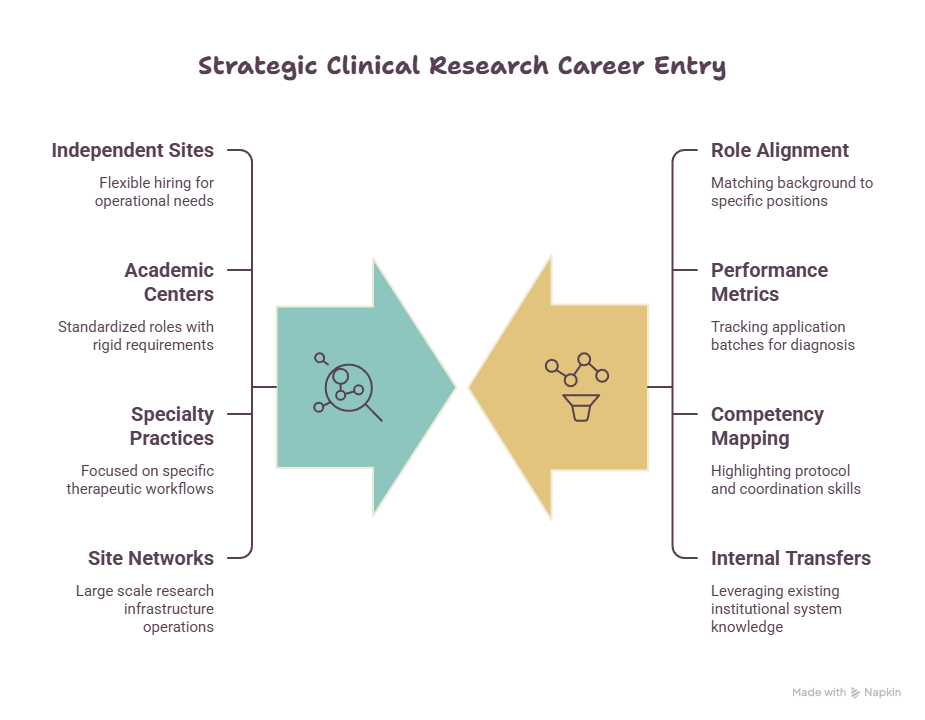
A large academic medical center may have standardized job grades, centralized HR screening, rigid minimum qualifications, and multiple layers between the applicant and the hiring investigator. Independent sites and smaller research organizations can sometimes hire more flexibly because the hiring manager is much closer to the operational pain.
That helps explain the April 2026 Reddit success story. The biology graduate who obtained a CRC/CRC-assistant opportunity had applied broadly, yet the employer that converted into an offer was a smaller site that was expanding.
A first-time candidate should therefore build an employer list that includes:
dedicated independent research sites;
hospital research departments;
academic medical centers;
oncology practices running industry trials;
dermatology research centers;
CNS and psychiatric trial sites;
cardiology practices conducting studies;
vaccine and infectious-disease sites;
site networks and SMO-affiliated locations;
principal-investigator research groups;
clinical research assistant and associate-CRC programs;
institutional regulatory and research administration departments.
Search for organizations where your existing background solves a real operating problem.
A pharmacy candidate should identify sites running studies with complicated concomitant medications, investigational-product workflows, and clinical safety requirements. A phlebotomist can target sites with heavy specimen schedules and trial logistics. A medical assistant can emphasize participant visits, clinical procedures, and site operations. A data-oriented candidate can target studies where data verification and data integrity dominate coordinator workload.
ACRP's 2026 career guidance specifically describes the internal transfer as a realistic route. Someone already working inside a hospital, university, medical center, or practice with research infrastructure may have an advantage because the employer can verify performance and the candidate already understands internal systems.
Internal candidates should search research departments directly rather than relying only on external job boards. Ask whether oncology, neurology, cardiology, surgery, infectious disease, psychiatry, or other departments operate clinical trials. Find teams working on investigator responsibilities, site monitoring, trial budgets, patient retention, and protocol execution.
Diagnose Applications in Batches of 20
Applicants often interpret every rejection as “I need more experience.”
A January 2026 Reddit candidate reported more than 100 applications with zero interviews across entry-level research and adjacent positions. Another February candidate with a biotechnology/research background described applying regularly to CTA, junior CRA, and data positions while encountering demands for previous CRO experience.
Those patterns need diagnosis.
For your next 20 applications, record:
Role level: CRC assistant, associate CRC, CRC I, full CRC, research assistant.
Employer type: independent site, hospital, academic medical center, CRO, sponsor.
Required experience: required, preferred, or absent.
Background fit: how many core tasks you already perform.
Therapeutic-area fit: oncology, cardiology, CNS, dermatology, etc.
Application route: company portal, referral, recruiter, internal application.
Screening result: rejection, recruiter call, hiring-manager call.
Interview stage: phone, panel, final.
Failure point: before screening, after screening, after technical interview.
Zero interviews from 20 well-matched applications suggests the top of the funnel needs work. Rewrite the résumé around CRC competencies, protocol discipline, patient coordination, clinical data quality, and research-team communication.
Repeated recruiter screens followed by hiring-manager rejection point toward weaker technical proof.
Final-round losses indicate that the résumé is already generating serious interest. Interview differentiation, examples, availability, therapeutic-area fit, compensation, or another candidate's direct experience may be determining the final choice.
That level of diagnosis prevents another six months of blind application volume.
5. Prepare for the Questions Sites Use to Decide Whether a Beginner Is Trainable
Sites often know that an inexperienced CRC candidate cannot describe years of independent trial management.
They can still test how the candidate thinks.
“Tell Me About a Time You Had to Follow a Detailed Procedure”
Choose an example involving real consequences: laboratory SOPs, medication workflows, patient procedures, financial controls, regulated documentation, or quality requirements.
Explain how you confirmed the requirements, documented completion, identified an exception, escalated appropriately, and prevented recurrence.
That answer maps naturally onto protocol adherence, protocol deviation handling, clinical quality management, and GCP responsibilities.
“How Would You Handle a Participant Who Misses a Required Visit?”
Show that you understand both protocol control and human reality.
You would verify the allowed visit window, review the protocol and site procedures, contact the participant appropriately, identify barriers, coordinate the earliest feasible reschedule, document the situation, escalate potential deviation implications, and preserve participant safety.
That answer combines patient retention, protocol deviations, trial timelines, ethical participant communication, and trial logistics.
“What Would You Do if Source Documentation and the Database Do Not Match?”
Explain the investigation sequence.
Review the source record. Confirm whether the discrepancy is transcription, missing documentation, timing, interpretation, or another issue. Avoid silently changing source information. Follow site procedures for correction or clarification, maintain traceability, resolve the database discrepancy, and escalate when the mismatch could involve safety or protocol compliance.
That demonstrates familiarity with clinical data verification, data integrity, GCP monitoring principles, risk-based monitoring, and quality management.
“A Participant Reports Hospitalization. What Do You Do?”
The coordinator should recognize that hospitalization may have safety significance and requires prompt assessment by the appropriate qualified personnel.
Document the report accurately, gather required factual information, notify the investigator or delegated clinical staff according to site procedures, determine study-reporting requirements with the responsible team, and pursue follow-up documentation.
That reveals awareness of adverse-event reporting, clinical trial safety monitoring, medical-monitor responsibilities, investigator responsibilities, and patient protection.
“Why Clinical Research, and Why CRC?”
This question deserves preparation because sites invest heavily in training.
The July 2026 Reddit résumé discussion shows that experienced community members may question candidates whose application looks heavily oriented toward another career path, because the site may worry the applicant will leave shortly after training.
Give a specific answer grounded in the role itself: working at the intersection of participants, protocol execution, clinical documentation, investigators, and study operations; learning site monitoring workflows; contributing to patient retention; managing trial logistics; and developing expertise in clinical research quality.
The strongest answer proves that you understand the daily job and still want it.
Finally, remember why CRC experience can become so valuable. A September 2026 Reddit discussion about CRA hiring explicitly recommended research assistant or CRC experience as a foundation because future monitors need EDC familiarity, source documents, regulatory documents, IRB exposure, and site knowledge. A June Reddit discussion also included professionals who had begun their research careers as CRCs and later moved into CRA roles.
The first CRC job can therefore generate evidence across site monitoring, clinical data review, risk-based monitoring, investigator communication, and clinical trial operations that dramatically changes what becomes possible later.
6. FAQs About Getting a Clinical Research Coordinator Job With No Experience
-
Yes. Multiple 2026 Reddit users reported doing exactly that, including a biology graduate hired by an expanding small site, a pharmacy worker hired into an entry-level hospital CRC position, a recent undergraduate with no previous research employment, and a journalism graduate entering a hospital CRC role.
The strongest applicants provide transferable evidence relevant to protocol adherence, participant coordination, clinical documentation, trial logistics, and research-team communication.
-
Sites commonly need evidence of organization, documentation accuracy, participant communication, protocol discipline, scheduling, clinical or scientific literacy, problem escalation, and ability to manage competing priorities.
O*NET's 2026 CRC task profile includes protocol-based participant scheduling, eligibility assessment, clinical procedures, study documentation, adverse-event records, and compliance activities. ACRP's entry-level CRC guidelines likewise focus hiring around competencies associated with successful performance.
Strengthen your application around patient safety, protocol execution, data quality, site logistics, and monitoring readiness.
-
Patient-facing healthcare backgrounds often translate especially well because they combine clinical terminology, documentation, scheduling, safety awareness, and communication.
Medical assistants, nurses, pharmacy staff, phlebotomists, patient navigators, medical scribes, and hospital employees can connect existing work to participant retention, adverse-event escalation, clinical safety monitoring, site operations, and research documentation.
Laboratory, quality, regulatory, administration, project coordination, and data backgrounds can also create strong entry profiles when positioned around the right site needs.
-
ACRP's 2026 career guidance states that no universal FDA requirement establishes professional certification as a qualification floor for a CRC, and employers define their own hiring requirements.
ACRP's CCRC credential itself requires 3,000 hours of verifiable paid human-subject research experience, which places it later in the professional journey for many candidates.
Before earning those hours, build knowledge around research assistant fundamentals, GCP responsibilities, protocol adherence, patient safety, and trial logistics.
-
Prioritize evidence that resembles CRC work.
Show patient volume, records maintained, deadlines controlled, procedures followed, specimens handled, medications reconciled, discrepancies resolved, stakeholders coordinated, safety issues escalated, audits supported, and improvements delivered.
Connect those accomplishments to site monitoring preparation, clinical data verification, patient retention, protocol compliance, and research-team coordination.
Quantification makes the evidence substantially stronger.
-
A preferred qualification leaves room for candidates whose transferable evidence satisfies the operational need.
Compare your background against the actual duties. Strong patient interaction, clinical documentation, scheduling, laboratory procedures, medication handling, regulated records, quality work, or data management can compensate for some missing trial-specific exposure when the position provides supervision.
Use your application to demonstrate protocol discipline, clinical safety awareness, timeline management, data integrity, and patient communication.
