
How to Break Into Clinical Research With No Experience in 2026: Reddit Hiring Stories + a Role-by-Role Entry Plan
Breaking into clinical research in 2026 is possible without direct industry experience, although the route has become much more selective. The strongest first targets usually sit close to study execution: research assistant training, protocol adherence, trial logistics, and site-level coordination. Recent Reddit hiring stories show the range clearly: experienced career changers can struggle for interviews, while a biology graduate reported landing a small-site position after roughly 80 applications.

1. Breaking Into Clinical Research in 2026 Starts With Choosing the Right First Door
The biggest mistake inexperienced applicants make is treating “clinical research” as one hiring market. A research assistant working on protocol adherence, a coordinator managing patient retention, a monitor performing clinical trial data review, and a safety professional handling pharmacovigilance monitoring participate in the same trial ecosystem while employers evaluate them against very different evidence.
That distinction is especially important in 2026 because the CRA title continues to attract applicants who would have a much stronger probability of entering through a site. A highly discussed September 2026 Reddit thread from a clinical trial manager described CRA work as an experienced role requiring familiarity with EDC systems, source documentation, regulatory documents, investigator site files, IRBs, and monitoring workflows. The poster recommended research assistant or CRC experience as more realistic foundations and observed that CTA hiring has also become more competitive.
That advice aligns with the actual responsibilities people accumulate through site monitoring preparation, protocol deviation management, clinical trial data verification, GCP monitoring, and investigator responsibility oversight. A candidate who has actually maintained source documents, answered queries, tracked visit windows, prepared regulatory files, and supported a monitoring visit gives a CRA hiring manager evidence that maps directly onto monitoring risk.
The frustrating part is that strong adjacent experience may still fail to trigger interviews. One July 2026 Reddit poster described nearly 10 years as a certified pharmacy technician, including six years in hospital oncology, exposure to investigational-drug workflows, regulatory documentation, GCP training, SOP work, and audit readiness. Applications spanning CRC, CTA, regulatory, study-startup, and recruitment roles had produced no interviews at the time of posting. That story illustrates why candidates need to translate adjacent experience into the language of clinical trial safety oversight, adverse-event compliance, data integrity, and site operations.
Another February 2026 Reddit candidate came from biotechnology, tailored applications and cover letters, contacted recruiters, and applied regularly for CTA, junior CRA, and data roles. The recurring barrier was previous CRO experience, including positions advertised as entry level. The practical lesson is to reduce dependence on sponsor and CRO openings during the first search. Academic medical centers, independent research sites, hospitals, specialty practices, research networks, site-management organizations, and university departments often contain more accessible pathways into research logistics, participant coordination, study documentation, and site quality management.
The encouraging counterexample came in April 2026. A biology graduate with retail employment, college laboratory projects, and limited hospital exposure reported applying to around 80 CRC and CRC-assistant jobs. A smaller expanding research site invited the candidate through three interviews and ultimately hired them. Reddit experiences remain anecdotal, yet the contrast is strategically useful: employer type, role level, timing, and willingness to target operational work can materially change the odds.
Formal certification also deserves precise expectations. ACRP currently requires 3,000 hours of verifiable clinical research work experience for CCRC eligibility. SOCRA's standard Category 1 CCRP route requires two years of full-time clinical research experience, while its education-based categories still require at least one year of qualifying experience. Early candidates therefore gain more immediate value from understanding ethical conduct and patient safety, research assistant responsibilities, clinical documentation, and collaboration inside research teams before chasing credentials designed for professionals who have already accumulated research hours.
| Clinical Research With No Experience: 30-Role Entry Decision Matrix | ||||
|---|---|---|---|---|
| Target Role | Entry Realism | Best Transferable Background | Proof Hiring Managers Need | Best Next Move |
| Clinical Research Assistant | High | Science graduate, healthcare, administration | Research training, documentation discipline, organization | CRC assistant or CRC |
| CRC Assistant | High | Healthcare, customer service, medical office | Scheduling, participant communication, retention awareness | Clinical Research Coordinator |
| Junior Clinical Research Coordinator | Medium–High | Clinical, science, research support | Visit-window control, documentation, protocol deviation awareness | Independent CRC |
| Clinical Research Coordinator | Medium | Healthcare, lab, academic research | Participant workflows, source records, monitoring readiness | Senior CRC, CTA, CRA pathway |
| Patient Recruitment Assistant | High | Customer service, outreach, healthcare | Pre-screening discipline, communication, patient engagement | CRC assistant |
| Research Scheduler | High | Medical scheduling, administration | Complex calendars, deadlines, timeline control | Study coordinator |
| Research Administrative Assistant | High | Office administration | Version control, meeting records, research-team communication | Regulatory or coordinator track |
| Regulatory Assistant | High | Compliance, legal admin, healthcare admin | Document accuracy, approvals, GCP responsibility awareness | Regulatory coordinator |
| Entry-Level Regulatory Coordinator | Medium | Compliance, quality, research admin | IRB workflows, essential documents, regulatory submission literacy | Study startup or regulatory specialist |
| IRB / Research Office Assistant | High | University administration, compliance | Deadline tracking, document review, human-subject protection | Regulatory coordinator |
| Study Startup Assistant | Medium | Contracts, regulatory, project admin | Document collection, activation milestones, timeline management | Study startup specialist |
| Site Clinical Trial Assistant | High | Administrative, science graduate | Filing, trackers, trial logistics | CRO CTA or CRC |
| CRO Clinical Trial Assistant | Medium–Low | Site experience, research admin | TMF familiarity, trackers, cross-functional coordination | Clinical operations specialist |
| Clinical Research Technician | High | Lab, biology, patient-care support | Specimen workflows, procedures, protocol adherence | CRC or specialized technician |
| Research Specimen Processing Technician | High | Laboratory, phlebotomy, biology | Chain of custody, labeling accuracy, protocol timing | Research technician or CRC |
| Research Phlebotomy Assistant | High where qualified | Phlebotomy, clinical care | Patient identification, timed collections, specimen integrity | Clinical research technician |
| Investigational Pharmacy Support | Medium where qualified | Pharmacy technician, pharmacist | Drug accountability, storage, trial safety awareness | IDS specialist or research coordinator |
| Research Nurse | High for eligible nurses | Registered nursing | Patient assessment, consent support, adverse-event reporting | Nurse coordinator or senior CRC |
| Medical Records / Chart Abstraction Assistant | High | Health information, medical administration | Accurate abstraction, confidentiality, data integrity | Data coordinator or CRC |
| Clinical Data Assistant | Medium–High | Data, biology, statistics, health information | Clean data entry, reconciliation, data review | Clinical data coordinator |
| EDC / Data Entry Support | High | Data entry, medical records | Accuracy, query awareness, source-to-system traceability | Data coordinator |
| Quality / Compliance Assistant | Medium | QA, regulated industry, auditing | CAPA thinking, SOP control, quality management | Clinical quality specialist |
| TMF / eTMF Assistant | Medium | Document control, records management | Completeness, naming conventions, inspection readiness | TMF specialist or CTA |
| Pharmacovigilance Case-Processing Assistant | Medium | Pharmacy, nursing, life science | Case chronology, seriousness concepts, safety monitoring | Drug safety associate |
| Drug Safety Associate Trainee | Medium–Low | Pharmacy, life science, clinical care | Safety terminology, case quality, PV compliance | PV specialist |
| Clinical Supply / Logistics Assistant | Medium–High | Supply chain, pharmacy, operations | Shipment tracking, temperature awareness, study logistics | Clinical supply specialist |
| Research Billing Assistant | High | Healthcare billing, finance | Coverage analysis, charge accuracy, research-versus-standard-care logic | Research finance specialist |
| Clinical Trial Budget Assistant | Medium–High | Finance, healthcare admin | Visit-cost logic, invoice tracking, trial budget management | Budget analyst or site operations |
| Research Project Assistant | High | Project administration, operations | Action logs, dependencies, milestone tracking | Project coordinator or CTA |
| CRA / Junior CRA | Low as a true first role | CRC, CTA, experienced site operations | Monitoring competence, source review, EDC, regulatory-file familiarity | Target after operational research proof |
2. The Best Entry Role Depends on What You Already Know How to Do
A “no experience” applicant rarely has zero useful experience. Hiring improves when you stop describing yourself by the experience you lack and start mapping existing work to the risks a research team needs controlled. O*NET's updated 2026 description of CRC work includes scheduling participants, assessing eligibility, preparing study documentation, recording adverse events, maintaining study records, and monitoring compliance. Those responsibilities connect directly to patient scheduling and retention, protocol compliance, adverse-event documentation, and clinical data integrity.
If You Come From Patient Care or a Medical Office
Nurses, medical assistants, phlebotomists, pharmacy technicians, patient-access staff, medical scribes, and clinic administrators should prioritize CRC assistant, junior CRC, research technician, recruitment, and site-support positions. The résumé should translate existing work into research-relevant evidence: maintaining appointment windows becomes protocol scheduling capability, medication documentation becomes accuracy under controlled procedures, escalation of clinical concerns becomes safety communication, and protected health information handling becomes evidence of confidentiality discipline.
That positioning connects naturally to ethical patient protection, clinical trial safety reporting, investigator responsibilities, site operations oversight, and participant retention. A healthcare candidate already accustomed to patients, documentation, deadlines, and escalation often has a much shorter operational learning curve than the phrase “zero clinical research experience” suggests.
If You Come From a Laboratory or Science Degree
Biology, chemistry, biotechnology, and laboratory candidates should look beyond CRA advertisements. Clinical research technician, specimen-processing, research assistant, laboratory support, data assistant, and site coordinator openings provide a cleaner bridge. Your strongest evidence may already include protocol execution, controlled sample handling, deviation documentation, assay records, data review, chain of custody, and reproducibility.
Rewrite those capabilities using the language of research protocol adherence, trial logistics, clinical data review, quality management, and data-integrity oversight. “Performed PCR” tells a clinical operations recruiter relatively little. “Executed controlled procedures against written protocols, documented deviations, maintained traceable records, and escalated anomalous results” reveals the behavior the industry actually buys.
If You Come From Administration, Operations, or Project Coordination
Clinical research contains an enormous amount of controlled administration. Research administration, regulatory assistance, study startup, site CTA, scheduling, billing, budgets, TMF support, and project-assistant roles can reward candidates who already manage deadlines and documents well.
Resume evidence should emphasize version control, action-item tracking, cross-functional communication, meeting follow-up, confidential records, document reconciliation, deadlines, and dependency management. Those skills feed directly into clinical trial timeline management, investigator meeting coordination, research-team collaboration, trial budget control, and eventual clinical trial project leadership.
If You Come From Pharmacy, Nursing, or Drug Safety
Pharmacy and clinically trained candidates have an additional route through pharmacovigilance, investigational-product support, drug safety, or research pharmacy operations. A hiring manager will care about medication knowledge, medical terminology, reconciliation, safety escalation, documentation quality, and regulated workflows.
Study clinical trial safety monitoring, global pharmacovigilance compliance, pharmacovigilance audit readiness, adverse-event reporting, and medical-monitor safety responsibilities. That creates vocabulary useful for interviews while your existing clinical experience supplies the behavioral proof.
If You Are a Fresh Graduate With Limited Work History
Fresh graduates need to manufacture credible evidence ethically rather than manufacturing experience. Prioritize research assistant, site assistant, participant recruitment, data-entry, research-administration, and junior coordinator positions. Academic medical centers and smaller research sites deserve substantial attention because they can expose one employee to several parts of the trial lifecycle.
Your university projects can still demonstrate protocol discipline, research collaboration, data verification, quality thinking, and trial logistics thinking when described through concrete actions. The April 2026 Reddit hiring story is useful here precisely because the successful applicant had a biology degree, limited clinical exposure, and no established research career. The opening appeared at a smaller site that was expanding.
3. Build a Proof Stack Before Sending Another 100 Applications
A candidate can understand clinical research vocabulary and still sound unprepared in an interview. The solution is a proof stack: several pieces of evidence showing you understand how trials protect participants, preserve data, and control execution.
Start with current GCP. FDA issued its final ICH E6(R3) Good Clinical Practice guidance in September 2025, emphasizing quality by design, proportional risk management, clearer responsibilities, modern data sources, and technology-enabled trial conduct. FDA subsequently listed E6(R2) among guidance documents withdrawn in April 2026, making familiarity with E6(R3) particularly relevant for candidates entering during 2026. NIH also states that GCP training applies to NIH-funded investigators and clinical trial staff involved in trial design, conduct, oversight, or management.
Your interview preparation should therefore connect GCP principles to actual work: protecting participant safety, maintaining protocol adherence, recognizing adverse-event reporting obligations, preserving clinical trial data integrity, and understanding how GCP monitoring visits test whether those controls actually worked.
Then build a synthetic clinical research portfolio using entirely fictional information. Create a mock participant visit tracker with visit windows, a fake screening log, a sample deviation assessment, a fictional query-resolution exercise, a study startup checklist, and a miniature regulatory-file index. Add a one-page explanation of how you would prepare for a monitoring visit using site monitoring principles, control a protocol deviation, verify clinical trial data, and maintain research logistics.
A strong portfolio remains clearly labelled as a learning exercise. Real patient information, proprietary protocols, sponsor materials, confidential documents, or invented employment history have no place in it. That boundary itself demonstrates the judgment expected in regulatory compliance, patient-safety work, quality management, and data-integrity oversight.
Finally, rebuild résumé bullets around risk controlled + action taken + measurable scale. “Scheduled patients” becomes “Coordinated 40+ weekly appointments across multiple providers while resolving conflicts and maintaining time-sensitive documentation.” “Entered data” becomes “Maintained high-volume records across controlled fields, reconciled discrepancies, and escalated incomplete documentation.” The goal is to make your previous work legible to someone hiring for clinical timelines, data verification, site operations, and research-team coordination.
4. Use a 30-Day Application System That Tells You Why You Are Being Rejected
Sending another hundred undifferentiated applications gives you activity without diagnosis. A useful job search creates data.
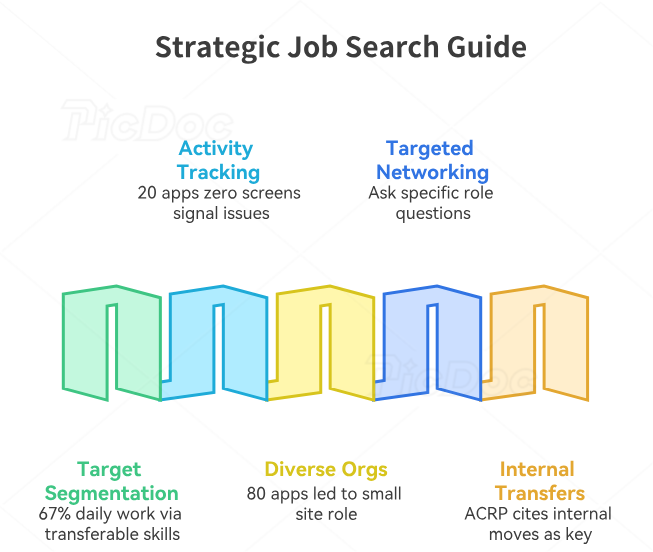
For the next 30 days, divide targets by distance from your current evidence. Most applications should go to roles where you can already explain roughly two-thirds of the daily work through transferable experience: research assistant, CRC assistant, research technician, regulatory assistant, recruitment, research administration, site CTA, research billing, or clinical data support. A smaller portion can target junior CRC and specialized roles aligned with your background. CRA, sponsor-side CTA, or specialist positions requiring independent ownership belong in the stretch category.
That structure keeps the search anchored in research assistant responsibilities, site-level logistics, CRC monitoring preparation, clinical data review, and regulatory compliance instead of betting the entire search on a title several steps downstream.
Track job family, employer type, therapeutic area, required experience, application date, referral status, screening result, interview stage, and final outcome. After every 20 carefully matched applications, calculate your screen rate. Twenty strong matches with zero recruiter conversations suggest a targeting or résumé problem. Recruiter screens followed by repeated hiring-manager rejection suggest weak role-specific evidence. Multiple final interviews followed by rejection suggest the gap has moved to interview differentiation, compensation, availability, or competition.
Smaller research organizations deserve deliberate attention. The successful April Reddit candidate found an expanding small site after approximately 80 applications. Search beyond famous CRO names by identifying local oncology practices, dermatology research centers, CNS sites, vaccine sites, academic departments, hospital research institutes, and principal investigators conducting trials. These environments can expose employees to participant recruitment, protocol deviations, study budgets, monitoring visits, and site operations much faster than a narrowly defined administrative position.
Networking also works better when the request is specific. Instead of asking a CRA how to “break into clinical research,” identify a professional one step ahead of your target and ask which tasks distinguished successful first-year employees. Speak with CRCs about site monitoring, regulatory coordinators about essential-document workflows, data staff about query resolution and verification, and research assistants about team communication. The conversation becomes practical enough to improve the next application.
Internal transfers deserve equal attention. Someone already working in a hospital, university, laboratory, pharmacy, or health system can search the employer's own research departments before leaving the institution. ACRP's 2026 career guidance specifically identifies internal movement within institutions conducting research as a realistic route toward coordinator work. Existing knowledge of the organization, EHR, patient population, compliance environment, and internal processes can reduce the employer's perceived onboarding risk.
5. Turn the First Job Into the Experience Your Second Job Requires
Your first clinical research job should be judged partly by the evidence it can generate. A modestly titled site role can become extremely valuable when it gives you access to participant scheduling, screening, source documentation, EDC entry, query resolution, IRB communication, regulatory files, safety reporting, investigational-product accountability, sponsor communication, and monitoring visits
For a future CRA, prioritize exposure to on-site and remote monitoring, risk-based monitoring, data review and verification, investigator meetings, and protocol deviation management. Volunteer to prepare monitoring documents, observe sponsor communication where permitted, resolve queries promptly, understand findings, and learn why corrections were requested.
For a regulatory career, seek ownership of IRB submissions, amendments, continuing review, investigator documentation, essential-document maintenance, and startup packages. Build deeper knowledge of investigator GCP responsibilities, IND and NDA regulatory processes, ethical patient protections, and clinical research regulatory compliance.
For data, document how many studies, participants, forms, or queries you support and how you prevent errors. Experience with clinical trial data verification, data integrity, quality-management systems, and protocol compliance becomes a strong foundation for clinical data management and quality roles.
For pharmacovigilance, pursue direct exposure to adverse-event intake, seriousness assessment workflows, follow-up, case quality, coding concepts, reconciliation, and inspection readiness. Study pharmacovigilance safety monitoring, global PV compliance, PV audits and inspections, and adverse-event reporting requirements.
For project management and operations leadership, collect proof across deadlines, stakeholders, budgets, risk, and closeout. Experience with clinical trial milestones, trial budget management, clinical research quality, team leadership, and study closeout eventually creates a credible clinical operations profile.
The career accelerator is breadth with evidence. Keep a private achievement log containing study phase, therapeutic area, responsibilities, systems used, volume handled, problems solved, inspections or monitoring exposure, and measurable improvements. Exclude protected patient data and confidential sponsor information. When you eventually pursue the next role, your résumé can show controlled growth rather than a vague statement that you “assisted with clinical trials.”
6. FAQs About Breaking Into Clinical Research With No Experience
-
Yes. Entry-level CRC and CRC-assistant hiring exists, particularly at research sites, hospitals, academic departments, and expanding independent sites. ACRP has even published competency-based hiring guidance specifically for entry-level CRCs. Employers frequently value healthcare, laboratory, administrative, and patient-facing experience when it maps to patient retention, protocol adherence, trial documentation, and ethical patient protection.
Employee requirements vary substantially. ACRP's current entry-level career guidance notes that federal regulation does not establish a universal degree, license, or certification requirement for coordinator and several other study-team roles; employers determine their own hiring thresholds.
-
CRA should generally be treated as a destination after relevant operational exposure. Monitoring requires confidence with source records, EDC systems, regulatory files, protocol compliance, site communication, findings, and participant-protection issues. Recent Reddit discussion from experienced clinical research professionals reinforces how difficult direct CRA entry has become in the current market.
Build those competencies through GCP monitoring exposure, remote and on-site monitoring preparation, risk-based monitoring, data verification, and site operations.
-
GCP training strengthens an entry application because it shows exposure to the ethical and quality framework governing trial conduct. Current FDA guidance centers on ICH E6(R3), which emphasizes participant protection, reliable results, quality by design, proportionality, and risk-based approaches.
The strongest application combines GCP knowledge with evidence that you can apply patient-safety principles, follow a research protocol, understand adverse-event compliance, and maintain data integrity.
-
Professional certification becomes more relevant after qualifying research experience has been accumulated. ACRP's CCRC eligibility currently requires 3,000 hours of verifiable work experience. SOCRA's standard CCRP route requires two years of full-time experience, with alternative education-based routes still requiring one year of qualifying experience.
Before reaching those thresholds, focus on research assistant training, protocol execution, trial logistics, and research-team communication. Those capabilities help produce the paid experience that later makes professional certification possible.
-
Prioritize clinical research assistant, research technician, specimen-processing, CRC assistant, junior CRC, recruitment, clinical data assistant, research administration, and site-based trial support. Biology graduates should emphasize controlled laboratory work, accurate records, protocol execution, data quality, sample handling, and scientific literacy.
Connect the résumé to protocol adherence, clinical trial data review, quality management, trial logistics, and site monitoring readiness. That framing gives the science degree operational meaning.
-
Stop treating application volume as the primary metric and diagnose the funnel. Review whether the majority of jobs genuinely match your current evidence, whether your résumé translates previous work into research-relevant risk control, and whether you are disproportionately targeting CRO or sponsor positions.
Then run a smaller, carefully matched application batch focused on research assistant work, site logistics, clinical trial coordination, research data quality, and regulatory documentation. Compare interview conversion before sending the next large batch.
