
Site vs CRO vs Sponsor for Your First Clinical Research Job: Reddit Career Advice + Long-Term Earnings Trade-Offs
Your first clinical research employer can shape years of earning power, mobility, and credibility. A site may give you stronger trial ownership, a CRO may accelerate industry exposure, and a sponsor may place you closer to study strategy and higher-value decisions. Candidates trying to break into clinical research without experience, compare certification with experience, or escape the entry-level experience catch-22 should evaluate the evidence each job lets them build, rather than chasing employer prestige alone.

1. Site vs CRO vs Sponsor: What You Actually Learn in Each Environment
The most useful way to compare site, CRO, and sponsor employment is to ask which side of trial execution you will learn deeply enough to prove later.
At a clinical research site, you are closest to participants and investigators. Entry roles may involve recruitment, scheduling, source documentation, informed consent workflows, investigational-product coordination, protocol procedures, data entry, query resolution, regulatory files, and sponsor communication. That makes the site especially valuable for someone pursuing a CRC role without previous research experience, building practical research protocol adherence, learning trial logistics coordination, or developing the communication skills required for site-team collaboration.
That operational proximity matters. Someone who has personally managed visit windows, chased missing data, prepared for monitoring, documented deviations, coordinated investigator signatures, and handled safety-reporting workflows can later describe concrete problems they have solved. Those experiences build stronger interview evidence than simply saying you understand GCP. Candidates should learn the practical connection between investigator responsibilities under GCP, patient safety and ethical conduct, adverse-event reporting, and clinical-trial data integrity while they are still close enough to see what failure looks like.
A CRO moves you toward outsourced trial delivery. Depending on the role, you may gain exposure to sponsor expectations, multiple sites, centralized systems, monitoring plans, TMF processes, metrics, timelines, escalation pathways, and standardized operating procedures. For candidates comparing a research assistant, CTA, and CRC as first jobs, the CRO can become particularly attractive when the position creates a credible bridge toward becoming a CRA without monitoring experience.
The pressure is different. CRO employees often have to satisfy both study-quality expectations and commercial delivery requirements. Recent Reddit discussions repeatedly describe CRO work as more metric-driven, particularly for monitoring positions, while sponsor-side contributors often describe greater emphasis on meeting the monitoring plan and broader study objectives. Experiences vary substantially by company, program, manager, therapeutic area, and resourcing model.
A sponsor places you closer to the organization ultimately responsible for the development program. Depending on the position, that can mean exposure to vendor oversight, portfolio priorities, protocol strategy, budgets, risk decisions, regulatory planning, study governance, and cross-functional decision-making. Understanding clinical-trial timeline management, quality-management strategy, clinical-trial leadership, and even the downstream logic of IND and NDA submissions becomes more commercially relevant here.
The catch is access. Sponsor jobs frequently attract candidates who already possess CRO or site evidence. Recent Reddit threads include experienced site professionals struggling to convert substantial site responsibility into industry interviews, illustrating why a prestigious title at a site does not automatically translate into sponsor-side readiness.
| Decision Factor | Site | CRO | Sponsor | Career Decision Signal |
|---|---|---|---|---|
| Typical entry barrier | Usually lowest | Moderate | Usually highest | Site often gives true beginners the fastest route to credible experience. |
| Best first-role examples | RA, CRC, regulatory coordinator | CTA, project associate, TMF role | Clinical operations associate, CTA, specialist | Compare responsibilities with this first-job role comparison. |
| Participant exposure | High in many roles | Usually low | Usually low | Site experience is strongest when you want patient-facing execution knowledge. |
| Protocol execution depth | Very high | Oversight-oriented | Strategy and oversight-oriented | Hands-on execution strengthens practical protocol-adherence evidence. |
| Monitoring exposure | You receive monitoring visits | Strongest direct pathway | Available but fewer entry openings | CRO roles can create the cleanest bridge into GCP monitoring. |
| Sponsor-facing communication | Regular but site-specific | Frequent | Internal and cross-functional | CRO experience teaches how sponsor expectations become operational deliverables. |
| Investigator interaction | Very high | Moderate to high for CRAs | Role-dependent | Useful for understanding real investigator GCP responsibilities. |
| Regulatory-document exposure | IRB and site files | Site and TMF oversight | Broader development context | Choose based on whether you want execution, oversight, or development strategy. |
| Safety workflow exposure | Identification and reporting | Reconciliation and oversight | Governance and program-level oversight | Strong candidates understand adverse-event compliance across all three layers. |
| Data-query experience | Hands-on resolution | Monitoring and escalation | Trend and quality oversight | Site work can build unusually concrete data-quality examples. |
| Vendor-management exposure | Limited to moderate | Moderate | Often substantial | Sponsor experience becomes valuable for later study-management positions. |
| Budget exposure | Site budgets and coverage | Project/resource controls | Program and vendor budgets | Commercial responsibility increases as you move toward sponsor ownership. |
| Study-level visibility | One site's reality | Multi-site execution | Whole-program view | Sponsor gives breadth of ownership; site gives depth of execution. |
| Therapeutic-area depth | Can become very deep | Variable by assignment | Often portfolio-specific | Deep oncology or rare-disease expertise can later become compensation leverage. |
| Exposure to multiple sponsors | Possible | Potentially high | One employer's portfolio | CRO breadth helps you learn different systems and expectations quickly. |
| Operational standardization | Highly variable | Usually strong | Usually mature but company-specific | Large CROs can teach repeatable processes useful across employers. |
| Performance metrics | Enrollment, data, visits, quality | Often utilization, DOS, timelines, quality | Study and portfolio outcomes | Understand the metric system before accepting a seemingly higher-paying role. |
| Travel burden | Usually low | Can be high for CRA roles | Highly model-dependent | Review the real trade-offs in CRA travel and burnout. |
| Remote-work potential | Lower for participant-facing roles | Often stronger | Role-dependent | Remote status has little value if workload makes the job effectively always-on. |
| Typical early-career pay | Often lower | Often higher after specialization | Potentially strong but harder to access | Compare role level with the 2026 CRA salary benchmarks. |
| Bonus/equity potential | Often limited | Varies | Can be significant | Compare total compensation, not salary alone. |
| Fastest CRA pathway | CRC → CRA transition | CTA/bridge → CRA | Possible but openings are scarcer | Use the CRA transition roadmap to judge whether the role creates monitoring evidence. |
| Best study-management preparation | Execution depth | Operational breadth | Ownership and governance | The strongest future CTMs eventually need all three perspectives. |
| Promotion speed | Can stall at smaller sites | Can be fast in growth cycles | Can be slower but broader | Promotion title matters less than new scope and decision authority. |
| External portability | Strong if responsibilities are measurable | Strong industry portability | Strong when scope is transferable | Build evidence that survives employer changes. |
| Biggest career risk | Remaining too long without expanding scope | Burnout or metric-heavy narrowness | Entering a narrow role with little execution exposure | A good employer can still be a poor career-capital decision. |
| Best reason to choose it first | Build undeniable execution evidence | Gain scalable industry exposure | Access development-side ownership early | Choose the environment that closes your biggest experience gap. |
2. Which Employer Is Easiest to Enter in 2026, and What Each One Actually Screens For
For a genuine beginner, a site is often the most realistic entry point because sites need people who can help deliver visits, maintain documentation, coordinate patients, enter data, answer queries, and support investigators. Candidates with limited research history can improve their odds by understanding essential research-assistant training, demonstrating protocol-adherence skills, showing familiarity with clinical-trial logistics, and targeting the specific proof described in no-experience CRC hiring.
The hiring question is rarely, “Do you know clinical research?” It is closer to, “How much supervision will you require before we can trust you with regulated work?”
That distinction explains why clinical research certification can strengthen a candidate while still failing to replace credible practical experience. A course can reduce the knowledge gap. The employer still needs evidence that you can follow instructions precisely, document contemporaneously, communicate deviations, protect confidentiality, escalate safety issues, and manage deadlines without silently losing control of the trial.
CRO entry roles tend to screen for a different form of readiness. Employers may care about documentation discipline, systems comfort, remote communication, issue tracking, sponsor responsiveness, TMF awareness, multi-project organization, and the ability to work inside standardized processes. Someone moving from site work should translate site tasks into industry language. “Scheduled subjects” is weak. “Managed protocol visit windows across competing participant and investigator schedules while preventing avoidable deviations” communicates operational value. The same principle applies to site operations oversight, data-integrity responsibilities, and GCP monitoring expectations.
Sponsor hiring usually demands the strongest evidence that you understand how local actions affect the wider program. A strong candidate can explain why an unresolved query affects database timelines, why weak site documentation creates inspection risk, why poor enrollment forecasts affect budgets and milestones, and why recurring deviations may indicate a systemic quality problem. Knowledge of clinical-trial quality management, global regulatory compliance, trial safety oversight, and trial timeline management therefore becomes increasingly valuable.
Recent Reddit accounts also warn against assuming extensive site seniority guarantees a lateral jump into equally senior industry work. Experienced site managers have reported being rejected when targeting CRO or sponsor positions above the level where employers believed their direct industry experience transferred.
That is painful, but strategically useful: optimize your first job for transferable evidence before optimizing your title.
3. Long-Term Earnings Trade-Offs: Base Salary Is Only One Part of the Decision
“Which pays more?” sounds simple until the comparison includes career stage, therapeutic area, bonus, equity, travel, promotion speed, workload, retirement benefits, insurance, remote flexibility, and future marketability.
The 2026 CRA salary analysis places practical U.S. CRA I discussions roughly around $75,000–$95,000, with compensation rising materially once candidates possess independent monitoring experience. That matters for a site employee contemplating a move because becoming a CRA without monitoring experience requires crossing a specific capability barrier. Years in research alone do not create the same market value as evidence that you can independently execute monitoring responsibilities.
Site salaries are frequently lower, particularly in academic or smaller research environments, but averages can hide major exceptions. Federal wage data also cannot neatly produce a universal “site salary,” “CRO salary,” or “sponsor salary” because clinical-research titles map imperfectly onto occupational classifications, and compensation varies substantially by setting. ACRP's 2026 comparison highlights precisely that limitation.
The smarter calculation is future earning power created per year spent in the role.
A lower-paid CRC position can be an excellent economic decision if it gives you oncology exposure, independent trial ownership, sponsor interaction, monitoring preparation, safety experience, and measurable enrollment or data-quality outcomes that later strengthen a CRC-to-CRA transition. It becomes less attractive when you spend several years repeating scheduling and data-entry tasks without gaining quality-management exposure, GCP oversight knowledge, regulatory responsibility, or advancement.
A CRO can increase compensation while creating faster exposure to different studies, systems, sponsors, and monitoring problems. The hidden cost may be heavy utilization pressure, travel, resourcing instability, or workloads that reduce the value of the headline salary. Anyone considering monitoring should price the lifestyle described in CRA travel and burnout experiences alongside the salary reported in CRA compensation benchmarks.
Sponsor compensation can become particularly attractive once bonus, equity, retirement benefits, paid shutdown periods, and broader advancement possibilities enter the package. Yet sponsor does not automatically win every individual comparison. One recent Reddit discussion included a site-level Senior CRC earning roughly $88,000 and considering a sponsor opportunity potentially paying less, a useful reminder that experienced site professionals can sometimes out-earn an early sponsor offer.
Another 2026 Reddit discussion comparing CRO and sponsor employment showed why broad generalizations fail: contributors frequently favored sponsors for work-life balance and career growth, while others emphasized that compensation and security vary materially between companies.
The correct comparison is therefore:
Guaranteed salary + realistic bonus + equity + retirement value + benefits + promotion probability + skills gained − travel burden − unpaid workload − burnout risk − career stagnation risk.
That equation produces a far more useful answer than employer type alone.
4. The Career Path Each Choice Opens—and the Doors It Can Delay
A first job should be judged partly by the second and third jobs it makes easier.
For someone targeting CRA work, a strong site role can create excellent preparation. A CRC who understands source documentation, consent, enrollment, deviations, essential documents, investigational-product accountability, queries, safety reporting, and monitoring visits sees trials from the exact environment a CRA later has to assess. Pairing that experience with GCP monitoring knowledge, site-operations oversight, data-integrity responsibilities, and the CRA bridge-role roadmap can make the later transition much more defensible.
A CRO may shorten the distance to industry progression because you are already inside systems, processes, sponsor relationships, and organizational structures that employ CRAs, project specialists, CTMs, clinical project managers, quality professionals, and operational leaders. A CTA or project role can therefore be strategically valuable even when it sounds less impressive than “Senior CRC.” Candidates should compare actual exposure with the RA-versus-CTA-versus-CRC career analysis, then ask whether the position builds clinical-trial timeline skills, quality-management capability, and sponsor-facing responsibility.
For candidates targeting CTM or project-management leadership, CRO breadth can be unusually useful. You may learn how problems repeat across sites, countries, vendors, and protocols. Later, however, sponsor-side experience can add the missing layer: why those operational decisions are being made, which risks leadership will tolerate, how vendors are governed, how development priorities shift, and how study-level decisions connect with a larger portfolio. That broader ownership aligns with clinical-trial leadership skills, project close-out responsibilities, and regulatory-development knowledge.
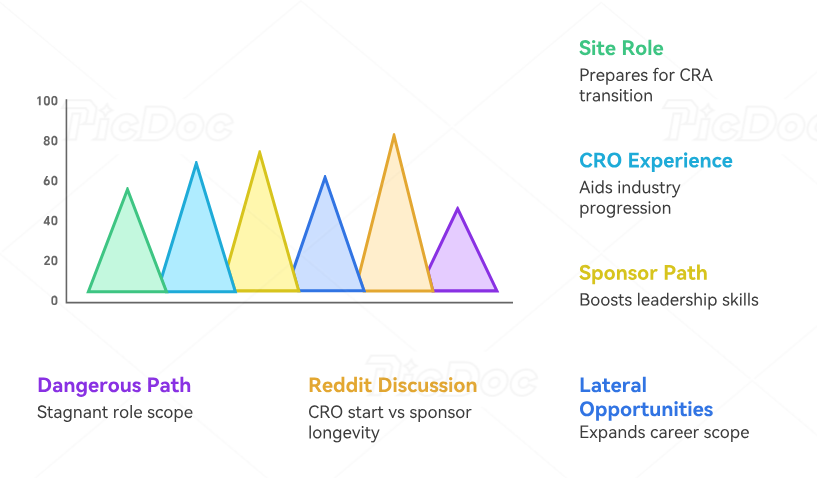
The sponsor path can also create lateral opportunities beyond monitoring. Clinical operations may connect with study management, regulatory affairs, pharmacovigilance, medical affairs, quality, data operations, vendor management, and program leadership. Knowledge of global pharmacovigilance compliance, pharmacovigilance audits and inspections, medical-monitor safety oversight, and medical-affairs regulatory compliance can become relevant as careers widen.
A recent 2026 Reddit discussion summarized an important pattern: some professionals explicitly described CRO work as a good place to start and sponsor employment as attractive for longevity. Other contributors stressed that sponsor jobs can still carry significant pressure, making the actual manager, program, workload, and corporate stability more important than the logo.
The dangerous path is therefore less about choosing the “wrong side” and more about spending years in a role whose scope barely changes.
5. A Decision Framework for Choosing Your First Offer Without Regretting It
Begin with your intended three-year destination, then work backward.
If your target is CRA, favor the role that gives you the strongest combination of protocol execution, monitoring exposure, site communication, source and data-quality knowledge, safety awareness, and documented problem-solving. A strong CRC opportunity can outperform a vague corporate “clinical associate” role if the latter gives you little access to monitoring or trial execution. Review the skills behind CRC hiring success, then compare them with the requirements needed to transition into CRA work.
If your target is study management, prioritize scope. Ask whether you will track milestones, manage risks, communicate with vendors, prepare governance material, support budgets, own action items, contribute to escalation, and see cross-functional decisions. Those experiences compound into clinical-trial project leadership, timeline management, and quality-management capability.
If your target is regulatory affairs, pharmacovigilance, or quality, evaluate exposure to regulated decisions rather than generic administration. Someone performing meaningful safety reconciliation, audit preparation, regulatory submissions, CAPA follow-up, or inspection-readiness work may build stronger mobility than someone holding a broader title with little ownership. The same reasoning applies to global pharmacovigilance compliance, PV inspection readiness, and IND/NDA regulatory work.
During interviews, ask what you will personally own by month six, which performance metrics determine success, which systems you will use, how many protocols or sites you will support, who trains you, where previous employees moved next, and which responsibilities distinguish someone who gets promoted. Those questions expose weak roles quickly.
Also ask how mistakes are handled. Clinical research careers accelerate when beginners can learn under controlled supervision. A workplace that hides errors, normalizes protocol deviations, understaffs safety work, or treats documentation as cleanup creates poor habits that can later damage credibility. Understanding ethical GCP conduct, adverse-event compliance, investigator obligations, and clinical-trial data integrity helps you recognize those red flags.
Finally, score each offer on learning density: how many marketable responsibilities will you become demonstrably competent at during the next 12–18 months? That measure often predicts long-term earnings more accurately than the difference between two first-year salaries.
6. FAQs: Site vs CRO vs Sponsor for Your First Clinical Research Job
-
For many true beginners, yes. Sites often have the clearest need for entry-level operational support and can provide direct exposure to recruitment, visits, documentation, data, investigators, protocol requirements, and sponsor interactions. That combination helps solve the clinical-research experience catch-22.
The quality of the site matters more than the category. A well-run site that trains you in trial logistics, protocol compliance, GCP responsibilities, and monitoring preparation can create exceptional career capital. A chaotic site where you perform repetitive administrative tasks without expanding scope can trap you.
-
There is no universal requirement. Direct site-to-sponsor transitions happen, particularly when the candidate has specialized therapeutic expertise, strong study ownership, relevant systems experience, internal referrals, or a role whose responsibilities match closely.
CRO experience can make the transition easier because it gives employers evidence that you already understand industry systems, sponsor expectations, multi-site execution, and standardized operating models. Candidates who ultimately want sponsor work should therefore compare the value of site, CTA, and CRC entry paths and the evidence required for industry-side hiring.
-
Sponsor and advanced CRO roles often create higher compensation ceilings than typical site positions, but employer type alone cannot predict an individual's package. Therapeutic area, seniority, role scarcity, bonus, equity, geography, travel, benefits, and leadership scope can materially change the result.
For monitoring careers, compare actual levels using the 2026 CRA salary guide and then evaluate lifestyle costs through the CRA travel and work-life analysis. A higher salary with extreme travel or chronic overtime can deliver less practical value than a slightly lower package with stronger benefits and sustainable advancement.
-
It can be the better financial decision when the salary sacrifice is buying scarce experience that improves your next move. A role giving you participant coordination, regulatory work, monitoring preparation, safety reporting, investigator communication, and protocol ownership may rapidly strengthen your eligibility for CRC advancement or a future CRA transition.
Set a time horizon. If responsibilities have stopped expanding after 12–18 months, start assessing whether the experience is still compounding.
-
A strong CRC role is one of the most transferable site paths because you learn the environment CRAs later monitor. CRO CTA, clinical project associate, in-house CRA, and formal CRA bridge positions can also create excellent routes.
The deciding factor is whether you are progressively learning monitoring techniques, site-quality oversight, protocol compliance, and data-integrity controls. A job title containing “clinical research” does little for your CRA goal if the actual work never builds those capabilities.
-
Sponsor experience can provide valuable access to study strategy, vendors, budgets, development decisions, and broader cross-functional work. CRO experience may give you greater operational repetition across sites, systems, sponsors, and therapeutic programs.
Recent Reddit discussions strongly favor sponsor employment in some areas such as work-life balance and broader career options, while experienced contributors also emphasize major employer-to-employer variation.
Candidates should compare responsibility using CRO-versus-sponsor CRA experiences, examine their likely CRA compensation trajectory, and determine which position closes the larger skill gap.
