CRA to Clinical Trial Manager: Reddit Promotion Stories, Skill Gaps & When Project Management Training Becomes Valuable
Moving from CRA to Clinical Trial Manager looks like a natural promotion until the first CTM interview exposes the gap: excellent monitoring experience does not automatically prove study-level ownership. A CRA may understand GCP monitoring, recognize protocol deviations, manage difficult sites, and protect clinical data integrity, yet still lack evidence in budgets, vendors, timelines, risk, and cross-functional leadership. The promotion becomes much easier when you deliberately build those missing CTM responsibilities before the title changes.
1. What Actually Changes When You Move From CRA to Clinical Trial Manager?
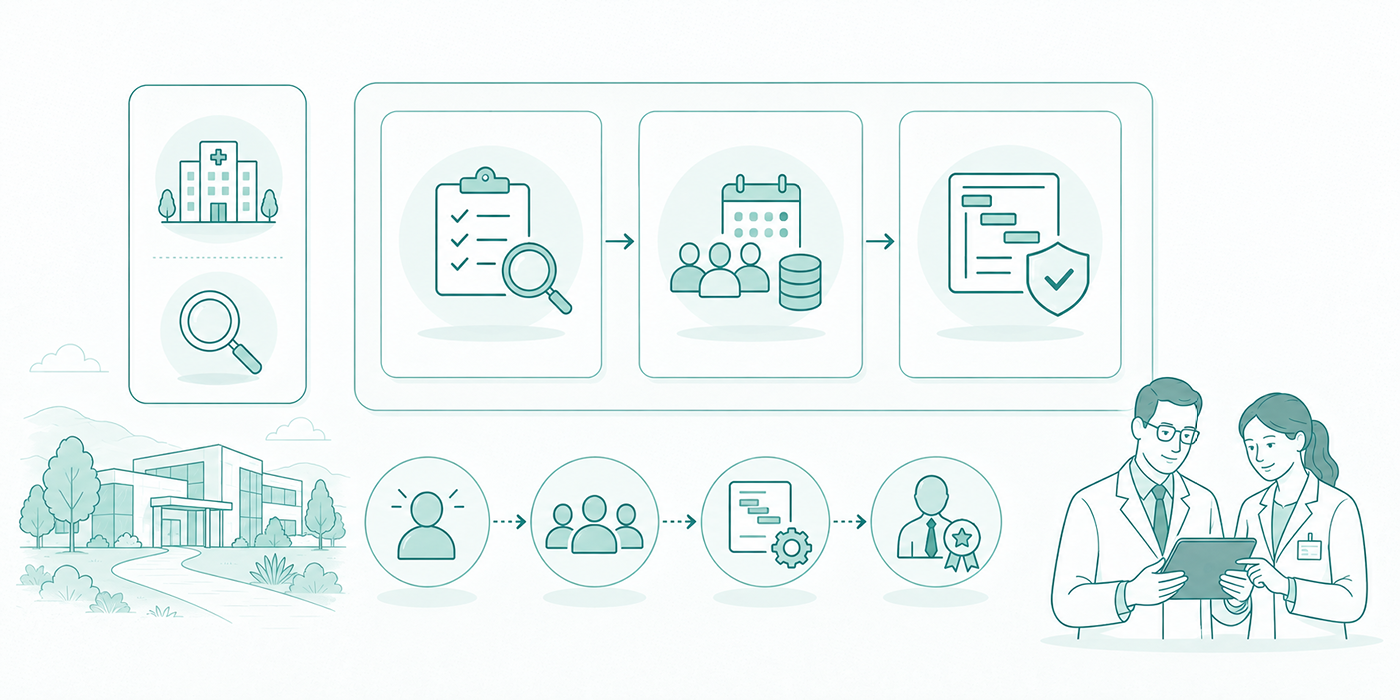
The most important transition is from owning sites to owning outcomes across the study.
A strong CRA can independently monitor sites, evaluate source documentation, identify compliance problems, review consent, manage findings, assess enrollment barriers, and escalate issues appropriately. Those skills remain useful, especially knowledge of on-site and remote monitoring, investigator GCP responsibilities, clinical trial site operations, and ethical patient-safety requirements.
The CTM has to look several levels higher.
Current Clinical Trial Manager job descriptions emphasize accountability for timelines, budgets, quality, vendor performance, risk management, cross-functional teams, inspection readiness, site strategy, data flow, and issue escalation. ICON's current CTM listings, for example, describe responsibility for clinical deliverables, budget tracking, vendors, country or study risks, cross-functional issue resolution, and trial execution against milestones.
That explains why a CRA with superb monitoring metrics can still struggle to land a CTM interview. The hiring manager may already believe you can monitor. The unanswered question is whether you can manage the entire machine.
A CRA sees one site's late data entry and pushes for correction. A CTM needs to recognize whether delayed data is becoming a study-wide trend, understand whether it threatens a database milestone, coordinate with data management, evaluate the effect on clinical trial timelines, decide whether additional controls are needed, and communicate the risk to stakeholders.
A CRA escalates a vendor-related problem. A CTM may own the escalation path, assess the vendor's corrective plan, monitor performance against deliverables, and determine whether the issue threatens trial quality management.
A CRA works within the monitoring plan. A CTM may help develop that plan, allocate resources, watch trends across CRAs, manage monitoring quality, and determine where attention is needed.
A CRA reports enrollment problems at assigned sites. A CTM needs to understand how those sites affect the overall enrollment forecast, whether the study needs new sites, whether timelines must change, and how the decision affects cost.
This is the skill gap that catches ambitious CRAs. They have spent years becoming excellent at CRA responsibilities, survived the realities of CRA travel and workload, and built strong site-management experience, only to discover that the next promotion evaluates scope rather than monitoring seniority.
The strongest transition candidate can say:
I understand what happens at the site level, and I have already demonstrated that I can convert site-level information into study-level decisions.
That is much more persuasive than simply saying you are ready to stop traveling.
| CTM Competency | Typical CRA Exposure | Promotion-Ready Evidence | Common Gap | Best Way to Build It |
|---|---|---|---|---|
| Study-level timeline ownership | Site visit deadlines | Tracks interconnected study milestones | Thinking only at site level | Master trial milestones |
| Budget awareness | Limited | Understands forecasts, changes and overruns | Zero financial exposure | Learn research budget mechanics |
| Vendor oversight | Raises vendor issues | Tracks vendor deliverables and escalation | Little contract/SOW exposure | Volunteer for vendor calls |
| CRA oversight | Peer support | Reviews performance and coaches monitors | No leadership evidence | Build team-management capability |
| Monitoring-plan ownership | Executes plan | Contributes to strategy and revisions | Execution-only experience | Understand monitoring strategy |
| Risk management | Escalates individual risks | Maintains study-level mitigation plans | Reactive problem solving | Practice risk-based quality management |
| Issue escalation | Escalates site problems | Prioritizes and coordinates resolution | Escalates without proposed solution | Bring options with every escalation |
| Enrollment forecasting | Tracks assigned sites | Models impact across study | Site-only thinking | Strengthen site operations analysis |
| Cross-functional leadership | Works with functions | Drives functions toward shared milestone | Coordination without influence | Strengthen stakeholder communication |
| Study meetings | Attends | Owns agenda, decisions and follow-up | Passive participation | Ask to chair recurring calls |
| Executive communication | Detailed site updates | Concise status, risk and decision summaries | Too much operational detail | Practice one-page status reporting |
| Data-flow oversight | Chases site queries | Identifies systemic data trends | Limited study-level analytics | Build data-integrity expertise |
| TMF oversight | Maintains assigned documents | Monitors overall completeness and quality | Document-level mindset | Own a TMF health review |
| Inspection readiness | Supports preparation | Coordinates readiness activities | Little audit exposure | Build inspection-ready quality habits |
| CAPA management | Provides site input | Tracks root cause and effectiveness | Treats CAPA as documentation | Participate in root-cause reviews |
| Protocol amendment execution | Implements locally | Coordinates rollout across functions/sites | Limited dependency planning | Deepen protocol-management skills |
| Start-up oversight | May support sites | Tracks activation dependencies | Monitoring begins after key decisions | Shadow start-up meetings |
| Database-lock planning | Resolves site actions | Coordinates multiple functions toward lock | Limited downstream visibility | Map milestone dependencies |
| Resource planning | Manages own workload | Anticipates team-capacity needs | No resourcing ownership | Support CRA allocation discussions |
| Decision documentation | Documents site actions | Documents study rationale and decisions | Weak governance trail | Own action/decision logs |
| Vendor performance metrics | Sees operational symptoms | Reviews KPIs and trends | No KPI ownership | Join vendor governance calls |
| Quality trend analysis | Finds individual deficiencies | Detects patterns across sites | Treats findings individually | Learn study-level quality analysis |
| Stakeholder management | Manages investigator relationships | Balances sponsor, vendors and functions | One-direction communication | Build influence without authority |
| Change management | Adapts own activity | Coordinates team response to change | No formal change planning | Lead one amendment rollout |
| Close-out strategy | Closes individual sites | Coordinates study close-out dependencies | Site-focused completion | Study project close-out |
| Problem-solving speed | Solves site problems | Prioritizes competing study problems | Everything feels urgent | Use impact/urgency triage |
| Delegation | Works independently | Assigns ownership and follows through | Doing everything personally | Develop delegation skills |
| Financial trade-offs | Rare exposure | Connects operational decisions with cost | Budget feels abstract | Understand trial financial controls |
| Global/country coordination | Assigned geography | Balances regional dependencies | Limited global exposure | Seek regional study assignments |
| Study-level accountability | Owns assigned sites | Owns a defined study deliverable | Helpful without being accountable | Ask for one measurable workstream |
2. The Skill Gaps That Keep Senior CRAs From Getting CTM Interviews
The most painful situation is reaching Senior CRA, carrying difficult sites, training junior monitors, consistently meeting metrics, and discovering that every CTM vacancy still asks for experience you have never formally been allowed to acquire.
That frustration is visible in recent Reddit discussions. In August 2026, one CRA described four years of CRA experience plus three years at site level and still struggled to secure internal interviews for local trial management or project roles. Another experienced CRA in the discussion described an even longer background in oncology and gene therapy while facing a similar transition problem.
The lesson is important: experience volume and management readiness are measured differently.
Budget ownership
CRAs often have limited visibility into study finances. CTM roles may require tracking budgets, explaining variances, approving or escalating changes, understanding vendor spend, and connecting operational decisions with cost. Current CTM descriptions explicitly include budget responsibility alongside timelines and study deliverables.
You do not need to become a finance specialist. You do need enough fluency to understand how delayed activation, additional monitoring, underperforming sites, vendor changes, and prolonged recruitment affect the study economically. Learning clinical trial budget fundamentals, trial milestone management, site-operations oversight, and quality-management strategy helps connect operations with cost.
Vendor management
A CTM may oversee central labs, imaging providers, eCOA vendors, technology providers, CRO functions, and other external partners. Current positions expect trial managers to participate in vendor selection, define requirements, monitor performance, manage relationships, address missed deliverables, and escalate quality concerns.
A CRA who only reports vendor failures still lacks the governance experience. Try to join vendor meetings, review metrics, own follow-up actions, and learn how a vendor issue interacts with study timelines, data quality, site operations, and inspection readiness.
Cross-functional leadership
The CTM frequently has responsibility without direct authority. Data management, safety, regulatory, medical, biostatistics, vendors, CRAs, start-up teams, and investigators may all contribute to one milestone while reporting elsewhere.
That makes team-management capability, clinical research communication, protocol execution, and quality oversight central promotion skills.
The CTM has to drive clarity: Who owns this? What is due? What is blocked? What happens if it slips? When should the issue be escalated?
Study-level thinking
This is frequently the decisive gap.
A monitor may know that three assigned sites have low recruitment. A CTM has to determine whether the forecast remains viable across 60 sites, whether high performers can absorb the shortfall, whether additional countries or sites are needed, what that does to the timeline, and whether the budget can support the response.
That study-level view connects monitoring expertise with clinical trial timelines, study quality management, data integrity, and project close-out planning.
3. What Recent Reddit CRA-to-CTM Promotion Stories Actually Teach
Recent promotion stories show that the cleanest path rarely looks like CRA → application → CTM.
It more often looks like:
CRA → visible stretch work → Lead CRA / partial trial-management responsibilities → evidence of study ownership → CTM.
A September 2026 Reddit contributor described one of the clearest examples. They deliberately joined a large, high-profile project as a Lead CRA, negotiated an arrangement containing some CTM responsibilities, later moved toward a roughly 50/50 CRA-to-CTM workload, and ultimately stepped into the CTM position when the incumbent left. The contributor also emphasized visibility and relationships with management.
That story reveals something a certification alone cannot create: trusted proximity to the work.
If your CTM is preparing a major amendment, ask whether you can help coordinate implementation. If database lock is approaching, volunteer for a defined workstream. If the team needs an ICF update, UAT support, enrollment tracking, TMF review, or inspection-readiness work, take ownership and document the result. An older Reddit CRA-to-CTM discussion made the same point: milestones and amendments create opportunities to perform useful work beyond ordinary monitoring scope.
A separate September 2026 discussion showed the same principle from another route. A senior CTA at a small sponsor reported taking on extensive trial responsibilities—plans, protocol work, SOP support, ICF work, EDC/UAT, TMF setup, source guidance, and SIV participation—with the explicit goal of proving readiness for CTM promotion.
That matters because the CRA career path is common, while it remains one pathway among several. A March 2026 Reddit discussion included people who moved through in-house CRA, CTA, coordinator, vendor PM, and other routes. Contributors generally agreed that prior monitoring exposure is especially useful for monitoring-heavy CTM roles because the CTM may review visit reports, manage CRA escalations, support CAPAs, and oversee monitoring quality.
This should change how you approach internal promotion.
Waiting until a CTM vacancy appears puts you in direct competition with people who already have study-management evidence. Building project leadership, trial-timeline ownership, risk-based quality management, site oversight, and close-out knowledge months before the vacancy exists gives management evidence they can defend during a promotion discussion.
Visibility also matters more than many technically excellent CRAs want to admit. A September 2026 contributor summarized their own CTM move around relationships, a supportive manager, visible opportunities, and successful execution.
Quiet competence can keep you employed for years. Promotion often requires observable competence at the next level.
4. When Project Management Training Becomes Valuable for a CRA
Project management training becomes most valuable when you already understand clinical operations and need a stronger system for managing scope, timelines, risk, stakeholders, resources, quality, and competing priorities.
ACRP's clinical research competency framework includes study and site management, leadership, communication, data management, GCP, and project-management concepts across the clinical research profession. Its current Project Management Best Practices program specifically teaches clinical-trial PM concepts through pharmaceutical research scenarios rather than generic business examples.
That can be useful for a Senior CRA who understands monitoring deeply but has never been taught how to construct a study-level risk register, map dependencies, manage stakeholder expectations, prioritize competing deliverables, or think systematically about scope and cost.
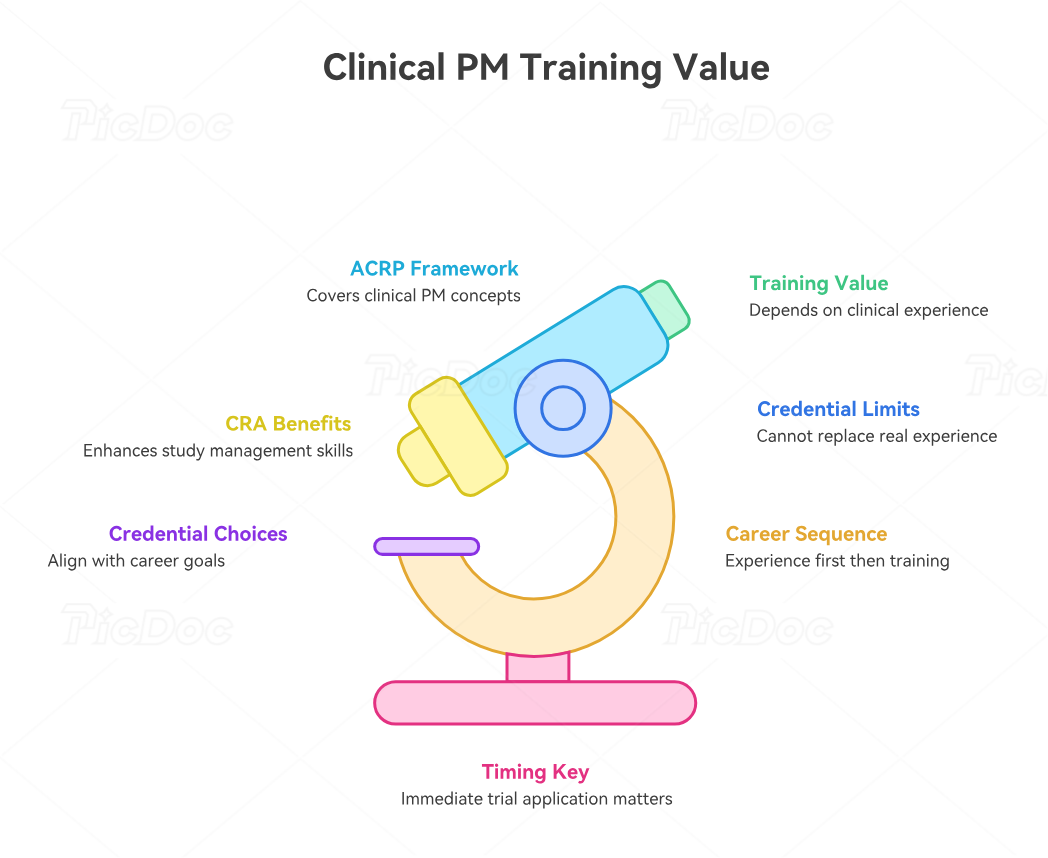
The training has far less leverage when the core problem is missing experience.
A certification cannot manufacture vendor ownership. It cannot give you a budget you have never tracked. It cannot replace leading a difficult study meeting, managing an underperforming CRA, coordinating an amendment, preparing for inspection, or recovering a slipping milestone.
The same principle appears repeatedly in discussions about clinical research certification versus experience, whether clinical research certification is worth the investment, and why employers value credible practical evidence.
A July 2026 Reddit discussion about moving from CRA toward Clinical Program Manager made this distinction directly. One respondent explained that project-management credentials can improve how someone performs the job, while trial-management experience tends to carry more weight during candidate selection.
For most CRAs, the most efficient sequence is therefore:
First: secure exposure to study-level work.
Second: identify where your management technique is weak.
Third: use targeted training to strengthen those capabilities.
Fourth: apply the framework immediately to real trial work.
A CRA struggling with timelines may benefit from formal PM methods alongside clinical milestone management. Someone inheriting team responsibility may gain more from clinical trial leadership skills. A candidate moving into inspection-heavy responsibility should strengthen quality management, GCP oversight, protocol adherence, and data integrity.
ACRP also offers the ACRP-PM specialty credential, although candidates must already hold an ACRP certification before sitting for that specialty exam. ACRP's own project-management resources emphasize scope, timelines, communication, risk, stakeholder alignment, and change management.
A broader credential such as PMP can become more useful when your career target expands from monitoring-focused CTM work toward clinical project manager, global study manager, program management, or portfolio leadership, where formal project-management language and methodology become more transferable.
The key is timing. Training delivers the greatest ROI when you can immediately connect the concepts to an actual trial.
5. A Practical CRA-to-CTM Promotion Plan for the Next 12 Months
Start by treating the next 12 months as an evidence-building project.
Months 1–2: Run a ruthless gap audit
Pull 15–20 CTM, Clinical Trial Lead, Local Trial Manager, Clinical Lead, and Associate CTM vacancies from your own employer and target companies.
Create columns for:
timeline ownership
CRA oversight
vendor management
budget exposure
risk management
inspection readiness
TMF oversight
enrollment forecasting
study meetings
cross-functional leadership
start-up
database lock
close-out
sponsor communication
Then mark every competency you can prove with a real example.
If your resume contains excellent CRA monitoring experience and strong site-management knowledge, yet offers little evidence of timeline management, team leadership, quality systems, or project close-out, you have identified the real promotion problem.
Months 2–4: Ask for named ownership, not vague shadowing
“Can I shadow you?” often produces meetings without evidence.
Ask for a workstream.
Useful requests include:
owning an enrollment tracker and forecast;
chairing a CRA meeting;
managing an amendment implementation tracker;
coordinating one vendor issue through resolution;
reviewing monitoring trends;
supporting a risk review;
leading a TMF health check;
coordinating database-lock actions;
managing a defined start-up dependency;
contributing to an inspection-readiness workstream.
This creates measurable proof of study coordination, cross-functional communication, protocol implementation, and clinical quality management.
Months 4–8: Move from helper to accountable owner
This is where promotion evidence becomes powerful.
“Assisted the CTM with enrollment” sounds junior.
“Owned weekly country enrollment forecasting across 24 sites, identified a projected shortfall, and coordinated recovery actions with CRAs and study leadership” shows CTM-adjacent thinking.
“Joined vendor calls” has little weight.
“Tracked recurring vendor deviations, maintained action ownership, escalated missed commitments, and supported corrective actions before a study milestone” shows governance.
The goal is to demonstrate the same capabilities current CTM positions request: timelines, risks, vendors, teams, quality, budgets, and study execution.
Months 6–9: Add targeted project-management training
This is the point where training can accelerate development because you now have real situations to apply it to.
Study clinical trial timeline management, clinical research leadership, quality-management strategy, budget-management principles, and project close-out procedures alongside formal project-management education.
You will understand the material differently once a missed milestone has actually landed on your desk.
Months 9–12: Make your promotion case explicit
Do not assume leadership knows you want the role.
Present a compact readiness case:
Current role: Senior CRA
Target: CTM / Clinical Lead / LTM
Evidence built: CRA leadership, study-level timelines, vendor oversight, risk management, inspection readiness, enrollment forecasting
Remaining gap: budget ownership
Requested next exposure: budget forecasting and study-level financial review
That conversation is much stronger than “I have been a CRA for five years and think I deserve the next level.”
Recent Reddit examples show why. One Senior CRA reported reaching two management offers after five years, including a sponsor CTM offer and a CRO project-management offer. The useful comparison in that story was broader than salary: one role provided direct CTM responsibility, while the other offered wider global project scope.
Your next move should be judged the same way. Compare CRO and sponsor career environments, CRA compensation and progression, travel and workload trade-offs, and the amount of real trial-management scope the new job gives you.
The role that builds the strongest next five years may matter more than the role that produces the prettiest title next month.
6. FAQs About Moving From CRA to Clinical Trial Manager
-
There is no universal number. Employers differ by study type, geography, therapeutic area, company structure, and whether the CTM role is monitoring-heavy or broader study management. Current CTM vacancies can require several years of overall clinical research plus project-management experience, while internal promotion pathways can move faster when someone already has substantial study-level responsibility.
Reddit experiences range widely. Some professionals describe transitions after roughly four to five CRA years, while others report companies that expect a longer Senior CRA path.
Your stronger question is whether your years include evidence in monitoring, study timelines, quality management, team leadership, and study-level problem solving.
-
Many CRO pathways use Senior CRA or Lead CRA as the most common launch point because those positions provide deeper monitoring judgment and more opportunities to mentor CRAs. Yet company structures vary. Sponsor organizations may use titles such as Local Trial Manager, Clinical Trial Lead, Study Manager, Associate CTM, or Country Trial Manager as intermediate positions.
A recent Reddit discussion described Lead CRA and country trial-management roles as useful bridges because they introduce oversight responsibilities before full CTM ownership.
If your organization offers a bridge role, evaluate whether it adds study-level oversight, cross-functional leadership, timeline responsibility, and quality ownership. Those responsibilities matter more than the bridge title itself.
-
CRA experience is especially valuable when the CTM role includes monitoring oversight, visit-report review, CRA performance management, site escalation, co-monitoring, and monitoring strategy. A March 2026 Reddit discussion showed strong practitioner preference for CRA backgrounds in monitoring-heavy CTM roles, while contributors also described successful CTMs who came through sponsor operations, CTA, CRC, vendor project management, and other paths.
The relevant issue is whether the candidate can competently oversee GCP monitoring, investigator responsibilities, site operations, and protocol compliance.
-
PMP can strengthen formal project-management knowledge, particularly if your long-term goal includes Clinical Project Manager, Global Study Manager, Program Manager, or broader portfolio roles. For an immediate CRA-to-CTM transition, practical study-management evidence usually addresses a more urgent hiring concern.
Clinical-research-specific training can also be useful because it connects PM concepts directly to GCP, trial operations, risk, stakeholders, and study deliverables. ACRP currently offers clinical research project-management training built around pharmaceutical trial scenarios.
Choose training after examining whether your real weakness is methodology or missing experience. The same decision framework applies when comparing certification with experience, certification ROI, leadership development, and trial-management skills.
-
Study-level ownership.
Budget gaps can be taught. Vendor experience can be added. Meeting leadership can be practiced. The deepest mental shift is learning to connect events across functions and understand how one problem affects the entire trial.
A CTM needs to connect a site delay with enrollment forecasts, monitoring resources, data flow, budget, vendor dependencies, regulatory timelines, and downstream milestones. That requires strong clinical trial timeline management, quality-management judgment, data-integrity awareness, team leadership, and project close-out thinking.
-
Prioritize work that expands your scope of accountability: CRA mentoring, study meetings, amendment implementation, enrollment forecasting, vendor oversight, TMF health reviews, CAPAs, start-up, inspection preparation, database-lock planning, risk reviews, and study-level metrics.
A recent CRA-to-CTM Reddit story specifically described building promotion readiness by progressively taking on CTM work while remaining a CRA.
Use those opportunities to demonstrate clinical research communication, protocol-management ability, quality oversight, trial logistics, and team leadership.
