
How to Become a CRA Without Monitoring Experience: Reddit Career Paths, Bridge Roles & a Realistic Transition Timeline
Breaking into a Clinical Research Associate role without prior monitoring experience is one of the hardest career transitions in clinical research because employers increasingly screen for evidence that you can evaluate sites rather than simply work inside them. Candidates who already understand protocol adherence, clinical trial logistics, GCP monitoring, and site operations still face the same hiring question: where is your proof that you can think like a monitor?

1. How to Become a CRA Without Monitoring Experience: Understand the Actual Hiring Gap
The most expensive mistake is treating “monitoring experience” as a simple number of months on a résumé. Employers use it as shorthand for a bundle of operational judgments.
A CRA may need to review source documentation against the CRF, identify inconsistencies, determine whether a protocol deviation requires escalation, evaluate investigator responsibilities under GCP, assess adverse-event documentation, check regulatory files, reconcile investigational product, manage outstanding queries, document findings, and push corrective actions without damaging the site relationship. Those responsibilities require far more than completing basic clinical research training.
That explains why an experienced CRC can still receive automatic rejections.
A coordinator may have spent years executing visits, consenting subjects, entering data, managing trial logistics, maintaining essential documents, and protecting clinical trial data integrity. The hiring team still needs evidence that the candidate can move from performing trial activities to independently evaluating whether another site performed them correctly.
This distinction is visible in the 2026 hiring market. A September 2026 r/clinicalresearch discussion came from a CRC with six years of experience who reported finding CRA advertisements repeatedly requiring prior monitoring experience. Responses recommended targeting Clinical Trial Assistant, Clinical Trial Coordinator, Assistant CRA, and In-House CRA roles as possible bridges.
Another 2026 thread involved a CRC II with 2.5 years of experience who was struggling to secure CRA opportunities. Respondents specifically mentioned CRO bridge programs and referrals as routes that had worked for them.
That does not mean direct-entry opportunities have disappeared. Medpace currently advertises a Cincinnati entry-level CRA position with structured PACE training and states that prior research experience is unnecessary for that particular opening. It also has a separate U.S. CRA pathway specifically recruiting candidates with at least two years of CRC experience.
The hiring landscape is therefore fragmented. Candidates researching how to break into clinical research should distinguish CRA training opportunities from standard experienced-CRA vacancies. ICON, for example, currently lists CRA roles requiring substantial independent monitoring experience, including one CRA I remote-monitoring position asking for 18 months or more.
This also explains why repeatedly adding certificates can produce disappointing results. The real comparison between clinical research certification and experience comes down to evidence. A credential can strengthen your understanding of GCP, documentation, safety, and regulations. It cannot independently prove that you have handled monitor-facing problems, prepared sites for visits, resolved findings, or exercised quality-management judgment.
Candidates caught in the familiar entry-level clinical research experience trap therefore need a different objective: build observable CRA-adjacent evidence before the title arrives.
2. Choose a CRA Bridge Role Based on the Evidence Missing From Your Résumé
The best bridge role depends on the weakness already visible in your profile.
A CRC who has managed screening, visits, source, EDC, investigational product, regulatory binders, adverse-event reporting, protocol compliance, and sponsor visits already possesses substantial site knowledge. Moving into another generic site-assistant position may add time without adding much evidence. That candidate should prioritize IHCRA, Assistant CRA, centralized monitoring, CTA roles with direct CRA support, or formal CRA training programs.
A research assistant usually has a different gap. Someone performing scheduling, recruitment, record maintenance, specimen handling, and research-team communication may still lack responsibility for trial logistics coordination, deviations, EDC queries, monitoring visits, regulatory correspondence, and site-level decisions. The more efficient step may therefore be a CRC position. The comparison between Clinical Research Assistant, CTA and CRC roles becomes especially important here.
A regulatory coordinator may know essential documents exceptionally well while having little exposure to source data or patient visits. That person should seek assignments involving site operations oversight, data review, monitoring preparation, deviations, and investigator GCP responsibilities.
A CTA has the opposite advantage. CRO systems, study trackers, TMF workflows, sponsor terminology, cross-functional meetings, clinical trial timelines, and documentation processes can make the CTA highly fluent in sponsor operations. The critical question becomes whether the role provides access to site performance, remote review, issue escalation, CRA support, or eventual co-monitoring.
This is why title chasing wastes time.
Ask five evidence questions instead:
Will this job expose me to site performance problems?
Will I work directly with CRAs, CTMs, sponsors, or monitors?
Will I review documentation for quality rather than simply file it?
Will I participate in quality-management decisions or corrective actions?
Can this role produce specific stories I can later use in a CRA interview?
A lower-paying IHCRA opportunity with real site oversight can carry more CRA career value than a higher-paying administrative title with limited monitoring adjacency. Candidates evaluating whether clinical research certification is worth the investment should apply the same logic. Every investment should close a specific hiring gap.
Current Reddit experience supports this role-based strategy. In an April 2026 discussion about CRCs struggling to secure CRA positions, contributors repeatedly suggested CRO-side CTA or IHCRA roles because they can create mentoring, remote-support, and eventual monitoring opportunities.
The most useful bridge therefore increases proximity to the CRA function, not simply proximity to the clinical research industry.
3. Build Monitoring-Equivalent Evidence Before Anyone Gives You the CRA Title
Candidates often say, “My company will not let me monitor, so I cannot build monitoring experience.”
You can still build many of the competencies employers are trying to detect.
Start with monitoring-visit preparation.
Instead of merely pulling requested documents when the CRA arrives, learn why each item appears on the request list. Understand which essential documents belong in the ISF, how version control failures create risk, how consent documentation is evaluated, which source elements support eligibility, and what makes clinical trial data integrity vulnerable.
Prepare your site as though you were reviewing it yourself.
Before a monitoring visit, examine open queries, late data, missing signatures, delegation logs, training records, consent versions, deviations, investigational-product records, safety documentation, and outstanding action items. This turns ordinary CRC work into an exercise in GCP monitoring technique.
Next, become unusually strong at finding and closing problems.
Suppose an eligibility source element is missing. A weak résumé says:
“Maintained study documentation.”
A stronger career record captures:
“Identified missing eligibility documentation before monitoring review, coordinated source clarification with the investigator, resolved the documentation gap, and prevented the issue from remaining open.”
That demonstrates protocol-adherence judgment, investigator oversight awareness, and clinical research communication.
Track these examples privately without retaining confidential participant information.
Create a CRA evidence inventory containing categories such as:
protocol deviations identified and resolved
monitoring findings closed
audit observations addressed
EDC queries reduced
late-data problems corrected
regulatory-file deficiencies fixed
consent-version problems prevented
investigational-product discrepancies reconciled
enrollment-risk issues escalated
difficult PI or site-team conversations handled
sponsor action items closed before deadline
CAPA-related work supported
start-up and close-out activities completed
This is far more useful than collecting vague responsibilities.
A December 2025 Reddit discussion illustrates the difference. CRAs and former CRCs emphasized compliance, regulatory understanding, responsiveness to monitor requests, audit exposure, working effectively with CRAs, and getting broad trial-lifecycle experience. Respondents who had made the transition described roughly two to four years of prior clinical research experience, although individual timelines varied considerably.
Audit exposure deserves special attention. Supporting a sponsor audit or inspection can reveal whether you understand quality management, GCP compliance, documentation reconstruction, issue escalation, root-cause thinking, and inspection readiness. Similar lessons can come from observing how teams manage pharmacovigilance audits and inspections.
You should also understand the full study lifecycle. A candidate who has only worked in maintenance may struggle to explain qualification, initiation, close-out, and site activation. Seek exposure to clinical trial timeline management, project close-out procedures, regulatory start-up, and IND/NDA regulatory concepts where appropriate to your role.
The goal is straightforward: when an interviewer asks how you would identify risk at a site, your answer should come from documented operational experience rather than textbook theory.
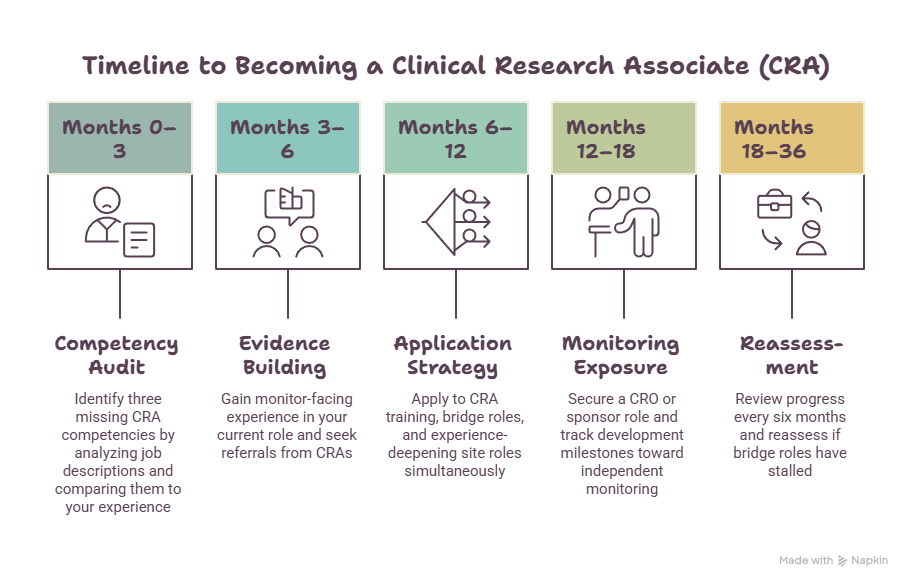
4. Use a Realistic CRA Transition Timeline Instead of Applying Blindly for Years
There is no universal number of months required before someone becomes a CRA. A useful timeline should begin with your current evidence level.
Months 0–3: Perform a CRA competency audit
Collect 20 to 30 current CRA job descriptions and identify recurring requirements.
Separate them into categories:
site monitoring
GCP and regulations
source and CRF review
essential documents
IRB/ethics
investigational product
safety
deviations
site communication
reports and follow-up
travel
therapeutic-area knowledge
data review
risk identification
Compare that list against your existing experience with protocol adherence, adverse-event compliance, clinical data integrity, and site operations.
Your first objective is identifying three missing competencies, rather than producing a vague plan to “gain more experience.”
Months 3–6: Engineer stronger evidence inside your existing role
Ask for work that exposes you to monitor-facing problems.
That could include preparing for monitoring visits, owning action-item closure, reconciling regulatory files, supporting trial close-out, managing complex queries, reviewing consent documentation, supporting audits, handling research protocol deviations, or coordinating with the CRA on GCP monitoring activities.
Begin speaking with CRAs who have actually seen your work.
A referral from someone who knows you respond quickly, prepare clean documentation, understand sponsor requests, communicate professionally with investigators, and protect patient safety under GCP carries much stronger information than a random LinkedIn connection.
Months 6–12: Apply across three lanes simultaneously
Use three application lanes.
Lane A: Direct CRA training opportunities.
Look for CRA academies, graduate CRA roles, entry-level CRA roles, and CRC-to-CRA programs. Current Medpace postings demonstrate that such routes still exist in the U.S. and other markets, although eligibility varies by location and opening.
Lane B: High-proximity bridge roles.
Target IHCRA, ACRA, centralized monitor, remote monitor, sponsor-side CTA, CTC, and site-management roles.
Lane C: Experience-deepening site roles.
If your current background is thin, seek a CRC role that offers stronger ownership over clinical research communication, trial logistics, site oversight, and sponsor interaction.
Candidates trying to secure CRC jobs without prior experience may need this lane first.
Months 12–18: Convert the bridge into actual monitoring exposure
Once inside a CRO or sponsor, career strategy changes.
Ask what competencies are required for CRA promotion. Find out whether your organization offers shadowing, co-monitoring, remote monitoring, visit-report training, therapeutic-area training, or internal CRA cohorts.
Track specific development milestones.
“Become CRA next year” is too vague.
A better progression looks like:
support remote site management;
review regulatory and site documents;
own defined follow-up activities;
participate in monitoring training;
shadow or co-monitor where permitted;
complete supervised visit/report requirements;
qualify for independent assignment.
That path builds monitoring competency alongside quality-management skills and clinical-trial timeline awareness.
Months 18–36: Reassess if direct conversion has stalled
A critical career mistake is staying in a bridge role indefinitely because someone once implied CRA promotion was possible.
Review your progress every six months.
Have you gained new responsibilities? Are internal CRAs being promoted from your role? Has your manager provided a competency path? Have you gained exposure to regulatory compliance, safety oversight, site risk, and monitoring deliverables?
If the answers remain weak, your bridge may have become a parking lot.
Reddit timelines show considerable variation. One late-2025 discussion included transitions after roughly two years, three to four years, and four years of CRC or broader clinical-research experience. Another contributor specifically suggested IHCRA work as a route that could sometimes convert within roughly 6 to 12 months depending heavily on company and market conditions.
Treat those figures as anecdotal ranges rather than promises.
5. Make Your Résumé and CRA Interview Prove That You Already Think Like a Monitor
Most unsuccessful transition résumés describe activity.
CRA hiring requires evidence of judgment, risk recognition, follow-through, and independence.
Compare these two styles:
Weak:
“Maintained regulatory binders and assisted with monitoring visits.”
Stronger:
“Prepared regulatory and source documentation for sponsor monitoring visits, resolved outstanding action items, reconciled missing essential documents, and coordinated corrective follow-up with investigators and study staff.”
The second version communicates elements of GCP monitoring, investigator oversight, quality management, and clinical research communication.
Your résumé should contain measurable evidence across five areas.
Compliance evidence: deviations, consent, regulatory files, training documentation, GCP responsibilities.
Data evidence: EDC timeliness, source accuracy, query closure, data integrity.
Safety evidence: AE/SAE processes, escalation, patient-safety compliance, investigational-product accountability.
Site-management evidence: monitoring preparation, sponsor correspondence, PI communication, enrollment problems, trial logistics.
Quality evidence: findings, corrective actions, audits, recurring-error prevention, quality-management processes.
Your interview preparation should follow the same structure.
Prepare stories answering:
Tell me about a protocol deviation you identified or managed.
Tell me about a difficult investigator or site-team interaction.
Describe a data discrepancy you had to resolve.
Explain how you prepared for a monitoring visit.
Describe an audit or inspection-readiness problem.
Tell me about a missed deadline and how you recovered.
Explain how you protect clinical trial data integrity.
Describe how you would escalate a serious patient-safety concern.
The strongest answers show sequence: risk identified → evidence reviewed → stakeholder engaged → action taken → outcome documented → recurrence reduced.
Candidates comparing certification with hands-on experience should remember that interviews expose the difference quickly. Someone can memorize terminology while struggling to explain how a late SAE, repeated consent error, persistent query backlog, or missing delegation documentation should be handled.
Your final application strategy should therefore emphasize job readiness, not desperation for the title.
A candidate who can discuss monitoring preparation, protocol compliance, site operations, data quality, PI communication, and corrective follow-up gives the hiring manager a much smaller training-risk problem to solve.
6. FAQs About Becoming a CRA Without Monitoring Experience.
-
Yes. Structured entry-level and training pathways still exist. Medpace currently advertises U.S. CRA openings that provide formal CRA training, including an entry-level Cincinnati role and a separate pathway for candidates with CRC experience.
Availability varies significantly between employers, locations, therapeutic areas, and hiring cycles. Candidates should therefore combine direct applications with bridge roles that build GCP monitoring exposure, protocol-adherence knowledge, clinical trial logistics, and quality-management evidence.
-
There is no universal threshold. Some current U.S. CRA training opportunities specifically accept candidates with two years of CRC experience, while Reddit transition stories include people moving after approximately two to four years of broader industry experience.
The quality of those years matters. Two years owning source, EDC, deviations, monitoring preparation, regulatory responsibilities, adverse-event reporting, and sponsor communication can produce stronger CRA evidence than longer experience confined to narrow administrative work.
-
Choose according to your missing competency.
A CRC usually builds deeper site execution, patient-facing trial knowledge, source documentation, protocol adherence, and site operations.
A CTA can provide CRO or sponsor exposure, TMF familiarity, study tracking, clinical trial timelines, and access to CRA teams.
The detailed Clinical Research Assistant vs CTA vs CRC comparison can help candidates choose based on career mobility rather than title.
-
For many candidates, yes. IHCRA roles can place you closer to site management, monitor support, document review, issue follow-up, remote oversight, and internal CRA development.
The key is verifying what the specific job actually contains. Ask whether the role supports monitoring activities, site escalation, training, co-monitoring, visit preparation, or formal progression. A bridge role gains value when its responsibilities materially close the field-CRA competency gap.
-
Certification can strengthen knowledge of GCP, regulations, documentation, safety, and clinical research terminology. Employers evaluating a CRA candidate still need behavioral evidence that the person can manage sites, recognize risk, communicate findings, and close problems.
The strongest approach combines relevant education with credible clinical research experience. Candidates considering additional credentials should assess certification career ROI against the exact requirements appearing in their target vacancies.
-
Prioritize responsibilities that reveal how a site performs under scrutiny: monitoring preparation, source documentation, EDC query closure, consent compliance, deviations, safety reporting, regulatory maintenance, investigational-product accountability, sponsor communication, audit preparation, and corrective-action follow-up.
Those responsibilities expose you to clinical trial data integrity, ethical patient-safety requirements, trial logistics, and investigator accountability, all of which transfer directly into monitoring conversations
