
Is Clinical Research Certification Worth It? Reddit Experiences, Employer Recognition & Career ROI by Role
Clinical research certification can strengthen a résumé, unlock an internal promotion, or become an expensive credential that never changes a hiring decision. The difference usually comes down to role, experience, and what the employer already trusts you to do. A coordinator who can demonstrate protocol adherence, patient retention, site monitoring readiness, and protocol deviation management has a stronger certification story than someone expecting a credential alone to establish job readiness.

1. Is Clinical Research Certification Worth It? Start With the Hiring Problem You Need It to Solve
The strongest way to evaluate clinical research certification is to ask which hiring doubt the credential is supposed to remove. An early-career research assistant may need evidence of essential clinical research training, competence with trial logistics, understanding of research protocol adherence, and confidence around clinical research communication. A credential can help organize and communicate that knowledge. The résumé still needs proof that the candidate can apply it around real participants, documents, deadlines, investigators, and study systems.
An experienced CRC faces a different problem. Their résumé may already demonstrate patient retention strategies, clinical trial budget management, monitoring-visit preparation, and protocol deviation handling. Certification then becomes a standardization signal. It tells a hiring manager that experience gained at one hospital, site network, or therapeutic area has been paired with a broader body of clinical research knowledge.
That distinction matters because professional credentials such as ACRP's CCRC, CCRA, and ACRP-CP have experience requirements. ACRP currently requires 3,000 hours of verifiable clinical research work experience for its CCRC, CCRA, and ACRP-CP pathways, with a potential 1,500-hour experience waiver under specified conditions. SOCRA's primary CCRP route generally requires two years of full-time clinical research experience or 3,500 part-time hours, with additional education-plus-experience pathways available. These credentials therefore validate professionals who have already accumulated meaningful research exposure.
The regulatory baseline provides another useful reality check. U.S. regulations require sponsors to select investigators and monitors who are qualified by training and experience. The rule does not prescribe an ACRP or SOCRA credential as the qualification mechanism. Employer policies create the certification requirements candidates encounter in job postings. That makes practical competence in areas such as GCP monitoring, adverse event reporting, ethical conduct and patient safety, and clinical trial data integrity central to the ROI calculation.
Cost changes the equation as well. ACRP's published 2026 flagship exam pricing ranges from $435 to $600, depending on membership and registration timing. CCRC, CCRA, and ACRP-CP credentials require maintenance every two years, with current maintenance fees ranging from $225 to $325 depending on membership and timing. A professional already building risk-based monitoring expertise, clinical trial quality-management skills, study timeline management, and team leadership capability should therefore calculate the credential against a specific career outcome.
A useful ROI formula is:
Career ROI = employer recognition × role relevance × existing experience × career timing − total certification cost and maintenance burden.
The credential becomes especially attractive when it satisfies a promotion criterion, strengthens a competitive lateral move, validates experience across employers, or comes with reimbursement. ROI becomes weaker when the candidate's real bottleneck is missing hands-on experience, weak interview evidence, limited therapeutic-area exposure, or poor examples of site operations oversight, data review, trial safety, or regulatory compliance.
| Career Situation | Likely Certification ROI | Employer Signal | Main Gap Certification Cannot Cover | Highest-Value Move |
|---|---|---|---|---|
| No clinical research experience | Low–Moderate | Shows structured learning | Real trial exposure | Pair training with RA, assistant, volunteer, or site-support applications |
| Research assistant with under 1 year experience | Moderate | Shows intentional career development | Ownership of trial responsibilities | Build examples involving recruitment, documentation, logistics, and protocol work |
| Research assistant targeting CRC | Moderate–High | Useful knowledge signal | Independent coordinator judgment | Document participant, regulatory, and study-management responsibilities |
| New CRC | Moderate | Can accelerate professional credibility | Depth across study cycles | Gain start-up, enrollment, monitoring, deviation, and close-out exposure |
| CRC with 2–3 years experience | High | Strong validation of established skills | Advanced leadership exposure | Use certification for CRC II, senior CRC, or lead applications |
| Senior CRC seeking promotion | Very High if employer rewards it | May satisfy progression criteria | Management accomplishments | Confirm promotion policy before paying |
| CRC targeting CRA | Moderate–High | Can strengthen transition narrative | Independent monitoring experience | Pair credential with monitoring-facing examples |
| In-house CRA targeting field CRA | Moderate | Supports monitoring knowledge | On-site visit ownership | Build evidence around remote review, issue escalation, and site management |
| CRA I | Moderate–High | Helpful differentiator in competitive hiring | Monitoring volume and complexity | Track visit metrics, findings, escalations, and therapeutic-area breadth |
| CRA II | Moderate | Professional credibility signal | Senior-level performance evidence | Prioritize complex studies and measurable monitoring outcomes |
| Senior CRA with 5+ years experience | Low–Moderate | Usually secondary to track record | Leadership and sponsor-facing results | Pursue only with reimbursement or clear employer preference |
| CRA targeting sponsor-side role | Moderate | Variable by sponsor | Sponsor strategy and oversight experience | Strengthen vendor, risk, issue-management, and cross-functional examples |
| Site regulatory coordinator | Moderate–High | Broadens clinical operations credibility | Submission depth | Show IRB, essential-document, amendment, and inspection-readiness work |
| Regulatory affairs career changer | Moderate | Shows trial-system knowledge | Regulatory submission experience | Build IND/NDA and lifecycle-regulatory knowledge |
| Clinical data coordinator | Moderate | Validates trial-context knowledge | Technical data-management depth | Show query management, EDC workflows, reconciliation, and database work |
| Clinical data manager | Low–Moderate | Useful secondary signal | Data systems and technical ownership | Prioritize database, cleaning, reconciliation, and lock experience |
| Pharmacovigilance beginner | Moderate–High | Can establish safety-domain foundation | Case-processing experience | Pair certification with ICSR, seriousness, causality, and reporting knowledge |
| Experienced PV specialist | Moderate | Supports professional development | Complex safety accomplishments | Emphasize signal, aggregate reporting, inspections, and global compliance |
| Drug safety professional targeting leadership | Moderate | Useful alongside experience | Strategic safety leadership | Develop inspection, governance, vendor, and signal-management evidence |
| Clinical trial project coordinator | Moderate–High | Shows broad trial literacy | Full project ownership | Own timelines, risks, vendors, milestones, and cross-functional actions |
| Clinical trial project manager | Moderate | Supports domain credibility | Delivery record | Quantify milestones, budgets, quality indicators, and recovery actions |
| Site manager | High | Useful leadership-quality signal | Business and people management | Pair with enrollment, finance, quality, staffing, and sponsor metrics |
| Academic medical center employee | High when tied to job ladder | Often more formally recognized | Institution-specific requirements | Check HR promotion matrix and reimbursement policy first |
| Independent research site employee | Moderate–High | Can reassure sponsors and employers | Operational performance | Connect credential to enrollment, quality, inspection, and sponsor outcomes |
| CRO employee | Variable | Experience often dominates | Study delivery record | Confirm whether hiring managers or promotion frameworks actually use it |
| Sponsor employee | Variable | Often role-dependent | Strategic and cross-functional scope | Prioritize sponsor-side accomplishments before stacking credentials |
| Principal investigator | Moderate | Can strengthen research-governance profile | Clinical expertise and trial record | Focus on oversight, safety, compliance, enrollment, and data integrity |
| Medical monitor | Low–Moderate for broad certification | Secondary to medical and safety expertise | Clinical decision-making | Prioritize safety oversight, benefit-risk assessment, and regulatory knowledge |
| RN moving into clinical research | High early-career potential | Adds research language to clinical credibility | Trial-specific workflows | Translate nursing experience into consent, safety, documentation, and coordination evidence |
| Pharmacist moving into research/PV | High early-career potential | Connects drug expertise with research operations | Direct industry experience | Target safety, regulatory, site, and medication-focused clinical research roles |
2. What Reddit Experiences Reveal About Certification, Hiring, and Salary
Recent clinical-research discussions on Reddit show a pattern that is more useful than a simple yes-or-no verdict. Some professionals report that certification helped them move from CRC work into CRA positions, while others say CCRA or CCRP received little attention once substantial monitoring experience was already on the résumé. Several commenters repeatedly arrive at the same practical threshold: employer reimbursement dramatically improves the decision.
That outcome makes sense when you examine what a CRA is actually hired to deliver. Recruiters can evaluate a monitor through evidence of risk-based monitoring, on-site and remote monitoring, clinical trial data review, and investigator meeting execution. A credential can reinforce those capabilities. Years of clean monitoring execution, credible escalation judgment, and documented site-management results provide far richer hiring evidence.
Site-level professionals appear to encounter a different ROI profile. Reddit users have described certification as mandatory for certain internal promotions, useful as a hiring tie-breaker, and occasionally associated with annual certification pay. One academic-medical-school employee reported a $1,500 annual increase tied to certification, while another discussion described CCRC as essential for an internal promotion. These are individual experiences rather than universal salary benchmarks, yet they show exactly how certification can produce direct ROI when an employer embeds it into the career ladder.
For a CRC, that distinction can be decisive. Someone already handling patient retention problems, clinical trial budgets, monitoring-visit preparation, and protocol deviations may gain immediate financial value if certification unlocks CRC III, senior coordinator, or lead-coordinator eligibility. The same exam can have much weaker financial value at a site where the job architecture makes no distinction between certified and non-certified staff.
Reddit also exposes a common career mistake: stacking credentials after experience has become the bigger differentiator. One 2026 CCRA discussion included professionals who saw limited value in paying personally for another credential once they were already established CRAs, especially when targeting sponsor roles. Other respondents valued certification as evidence of deeper monitoring knowledge or as a modest candidate-profile advantage.
The takeaway for an established monitor is highly practical. Before buying another credential, audit whether your résumé can prove GCP monitoring competence, data verification skill, risk-based monitoring judgment, remote monitoring capability, and effective investigator communication. Weak evidence in those areas can limit career mobility far more aggressively than one missing acronym after your name.
For early-career candidates, certification serves another purpose: it gives structure to knowledge that a short résumé cannot yet demonstrate across multiple employers. Someone learning research-assistant responsibilities, protocol compliance, clinical research collaboration, and essential RA training requirements can use education to become far more interview-ready. The strongest early-career strategy then converts that learning into documented responsibilities, quantified contributions, and examples of judgment.
3. Employer Recognition: Where Certification Actually Moves the Needle
Employer recognition exists on a spectrum. Some organizations explicitly require a credential after hire. Others list CCRC or SOCRA certification as preferred. Many CRO and sponsor roles focus far more heavily on experience, therapeutic-area exposure, systems knowledge, monitoring history, and study complexity.
Current job postings demonstrate the first two categories clearly. A Franciscan Health Clinical Research Coordinator posting requires both CCRP and CCRC within 1.5 years of hire, while a Fred Hutch Clinical Research Coordinator II posting identifies CCRC or SOCRA certification among its preferred qualifications. This creates tangible ROI for candidates pursuing employers with formal credentialing expectations.
At academic medical centers and mature research sites, certification can fit naturally into competency ladders because organizations already measure progression through escalating responsibilities. A coordinator may progress from routine study execution into site operations oversight, clinical trial quality management, budget management, and team leadership. Certification gives HR departments a standardized checkpoint that can sit beside tenure, performance, and competency requirements.
CRO hiring tends to expose candidates to a different evaluation model. Monitoring managers can examine how many sites a CRA managed, which phases and therapeutic areas they covered, how they handled protocol deviations, whether they can execute risk-based monitoring, how effectively they perform remote and on-site visits, and how well they complete data review and verification. Certification becomes one signal inside a much larger operational evidence set.
Sponsor-side positions raise the threshold further because many roles require broader judgment. A strong candidate may need examples involving clinical trial safety monitoring, global regulatory compliance, clinical trial timeline management, quality-management strategy, and vendor or CRO oversight. A broad credential contributes credibility, while strategic accomplishments usually drive the higher-level hiring decision.
Recognition also depends on role alignment. A candidate pursuing pharmacovigilance receives greater interview value from demonstrating adverse-event reporting compliance, pharmacovigilance audit readiness, global PV compliance, and clinical trial safety monitoring than from collecting an unrelated credential. Someone targeting regulatory work gains more leverage from understanding IND/NDA submissions, while an aspiring PI needs deeper command of investigator responsibilities under GCP.
ACRP's 2026 exam content also reflects the industry's current GCP environment. Beginning July 15, 2026, ACRP examinations moved to ICH E6(R3) as the applicable GCP guideline, making current preparation especially relevant for professionals whose previous knowledge was built around E6(R2). Professionals dealing with GCP monitoring techniques, ethical patient protection, investigator oversight, and clinical trial data integrity should therefore judge study materials against current standards rather than relying on older exam-preparation content.
4. Career ROI by Role: Who Gains the Most From Clinical Research Certification?
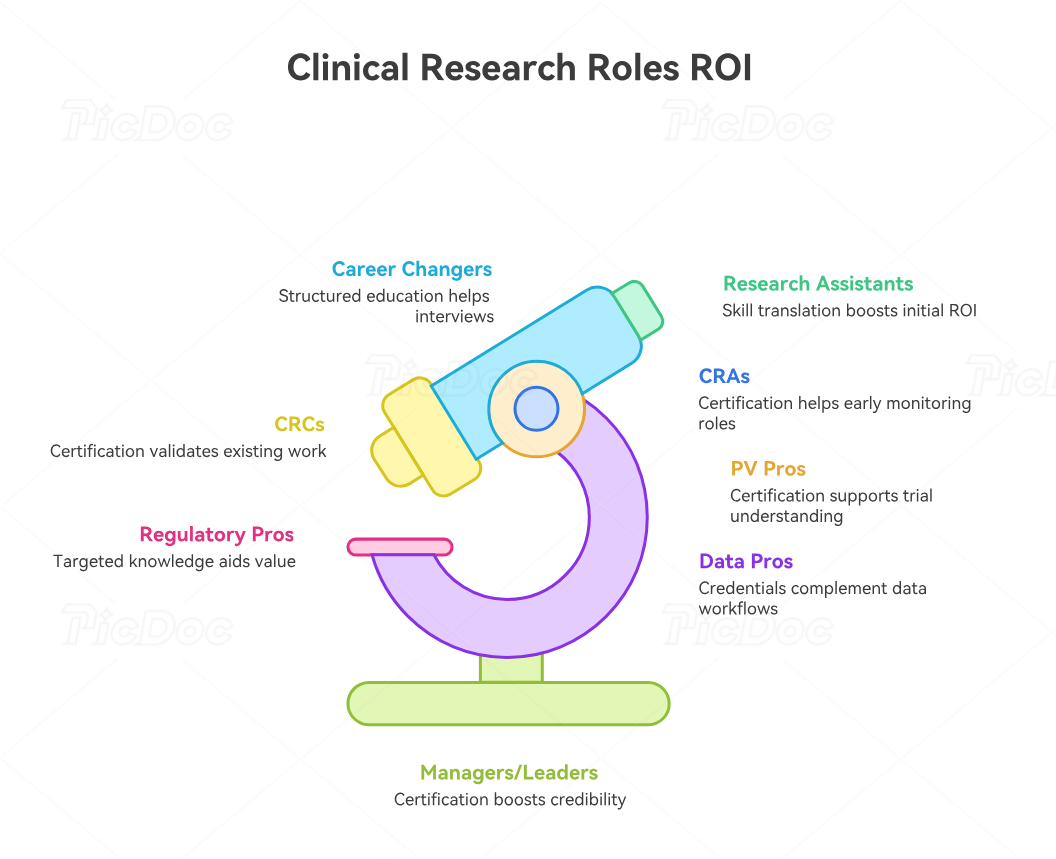
Research Assistants and Career Changers
For a research assistant or career changer, the highest initial ROI comes from skill translation. Clinical research contains unfamiliar language, workflows, documentation expectations, and compliance boundaries. Structured education can help someone understand research protocol adherence, trial logistics coordination, research-team communication, and essential RA training before interviewing.
The crucial ROI target is an experience-producing first role. A candidate who can discuss consent workflows, source documentation, delegation, participant scheduling, GCP, and study documentation enters interviews with far more useful vocabulary. Once hired, each responsibility becomes evidence that can later support CRC, regulatory, data, or operations progression.
Clinical Research Coordinators
CRC is one of the strongest roles for certification ROI because certification can align closely with existing responsibilities and formal site career ladders. A coordinator already responsible for patient retention, site monitoring preparation, clinical trial budget management, and deviation management has exactly the kind of operational experience that a professional credential can validate.
The strongest financial case appears when a site uses certification for CRC II/III, senior CRC, lead coordinator, or manager progression. Ask HR for the actual job architecture before registering. If certification moves you into a higher salary band, the ROI becomes quantifiable. If the next level instead requires team leadership, enrollment performance, budget ownership, or site operations oversight, invest accordingly.
Clinical Research Associates
For CRAs, certification ROI usually peaks earlier in the monitoring career. A CRA with developing experience can use CCRA or another recognized credential to strengthen evidence around risk-based monitoring, GCP monitoring, clinical data verification, and remote versus on-site monitoring.
As monitoring tenure grows, employers gain more direct performance evidence. Number and complexity of sites, enrollment challenges, critical findings, CAPA follow-up, inspection readiness, travel load, therapeutic-area exposure, and sponsor feedback become powerful signals. Reddit discussions reflect this shift, with some early-career professionals viewing certification as a useful résumé booster and more experienced CRAs questioning self-funded maintenance.
Pharmacovigilance and Drug Safety Professionals
A broad clinical research certification can support pharmacovigilance careers when it strengthens understanding of the wider trial environment. The practical hiring case becomes much stronger when the candidate also understands clinical trial safety monitoring, adverse event reporting requirements, global pharmacovigilance compliance, and PV audits and inspections.
Location-specific preparation can also help candidates understand how to position themselves in regional job markets. Someone evaluating opportunities through a pharmacovigilance certification pathway in California, Florida, Massachusetts, or Maryland should still build role-specific evidence around case processing, seriousness, expectedness, causality, reconciliation, signal work, and inspection readiness.
Data and Regulatory Professionals
Clinical data roles reward evidence of clean workflows and systems discipline. A credential has useful supporting value when paired with clinical trial data review and verification, clinical trial data integrity, quality-management practices, and strong protocol adherence. Employers will still want concrete examples involving EDC, query workflows, reconciliation, database cleaning, and lock readiness.
Regulatory professionals should apply the same role-matching logic. Knowledge of IND and NDA submissions, global regulatory compliance, GCP investigator responsibilities, and ethical clinical trial conduct creates a more targeted value proposition than a generic line under "certifications" on the résumé.
Clinical Trial Project Managers and Site Leaders
For experienced project professionals, certification ROI depends heavily on the scale of accomplishments already visible. A hiring manager evaluating a CTM or clinical PM wants evidence of timeline and milestone control, quality-management strategy, clinical trial team leadership, and disciplined project close-out.
At this level, measurable outcomes carry enormous weight: enrollment recovery, budget variance, milestone delivery, vendor remediation, inspection outcomes, query aging, site activation speed, protocol deviation reduction, and team performance. Certification can increase professional credibility around those achievements. The achievements themselves provide the business case for seniority.
Principal Investigators and Medical Monitors
For PIs, certification has a narrower ROI because clinical qualification, therapeutic expertise, investigator experience, and oversight performance dominate the profile. A PI's strongest proof involves investigator responsibilities under GCP, clinical trial data integrity, site operations oversight, and competent clinical trial budget management.
Investigators developing independent research programs gain additional leverage from understanding investigator-initiated trials, while physicians moving toward medical monitoring require deeper clinical trial safety oversight and regulatory compliance for medical monitors. Certification can support those pathways by demonstrating structured research knowledge around an already substantial clinical foundation.
5. How to Decide Whether to Pay for Clinical Research Certification in 2026
Start with target-job evidence, rather than certification marketing. Collect 20–30 postings for roles you could realistically pursue during the next 12 months. Record how many require certification, how many prefer it, and how many omit it completely. Then repeat the exercise for responsibilities. If postings repeatedly emphasize risk-based monitoring, clinical trial data review, safety monitoring, and quality management, those recurring capabilities deserve serious investment regardless of the credential decision.
Next, identify your actual résumé deficit. Someone who already has years of site experience but receives few interviews may benefit from stronger positioning around monitoring-visit work, deviation resolution, trial logistics, and data verification. Certification can then provide an additional screening signal. A candidate whose résumé contains almost no trial responsibility should prioritize opportunities that create those examples.
Calculate full ownership cost before registering. Include exam fees, study materials, membership if applicable, continuing education, renewal charges, and the hours you will spend preparing. ACRP's current fee structure makes employer reimbursement particularly meaningful because maintenance continues after the initial exam. Ask whether your organization reimburses the exam, provides CE credits internally, pays renewal fees, or offers a salary differential.
Then calculate the career-event probability. Certification completed six months before a realistic CRC-to-senior-CRC promotion can have high timing value. Certification obtained during a planned CRA monitoring transition, clinical trial PM progression, pharmacovigilance transition, or regulatory affairs pathway can also support a specific move. Collecting credentials without a defined use date creates far weaker economics.
Finally, avoid credential stacking that outruns your responsibility level. A professional gains more market value when each learning step changes what they can do. Move from understanding research-assistant training to managing protocol adherence, then toward site monitoring, risk-based monitoring, quality oversight, or leadership as your career advances.
The cleanest decision rule is simple: pay for certification when you can name the specific employer, promotion, role transition, or capability gap that the credential will help address. That turns certification spending into career investment rather than résumé decoration.
6. FAQs About Clinical Research Certification Value and ROI
-
It can improve your credibility by showing structured knowledge of areas such as GCP responsibilities, research protocol adherence, clinical trial logistics, and research-team communication. Entry-level hiring still depends heavily on whether the candidate can connect prior work, education, healthcare exposure, laboratory experience, data work, or patient-facing responsibilities to the needs of the research role.
Professional certifications such as ACRP's major credentials also require verifiable clinical research experience, so a true beginner may need an educational program and first research role before becoming eligible for those exams.
-
CCRC can have strong ROI for an experienced coordinator, particularly when the employer recognizes certification in promotion criteria or prefers it during hiring. Current job postings show examples where recognized coordinator certification is preferred or required after hire.
Its value increases when the candidate already has solid evidence around patient retention, clinical trial budgets, monitoring visits, and protocol deviation management. Ask your employer whether CCRC affects grade, pay, promotion eligibility, or reimbursement before applying.
-
The ROI becomes highly employer-specific. A developing CRA may gain a useful standardized monitoring credential, particularly when competing against candidates with similar experience. An experienced CRA with years of strong monitoring performance may find that risk-based monitoring results, remote and on-site monitoring expertise, data-review competence, and investigator-management experience dominate the hiring discussion.
Recent Reddit discussions show both experiences: some professionals view CCRA as helpful validation, while others see little sponsor-side impact and would pursue it mainly with employer reimbursement.
-
The better credential depends on job function, employer preference, eligibility, geography, and career direction. ACRP offers role-specific options including CCRC for coordinators, CCRA for monitors, and ACRP-CP for professionals working across broader clinical research functions. SOCRA uses the broader CCRP credential across clinical research roles and accepts several experience/education pathways.
Compare target postings while also strengthening GCP monitoring knowledge, ethical research conduct, data integrity practices, and quality-management capability. Employer demand should guide the final selection.
-
Certification can increase earnings when an employer directly ties it to a higher job grade, certification differential, promotion, or more senior role. Reddit reports include examples of certification being required for progression and one academic-medical-school employee receiving an annual certification-related increase. Those experiences demonstrate possible ROI rather than a universal salary premium.
Salary leverage becomes stronger when certification accompanies higher-value responsibilities such as clinical trial leadership, quality management, trial timeline ownership, and project close-out management.
-
Yes, particularly when the program builds knowledge that directly supports drug-safety responsibilities. Employers evaluating a PV candidate care about competence in clinical trial safety monitoring, adverse-event reporting, global pharmacovigilance compliance, and PV inspections and audits.
Candidates can also evaluate regional pathways through guidance for pharmacovigilance certification in Illinois, Georgia, Michigan, and Missouri.
