
Clinical trial inspections are exposing weaknesses that routine monitoring can miss: incomplete source records, poorly controlled electronic systems, delayed safety escalation, and sponsor oversight that fails when responsibilities are outsourced. With ICH E6(R3) reshaping quality management and trial conduct, organizations preparing for 2027–2028 face increasing pressure to demonstrate that their controls work.
This report analyzes documented FDA and EMA inspection findings, identifies emerging compliance risks, and provides a 30-point audit readiness matrix. It translates regulatory observations into practical actions for sponsors, CROs, investigators, quality assurance teams, and clinical research professionals.

1. ICH-GCP Inspection Trends: What the Regulatory Evidence Reveals for 2027–2028
As of November 2026, inspection findings for 2027 and 2028 are still future outcomes. The most useful preparation therefore combines documented inspection results with the requirements and operational risks likely to influence subsequent regulatory scrutiny.
The strongest evidence comes from FDA Bioresearch Monitoring (BIMO) inspection materials, the European Medicines Agency's GCP inspection reports, and the implementation of ICH E6(R3).
Organizations should evaluate these findings alongside clinical research quality management strategies, investigator GCP responsibilities, and established clinical monitoring procedures.
What FDA's inspection observations actually show
The FDA's fiscal year 2024 BIMO materials identify several recurring categories of clinical investigator observations:
Failure to follow investigational plans and protocol requirements.
Inadequate or inaccurate clinical study records.
Deficiencies in investigational product accountability.
Failure to report or document adverse events appropriately.
Problems involving informed consent and participant protection.
Deficiencies concerning investigator commitments and regulatory responsibilities.
These findings identify operational areas where documented compliance can break down.
A protocol deviation may begin with an eligibility mistake, incomplete research protocol adherence, or weak site operational oversight. Inadequate records may originate from inconsistent clinical trial data integrity controls, while safety reporting failures may reflect incomplete pharmacovigilance escalation procedures.
FDA inspection statistics must also be interpreted correctly. Its FY2024 BIMO metrics use inspections receiving final center classifications during that fiscal year. Those figures therefore differ from a simple count of inspections physically performed during 2024.
What EMA's 2024 GCP inspection report established
The EMA's 2024 GCP Inspectors' Working Group report, published in January 2026, provides a detailed picture of deficiencies recorded during CHMP-requested inspections.
<text>
67 CHMP-requested inspections were conducted in 2024.
335 major and critical deficiencies were identified.
324 findings were classified as major.
11 findings were classified as critical.
</text>
The inspected locations included 42 clinical investigator sites, 18 sponsor sites, five CRO sites, and two analytical laboratories.
The report's most frequently represented broad categories included general compliance, sponsor trial management, investigational site operations, investigational medicinal products, computer systems, and participant protection.
Several detailed categories deserve particular attention:
41 findings concerned essential documents, 38 concerned source documentation, 35 concerned monitoring, and 27 concerned data management.
These figures identify where significant deficiencies appeared within this inspection program. They should not be interpreted as the percentage of all clinical trials experiencing those problems.
The distinction matters when benchmarking clinical trial monitoring quality, sponsor responsibilities, data reliability, and regulatory compliance performance.
Why these findings matter for 2027–2028
The regulatory environment has changed in important ways.
ICH E6(R3) emphasizes quality by design, proportionate risk management, participant protection, appropriate oversight, and reliable trial data.
In the European Union, the E6(R3) principles and Annex 1 became effective on July 23, 2025. The consolidated guideline, incorporating Annex 2 for additional trial designs and data sources, is scheduled to become effective on January 15, 2027.
The FDA issued its final E6(R3) guidance in September 2025.
These developments create important preparation priorities for organizations managing remote clinical monitoring, modern trial data systems, risk-based quality processes, and complex sponsor oversight arrangements.
The practical challenge is demonstrating that documented controls have been implemented, tested, and improved when weaknesses are discovered.
| ICH-GCP Compliance 2027–2028: 30-Point Inspection & Audit Readiness Matrix | ||||
|---|---|---|---|---|
| Inspection Pressure Point | Failure Signal | Required Audit Test | Evidence of Effective Control | CCRPS Resource |
| 1. Informed consent timing | Consent documented after procedures | Compare signature timestamps with first study activity | Verified consent chronology and deviation handling | Consent ethics |
| 2. Consent version control | Expired forms used at enrolment | Reconcile approval, release, and signature dates | Approved version history and staff training evidence | Ethics records |
| 3. Participant re-consent | Important new risk not communicated | Trace safety updates to participant communication | Documented assessment and appropriate re-consent | Patient rights |
| 4. Protocol eligibility | Unsupported inclusion decisions | Sample source evidence against eligibility criteria | Investigator-supported eligibility determination | Protocol rules |
| 5. Protocol deviations | Recurring undocumented departures | Compare source events, deviation logs, and reports | Complete deviation history and trend review | Site oversight |
| 6. SAE recognition | Hospitalizations missing from safety records | Reconcile hospital data and AE/SAE logs | Consistent classification and escalation evidence | SAE reporting |
| 7. Safety reporting clocks | Late notification to responsible parties | Reconstruct awareness and submission timestamps | Verified reporting chronology and follow-up | Safety oversight |
| 8. Medical causality | Unsupported relationship assessments | Review medical rationale and follow-up evidence | Traceable clinical assessment | Medical review |
| 9. Investigator delegation | Unqualified personnel performing tasks | Cross-check qualifications, training, and duties | Documented competency and appropriate oversight | PI duties |
| 10. Staff training | Training completed after assignment | Compare training dates with first task performance | Role-specific current competency evidence | Training |
| 11. Source documentation | Missing or conflicting clinical observations | Reconstruct selected visits from original sources | Complete attributable source evidence | Data integrity |
| 12. EDC audit trails | Changes without reliable attribution | Trace entries, changes, identities, and timestamps | Recoverable and interpretable change history | Quality controls |
| 13. Shared system accounts | Unclear electronic record ownership | Reconcile active users with system access logs | Unique accounts and timely access removal | Access control |
| 14. Computerized system validation | Unverified critical system functions | Check validation scope against intended use and risk | Approved validation and change-control evidence | System quality |
| 15. TMF completeness | Missing essential records and version gaps | Sample required documents across trial milestones | Current file index and retrievable evidence | Trial records |
| 16. Monitoring follow-up | Repeated unresolved site findings | Match monitoring letters with closure evidence | Verified closure and risk escalation | Monitoring |
| 17. Centralized monitoring | Signals generated without follow-up | Trace alert thresholds to investigation records | Documented signal review and decisions | Risk management |
| 18. Sponsor-CRO oversight | Outsourced deficiencies unseen by sponsor | Review contract duties, oversight, and escalation | Performance reviews and documented interventions | CRO oversight |
| 19. Vendor data transfers | Lost records or mismatched transferred datasets | Reconcile counts, identifiers, metadata, and exceptions | Validated transfer and reconciliation logs | Data lifecycle |
| 20. IMP temperature excursions | Product released without stability assessment | Trace excursion through segregation and disposition | Authorized release or rejection evidence | Trial logistics |
| 21. IMP accountability | Unexplained dispensing or stock mismatch | Reconcile receipt, allocation, return, destruction | Reconciled chain of custody | Site controls |
| 22. Laboratory data | Unexplained abnormal or missing critical results | Check reference ranges, alerts, and data transfer | Complete medical review and follow-up | Lab review |
| 23. Randomization and blinding | Unauthorized treatment assignment disclosure | Review access, unblinding events, and controls | Controlled assignments and exception records | Medical oversight |
| 24. Remote consent systems | Weak identity and consent-process evidence | Test authentication, versioning, and records | Reconstructable compliant consent process | Participant rights |
| 25. Wearable-device data | Missing observations and unvalidated algorithms | Test data provenance, gaps, and device suitability | Defined intended use and missing-data controls | E6(R3) |
| 26. Decentralized trial activities | Unclear oversight of home visits or local providers | Trace responsibilities and participant protections | Defined roles, training, and quality oversight | Remote oversight |
| 27. Real-world data use | Questionable provenance or unsuitable datasets | Evaluate fitness for purpose and traceability | Documented reliability and data governance | Data governance |
| 28. Corrective action | Repeated findings after retraining | Check root cause and effectiveness testing | Verified prevention of recurrence | CAPA strategy |
| 29. Participant confidentiality | Identifier exposure through exports or vendors | Review access, transfers, incidents, and containment | Documented privacy controls and incident closure | Ethics compliance |
| 30. Inspection-response governance | Promised CAPA without verified implementation | Reperform previous findings and closure checks | Evidence-backed resolution and sustained control | Inspection readiness |
2. The Most Important GCP Inspection Findings and Their Root Causes
Inspection observations should be evaluated according to the risk they create, the organizational systems responsible, and the evidence required for remediation.
An organization may correct a missing signature while leaving the underlying training or document-control weakness unresolved. Repeated deficiencies often indicate that operational controls are failing across more than one process.
Finding 1: Inadequate essential documents and source records
The EMA's 2024 report recorded 41 major or critical findings concerning essential documents and 38 concerning source documentation within the inspection categories examined.
These findings highlight the importance of reconstructing trial events using reliable, accessible evidence.
Common weaknesses include missing approval records, inconsistent document versions, poorly controlled certified copies, unclear source-data locations, and incomplete documentation of critical trial activities.
For example, an EDC entry showing that an eligibility assessment was completed may be insufficient if the supporting source evidence is missing.
A robust audit should reconstruct participant visits by linking protocol requirements, investigator oversight records, source documentation, and monitoring findings.
Recommended corrective approach: Identify the missing evidence, determine whether it can legitimately be retrieved, assess its impact, document the gap, and strengthen the process responsible for record creation and retention.
Avoid fabricating retrospective originals or making undocumented changes.
Finding 2: Monitoring deficiencies and incomplete issue escalation
The EMA report identified 35 findings in its monitoring subcategory.
A monitoring deficiency may involve delayed review, insufficient escalation, ineffective issue tracking, or a mismatch between identified risks and the monitoring strategy.
Consider a sponsor whose centralized system repeatedly detects missing primary endpoint data. If alerts remain unresolved until database lock, the organization has failed to use its available monitoring information effectively.
The appropriate response involves evaluating the underlying risk, assigning responsibility, confirming corrective actions, and reviewing whether monitoring controls need modification.
This approach draws on onsite and remote GCP monitoring, risk-based quality management, clinical project leadership, and site oversight requirements.
Recommended corrective approach: Test whether significant monitoring observations are identified, escalated, resolved, and independently verified within risk-appropriate timeframes.
Finding 3: Data management and computerized system weaknesses
Data management accounted for 27 findings in the EMA's 2024 trial-management subcategories. Computer systems also appeared as a separate category of major findings.
A critical issue is whether clinical trial data remain reliable throughout their lifecycle.
Potential failures include unclear data ownership, incomplete vendor transfers, access-control weaknesses, unexplained audit trail changes, inadequate computerized system validation, and unresolved discrepancies between source records and submitted datasets.
A sponsor may receive a technically complete dataset yet lack evidence demonstrating how the information was collected, modified, reviewed, and transferred.
Inspection readiness requires appropriate clinical trial data integrity practices, sponsor quality oversight, monitoring verification, and relevant ICH E6(R3) competencies.
Recommended corrective approach: Map critical data flows, validate appropriate system functions, test access rights, inspect audit trails, and reconcile records across interfaces.
Finding 4: Informed consent and participant protection failures
Consent failures remain particularly consequential because they can affect participant autonomy and the ethical legitimacy of study procedures.
Potential problems include use of outdated consent forms, procedures performed before appropriate consent, inadequate explanation of new risks, or missing documentation of required safeguards.
A common underlying cause is ineffective communication between document control, ethics approval management, and site staff.
For example, a revised form may receive approval but remain unavailable to the coordinator conducting consent discussions.
A meaningful compliance assessment must review the actual informed consent process, IRB/IEC documentation, participant communication, and investigator oversight.
Recommended corrective approach: Reconstruct the consent timeline for sampled participants and verify that changes in approved materials reached the correct personnel before use.
Finding 5: Incomplete safety reporting and investigational product accountability
Safety and product-control deficiencies can create immediate risks to participants.
An unexpected hospitalization may appear in a clinical source note without timely entry into the safety reporting process. A drug temperature excursion may be documented while affected units remain available for dispensing.
The common weakness is the failure to connect an observed event with the action required.
An effective process should establish who receives a safety notification, who performs medical assessment, which reporting requirements apply, and how follow-up information is incorporated.
Similarly, investigational product controls should cover receipt, storage, dispensing, return, reconciliation, and authorized disposition.
Relevant competencies include SAE reporting compliance, medical monitor responsibilities, trial logistics, and medical safety assessments.
Recommended corrective approach: Perform cross-system reconciliation using source records, safety databases, pharmacy logs, and escalation timestamps to identify missing or delayed actions.
3. How ICH E6(R3) Changes Compliance Priorities for 2027–2028
ICH E6(R3) strengthens the expectation that organizations select controls based on the importance of the activity and its potential effect on participants or trial reliability.
The central challenge for quality teams is translating those principles into documented, testable practices.
Quality by design and critical-to-quality factors
Sponsors should identify the aspects of trial design and conduct that are essential to participant protection and the reliability of results.
Examples include informed consent, safety-critical dosing, primary endpoint collection, important eligibility criteria, and the handling of data used to support key conclusions.
Monitoring resources should be proportionate to the risks associated with these factors.
A repeated primary endpoint discrepancy may require stronger controls than a low-risk administrative formatting error.
The audit should establish whether quality management planning identifies relevant risks, clinical monitoring activities respond to those risks, and trial project leadership reviews their continued suitability.
Data governance across the full lifecycle
Modern trials may collect data from sites, laboratories, imaging providers, wearable devices, electronic health records, and external service providers.
Each transfer introduces questions involving attribution, traceability, integrity, security, and data completeness.
Organizations preparing for 2027–2028 should test how critical data move between systems and whether changes can be reconstructed.
For example, wearable data may be transmitted successfully while missing observations or algorithm updates remain undocumented.
The appropriate assessment considers the system's intended use, the reliability required for the trial objective, and the effect of potential failure.
These responsibilities connect clinical data integrity, medical data review, sponsor quality systems, and E6(R3) professional expectations.
Decentralized trials and real-world data
The scheduled January 2027 EU effectiveness of ICH E6(R3) Annex 2 makes decentralized and alternative trial designs an important preparation area.
Relevant activities may include remote consent, home-based assessments, local healthcare providers, digital health technologies, and real-world data sources.
An audit should determine whether the arrangement has clear responsibilities, suitable participant protections, appropriate oversight, and reliable evidence supporting the data's intended use.
A remote visit conducted by a third-party provider still requires appropriate accountability and quality controls.
Organizations should connect these reviews with remote monitoring procedures, participant protection requirements, clinical trial data governance, and site operations oversight.
Sponsor oversight of CROs and technology providers
Outsourcing can distribute operational responsibilities across multiple organizations.
Sponsors should maintain an appropriate understanding of the transferred activities, associated risks, performance expectations, and escalation arrangements.
This includes third-party systems and services that influence participant protection or critical trial data.
A vendor performance dashboard becomes useful when its indicators trigger meaningful investigation and intervention.
The sponsor should be able to demonstrate actual oversight through documented decisions, issue escalation, quality reviews, and corrective actions.
Prepare using sponsor versus CRO responsibilities, clinical research quality management, project leadership principles, and clinical trial milestone oversight.
What Is Your Biggest GCP Inspection Readiness Risk for 2027–2028?
Choose one and submit to reveal a targeted corrective strategy.
Submit
Please select an answer above.
Sample five participant files per risk-selected site. Reconstruct consent, eligibility, critical procedures, safety events, and source-to-EDC histories. Record every missing link, assign corrective actions, and retest after implementation.
Build a vendor responsibility map. Review quality agreements, data ownership, monitoring metrics, escalation records, audit rights, and sponsor interventions. Test whether critical signals result in documented decisions.
Map every critical data source and transfer. Test unique user access, audit trail interpretation, system validation, change control, reconciliation, and recovery of original information.
Trace a sample of adverse events, protocol deviations, and monitoring alerts from initial awareness to responsible-party notification, assessment, reporting, and closure. Investigate delays or missing evidence.
Reopen three recurring finding categories. Evaluate root causes, corrective actions, preventive controls, and objective effectiveness evidence. Test whether the same failure can still occur under normal operations.
4. How to Conduct a GCP Inspection Readiness Audit and Close High-Risk Findings
A successful GCP audit should test the evidence supporting operational compliance.
Reading SOPs confirms that procedures exist. Reconstructing actual trial events demonstrates whether the procedures were followed.
Quality teams should focus their work on the processes that protect participants and preserve the credibility of critical data.
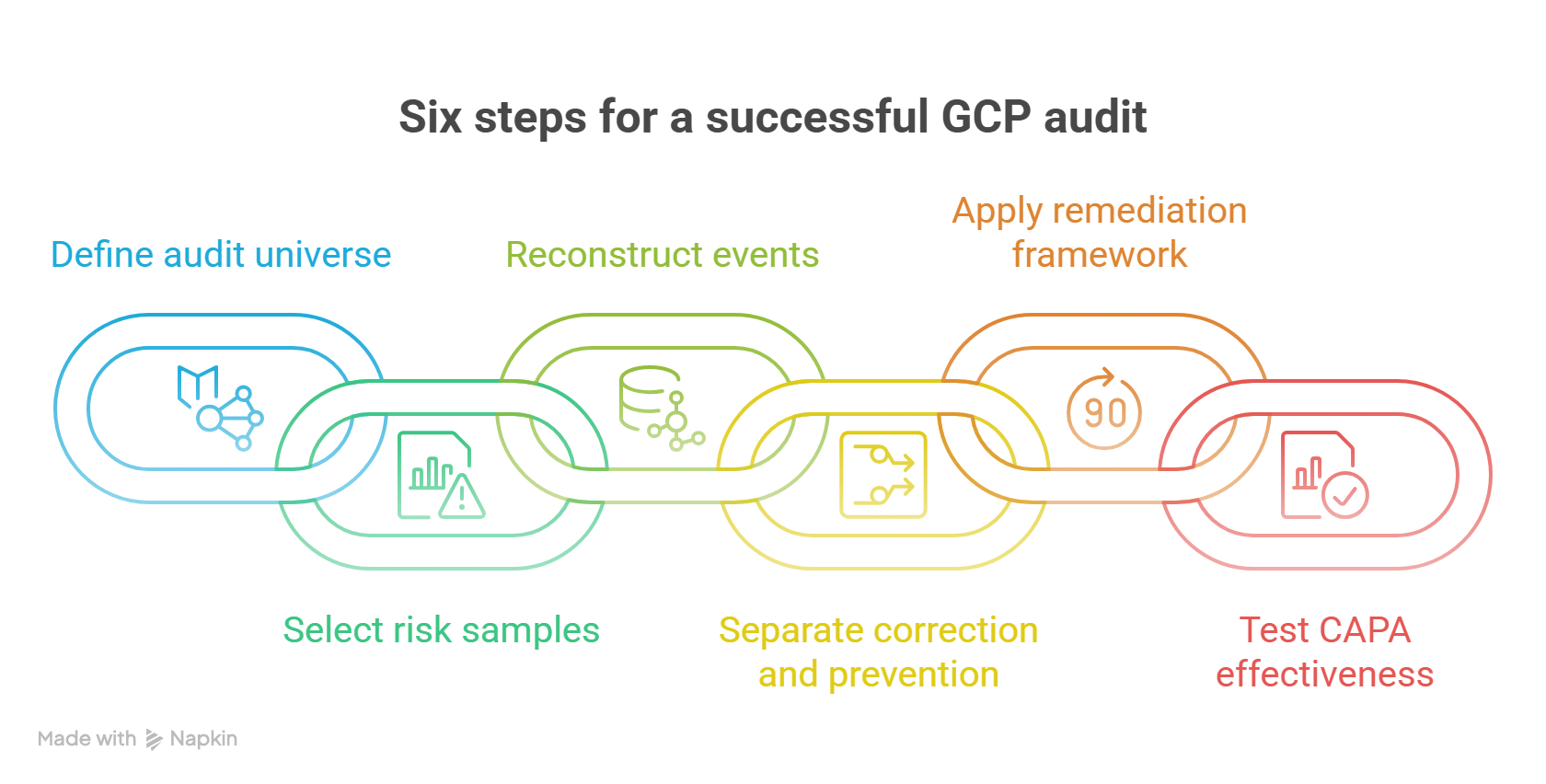
Step 1: Define the audit universe and risk profile
Identify the trial's sites, sponsors, CROs, laboratories, technology vendors, monitoring systems, and essential data flows.
Record the activities most important to safety and trial conclusions.
A first-in-human interventional study may require extensive attention to early safety decisions and investigational product controls. A decentralized study may require additional review of remote activities, technology providers, and data transfers.
This selection should be supported by clinical research quality planning, medical monitoring requirements, site operational oversight, and trial data integrity controls.
Step 2: Select risk-based samples
Sample records using predefined criteria such as:
Participants with serious adverse events.
Participants experiencing important protocol deviations.
Sites with recurring monitoring observations.
Studies using complex external data transfers.
Records involving unusual eligibility or consent circumstances.
Investigational product excursions or discrepancies.
Consider both random samples and targeted samples selected because of identified risks.
For example, a site with repeated late safety reports may warrant a larger sample of adverse event cases than a site without similar signals.
This strategy strengthens GCP monitoring effectiveness, pharmacovigilance audit preparation, clinical safety oversight, and protocol compliance verification.
Step 3: Reconstruct the event rather than checking isolated documents
For each sampled critical event, follow the complete record sequence.
A serious adverse event audit might begin with the original clinical note, then compare safety logs, investigator awareness, sponsor notification, medical assessment, follow-up reports, and relevant regulatory submissions.
A consent audit might connect ethics approval, form version, participant discussion, signature dates, and the first study-specific procedure.
An investigational product audit should trace receipt, temperature monitoring, allocation, dispensing, returns, and authorized disposition.
This reconstruction method connects adverse event reporting, informed consent compliance, trial logistics, and source documentation standards.
Step 4: Separate correction, corrective action, and prevention
A correction addresses an identified problem. Corrective action addresses the cause of a detected nonconformity. Preventive controls reduce the likelihood of recurrence or related failures.
Suppose a site repeatedly uses outdated consent forms.
Replacing the affected forms addresses the immediate situation. Investigating document distribution and training identifies why the error occurred. Implementing controlled release procedures and testing their effectiveness addresses recurrence.
Repeated retraining alone may leave underlying system defects unresolved.
The response should be grounded in clinical trial quality management, investigator team oversight, research staff training, and trial leadership practices.
Step 5: Apply a 30-60-90 day remediation framework
Use a structured timetable appropriate to the severity and urgency of the findings.
Days 1–30: Contain significant risks, protect affected participants, establish the factual record, perform necessary reporting, and assign investigation ownership.
Days 31–60: Complete root cause analysis, implement revised controls, document process changes, and provide targeted competency development.
Days 61–90: Test effectiveness using independent samples, evaluate remaining risks, and verify that the new controls operate under normal study conditions.
This is an illustrative improvement framework. Actual regulatory response deadlines, urgent corrective actions, and commitments must follow the applicable authority's requirements.
Review progress through quality management governance, clinical project milestones, site oversight, and inspection preparation practices.
Step 6: Test whether the CAPA actually worked
A completed CAPA record should be supported by objective evidence.
For example, after implementing a new safety escalation workflow, examine recent cases to determine whether notifications occurred appropriately and whether the responsible professionals received the required information.
When an audit trail issue is corrected, verify that new entries and modifications are attributable, reviewable, and recoverable.
Effective closure requires evidence that the relevant failure mode is controlled.
This principle should guide GCP monitoring improvement, clinical data integrity remediation, pharmacovigilance quality assessment, and sponsor quality oversight.
5. Forecasting 2027–2028 GCP Compliance Risks and Measuring Inspection Readiness
The clearest forward-looking compliance priorities involve areas where established inspection weaknesses intersect with newer trial technologies, complex outsourcing, and ICH E6(R3) expectations.
These are reasoned risk priorities for 2027–2028, rather than reported inspection findings from those years.
Outlook 1: Greater scrutiny of demonstrable risk-based quality management
Organizations increasingly need to justify how monitoring and quality resources are allocated.
A documented risk assessment offers limited assurance when actual monitoring activities fail to address identified critical risks.
Audit teams should look for alignment between critical-to-quality factors, risk assessments, monitoring plans, observed signals, and corrective decisions.
The strongest controls connect quality by design, remote and onsite monitoring, clinical trial milestone management, and sponsor project oversight.
Suggested readiness indicator: Percentage of high-priority risk signals receiving documented evaluation within their assigned timeframe.
Outlook 2: More complex inspection questions about electronic data
As trials expand their use of electronic systems and external data providers, inspectors have more potential points at which to examine provenance and reliability.
High-value tests include user access histories, algorithm changes, audit trail completeness, data transfer reconciliation, electronic consent workflows, and third-party system controls.
The preparation priority is ensuring that significant data can be reconstructed from the original capture through final analysis.
This involves trial data integrity requirements, E6(R3) professional competencies, medical data review, and clinical quality controls.
Suggested readiness indicator: Percentage of sampled critical data transfers with complete reconciliation and traceable exception resolution.
Outlook 3: Increased importance of vendor and decentralized trial oversight
Remote visits, local providers, digital health technologies, and outsourced data management can create fragmented operational responsibilities.
The practical audit question is whether the sponsor can demonstrate who performed critical activities, which standards applied, and how emerging risks were addressed.
Annex 2 provides additional GCP considerations for trial designs and data sources beyond conventional site-based models.
Sponsors should therefore test CRO oversight arrangements, remote monitoring responsibilities, participant safety safeguards, and vendor-related data controls.
Suggested readiness indicator: Percentage of critical vendors with current risk assessments, documented oversight reviews, and tested escalation pathways.
Outlook 4: Continued importance of source records, consent, and safety reporting
Modernization should not distract quality teams from the deficiencies repeatedly represented in historical inspection evidence.
Accurate clinical documentation, valid consent processes, appropriate protocol conduct, and reliable safety escalation remain central to participant protection and trial credibility.
Organizations should continue testing informed consent quality, protocol adherence, adverse event reporting, and source record reliability.
Suggested readiness indicator: Percentage of sampled critical participant events that can be reconstructed completely and accurately.
Outlook 5: Stronger attention to recurring deficiencies and CAPA effectiveness
An organization that records corrective actions but repeatedly experiences the same findings has a quality system problem.
For 2027–2028 readiness, quality teams should track recurring issues across sites, studies, service providers, and functional areas.
Useful indicators include repeat findings after CAPA closure, overdue high-risk actions, unresolved safety deviations, and failures identified during effectiveness checks.
Senior management should evaluate whether persistent patterns require additional resources, revised processes, or more direct sponsor intervention.
These reviews should be integrated with clinical research quality management, site leadership responsibilities, clinical project oversight, and pharmacovigilance inspection readiness.
Suggested readiness indicator: Percentage of high-risk CAPAs passing independent effectiveness checks, together with the rate of repeat findings after closure.
All suggested indicators should be defined with clear numerators, denominators, review periods, and ownership. Appropriate thresholds depend on study risks and organizational requirements.
6. Frequently Asked Questions About ICH-GCP Inspection and Audit Trends for 2027–2028
-
Documented historical inspection observations identify protocol deviations, incomplete source records, informed consent problems, safety reporting deficiencies, investigational product accountability, monitoring weaknesses, and inadequate sponsor oversight.
These remain important readiness priorities as ICH E6(R3) is implemented across clinical research organizations.
A strong preparation program should test investigator responsibilities, clinical trial data integrity, GCP safety reporting, and quality management controls.
The precise frequency of findings in 2027 and 2028 will become measurable only after those inspections occur and relevant results are released.
-
ICH E6(R3) emphasizes quality by design, proportionate risk management, appropriate oversight, participant protection, and reliable trial data.
Organizations should be able to explain how critical-to-quality factors were selected, how risks were managed, and why monitoring controls were suitable.
Inspectors may evaluate whether documented processes correspond to actual decisions and operational evidence.
Relevant preparation includes E6(R3) competency development, risk-based quality management, clinical monitoring methods, and clinical trial data governance.
-
Inspection grading depends on the applicable regulatory inspection framework.
Generally, major findings represent significant departures from applicable GCP requirements or deficiencies that may materially affect participant protection or data reliability.
Critical findings involve more serious concerns, potentially including severe threats to participant rights, safety, well-being, or the integrity of trial results.
The exact classification should follow the authority's definitions and the circumstances of the finding.
Organizations should strengthen participant safety controls, medical oversight processes, data integrity safeguards, and quality management systems to address high-consequence deficiencies.
-
An FDA Form 483 documents inspectional observations that, in the investigator's judgment, may constitute violations of applicable requirements.
The agency evaluates the observations, establishment responses, available evidence, and relevant regulatory considerations when determining appropriate follow-up.
Organizations should respond through factual investigation, risk assessment, appropriate corrective action, and clear supporting evidence.
A timely response should explain how identified issues are addressed and how recurrence will be prevented.
These competencies are relevant to GCP inspection preparation, clinical research quality systems, site investigator obligations, and protocol compliance.
-
Sponsors should maintain clear documentation of outsourced responsibilities, contractual arrangements, performance expectations, relevant risk assessments, escalation procedures, and oversight decisions.
Evidence may include quality agreements, oversight meeting records, performance reviews, monitoring trends, significant issue notifications, and CAPA verification.
The appropriate level of oversight depends on the importance and risk of the transferred activities.
Preparation should combine sponsor-CRO responsibility guidance, clinical trial project leadership, quality management procedures, and clinical monitoring oversight.
-
Priority areas include inadequate user access controls, missing audit trails, unreliable source-to-EDC corrections, incomplete data transfers, insufficient system validation, and failure to preserve original information.
Risk increases when critical trial data move through multiple systems or external providers.
An effective audit should assess whether the data can be traced from original capture to final use, including modifications and transfers.
Relevant controls are covered by clinical trial data integrity guidance, quality management practices, GCP monitoring techniques, and E6(R3) technology-related expectations.
