
Good Clinical Practice Certification Worth It? Reddit Experiences, Employer Requirements & When GCP Training Actually Helps
Good Clinical Practice training sits in an awkward place for job seekers: it is foundational to clinical research, yet a completion certificate rarely substitutes for real clinical research experience. For candidates trying to break into clinical research with no experience, the useful question is how GCP changes employer risk, interview readiness, and operational credibility.
That distinction matters even more under modern GCP monitoring expectations, increasingly risk-based trial oversight, and stricter expectations around protocol adherence.

1. Good Clinical Practice Certification Worth It? Start by Separating Training Value From Hiring Value
A GCP certificate proves that you completed training covering the ethical and quality principles governing human clinical trials. It can demonstrate familiarity with concepts such as informed consent, investigator oversight, source documentation, protocol compliance, participant protection, safety reporting, essential records, sponsor responsibilities, and data reliability. Those concepts matter across research assistant responsibilities, clinical trial site operations, investigator responsibilities under GCP, and clinical trial safety oversight.
The hiring value depends on what else appears beside that certificate.
A candidate with zero research exposure who completes credible GCP training has removed one knowledge gap. That can strengthen an application for a clinical research assistant, CTA, or CRC role, particularly when the candidate can discuss research protocol adherence, trial logistics coordination, patient safety principles, and adverse-event reporting intelligently during an interview.
The same certificate adds much less differentiation to an experienced CRC or CRA because employers already expect that professional to understand GCP through actual trial work. Reddit discussions from 2026 reflect this distinction repeatedly: experienced industry professionals describe GCP training as foundational and commonly repeated through employer systems, while some entry-level candidates report that having current training helped them clear an initial credibility hurdle.
The underlying hiring hierarchy is therefore important. A certificate may demonstrate knowledge exposure. Evidence from CRC responsibilities, monitoring activities, site operations, clinical data integrity, or safety reporting demonstrates applied capability. Employers generally have far more difficulty replacing the second.
This is why candidates caught in the familiar entry-level experience Catch-22 should treat GCP as one component of a broader evidence stack rather than the centerpiece of the application.
2. Employer Requirements for GCP: Mandatory Training and Competitive Hiring Credentials Solve Different Problems
The word required causes much of the confusion surrounding GCP.
An employer can require employees involved in clinical trials to maintain appropriate GCP training while still giving almost no hiring advantage to an applicant who arrives with a generic completion certificate. These are separate decisions. One concerns whether personnel are appropriately trained for regulated work. The other concerns who is strongest among competing candidates.
FDA's final E6(R3) guidance, issued in September 2025, describes GCP as an international ethical, scientific, and quality standard designed to protect participants and support reliable trial results. It also strengthens themes around quality by design, risk proportionality, clearer responsibilities, and critical thinking. That makes understanding modern GCP particularly relevant to people working in clinical trial quality management, clinical data integrity, GCP monitoring, investigator oversight, and ethical patient protection.
For a CRC, PI, research assistant, CRA, or other trial professional, the organization may specify its accepted training provider, curriculum, renewal schedule, learning-management system, or study-specific requirements. Someone who completed GCP elsewhere can therefore still be asked to repeat training during onboarding. Recent Reddit discussions describe exactly this experience across hospitals, CROs, and research sites.
That explains why a job seeker should never interpret “the employer will train you again” as evidence that learning GCP beforehand has zero value.
For an applicant pursuing CRC jobs without experience, current training can make a conversation about informed participant protection, protocol adherence, adverse-event compliance, and trial logistics considerably stronger.
For an experienced CRA, the hiring conversation moves further downstream. Employers are far more interested in whether the candidate can conduct on-site and remote monitoring, identify meaningful compliance risks, communicate with difficult sites, escalate issues appropriately, understand sponsor expectations, maintain documentation quality, and protect trial integrity. Anyone attempting to become a CRA without monitoring experience therefore needs far more than the GCP line on a résumé.
This distinction is especially important in a difficult hiring market. A September 2026 clinical-research discussion highlighted how CRA candidates are expected to understand source documents, regulatory documents, EDC systems, investigator-site files, IRB processes, and broader trial operations. A candidate who responds to that market by collecting generic certificates while avoiding the experience problem employers actually screen for is solving the cheaper problem.
The strongest use of GCP training is therefore role readiness. It should improve the quality of your decisions, interview answers, documentation thinking, and understanding of why trial procedures exist.
3. Reddit Experiences With GCP Certification: The Consensus Changes Depending on Career Stage
Reddit discussions about GCP can appear contradictory because participants are usually answering from different career stages.
One group says GCP barely affects hiring because employers provide training anyway. Another says completing GCP helped them receive more responses. Both experiences can coexist.
For an applicant with zero clinical research background, every credible signal matters because the résumé contains limited evidence. Current GCP training can sit beside relevant research-assistant preparation, collaboration skills, protocol knowledge, and trial logistics familiarity. That combination signals substantially more intent than submitting a generic science résumé to a clinical site.
A July 2026 Reddit discussion included professionals recommending reputable, accessible GCP training for newcomers while simultaneously warning candidates against assuming that an expensive course automatically creates greater employer value. One contributor reported better employer responses after adding GCP, while others emphasized that employers frequently require their own version after hiring.
That is the useful middle ground.
GCP can improve an entry-level application because it reduces unfamiliarity. It cannot erase the difference between somebody who has studied consent requirements and somebody who has participated in actual consent workflows, between reading about deviations and managing real protocol adherence, or between learning monitoring terminology and performing real monitoring activities.
The same logic explains why certification versus experience produces such heated discussions. Candidates want a controllable credential. Employers want evidence that somebody can function reliably inside a complicated trial environment.
For someone pursuing their first clinical research job, GCP has a legitimate place. For someone already managing study participants, handling deviations, supporting adverse-event reporting, maintaining regulatory files, or coordinating clinical trial site operations, another generic GCP completion certificate rarely changes the résumé dramatically.
Candidates also need to distinguish GCP training from experience-dependent professional credentials. A December 2025 Reddit discussion made this distinction clearly: contributors described entry-level GCP training as potentially helpful while emphasizing that established professional certifications and substantive research experience occupy a different category.
The practical rule is simple: the less clinical research proof you currently possess, the more useful foundational GCP training can become. As your experience increases, the certificate itself becomes less important than how well you apply the principles.
4. When GCP Training Actually Helps Your Clinical Research Career
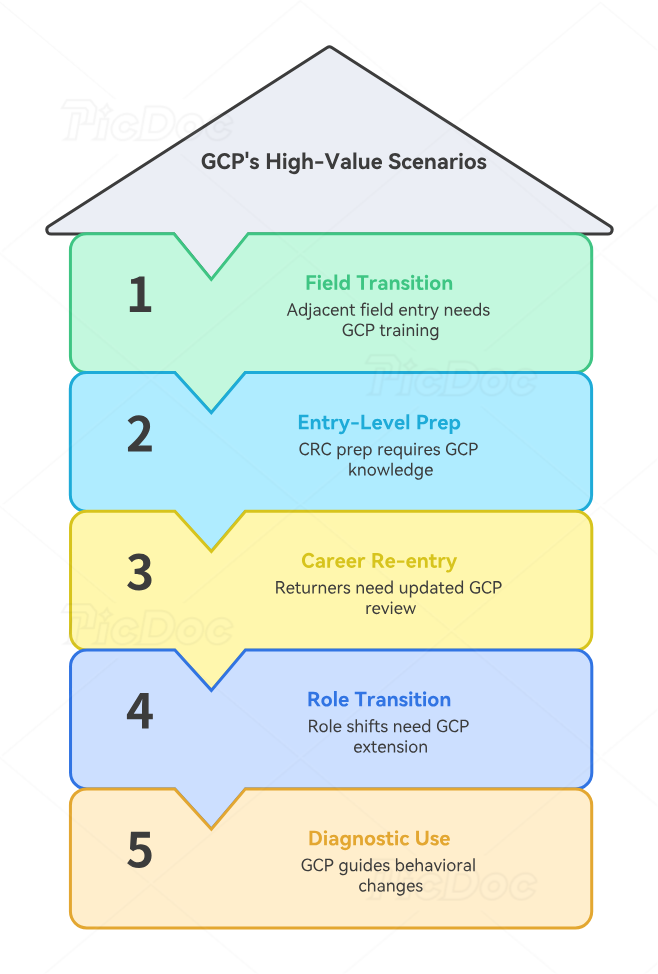
GCP produces its highest return when it closes a specific capability gap.
The first high-value situation is the candidate entering research from medicine, nursing, pharmacy, biology, public health, laboratory science, or another adjacent field. These candidates may understand patients or science well while knowing little about site operations, trial logistics, investigator obligations, or GCP monitoring. Training gives them a conceptual map before their first interview.
The second is preparation for entry-level site work. A candidate pursuing CRC jobs without previous research experience should be capable of discussing why eligibility documentation matters, why informed consent must precede study procedures where required, why deviations require appropriate handling, why participant safety takes priority, and why source and trial records must support reliable reconstruction of study conduct. Familiarity with patient-safety principles, adverse-event compliance, data integrity, and protocol adherence can turn vague enthusiasm into interview-ready knowledge.
The third is career re-entry. Somebody who worked in research several years ago may benefit substantially from reviewing current expectations. ICH E6(R3) places strong emphasis on proportionality, quality by design, risk-based thinking, fit-for-purpose systems, and clearer responsibility across the trial lifecycle. FDA finalized E6(R3) guidance in September 2025. In Europe, Principles and Annex 1 have been effective since July 2025, while Annex 2 is scheduled to take effect there in January 2027.
The fourth is role transition. A research assistant pursuing CRC responsibilities can use GCP knowledge alongside research-assistant collaboration skills, protocol execution, and trial coordination. A CRC targeting a CRA role needs to extend that foundation into monitoring techniques, sponsor communication, issue escalation, site oversight, and independent judgment. Understanding the difference between CRA and site-side career progression prevents candidates from mistaking theoretical preparation for monitoring readiness.
GCP also has particular value when the learner uses it diagnostically. Instead of asking, “Can I pass the quiz?” ask how each principle would change your behavior when consent documentation is incomplete, a protocol deviation occurs, source data conflict with the EDC, an investigator delegates duties poorly, a safety event emerges, or a site repeatedly misses critical procedures.
That is where training turns into professional judgment.
5. How to Choose GCP Training and Turn the Certificate Into Evidence Employers Can Use
Price is a poor proxy for hiring value.
Before choosing a course, examine whether the curriculum reflects current GCP principles, whether the training is relevant to your role and jurisdiction, whether your target employer or institution accepts the provider, whether completion produces appropriate documentation, and whether the material teaches enough operational context for you to apply the concepts.
This is particularly important because candidates navigating the clinical research certification ROI question can easily spend money solving the wrong problem. Someone facing the experience Catch-22 usually gains more from pairing efficient GCP training with real research exposure than from repeatedly purchasing overlapping introductory courses.
The résumé strategy matters too.
Listing “GCP certified” in isolation gives an employer very little information. A stronger candidate can connect that knowledge to the target role. For a research assistant, that may mean understanding protocol adherence, clinical trial logistics, and team communication. For a CRC applicant, it means connecting GCP to site operations, consent, eligibility, source documentation, safety, regulatory maintenance, and visit execution.
For a CRA applicant, the certificate should sit behind evidence of monitoring competence, issue identification, follow-up, site communication, quality management, and risk judgment. This becomes especially important for candidates trying to move from CRC to CRA without prior monitoring, where the hiring barrier is often operational proof rather than lack of another training certificate.
Interview preparation is where GCP can produce more value than the résumé line itself.
Take major principles and convert them into scenarios. If informed consent documentation contains an error, what would you do? If a participant reports a potential adverse event, what information must move through the appropriate safety process? If a study team repeatedly deviates from the protocol, how would you think about root cause, escalation, retraining, documentation, and participant risk? If data reliability is threatened, how would clinical trial data-integrity principles influence your response? If an investigator appears disengaged, how do investigator responsibilities shape the discussion?
Candidates who can answer those questions thoughtfully demonstrate a deeper form of readiness than candidates who simply display a completion badge.
Then build the next layer. Pair GCP with real research experience, build role-specific proof through entry-level clinical research pathways, understand the tradeoffs between research assistant, CTA, and CRC roles, and target the responsibilities that move you closer to the job you actually want.
That is how a small credential becomes part of a credible career strategy rather than résumé decoration.
6. FAQs About GCP Certification, Employer Recognition and Career Value
-
Appropriate GCP training is commonly expected for people involved in regulated clinical trials, although the precise requirement, accepted provider, curriculum, documentation, and retraining schedule depend on the organization, study, sponsor, institution, and applicable procedures. Employers may require their own training even when you already hold a certificate.
Candidates should therefore understand investigator GCP responsibilities, clinical research site operations, ethical participant protection, and monitoring expectations instead of treating the certificate itself as the endpoint.
-
It can improve a beginner's profile when the applicant has little previous clinical research exposure, particularly by demonstrating initiative and providing enough regulatory vocabulary for a stronger interview. Its impact becomes substantially greater when paired with entry-level research experience, research assistant preparation, CRC-ready skills, and credible evidence employers can verify.
Recent Reddit discussions support that nuanced view: some hiring professionals describe current GCP training as a small positive for beginners while stressing that experience rapidly becomes the stronger differentiator.
-
GCP knowledge is foundational for CRA work. A completion certificate does not demonstrate independent monitoring competence.
CRA candidates are expected to understand areas such as on-site and remote monitoring, source documentation, essential records, protocol deviations, issue escalation, site communication, safety, regulatory compliance, and data quality. Someone attempting to become a CRA without monitoring experience should concentrate on monitoring-adjacent evidence and study ownership rather than accumulating generic certificates.
The current market makes that distinction especially important. Experienced contributors in 2026 clinical-research discussions have emphasized how difficult direct CRA entry has become without strong operational experience.
-
Employer value does not automatically increase with price.
Evaluate whether the course is current, credible, relevant to your target work, accepted where necessary, and capable of teaching meaningful application. Reddit contributors repeatedly warn newcomers against assuming that paying substantially more for basic GCP training creates a proportionally stronger hiring credential.
Before spending heavily, compare that investment with building real clinical research experience, learning clinical trial logistics, understanding protocol compliance, and developing research-team communication.
-
For many genuine beginners, completing credible current GCP training before applying is a sensible move because it can improve interview vocabulary and demonstrate intentional preparation. It works best when you simultaneously learn how CRCs handle site operations, adverse-event reporting, protocol adherence, and clinical data integrity.
A candidate pursuing CRC employment without previous experience should then develop specific examples showing transferable skills in documentation, patient communication, scheduling, quality control, problem solving, privacy, and coordination.
-
Training currency depends on the certificate, provider, institution, sponsor requirements, and organizational SOPs. Some organizations require periodic retraining or their own learning-management-system version regardless of an external certificate's stated validity.
The safest career approach is to verify the requirements of the organization where you will perform the work and maintain knowledge that reflects current expectations. With modern GCP increasingly emphasizing risk-based quality, participant protection, reliable data, and fit-for-purpose trial processes, professionals should understand the principles behind quality management, data integrity, clinical monitoring, and patient safety, rather than relying on an old completion date as evidence of current competence.
