
Clinical Trial Manager Career Roadmap: Essential Steps and Salary Guide
If you are aiming for a Clinical Trial Manager role, you are probably feeling the same friction most people hit: you have experience, but not the “ownership” proof hiring managers want. You might be a CRC managing chaos on site, a CRA drowning in visits, or a CTM assistant trying to break out of task work. This roadmap shows you the exact steps, skills, and credibility signals that move you into true trial leadership, plus the salary levers that raise your offers without gambling your work life.

1) What a Clinical Trial Manager Really Does (And Why the Role Is Misunderstood)
A Clinical Trial Manager (CTM) is not a senior coordinator. The CTM is the operational owner of a study’s execution, responsible for converting protocol intent into real world delivery across sites, vendors, and timelines. If you have ever watched a trial get crushed by “small issues” that quietly turn into missed milestones, you already know why this role matters.
The hard truth is that many talented people stall because they confuse activity with ownership. You can do 60 hours of work and still not be CTM ready if you cannot protect timelines, reduce risk, and drive alignment. That is why CTM interviews focus less on “what you did” and more on “what you prevented,” “what you fixed,” and “what you led.”
A CTM’s highest value is decision quality under pressure. When enrollment stalls, you do not “follow up.” You redesign the site plan, change governance, escalate correctly, and make the trial move. When data is messy, you do not “remind sites.” You attack root causes, partner with data management, and stop the same defect from repeating.
If you want the cleanest definition, a CTM owns the operational triangle: time, quality, and cost. That triangle connects directly to how sponsors judge trial performance and how you get promoted.
Use these CCRPS references as context for adjacent career paths and expectations: clinical trial assistant career guide, clinical research assistant career roadmap, clinical research salary report 2025, and top 10 highest paying clinical research jobs in 2025.
2) The Clinical Trial Manager Career Roadmap (Exact Steps From Entry Roles to CTM)
Most CTMs come from one of three pipelines: site operations, monitoring, or project operations. The fastest path is the one that builds proof of operational ownership, not the one that “sounds” more senior on paper.
Step 1: Build the foundation in execution roles (0 to 2 years)
If you are starting at the beginning, roles like Clinical Trial Assistant, Clinical Research Assistant, and entry Clinical Operations support are about learning the machinery. You want to understand document flow, TMF discipline, study start up tasks, and how decisions are captured.
Your early goal is to become the person who prevents rework. That means mastering basics like version control, action tracking, and clean communication. People get stuck here because they are “helpful” but invisible. You must become measurable.
Helpful CCRPS context: creating the perfect clinical research certification study environment and proven test taking strategies for clinical research exams.
Step 2: Move into roles that touch trial leadership (2 to 5 years)
To become CTM ready, you need exposure to trial governance, risk, and performance. The most common stepping stones are CRA, Senior CRC, or a project operations role inside a sponsor or CRO.
If you come from the CRA path, your advantage is site behavior and monitoring reality. You know what sites actually do versus what they promise. Pair that with a stronger understanding of cost, resourcing, and vendor governance to avoid being boxed into “monitoring only.” CCRPS salary context helps here: clinical research associate CRA salaries worldwide 2025 and clinical research coordinator salary guide 2025.
If you come from site operations, your advantage is patient flow and protocol reality. Your gap is often sponsor side governance and vendor management. You close that by volunteering for start up coordination, acting as the site performance lead, or becoming the person who owns enrollment forecasts.
Step 3: Get into an associate CTM or study management role (4 to 7 years)
Titles vary: Associate CTM, Study Manager, Trial Manager, Clinical Operations Lead. What matters is that you own cross site work and you are accountable for trial metrics. The moment you start running weekly cross functional calls, managing a risk register, and driving site tiering, you are stepping into CTM territory.
If you want a clear adjacent comparison, study the operational expectations in project management focused roles: clinical research project manager salary trends 2025 and the broader salary benchmarking in the clinical research salary report 2025.
Step 4: Become CTM ready by owning outcomes, not tasks (6 to 10 years)
CTM readiness is not years of experience. It is evidence of these four capabilities:
You can protect timeline commitments under real world constraints
You can drive quality without creating bureaucracy
You can control cost by preventing rework and scope creep
You can lead stakeholders through conflict with facts
This is also where many people burn out. The CTM role can become constant firefighting if you do not build systems. Your roadmap must include “how you work,” not only “what you know.” CCRPS has strong role roadmaps that reinforce this system building mindset, such as quality assurance QA specialist career roadmap and regulatory affairs specialist career roadmap.
3) The CTM Skill Stack That Gets You Hired (And Promoted Fast)
CTM candidates usually fail interviews for one reason: they talk about effort instead of control. The skill stack below is designed to make you sound like a person who can run a trial with predictability.
Operational leadership skills that separate average from elite CTMs
Risk management must be more than a spreadsheet. You need trigger based thinking. For each key risk, define what early signals look like, who owns mitigation, and what “good” looks like week by week. This approach reduces surprise escalations and builds sponsor trust.
Governance design is another separator. High performers run meetings that create decisions. Weak performers run meetings that recycle status. Your governance should have fixed outputs: action owners, due dates, blocked items, and a clear escalation chain.
You also need site portfolio management. CTMs do not treat all sites equally. You tier sites based on performance and risk, then apply different interventions. That is how you rescue enrollment without burning the team.
For salary and performance context on specialized tracks that overlap with CTM work, review: clinical data manager career roadmap and lead clinical data analyst career guide.
Trial execution skills you must be able to explain with examples
Study start up control: You need to understand what truly drives start up speed. It is rarely “the regulatory team is slow.” It is often document completeness, contract friction, feasibility quality, and weak site selection. CTMs who know how to screen sites and stage start up tasks prevent months of delays.
Data quality and closeout readiness: You should be able to speak about query aging, protocol deviation trends, TMF completeness, and inspection readiness in measurable terms. Even if you are not a data manager, CTMs are expected to drive cross functional alignment when the data is blocking.
Safety coordination: You do not need to be a pharmacovigilance specialist, but you must understand how safety timelines can break a trial. If you want deeper context on safety career tracks, CCRPS has excellent resources like pharmacovigilance specialist salaries and career growth 2025 and drug safety specialist career guide 2025.
Tools and artifacts that prove CTM maturity
If you want to look CTM ready on day one, build these artifacts and bring them into interviews:
Trial dashboard with enrollment, activation, deviations, query aging, TMF health
Risk register with triggers, mitigation owners, and status updates
Site tiering model and rescue plan
Decision log showing how issues were resolved
Timeline critical path map with dependencies
Vendor governance tracker with SLAs and deliverables
These artifacts make you credible because they show you know how to run the work, not just talk about it.
If you are studying, build consistency using CCRPS guidance such as creating the perfect clinical research certification study environment and reinforce exam execution discipline through proven test taking strategies.
4) Clinical Trial Manager Salary Guide (And the Levers That Raise Offers)
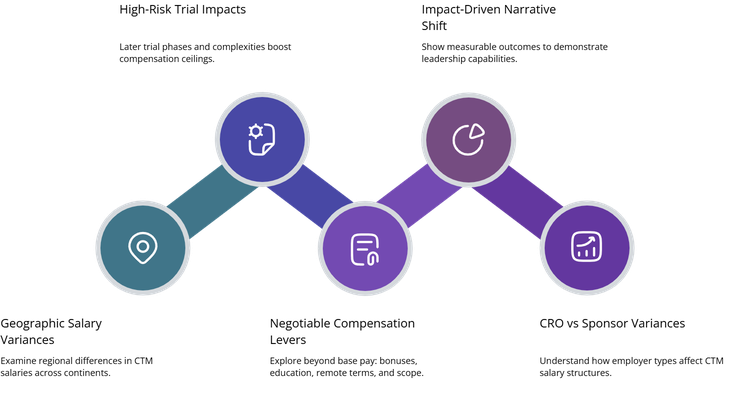
CTM salary is not only about geography. It is about risk level, trial complexity, therapeutic area pressure, and your ability to reduce expensive mistakes. Employers pay for predictability.
Start with market context. Use the clinical research salary report 2025 to benchmark your base expectations, then cross check “high pay roles” through top 10 highest paying clinical research jobs in 2025.
What drives CTM compensation in real hiring decisions
Trial phase and complexity: Later phase studies with higher enrollment, multi country complexity, or heavy vendor stacks tend to pay more because they create more opportunity for costly failure. If you have led complex rescue work, that becomes a premium.
Employer type: Sponsor roles often pay higher base, while CRO roles can offer faster promotion velocity. Vendor heavy environments reward CTMs who can manage governance without chaos.
Proof of impact: The highest paying candidates talk in outcomes. They explain how they reduced protocol deviations, shortened query aging, improved activation cycle time, or recovered recruitment. If your resume does not have measurable impact, you will be priced like a generic operator.
Remote and hybrid reality: Remote CTM roles exist, but remote does not mean “less accountable.” It means better documentation, stronger dashboards, and cleaner escalation habits. If you want remote, you must show you can run trials without relying on hallway conversations.
Compensation levers you can actually negotiate
Base salary is only one lever. Strong candidates negotiate:
Leveling: Associate CTM versus CTM versus Senior CTM based on scope
Bonus eligibility: trial milestone based or performance based
Sign on: especially when you can start fast and reduce ramp time
Remote or hybrid terms: based on your proven operating system
Education support: certifications and ongoing training
Title scope alignment: ensuring responsibilities match level so you can grow
If you are moving from CRA to CTM, validate your comp narrative with CRA salaries worldwide 2025 and then align with project style roles using clinical research project manager salary trends 2025.
The “salary trap” that keeps people underpaid
Many candidates accept low offers because they cannot clearly explain what they own. If you say “I helped manage the trial,” you will be priced like support. If you say “I owned site performance, enrollment forecasts, and escalation resolution across 18 sites and prevented timeline slip,” you will be priced like leadership.
Use CCRPS career roadmaps as vocabulary boosters for how senior roles describe ownership, such as how to become a principal investigator, clinical medical advisor career path, and medical science liaison career roadmap.
5) How to Become CTM Ready Faster (Resume Proof, Interview Wins, and a 30 60 90 Plan)
Speed comes from targeting the right proof points. Most people try to become CTM ready by collecting more tasks. Instead, you become CTM ready by owning one operational pillar and making your impact measurable.
Build a “CTM proof portfolio” inside your current job
Pick one pillar and build a system around it:
Enrollment: forecasting model, site tiering, weekly interventions
Quality: deviation trend analysis, retraining plan, TMF health checks
Data: query aging reduction, reconciliation discipline, root cause fixes
Vendor governance: SLAs, cadence, deliverable tracking, escalation protocol
Then document everything. CTMs win because they can show how they think, not just what they did.
If you need tool and platform awareness to sound credible, CCRPS directories can help you reference the landscape: top 50 remote clinical trial monitoring tools 2025, top 100 clinical data management and EDC platforms 2025, and top 75 clinical trial patient recruitment companies 2025.
Resume positioning that hiring managers actually respond to
Your resume must read like you were accountable. Replace task language with control language:
“Owned weekly trial governance and risk register for X sites”
“Reduced query aging from X to Y by fixing root causes with sites and DM”
“Recovered enrollment by segmenting sites and deploying a rescue plan”
“Prevented timeline slip by rebaselining and aligning stakeholders on critical path”
Layer salary and market awareness through clinical research salary report 2025 and role comparisons like clinical data coordinator career path to show you understand how responsibility scales.
Interview questions CTMs must answer with confidence
Be ready to answer these with specific examples:
Tell me about a trial risk you identified early and how you mitigated it
How do you manage site performance when enrollment stalls
How do you handle vendor underperformance without burning relationships
What does your weekly governance look like, and what outputs do you expect
How do you keep a trial inspection ready throughout execution
How do you communicate bad news to leadership without losing trust
If you struggle with structured preparation, build routines using test taking strategies and a stable workflow using study environment guidance. The content is aimed at exams, but the discipline translates to interview readiness.
30 60 90 day plan for new CTMs
Day 0 to 30: Build visibility and control
Map stakeholders, governance cadence, and escalation paths
Audit dashboards, trial timelines, and key risks
Baseline site tiering and vendor deliverables
Define weekly outputs and decision logs
Day 31 to 60: Drive the highest impact fixes
Attack the top 2 drivers of delay or quality defects
Implement site rescue interventions with measurable targets
Strengthen TMF and inspection readiness routines
Align cross functional teams on one operational narrative
Day 61 to 90: Prove you can run the trial predictably
Reduce recurring issues through root cause fixes
Stabilize metrics so leadership sees fewer surprises
Document playbooks for repeatability
Set the next quarter plan with milestone confidence
For broader career navigation, CCRPS role roadmaps can help you benchmark what “senior” really means across functions, such as regulatory affairs associate career guide, clinical regulatory specialist career pathway, and quality assurance specialist career roadmap.
6) FAQs: Clinical Trial Manager Career Roadmap and Salary Questions
-
The fastest path is the one that gives you proof of ownership. Many people waste years collecting tasks that never turn into leadership credibility. A strong route is CTA or CRA to Associate CTM or Study Manager, then CTM. Your shortcut is measurable control over one pillar like enrollment, risk, vendor governance, or quality. Build dashboards, risk registers, and site tiering models so you can show how you run execution. Use market context to position your leveling properly, including the clinical research salary report 2025 and comparisons like CRA salaries worldwide 2025.
-
They look for evidence that you can protect time, quality, and cost without chaos. That includes running governance meetings that produce decisions, managing a risk register with triggers, rescuing enrollment through site segmentation, and holding vendors accountable through SLAs and deliverables. They also look for documentation discipline and inspection readiness. If your background is monitoring heavy, strengthen cross functional leadership vocabulary using adjacent CCRPS roadmaps like clinical data manager career roadmap and quality assurance specialist career roadmap.
-
You must reframe yourself from “site visit executor” to “site performance leader.” Own metrics like activation cycle time, enrollment forecasts, query aging themes, deviation trend actions, and escalation resolution. Volunteer to run parts of governance and bring a dashboard that proves you manage by indicators. Then align your narrative with sponsor priorities, not CRA tasks. Use CCRPS salary comparisons to guide leveling, including CRA salary data and project style benchmarking like clinical research project manager salary trends.
-
A “good” salary depends on complexity, scope, and employer type, not only location. Compensation rises when you can reduce expensive failure modes: delayed enrollment, high deviations, poor TMF health, vendor misses, and slow closeout. Your best lever is proof of impact. Talk in outcomes and show artifacts like dashboards and risk registers. Use clinical research salary report 2025 for baseline context and check role premium trends through top 10 highest paying clinical research jobs in 2025.
-
Negotiate with evidence and leveling clarity. First, align the job scope to the correct level. If you are expected to own governance, risk, site performance, and vendor oversight, you should not accept an “associate” pay band unless there is a clear promotion plan. Ask about bonus criteria, remote terms, sign on, and education support. Present a clean comp comparison anchored in market references like the clinical research salary report 2025. Keep the tone collaborative: you want alignment so you can perform and stay long term.
-
Prioritize learning that improves execution control. Strengthen GCP fluency, documentation discipline, and inspection readiness. Build skill in risk management, governance design, and data driven site performance. Even when studying for certifications, focus on routines that create consistent output under pressure. CCRPS resources can support your preparation habits, including creating the perfect study environment and proven test taking strategies. Also expand your platform awareness with directories like top 100 EDC platforms 2025 so you can speak the language of modern trial operations.
-
Burnout usually comes from living in permanent reaction mode. CTMs get crushed when governance is weak, metrics are unclear, and issues are escalated late. You avoid burnout by building systems: dashboards that show leading indicators, risk registers with triggers, site tiering models, and vendor governance routines. You also protect your energy by setting clear escalation rules and refusing to accept “urgent” work that should have been prevented. If you want to understand how other functions manage risk and readiness, review CCRPS role roadmaps like QA specialist career roadmap and regulatory affairs specialist roadmap.
