
Clinical Medical Advisor Career Path Clear Steps and Advancement
Clinical medical advisor roles sit at the intersection of medicine, strategy, and evidence. You are the person who translates real-world clinical insight into regulatory-proof protocols, safe trial designs, and credible messaging that payers and regulators will accept. Yet most clinicians slide into these roles without a clear roadmap and leave money, influence, and advancement on the table. In this guide, you will see exactly how to move from frontline clinician to high-impact clinical medical advisor with a stepwise path, salary levers, and future-proof skills you can start building today.

1. What Does a Clinical Medical Advisor Really Do?
A strong clinical medical advisor is not “a doctor who answers emails.” You are a strategic node between sponsors, investigators, regulators, and patients. You pressure-test protocol designs before they become expensive failures, similar to the risk thinking in AI-driven failure prediction. You help align inclusion criteria with real-world recruitment realities, working alongside sites listed in top trial site directories and academic centers.
You also interpret emerging safety signals with pharmacovigilance teams whose salary and scope trends are mapped in the PV specialist industry report. That means you need fluency in case narratives, benefit–risk arguments, and how regulators view signals, not just clinical pattern recognition. Many clinical medical advisors eventually sit close to roles profiled in the top 10 highest paying clinical research jobs, but only if they can show that their decisions shorten timelines, de-risk inspections, and strengthen labeling strategy.
Crucially, you are also an educator. You train field teams and study staff so they actually understand complex mechanisms of action, endpoint definitions, and protocol nuances. The same instructional skill set that helps candidates pass exams using resources like proven test-taking strategies and study-environment optimization becomes a core value driver when you use it to raise the quality of recruitment, documentation, and safety reporting across your trials.
2. Clinical Medical Advisor Career Roadmap: From Clinic to Strategic Leader
Most clinical medical advisors start as clinicians who occasionally support research at hospitals listed in trial-active hospital directories or academic centers from research fellowship lists. The risk is staying “the helpful clinician who signs forms” instead of deliberately collecting skills that hiring managers use to filter advisor candidates. A structured path solves that.
Your first phase is clinical credibility plus GCP literacy. Use certification-aligned resources like clinical research salary and role reports to understand how different positions fit together, and pair them with exam-style content such as test-taking strategies and exam anxiety control. That combination lets you speak the language of CRAs, CRCs, and monitors, not only clinicians.
Next, you build bridge roles: medical writing, safety review, or junior advisor positions inside CROs and sponsors cataloged in global CRO vendor guides. Here, your goal is to touch protocols, investigator brochures, safety updates, and cross-functional meetings. Align your responsibilities with the quality mindsets described in QA specialist career pathways and clinical compliance officer guides, so that every clinical recommendation you make is backed by inspection-ready thinking.
Once you secure a core clinical medical advisor role, you accelerate by narrowing your therapeutic area and broadening your strategic footprint. That might mean leading cross-trial advisory boards, partnering with MSL teams whose exam journey is covered in MSL certification exam tips, or shaping trial portfolios that use cutting-edge tools from data-management platform directories. At this stage, you are no longer the person who only reviews slides; you are one of the voices that determines where the development budget goes next.
3. Building the Expertise Recruiters Actually Pay For
Recruiters do not search for “smart doctor, generally helpful.” They search for people who reduce trial risk, accelerate evidence generation, and support commercially meaningful labels. That is why deep familiarity with innovative trial models described in AI powered trials and decentralized trial forecasts is becoming as important as your clinical specialization.
You need to be comfortable with data coming from wearables and smart devices, not only clinic visits. Articles on wearable-driven clinical trials and smart pills and digital biomarkers show how endpoints are evolving. As a clinical medical advisor, your job is to validate whether those endpoints make clinical sense, can be measured reliably, and will resonate with regulators and payers. That goes beyond reading p-values; it means understanding signal quality, patient behavior, and device limitations.
Equally important is your ability to navigate complex global ecosystems. Growth forecasts in Africa as the next clinical trial frontier and China’s potential dominance in research show that clinical medical advisors who understand regional practice patterns, standard-of-care differences, and logistics challenges will be in demand. Combine that with directories of trial sites and SMOs and patient-recruitment vendors, and you have a toolkit for designing trials that are not only scientifically rigorous but operationally feasible.
To tie everything together, invest in formal development. That includes certification programs across clinical research, pharmacovigilance, and regulatory affairs, such as those aggregated in pharmacovigilance training directories and career-pathway pieces like the regulatory affairs specialist roadmap and clinical regulatory specialist path. These do two things. They give you language that resonates with hiring managers, and they demonstrate that you can complete demanding learning journeys, just like candidates who conquer exam anxiety with structured CCRPS exam strategies.
What Is Your Biggest Roadblock to Becoming a Clinical Medical Advisor?
4. Salary Growth, Global Demand and Future Outlook
Clinical medical advisor salaries usually track senior clinical research, medical affairs, and PV roles that appear in the upper tiers of the clinical research salary report and top-paying job rankings. In large pharma and biotech companies, total compensation often rivals or exceeds advanced PV and regulatory roles described in the pharmacovigilance salary report and regulatory affairs pathways, particularly when you are embedded in high-innovation portfolios.
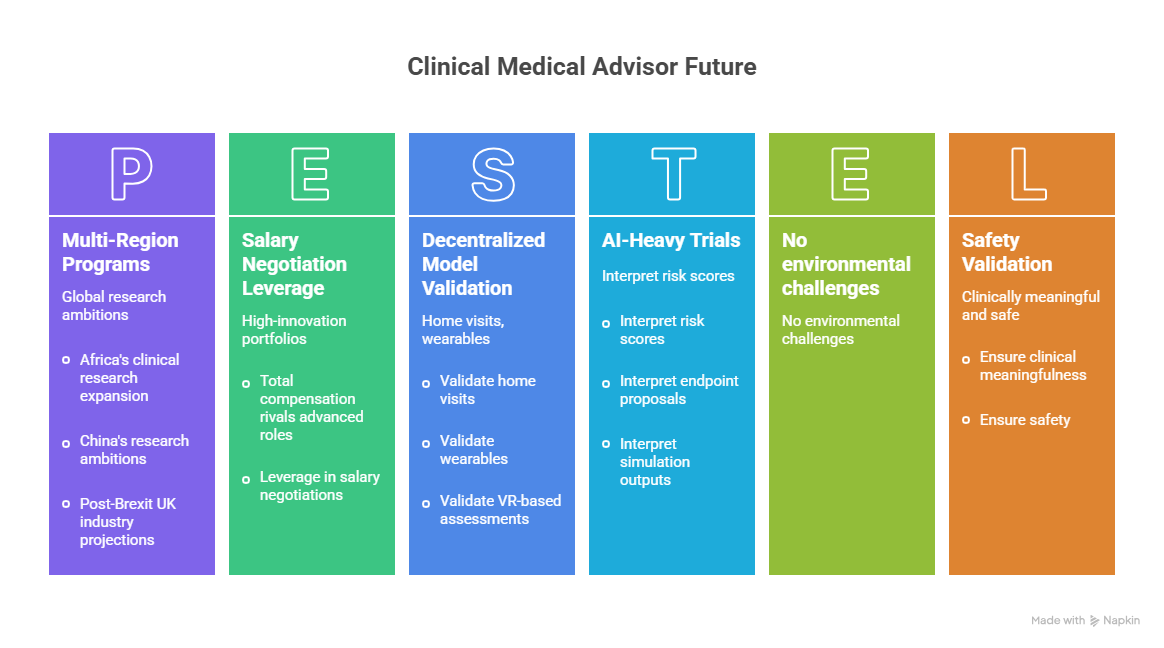
Demand is rising fastest where pipelines intersect with advanced technologies. Sponsors designing AI-heavy and digitally enabled trials, as forecast in AI powered clinical trial analyses, need clinical advisors to interpret risk scores, endpoint proposals, and simulation outputs. As decentralised models expand in line with DCT disruption forecasts, you also become the person who validates whether home visits, wearables, drones, and VR-based assessments described in emerging-tech trial articles are clinically meaningful and safe.
Geographically, growth clusters follow the same patterns mapped in macro-level analyses like Africa’s clinical research expansion, China’s research ambitions, and post-Brexit UK industry projections. Clinical medical advisors who are willing to work on multi-region programs, or who understand how practice patterns differ across the hospitals and SMOs cataloged in trial site mega-directories, will have more leverage in salary negotiations and role selection.
Looking ahead, automation will change your work but not erase the need for clinical judgment. Articles about AI replacing some research jobs, such as meet your new AI boss, highlight how low-complexity tasks will shrink. That simply means clinical medical advisors must live closer to strategic decisions: helping project managers interpret early failure predictions, guiding PV teams on subtle signal interpretation, and shaping development decisions that determine which programs receive investment. Salaries will increasingly bifurcate between advisors who embrace this strategic positioning and those who stay in narrow, reactive review roles.
5. Common Mistakes That Stall Clinical Medical Advisor Careers
The most damaging mistake is assuming that a medical degree plus vague “interest in research” guarantees advancement. In reality, hiring managers compare you to candidates who have already aligned themselves with clear career roadmaps like the QA specialist path, compliance officer guide, and regulatory specialist tracks. If your CV does not show similar intention, you fall behind even if your clinical skills are stronger.
Another common trap is staying inside a single institution that never exposes you to the broader ecosystem of CROs, data-platform vendors, and recruitment partners cataloged in CRO buyers guides, data-management platform lists, and patient-recruitment company directories. Clinical medical advisors who understand how all these players fit together, and who have experience with at least some of them, are far more useful to sponsors designing global programs.
Finally, many clinicians underestimate mindset. The same anxiety that stops candidates from pursuing certification until they read exam-anxiety guidance often stops them from applying for industry roles. They tell themselves they are “not ready yet” instead of taking a stepping-stone position and using structured learning, similar to test-taking strategies, to close gaps while already inside the ecosystem. Over a five-year horizon, those who act early consistently pull ahead of clinicians who wait for a perfect, risk-free transition that never appears.
6. Clinical Medical Advisor Career FAQs
-
Not always. Strong clinical experience plus deliberate exposure to trials can be enough if you package it correctly. Work at research-active hospitals from clinical trial hospital directories, support investigators on protocols, and complete structured training drawn from CCRPS exam-aligned guides. Highlight collaboration with CRAs, CRCs, and PV teams whose roles appear in the clinical research salary report. Entry roles in medical information, safety review, or junior advisory functions at CROs are realistic first steps.
-
Compensation varies by region and specialty, but senior advisors in high-innovation portfolios often match or exceed earnings for many full-time clinicians, especially once you include bonuses and equity. Use cross-role benchmarks from the top 10 highest paying clinical research jobs, pharmacovigilance salary reports, and CRA global salary data to triangulate realistic ranges. The biggest difference is that your time becomes more predictable, and your impact plays out through trial portfolios instead of daily clinic volume.
-
Beyond clinical expertise, recruiters look for GCP literacy, cross-functional collaboration, and comfort with modern trial technology. Evidence that you understand AI driven models from AI powered trial analyses, decentralized designs from DCT elimination forecasts, and digital biomarkers from smart pill and wearable articles is extremely valuable. Pair that with any experience partnering with PV, QA, or regulatory teams whose paths are described in CCRPS career guides, and you move into a much stronger candidate pool.
-
Specialization usually wins in the long term, because sponsors want clinical medical advisors who can see subtle pattern shifts and anticipate standard-of-care changes. Choosing a high-innovation area, such as oncology or rare disease, aligns you with roles that appear toward the top of the clinical research salary report. However, early in your transition it can help to work broadly across indications at CROs featured in CRO vendor directories before committing. Once you pick a focus, double down with conferences, publications, and advisory work in that area.
-
You protect your relevance by owning the questions AI cannot answer alone. Study how tools described in AI failure prediction and AI audits work, then position yourself as the clinical brain that interprets their output. Combine this with expertise in emerging trial designs, such as VR/AR-based assessments from virtual reality trial articles and decentralized models from DCT forecasts. Employers will pay for advisors who help them deploy AI safely and credibly, not those who resist it.
-
Good stepping-stone roles include safety physician, medical information specialist, medical writer, or clinician embedded in clinical operations for trial-intense organizations. Look for employers that appear frequently in trial site directories, hospital research lists, and pharma and biotech hiring directories. Combine that role with structured learning using CCRPS exam-style content so you can quickly pivot into formal clinical medical advisor positions.
-
Treat your path like a development program. First, secure a foothold in clinical research using certification-aligned resources such as exam strategies and study-environment guides. Second, move into roles that combine clinical insight with cross-functional exposure, including PV, QA, and regulatory positions described in CCRPS career roadmaps. Third, specialize in a therapeutic area while taking on responsibility for portfolios that use advanced technologies from AI and wearable-focused articles. By the time you are ready for medical director or VP roles, you will have both the clinical depth and strategic breadth that top employers reserve their highest salary bands for.
