
Which GCP Certification Do Employers Recognize? Reddit Questions, ICH E6(R3) Expectations & Credential Red Flags
Good Clinical Practice training looks deceptively simple until a recruiter, sponsor, CRO, hospital, or research site asks whether your certificate actually satisfies its requirements. Candidates comparing whether clinical research certification is worth it, weighing certification against practical experience, trying to break into clinical research without experience, or learning investigator responsibilities under GCP need to distinguish a useful GCP training certificate from a credential that merely looks official.

1. Which GCP Certification Do Employers Actually Recognize?
There is no single GCP certificate that every employer, sponsor, CRO, hospital, academic medical center, and investigator site is required to accept. NIH itself does not mandate one specific course. Its policy allows GCP education through an appropriate course, academic program, or certification from a recognized clinical research professional organization, while expecting NIH-funded investigators and relevant trial staff to keep their training current. NIH also states that GCP training should generally be refreshed at least every three years.
That distinction matters when candidates encounter the entry-level clinical research experience catch-22. A GCP certificate may establish baseline regulatory literacy, but hiring managers can still want evidence of protocol adherence, trial logistics coordination, clinical research communication, and safe handling of adverse-event reporting responsibilities.
For applicants, CITI Program GCP training is one of the strongest institutional signals because of its broad use across universities, hospitals, research organizations, and healthcare companies. CITI states that more than 1,800 institutions use its GCP training and that specified courses meet the minimum criteria identified by TransCelerate for mutual recognition among participating sponsors. Its current GCP courses are aligned with ICH E6(R3).
NIH/NIDA GCP training is another credible route, particularly for academic, NIH-funded, and entry-level contexts. NIH explicitly lists its free NIDA Good Clinical Practice course among available training options. A July 2026 Reddit discussion asking which provider employers recognize likewise highlighted NIH/NIDA as a commonly accepted free option, while older clinical-research discussions repeatedly mention CITI as a common institutional standard.
Experienced professionals must make another distinction. ACRP's CCRA, CCRC, and related credentials and SOCRA's CCRP are professional certifications rather than ordinary introductory GCP completion certificates. They can carry substantially more career signal because eligibility and examination requirements assess professional knowledge and experience. ACRP's CCRA and CCRC examinations moved to ICH E6(R3) content in July 2026, while SOCRA states that its examination framework incorporates E6(R3).
That makes the right credential dependent on career stage. Someone pursuing a first research assistant, CTA, or CRC position may need current GCP training plus credible operational proof. Someone planning a CRC career without prior experience needs different evidence from an experienced monitor preparing to become a CRA without previous monitoring experience or evaluating CRO versus sponsor CRA careers.
| Credential / Situation | Recognition Signal | Best Use | Main Risk | Smart Next Step |
|---|---|---|---|---|
| CITI ICH-focused GCP course | Strong institutional familiarity | Sites, CROs, academia, sponsors | Wrong course variant for role | Pair with protocol-adherence knowledge |
| CITI FDA-focused GCP course | Strong for U.S. regulated work | U.S. drug/device trials | Assuming FDA focus covers every global requirement | Build monitoring knowledge |
| NIH/NIDA GCP course | Credible public-sector training signal | Academic and entry-level candidates | Expecting the certificate alone to win interviews | Add research-assistant training evidence |
| Employer-provided GCP onboarding | Very strong inside that organization | New employees | Limited portability | Retain completion documentation and understand GCP responsibilities |
| Sponsor-specific GCP training | Excellent for sponsor studies | Activated trial staff | May not replace another sponsor's requirement | Understand clinical research quality management |
| Institutional hospital GCP course | Strong locally | Hospital research teams | External portability varies | Strengthen site-operations knowledge |
| University research-office GCP training | Strong academic signal | Academic clinical research | May be institution-specific | Learn investigator-initiated trial requirements |
| SOCRA qualifying GCP coursework | Industry-recognition signal | Site professionals | Confusing course completion with CCRP certification | Compare certification ROI by role |
| SOCRA CCRP | Professional credential | Experienced research professionals | Using it as a substitute for operational experience | Document certification plus experience |
| ACRP CCRA | Strong CRA-specific professional signal | Experienced monitors | Eligibility barrier for beginners | Build toward CRA transition readiness |
| ACRP CCRC | Strong coordinator-specific signal | Experienced CRCs | Not designed as an instant entry credential | Build CRC hiring evidence |
| ACRP-CP or comparable advanced credential | Professional competency signal | Cross-functional professionals | Poor ROI if taken without a role strategy | Map it to your clinical research career path |
| E6(R3)-aligned basic GCP course | Current regulatory signal | New and returning staff | Shallow checkbox training | Apply concepts through quality-management practice |
| E6(R2)-only certificate | Potentially dated | Historical evidence only | Missing R3 expectations | Refresh knowledge around data integrity |
| E6(R3) update-only module | Useful supplemental signal | Previously trained professionals | Mistaking an update module for full GCP training | Verify employer acceptance and review GCP ethical principles |
| Device-focused GCP training | Strong when role-specific | Medical-device trials | Using drug-focused material for device work | Verify applicable regulatory scope alongside regulatory compliance principles |
| Pharmacovigilance-heavy training | Useful safety specialization | PV and safety roles | Confusing PV specialization with complete trial GCP training | Build global pharmacovigilance compliance knowledge |
| Medical-monitor-oriented training | Strong role relevance | Safety oversight | Insufficient operational trial knowledge | Study medical-monitor safety responsibilities |
| Internal CRO training | High employer relevance | CRO employees | Credential may have little external branding | Understand CRO and sponsor expectations |
| Internal sponsor training | High sponsor relevance | Sponsor employees and study teams | Assuming universal portability | Strengthen trial-team management understanding |
| Generic online “GCP certified” badge | Weak without recognized provenance | Limited | Unknown curriculum and issuer | Choose training tied to real GCP responsibilities |
| Course with no completion assessment | Weaker evidence | Informal learning | Cannot demonstrate knowledge verification | Build practical proof through trial coordination skills |
| Certificate without issue date | Weak compliance documentation | Avoid | Employer cannot judge currency | Maintain auditable records using inspection-ready habits |
| Certificate with no curriculum version | Unclear | Limited | Cannot establish R2 versus R3 alignment | Verify coverage of risk-based quality concepts |
| Certificate from unknown provider | Low until validated | Rarely the safest first choice | Marketing stronger than curriculum | Compare it with credential ROI criteria |
| GCP certificate plus no practical evidence | Baseline only | Early career | Resume remains theoretically heavy | Solve the experience catch-22 |
| GCP plus site experience | Strong combination | CRC and site roles | Poorly documented achievements | Show site-operations capability |
| GCP plus monitoring exposure | Strong CRA trajectory | CRA transition | Overstating independent monitoring | Develop monitoring-visit competence |
| GCP plus safety experience | Strong for safety-focused roles | PV, medical monitoring | Weak trial-operations breadth | Master adverse-event compliance |
| GCP plus regulatory experience | Strong compliance signal | Regulatory and study-start-up roles | Narrow operational exposure | Develop IND/NDA regulatory knowledge |
| Current GCP plus demonstrated quality systems knowledge | Excellent senior-role signal | PM, QA, senior clinical operations | Treating GCP as memorization | Apply risk-based quality management |
2. ICH E6(R3) Changed What “Current GCP Training” Should Mean in 2026
A certificate's issuer matters, but its curriculum version now matters just as much. ICH E6(R3) represents the current evolution of Good Clinical Practice. FDA issued its final E6(R3) guidance in September 2025, emphasizing flexible trial conduct, quality by design, proportionality, risk-based approaches, modern technology, clearer responsibilities, and reliability of trial results.
For professionals studying ethical conduct and participant safety, clinical-trial data integrity, GCP monitoring techniques, and clinical research quality management, R3 should change how GCP is understood. Memorizing investigator obligations without understanding critical-to-quality factors, proportionate controls, computerized systems, data governance, risk-based oversight, and operational decision-making creates a dangerous form of superficial competence.
EMA's Principles and Annex 1 version of E6(R3) became effective on July 23, 2025. Annex 2, covering considerations for trials incorporating decentralized elements, pragmatic designs, and real-world data, reached ICH Step 4 in June 2026 and is scheduled to become effective in the EU on January 15, 2027. These developments are especially relevant for professionals handling remote and on-site monitoring, clinical trial timelines, site operations oversight, and trial safety oversight.
The practical test is therefore more demanding than asking, “Does my certificate say GCP?”
Ask whether the curriculum teaches you to identify which risks threaten participant safety or reliable conclusions, whether controls are proportionate to those risks, who owns each responsibility, how trial data flow through computerized systems, how important deviations are escalated, and how quality is built into a trial before failures appear. Those concepts influence protocol adherence, adverse-event reporting, project quality controls, and eventually project close-out.
NIH removed another source of ambiguity in April 2026 by explicitly confirming that GCP training consistent with ICH E6(R3) satisfies its GCP requirement. That makes an R3-aligned course a safer choice for someone selecting training today than deliberately choosing a course frozen around R2 terminology.
However, an old R2 certificate should not automatically be treated as worthless. Employers may evaluate its age, internal policy, study requirements, refresher history, and whether the professional subsequently completed an R3 update. Someone already demonstrating strong investigator GCP knowledge, regulatory compliance, trial logistics, and clinical research collaboration may simply need updated documented training rather than another expensive credential.
3. The GCP Credential Red Flags Recruiters, Sites and Sponsors Can Spot Quickly
The first red flag is a certificate that says very little about what was actually taught. A polished badge without a provider name, curriculum version, completion date, assessment, or recognizable training standard creates verification work for the employer. In clinical research, documentation itself is part of credibility. Someone seeking a first clinical research position should understand that a vague certificate can undermine the very compliance signal it was supposed to create.
The second red flag is marketing language that overstates what a short course makes you qualified to do. Completing GCP education does not suddenly prove competence in CRA monitoring, CRC operations, medical monitoring, or principal-investigator oversight. Recruiters who work in clinical operations understand the difference.
The third red flag is using “certified” ambiguously. “Completed GCP training” is a precise statement. “GCP certified professional” can imply something much broader, particularly when compared with formal professional credentials such as ACRP's role-based certifications or SOCRA's CCRP. This matters because employers comparing certification and experience will quickly distinguish course completion from experience-validated professional certification.
The fourth is an outdated curriculum with no evidence of retraining. NIH recommends refreshing GCP at least every three years, and individual institutions or sponsors can impose their own requirements. A candidate discussing quality management, data integrity, trial monitoring, or global regulatory compliance while presenting stale training creates an avoidable credibility gap.
The fifth red flag is certificate collecting without evidence of application. Recent Reddit discussion captures this frustration clearly: experienced industry commenters often distinguish ordinary GCP training from credentials such as ACRP or SOCRA certifications and emphasize that employers commonly retrain personnel after hiring. For beginners, repeatedly buying certificates can become an expensive substitute for building credible entry-level proof, understanding research assistant responsibilities, demonstrating protocol execution, and showing effective research-team communication.
4. How to Choose the Right GCP Training for Your Actual Clinical Research Role
Start with the work you intend to perform, because the best training choice changes by function.
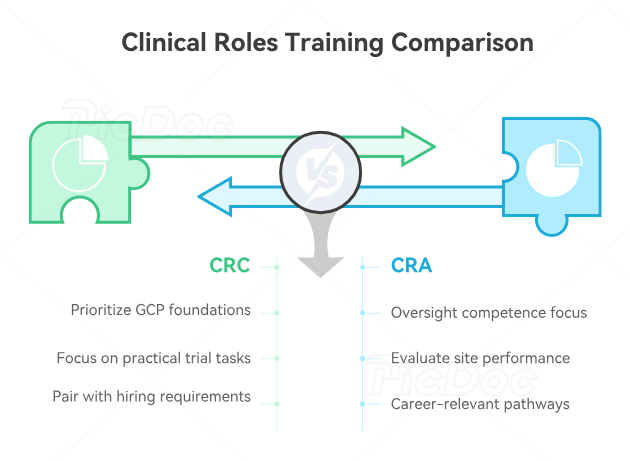
An aspiring CRC should prioritize current GCP foundations plus practical understanding of informed consent, source documentation, deviations, enrollment, investigational product processes, safety reporting, and investigator oversight. Pairing current training with knowledge of CRC hiring requirements, site operations, protocol adherence, and adverse-event compliance creates a much stronger hiring story than adding three nearly identical introductory certificates.
A prospective CRA needs to think beyond the certificate into oversight competence. Employers will care about how you evaluate source documentation, deviations, consent, site performance, data quality, follow-up, escalation, and risk. That makes CRA transition pathways, GCP monitoring methods, CRA travel realities, and CRO-versus-sponsor expectations more career-relevant than collecting generic badges.
For pharmacovigilance professionals, GCP should sit beside role-specific competence in case processing, expedited reporting, aggregate safety, signal management, inspections, and regulatory obligations. A professional studying global pharmacovigilance compliance, PV audits and inspections, adverse-event reporting, or medical-monitor safety oversight needs deeper safety knowledge than a broad GCP course can provide.
Research assistants and CTAs need another blend. Their advantage comes from showing they understand research-assistant training requirements, trial logistics coordination, team communication, and the differences between RA, CTA, and CRC entry routes.
For experienced professionals, professional certification becomes more defensible when it solves an identifiable career problem. If you already have meaningful trial experience, an ACRP or SOCRA credential may validate accumulated competence more powerfully than another introductory training certificate. SOCRA's CCRP program is NCCA-accredited, while ACRP maintains role-based credentials such as CCRA and CCRC. Evaluate that investment against clinical research certification ROI, your existing experience evidence, your intended CRA career trajectory, and the actual requirements appearing in your target jobs.
5. How to Put GCP Training on Your Resume Without Overclaiming It
The strongest resume treatment is precise:
Good Clinical Practice Training — [Provider], ICH E6(R3), completed [month/year]
Add the course version or scope when useful. If the program covered FDA-regulated clinical investigations, devices, international ICH requirements, or another defined area, state that accurately. This allows recruiters comparing your background with clinical research job requirements, entry-level experience expectations, CRC screening criteria, or CRA transition requirements to understand exactly what you completed.
Then use the rest of the resume to demonstrate application.
A site candidate can show experience maintaining regulatory documentation, supporting consent workflows, escalating deviations, reconciling study records, coordinating visits, or tracking action items. Those bullets reinforce your understanding of protocol adherence, site operations oversight, clinical trial logistics, and participant-safety principles.
A monitoring candidate should document exposure to findings, follow-up, source review, issue escalation, remote monitoring, site communication, and risk-based oversight where truthful. That supports monitoring competence, quality-management knowledge, data-integrity awareness, and eventual CRA career mobility.
Avoid writing “ICH-GCP certified expert” after a short online module. Avoid inventing sponsor recognition. Avoid claiming TransCelerate recognition unless the specific course meets the applicable criteria. Avoid implying that an introductory certificate gives you independent CRA, PI, safety, or regulatory authority.
The hiring advantage comes from a simple equation:
Current training + recognizable provider + role-relevant knowledge + documented application = credible GCP readiness.
That combination is considerably stronger than certificate volume. It also aligns with the broader reality behind certification versus experience, clinical research career entry, clinical research quality management, and professional GCP responsibility.
6. FAQs About Employer-Recognized GCP Certification
-
CITI GCP training has particularly broad institutional visibility, with CITI reporting use by more than 1,800 institutions and specified courses meeting TransCelerate's minimum criteria for mutual recognition. NIH/NIDA also provides a credible free GCP option, especially relevant to academic and NIH-associated research. Employer acceptance still depends on the organization, study, sponsor, and course scope. Before paying, compare the credential with your intended clinical research entry route, CRC requirements, CRA pathway, and certification ROI.
-
Someone taking GCP training now should strongly prefer training aligned with E6(R3). FDA's final R3 guidance was issued in September 2025, NIH explicitly confirmed in 2026 that R3-consistent GCP training satisfies its requirement, and major certification organizations have updated examination content. If you already hold recent R2 training, check your employer or sponsor's retraining policy before unnecessarily repeating an entire course. Meanwhile, strengthen your practical understanding of risk-based quality management, GCP monitoring, data integrity, and patient-safety obligations.
-
Price is a weak proxy for recognition. NIH offers free GCP training and specifically identifies acceptable pathways without requiring a particular paid provider. Employers care more about training provenance, curriculum, currency, documentation, role relevance, and internal acceptance. A free credible course combined with practical research training, protocol knowledge, trial coordination capability, and a strategy for breaking into clinical research can be more useful than an expensive unknown certificate.
-
They solve different problems. A basic GCP course provides foundational training. ACRP's role-based certifications and SOCRA's CCRP are professional credentials designed to assess experienced clinical research professionals. SOCRA's CCRP is NCCA-accredited, and ACRP's CCRA and CCRC examinations use current E6(R3) content. Candidates should evaluate professional certification after reviewing their experience level, career-entry barriers, intended CRA trajectory, and expected certification career ROI.
-
NIH states that GCP training should be refreshed at least every three years to remain current with regulations, standards, and guidelines. An employer, sponsor, institution, or protocol may impose additional requirements, so the safest approach is to check the governing policy rather than assuming one certificate remains acceptable indefinitely. Professionals responsible for investigator GCP duties, trial safety reporting, site oversight, or regulatory compliance should treat retraining as part of continuing competency rather than administrative housekeeping.
-
It can remove one knowledge gap and show intentional preparation, but hiring decisions usually depend on a wider evidence package. The strongest beginner profile combines current GCP training with understanding of entry-level clinical research roles, strategies for overcoming the clinical research experience catch-22, credible CRC resume evidence, and practical competence in research-team communication. A certificate gets more valuable when the resume proves you understand how GCP changes actual trial behavior.
