Medical Monitor Career Guide: Definitive Path to Success 2025
Medical Monitors sit at the center of risk benefit decisions in clinical trials. Sponsors trust them to interpret safety signals quickly, guide investigators through complex protocols, and protect patients while keeping timelines realistic. If you are a clinician or pharmacovigilance professional who wants more strategic influence, this role gives you direct impact on global studies, regulatory outcomes, and portfolio decisions. This guide maps the skills, credentials, and career moves that turn clinical experience into a high trust Medical Monitor profile that sponsors actively compete to hire in 2025.

1) What a Medical Monitor actually does in modern trials
A Medical Monitor is the clinical conscience of a study. You translate dense protocols into clear guidance for investigators, answer eligibility and dosing questions in real time, and decide how to handle adverse events that are not described perfectly in the protocol. If you already work in safety or PV, you will recognize overlaps with guides such as the pharmacovigilance certification exam prep and PV exam question collections. Medical Monitors use that same case level thinking, but layer strategic judgement over entire programs.
On any given day you might review cumulative safety listings, adjudicate complex serious adverse events, and decide whether new data justifies protocol amendments or risk minimization measures. Articles that explore AI predicting trial failures or patient dropout prediction illustrate how much data sits behind each decision. Medical Monitors connect that data to regulatory expectations, drawing on knowledge similar to that used in principal investigator certification exams and PI exam questions.
You also play a visible role during inspections and data monitoring committee discussions. Regulators and independent experts evaluate how consistent your decisions were, how thoroughly you documented rationales, and whether you detected emerging signals early. Concepts from quality assurance specialist career roadmaps and clinical compliance officer guides are directly relevant here, because Medical Monitors must think like both clinicians and compliance leaders.
2) Skills, education, and experience Medical Monitors need
You cannot succeed as a Medical Monitor on clinical knowledge alone. Employers expect you to combine evidence based medicine with GCP, trial operations, and risk based monitoring. Many physicians bridge this gap through targeted learning such as clinical research project manager certification or CRA exam preparation. These programs teach how protocols are operationalized, how monitoring data reveal site behavior, and how deviations should be handled.
Pharmacovigilance expertise is essential, whether gained from hands on case evaluation or through structured courses like pharmacovigilance exam prep guides and PV preparation strategies. You must understand MedDRA coding, narrative quality, signal detection and periodic safety reports. Sponsors also look for familiarity with systems used by top 75 remote PV programs because these tools shape how quickly you can access and interpret cumulative data.
Strong communication and leadership skills separate trusted Medical Monitors from purely technical ones. You will handle escalations from CRAs, investigators and DMC members, often under time pressure. Concepts from clinical compliance officer career guides help here, because you frequently balance sponsor expectations with site realities. The best Medical Monitors explain complex decisions clearly, write concise guidance that CRAs can implement, and train investigators so that protocol intent is understood rather than guessed.
3) Step by step roadmap to a Medical Monitor role
Most Medical Monitors follow one of three entry routes. The first route starts with clinical practice, then moves into investigator roles and finally transitions into sponsor or CRO positions. Physicians who act as principal investigators can accelerate this route by studying PI exam guides and PI exam questions. These resources deepen mastery of trial design and regulatory responsibilities, which makes sponsor hiring managers more comfortable giving them oversight beyond a single site.
The second route begins in pharmacovigilance or drug safety teams. Doctors who join PV as case reviewers can move from individual case handling into aggregate report authorship and signal evaluation. Once they combine this experience with trial exposure, they become strong candidates for Medical Monitor roles. Leveraging learning from pharmacovigilance question banks and employer lists like the top 100 pharma and biotech companies hiring PV specialists helps you target organizations that build clear pathways from PV into monitoring.
The third route goes through clinical development or project management. Some physicians join sponsors as clinical scientists or clinical research physicians, then gradually take over trial level responsibility. Studying content similar to project management exam questions is helpful here, because Medical Monitors must understand timelines, budget impacts, and country specific regulatory constraints. Whatever route you choose, your roadmap should include documented experience in trial design, PV, regulatory interaction, and cross functional decision making.
What Is Your Biggest Barrier To Becoming A Medical Monitor?
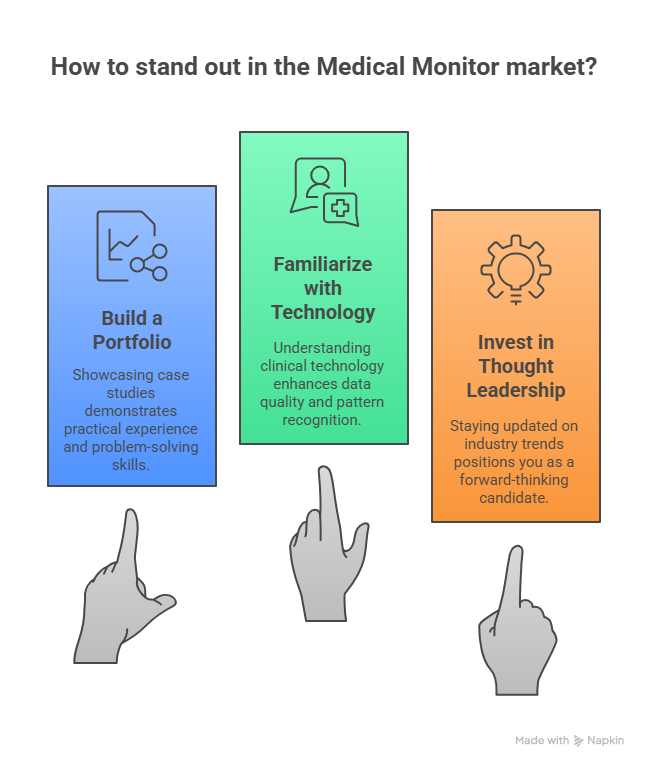
4) How to stand out in a crowded Medical Monitor market
In 2025, many physicians are exploring remote friendly roles such as Medical Monitor. Recruiters screen aggressively for candidates who can demonstrate impact rather than only credentials. One practical way to stand out is to build a portfolio of case studies that describe how you handled challenging benefit risk situations. These can come from PV work informed by pharmacovigilance prep guides or from investigator experience where you balanced patient needs with protocol requirements.
You should also develop familiarity with the wider clinical technology ecosystem. Medical Monitors who understand tools listed in top 50 remote monitoring platforms and top 100 data management and EDC platforms can ask better questions about data quality. They see patterns in monitoring findings that signal design issues rather than isolated site errors. This makes you a more valuable partner to project managers and quality leads who must keep trials inspection ready.
Finally, invest in thought leadership and continuous learning. Reading on AI powered clinical trials, blockchain in trials, and virtual reality or augmented reality in research helps you anticipate how future protocols will look. When you reference these trends in interviews and internal discussions, you signal that you are not just filling a current vacancy but can help the company navigate the next decade of change.
5) Future proofing your Medical Monitor career in AI driven and decentralized research
AI and decentralized trials are reshaping where Medical Monitors spend their time. Algorithms are increasingly used for signal detection and risk prediction. However, final decisions about patient safety, protocol continuation, and regulatory communication still require human judgement. Articles that explore how AI predicts trial failures, AI driven job changes in research, and smart pills and digital biomarkers highlight the scale of data you will oversee. Your role is to interpret the models, challenge assumptions, and ensure that clinical logic remains sound.
Decentralized trials require Medical Monitors to think beyond the traditional site model. You will evaluate safety signals coming from remote visits, home nursing, and wearable devices. Learning from guides on decentralized trial disruption and patient recruitment megatrends can help you ask better questions about how patient reported data are validated, how missing data are handled, and how protocol deviations are defined in home based settings.
To stay relevant, Medical Monitors should also develop a basic understanding of regulatory and quality frameworks. Insight from regulatory affairs specialist roadmaps and clinical quality auditor pathways helps you design decisions that will withstand inspection. When regulators review your trials in a world of AI supported monitoring and digital biomarkers, they will still ask the same core questions about patient protection and data reliability. Medical Monitors who can translate new technology back into these familiar regulatory principles will remain in high demand.
6) Medical Monitor career FAQs
-
Most sponsors and CROs require a medical degree and some years of clinical practice, especially for high risk therapy areas. Active clinical practice is not always mandatory, but recent experience with patient care strongly improves credibility with investigators and regulators. If you have left practice, consider occasional clinical sessions or volunteer roles while you build trial experience. Complement this with structured learning such as principal investigator exam guides and PV certification resources so you can speak fluently about both patient reality and regulatory expectations.
-
Typical candidates have three to seven years of post residency experience, including at least two years in clinical research, PV, or development roles. Time alone is less important than evidence of complex decision making. You should be able to describe how you managed safety issues, contributed to protocol design, or interacted with regulators. Drawing from work that aligns with pharmacovigilance preparation strategies or project management responsibilities will give you strong examples for interviews and internal promotion discussions.
-
A principal investigator is responsible for study conduct at a specific site, while a Medical Monitor oversees medical aspects across all sites or even multiple trials. Investigators focus on their local participants and staff. Medical Monitors focus on protocol wide safety, consistency of event assessment, and benefit risk evaluation across the full dataset. If you already serve as an investigator, studying PI exam question sets and seeking sponsor level responsibilities such as protocol review or DMC participation can help you pivot into Medical Monitor roles.
-
Yes, many Medical Monitors come from PV. Your experience with case narratives, aggregate reports, and signal detection is highly relevant. To transition smoothly you should add trial operations knowledge and direct interaction with investigators. Engage with resources like the pharmacovigilance certification exam guide alongside material on CRA or project manager certification. Aim to participate in protocol review meetings, risk management planning, and cross functional safety committees so you can demonstrate competence beyond case based decision making.
-
AI is automating repetitive tasks such as basic signal detection and listings review, yet it increases the demand for people who can interpret complex outputs. Trials that use tools described in AI powered trial articles and failure prediction insights generate more safety and efficacy information, not less. Medical Monitors will spend less time manually scanning tables and more time discussing scenarios with DMCs, regulators, and executives. Developing basic literacy in statistics, data science and AI model limitations is the best way to stay relevant while these technologies expand.
-
Large global pharma offers stability, complex portfolios, and clear pathways into medical director or therapeutic area leadership roles. High growth biotech can provide faster responsibility and equity upside, but sometimes with leaner support structures. PV vendors, CROs and technology companies featured in lists such as top 50 contract research vendors or top 75 remote PV programs increasingly hire Medical Monitors to support specialized services. Choose environments that match your risk appetite, preferred therapy areas and interest in innovation such as decentralized or AI heavy trials.
