
Is Pharmacovigilance a Good Career in 2026? Reddit Experiences on Hiring, Pay, Remote Work & Long-Term Growth
Pharmacovigilance remains a serious career option in 2026, particularly for people who can move beyond routine case processing into safety science, signal management, compliance, systems, aggregate reporting, and benefit-risk work. The harder question is where you enter the field and what skills you build after entry. Current hiring discussions show real competition for junior roles, while experienced professionals still find value in global pharmacovigilance compliance, drug-safety reporting, PV inspection readiness, and broader clinical trial safety oversight.

1. Is Pharmacovigilance a Good Career in 2026? The Answer Depends on Which Part of PV You Enter
Pharmacovigilance has a durable reason to exist: medicines require continuing safety surveillance after approval, safety information changes over time, adverse events must be assessed and reported, signals must be evaluated, and regulators expect structured quality systems. The EMA's current Good Pharmacovigilance Practices framework still spans areas such as pharmacovigilance systems, inspections, audits, individual case safety reports, periodic safety reports, signal management, safety communication, and risk minimization. The framework was actively updated again in September 2026, including a revised inspection module.
That regulatory depth creates long-term work for people who understand pharmacovigilance compliance, safety-reporting requirements, audit and inspection preparation, clinical-trial safety oversight, and the broader relationship between patient safety and GCP.
The risk comes from assuming every PV job has the same career ceiling.
Entry-level work may center on ICSR intake, duplicate checks, data entry, MedDRA coding, narrative preparation, seriousness assessment support, expectedness checks, follow-up, quality control, and regulatory submission timelines. Those tasks teach the machinery of drug safety, yet spending too many years performing only high-volume case processing can make progression harder. Candidates who understand clinical data integrity, regulatory compliance, quality management, protocol compliance, and safety-event reporting have more directions in which to expand.
That distinction appears clearly in 2026 Reddit discussions. One March thread involving a new PV associate raised concerns about whether entry-level work would become repetitive case processing, while an experienced commenter argued that analytics and broader safety capabilities would become increasingly important. Another April discussion described slow hiring and suggested that automation-related opportunities are emerging inside existing safety operations, signal, systems, and compliance roles rather than appearing under obvious “PV + AI” titles. These are individual experiences rather than labor-market statistics, but they reveal an important career pressure point.
So pharmacovigilance can be a strong career in 2026 if the first job becomes a platform for building scarce expertise. Someone who progresses from case processing into global regulatory compliance, inspection readiness, signal management, aggregate safety writing, systems, epidemiology, or medical review creates a very different career from someone whose résumé remains almost identical after five years.
2. Pharmacovigilance Hiring in 2026: Why Getting the First Job Feels Harder Than the Career Looks
The toughest stage of a PV career is often the entrance.
Employers may advertise junior titles while still preferring candidates who already understand ICSR workflow, MedDRA coding, seriousness, expectedness, causality, follow-up, narrative writing, regulatory timelines, and safety databases. That creates a version of the same entry-level experience Catch-22 seen across entry-level clinical research, CRC hiring, research-assistant training, and certification-versus-experience decisions.
Recent Reddit threads reflect that pressure. A June 2026 PharmD graduate described applying across PV, clinical research, data management, and drug-safety jobs despite relevant ADR reporting, clinical documentation, VigiFlow, and GCP exposure. Another September discussion from a B.Pharm/M.Pharm candidate showed the exact knowledge stack fresher applicants now try to build: ICSR processing, AE/ADR/SAE/SUSAR distinctions, seriousness, expectedness, causality, MedDRA, GCP, workflow, and Argus.
The lesson is that “interested in drug safety” is too weak a hiring proposition.
A stronger applicant understands how adverse-event reporting fits into global pharmacovigilance regulation, how case quality affects clinical data integrity, how safety work connects with medical-monitor responsibilities, and why ethical patient protection drives the reporting system in the first place.
For entry-level hiring, the most useful skills are therefore practical.
Know how a case moves from intake to triage, data entry, coding, medical assessment, follow-up, QC, and submission. Be able to explain seriousness versus severity. Understand listedness and expectedness conceptually. Recognize why MedDRA coding consistency matters. Know what makes a narrative useful. Understand why missing dates, indications, laboratory values, reporter details, concomitant medicines, and medical history can weaken assessment. Connect those details to regulatory safety reporting, quality-management principles, audit readiness, and regulatory compliance.
Professional background also changes the entry route. Pharmacists may have stronger medication knowledge. Physicians and PAs can bring differential diagnosis, comorbidities, laboratory interpretation, and causality reasoning. Nurses may bring patient assessment and documentation experience. Life-science graduates may need to demonstrate more applied safety workflow knowledge. A June 2026 Reddit thread from a PA-C with five years of internal-medicine experience showed this exact dilemma: substantial clinical knowledge still did not automatically answer whether the appropriate first title was safety scientist, drug-safety associate, or another PV role.
That is why candidates should avoid collecting certificates without building usable proof. Clinical research certification ROI, practical research training, GCP-level safety knowledge, regulatory affairs fundamentals, and PV compliance knowledge create the most value when they improve the candidate's ability to solve realistic safety problems.
3. Pharmacovigilance Salary in 2026: Why Job Title, Employer and Specialization Matter More Than the Word “PV”
PV pay is unusually difficult to summarize because companies use overlapping titles for dramatically different jobs.
As of September 1, 2026, Salary.com estimates a U.S. Pharmacovigilance Associate average around $53,575, with a 25th-to-75th percentile range of roughly $47,691-$58,474. Its separate Drug Safety Associate category averages approximately $75,123, while its Pharmacovigilance Specialist category averages approximately $112,619. Those categories overlap conceptually, which demonstrates why candidates should compare actual responsibilities rather than assume that “associate,” “specialist,” or “scientist” represents a standardized industry level.
Current job advertisements make the spread even clearer. A September 2026 U.S. remote listing for an Associate, Pharmacovigilance Operations/Drug Safety role advertised $90,000-$115,000, while other current remote PV listings span specialist, systems, management and executive work at much higher ranges. These examples show market possibilities rather than guaranteed salary bands.
Your earning trajectory depends heavily on the work you accumulate.
Someone doing standardized case processing may encounter a ceiling sooner than someone who acquires expertise in global regulatory compliance, PV inspections, safety systems, signal management, aggregate reporting, benefit-risk evaluation, or medical safety oversight. The same pattern appears elsewhere in clinical development, where CRA compensation changes materially with employer type, responsibility, and experience, and CRO versus sponsor roles can create different career economics.
Reddit reports illustrate the plateau problem particularly well. A July 2026 poster with six years in drug safety described earning slightly above $90,000 at a CRO and feeling that salary growth had flattened. Commenters emphasized changing companies, moving toward sponsors, or expanding beyond case review into more valuable work such as signals. The same thread also contained concern about limited openings and offshoring. These are anecdotal experiences, yet they highlight a structural issue: career growth can stall when responsibilities stop expanding.
A 2025 UK discussion showed a similar theme from another market: an eight-year PV professional in management reported low-£50,000s compensation while working fully remotely and questioned whether the field had become underfunded relative to neighboring clinical-research functions.
This makes specialization an economic strategy, not just a learning strategy. Experience with pharmacovigilance audits, regulatory submissions, safety oversight, quality systems, and global PV compliance makes a professional harder to replace than someone whose only differentiator is throughput.
4. Is Pharmacovigilance Remote-Friendly in 2026? Yes, but Remote Work Is Unevenly Distributed
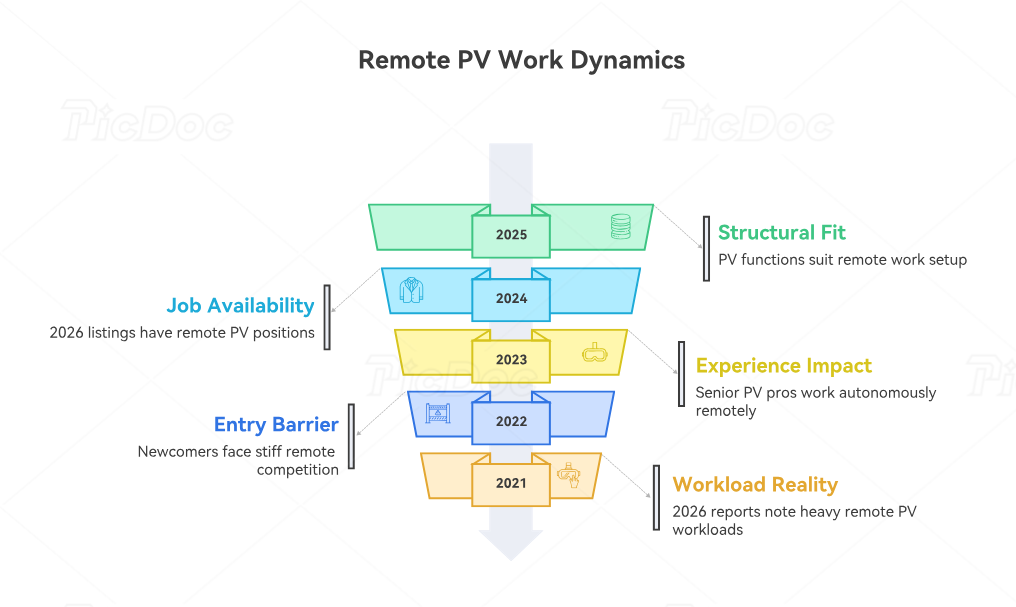
Pharmacovigilance is structurally compatible with remote work because much of the function revolves around safety databases, medical records, literature, coding, regulatory documentation, review workflows, signal evaluation, written communication, and virtual cross-functional collaboration.
Current U.S. listings confirm that fully remote PV work still exists across multiple levels. Indeed listings in September 2026 included remote PV operations/drug-safety positions, safety-system consulting, specialist work, and senior leadership. LinkedIn was also surfacing a large remote pharmacovigilance search inventory, although broad search counts can include adjacent safety and technology roles and should not be treated as a precise count of pure PV vacancies.
The opportunity is distributed unevenly.
A senior specialist with years of regulatory compliance, PV audit, signal, aggregate, system, and safety-oversight experience can often function autonomously. A beginner still learning clinical safety reporting and quality-management fundamentals competes with a much larger applicant pool for each remote vacancy.
That matters because remote work can accidentally become an entry barrier. A candidate may reject three strong hybrid roles that provide database access, case ownership, reviewer feedback, inspection exposure, and mentoring while spending six months chasing one fully remote opening with hundreds of applicants.
The better question is therefore: What arrangement gives you the highest-value experience per year?
For someone already competent in global PV regulation, safety event assessment, regulatory documentation, quality systems, and inspection readiness, remote flexibility can be an excellent career benefit. For someone with zero PV experience, proximity to stronger training may be worth more than location flexibility during the first year.
Remote also does not guarantee light workload.
A 2026 Reddit discussion about PV automation included an experienced worker describing 12-to-14-hour case-processing days in a service environment, illustrating how remote or technology-enabled work can still be throughput-driven. Another UK PV manager described being fully remote while still feeling financially stalled. These individual reports should not be generalized to every employer, but they show why candidates should evaluate workload, staffing ratios, case volumes, weekend coverage, follow-up queues, quality targets, and after-hours expectations separately from the word “remote.”
Ask better interview questions: How many cases does the team process? How is productivity measured? What percentage of work is outsourced? Who handles medical review? Are employees cross-trained in signals or aggregate reports? Does the role include audit preparation? How much exposure exists to regulatory compliance, safety oversight, data quality, and risk management?
Those answers predict career quality better than the home-office benefit alone.
5. Long-Term Pharmacovigilance Growth: The Safest Strategy Is to Move Toward Judgment, Systems and Safety Strategy
PV is evolving rather than disappearing.
The parts most exposed to automation and cost pressure are the highly standardized ones: intake classification, duplicate checks, structured extraction, coding suggestions, workflow routing, quality flags, literature triage, and portions of repetitive case documentation. That makes career planning increasingly important for professionals whose responsibilities remain concentrated in manual processing.
The defensive move is to become stronger at tasks requiring context and judgment: signal validation, clinical assessment, benefit-risk reasoning, complex case review, aggregate interpretation, inspection response, CAPA, vendor oversight, governance, risk minimization, safety systems, and cross-functional decision-making. Those capabilities connect directly with PV compliance, pharmacovigilance inspections, medical safety oversight, regulatory affairs, and clinical research quality systems.
Current regulation supports this direction. EMA's GVP framework continues to cover signal management, pharmacovigilance audits, inspections, risk minimization, safety communication, periodic safety reporting, and post-authorization safety studies. The agency also notes upcoming GVP updates associated with ICH E2D(R1) and ICH M14 developments.
That creates multiple career ladders.
An operations professional can progress from case processing to QC, team leadership, vendor governance, and safety operations management. A scientifically oriented professional can move toward medical review, signal management, aggregate reporting, benefit-risk, or pharmacoepidemiology. A technically minded professional can specialize in safety databases, validation, integrations, automation, analytics, or systems implementation. A compliance-oriented professional can build toward PV auditing, quality management, global regulatory compliance, inspection management, and governance.
The career trap is staying broad enough to remain replaceable but narrow enough to lack specialist leverage.
After the first 12-24 months, ask what you can now do that a new graduate cannot. After three years, ask what safety decisions you own. After five years, ask whether employers are buying your time or your judgment. Those questions reveal whether your career is compounding.
Candidates can also increase geographic mobility by understanding how PV expectations vary by market. Someone exploring U.S. pathways can compare state-specific preparation such as pharmacovigilance certification in California, Florida, Illinois, Massachusetts, or Maryland while still prioritizing actual employer requirements and practical experience.
The strongest 2026 PV career strategy is therefore simple: use entry-level operations to learn the system, then deliberately move toward work involving interpretation, ownership, regulation, technology, or scientific judgment.
6. FAQs About Pharmacovigilance Careers in 2026
-
Yes, particularly for professionals who build beyond basic transactional case work into safety science, signal management, aggregate reporting, systems, quality, medical review, risk management, or global pharmacovigilance compliance.
The field continues to operate under extensive regulatory requirements involving adverse-event reporting, inspection readiness, clinical safety oversight, and quality management. EMA's GVP framework also remained actively updated in 2026.
-
The first role can be difficult because many employers prefer applicants who already understand ICSR processing, MedDRA, safety terminology, narratives, seriousness, expectedness, follow-up, quality checks, and safety systems.
Treat this like the broader clinical research experience Catch-22. Combine appropriate training with practical clinical research preparation, safety-reporting knowledge, regulatory fundamentals, and quality-system awareness.
-
Signal management, medical review, aggregate reporting, benefit-risk assessment, pharmacoepidemiology, PV quality, audits, compliance, safety systems, analytics, vendor oversight, and risk management all move professionals toward higher-judgment work.
A strong foundation should still include adverse-event reporting, patient-safety principles, clinical data integrity, PV audits and inspections, and global regulatory compliance.
-
Many PV jobs can be performed remotely, and current September 2026 listings include fully remote operations, systems, specialist, management, and leadership opportunities. Remote availability varies by employer, geography, seniority, and responsibility.
Early-career candidates should weigh remote flexibility against the quality of training and exposure they can obtain. A hybrid role providing direct experience with safety reporting, PV compliance, quality systems, and inspection preparation can create better long-term remote options.
-
It can, but title and responsibility create enormous variation. Current U.S. salary estimates differ sharply between Pharmacovigilance Associate, Drug Safety Associate, and Pharmacovigilance Specialist categories, while live remote job advertisements show that experienced roles can pay substantially more.
Higher-value experience in regulatory compliance, medical safety oversight, PV inspections, regulatory affairs, and safety strategy generally creates stronger negotiating leverage than years of repetitive throughput alone.
-
AI and automation are more likely to reshape the work unevenly. Highly structured processing activities are easier to automate than complex causality assessment, signal interpretation, benefit-risk decisions, inspection response, safety strategy, governance, or nuanced medical review.
That makes PV quality expertise, global compliance knowledge, clinical safety judgment, inspection capability, and strong data-integrity thinking increasingly valuable.
Recent Reddit discussions from PV professionals similarly frame AI as something being absorbed into operations, systems, signal, compliance, and automation work rather than creating a simple replacement of the whole profession.
