
Best Clinical Research Certificate Programs Compared (CCRPS vs. ACRP vs. SOCRA)
Breaking into clinical research is hard enough without picking the wrong certificate path first. Many professionals waste time chasing a credential that looks impressive on paper but does not match their role, experience level, hiring target, or day-to-day responsibilities. This comparison cuts through that confusion. It shows where CCRPS, ACRP, and SOCRA differ in structure, positioning, eligibility style, learning experience, and career fit so you can choose a program that actually helps you move forward instead of giving you a logo with weak practical payoff.

1. Why This Comparison Matters More Than Most People Realize
A lot of people approach certification the wrong way. They search “best clinical research certificate,” see familiar names, then assume the most recognized option must be the best option for them. That shortcut causes expensive mistakes. In clinical research, the better question is not “Which brand is biggest?” It is “Which path matches my role, my starting point, my experience, and the kind of work I need to prove I can do?”
That distinction matters because CCRPS, ACRP, and SOCRA do not occupy the exact same lane. CCRPS presents role-specific, workforce-aligned clinical research training and certification programs built around practical execution readiness, while ACRP centers professional certification exams such as ACRP-CP, CCRC, CCRA, and CPI, and SOCRA centers its CCRP credential as a broad clinical research certification tied to eligibility and examination standards. Official provider materials show that these organizations differ in program structure, eligibility framing, maintenance cycles, and how specialized or role-targeted their offerings are.
This is exactly why people moving into a clinical research coordinator career path, a clinical research associate role, a clinical trial manager track, or a clinical research project manager path need more than a surface-level ranking. They need to know whether the credential helps them gain entry, move up, shift functions, or validate years of experience they already have.
The confusion gets worse because clinical research hiring is not one market. A site coordinator, sponsor-side CRA, investigator, pharmacovigilance professional, regulatory associate, and clinical operations manager are all operating under the same broad industry umbrella, but their credibility signals are different. Someone trying to strengthen readiness for GCP compliance, regulatory documents, adverse event reporting, protocol management, and audit readiness may need a very different learning experience than someone who already has deep field experience and wants a standardized exam-backed credential.
That is why this comparison is valuable. It does not pretend all three options solve the same problem. It shows what each one is really best for.
Best Clinical Research Certificate Programs Compared: High-Value Decision Matrix (25+ Factors)
Use this to choose the credential that actually matches your role, experience, and hiring target.
| Comparison Factor | CCRPS | ACRP | SOCRA |
|---|---|---|---|
| 1. Core positioning | Role-specific workforce-aligned training + certificate programs | Professional certification body with exam-based credentials | Professional certification body with broad CCRP credential |
| 2. Best known for | Practical preparation for specific job tracks | Recognized role-based and broad research certifications | One broad credential across clinical research settings |
| 3. Role targeting | High | High for certain credentials | Moderate; broader umbrella approach |
| 4. Beginner friendliness | Strong | Often less beginner-oriented if eligibility is a barrier | Can be less direct for true beginners depending on eligibility |
| 5. Experience-first model | Less dependent on prior long experience for learning pathway | Strongly exam-and-eligibility oriented | Strongly eligibility-and-exam oriented |
| 6. Main value type | Learning + execution readiness | Validation of professional competence | Validation across broad clinical research practice |
| 7. Study format | Self-paced online program structure | Certification exam route with prep resources | Certification exam route |
| 8. Ideal for career changers | Often strong fit | Depends on eligibility and background | Depends on eligibility and background |
| 9. Ideal for working coordinators | Good if skills need building | Very good if validating experience | Very good if seeking broad credential |
| 10. Ideal for CRAs | Good for targeted training tracks | Strong through CCRA/ACRP-CP | Broad rather than CRA-specific |
| 11. Ideal for investigators | Some role-based relevance | Strong through CPI | Possible if role fits clinical research practice scope |
| 12. Credential granularity | Multiple role-focused programs | Multiple credentials and specialties | Single flagship credential |
| 13. Broadest credential option | No single broad exam focus like ACRP-CP/CCRP | ACRP-CP | CCRP |
| 14. Specialized credential options | Role-specific certificates | CCRC, CCRA, CPI, specialties | Less specialized by title |
| 15. Maintenance cycle | Program-specific learning model, not positioned like recurring cert maintenance | Every 2 years | Every 3 years |
| 16. Main proof mechanism | Program completion | Passing standardized exam | Eligibility approval + passing exam |
| 17. Best for “I need practical training” | Strong | Moderate unless paired with prep and experience | Moderate unless paired with experience |
| 18. Best for “I need a recognized exam credential” | Moderate | Strong | Strong |
| 19. Best for “I need role clarity” | Strong | Strong in role-specific certifications | Broader orientation |
| 20. Best for “I need broad research credibility” | Moderate | Strong | Strong |
| 21. Common buyer mistake | Assuming certificate alone replaces experience | Choosing it before meeting fit or readiness | Assuming one broad credential fits every hiring need |
| 22. Hiring signal type | Training readiness signal | Certification credibility signal | Certification credibility signal |
| 23. Good for role transitions | Often yes | Yes if target credential fits role history | Yes if broad recognition is the goal |
| 24. Learning depth by role | Usually stronger by track | Depends on prep and experience base | Depends on prep and experience base |
| 25. Best first step for true newcomers | Often the most direct | Not always the easiest first move | Not always the easiest first move |
| 26. Best for experienced professionals seeking validation | Good but not always the primary reason | Excellent | Excellent |
| 27. Best for one-size-fits-many credential seekers | Less so | Good with ACRP-CP | Good with CCRP |
| 28. Best for exam-driven achievers | Moderate | Strong | Strong |
2. What CCRPS, ACRP, and SOCRA Actually Offer
The first mistake people make in this comparison is treating all three as interchangeable “certification providers.” They overlap, but they are not identical.
CCRPS markets clinical research certification and training programs that are role-specific and online, including tracks such as coordinator and associate training. It explicitly positions its programs as professional education for adult learners and says it does not issue academic degrees or medical licensure. Official CCRPS materials also describe its programs as workforce aligned and designed to strengthen role competence, regulatory alignment, documentation discipline, and audit readiness.
That means CCRPS is usually best understood as a training-forward option. If someone wants structured learning tied to real operational work such as GCP essentials for CRAs, informed consent procedures, managing protocol deviations, study documentation, and clinical trial auditing, CCRPS is operating in a lane that emphasizes preparation and applied readiness more than a pure exam-validation model.
ACRP is different. Its official certification pages position ACRP as a long-established certification body offering ACRP-CP, CCRC, CCRA, and CPI, plus specialty programs. ACRP frames these credentials as standardized demonstrations of clinical research knowledge and skills, with maintenance required every two years.
So when people choose ACRP, they are often choosing it because they want an exam-based professional credential that signals established competence. This can be especially attractive for professionals already working in research who want stronger external validation for roles tied to CRA monitoring techniques, site selection and qualification, CRC responsibilities, PI oversight, and clinical operations leadership.
SOCRA also sits in the certification-validation lane, but with a different structure. Its official materials present CCRP as a broad certification for clinical research professionals across pharmaceuticals, biologics, devices, and behavioral research, grounded in GCP, CFRs, and ethical principles. SOCRA also requires eligibility plus a passing exam, and it states that certification maintenance is on a three-year cycle.
That broader framing is important. SOCRA often appeals to people who want one credential that travels across settings rather than one tightly role-labeled certification.
3. Which Program Is Best for Different Types of Clinical Research Professionals
The right answer changes dramatically depending on who you are.
If you are a true beginner, career changer, or someone trying to break into research without much direct experience, CCRPS will often make more sense as a first move. That is not because exam-based credentials are weak. It is because beginners usually do not just need validation. They need skill-building, role understanding, vocabulary, workflow fluency, and practical confidence. Someone entering research for the first time usually needs grounding in case report forms, randomization, blinding, primary versus secondary endpoints, and placebo-controlled trial design before they need a highly standardized exam signal.
If you are already working as a coordinator or associate and want to prove competence to employers, ACRP can be very strong. Its role-specific certifications are appealing because they map more explicitly to recognizable industry functions. For people who are already doing the job and want a recognized credential, exam-based validation can carry weight precisely because it is harder to dismiss as simple course completion. That logic is especially strong for professionals advancing in CRA career pathways, CRC advancement tracks, clinical data management careers, regulatory specialist careers, and quality auditor careers.
If you want a broad umbrella credential that can apply across multiple clinical research environments, SOCRA becomes attractive. Its single flagship CCRP may feel cleaner to professionals who do not want to choose among several role-labeled certifications, especially if their work spans site, sponsor, investigator, or mixed operational settings. Its broad scope under GCP and ethical principles supports that positioning.
The clearest way to think about it is this:
CCRPS is often strongest when the question is, “How do I learn the work and become more execution ready?”
ACRP is often strongest when the question is, “How do I validate my role-specific professional competence through a recognized certification exam?”
SOCRA is often strongest when the question is, “How do I earn a respected broad clinical research credential that is not confined to one narrow title?”
That framework is partly an inference from how each provider describes its own offerings. The official pages support the structural differences, and the career-fit interpretation comes from those differences rather than from a provider claiming that exact language.
What is your biggest certification decision blocker right now?
Choose one. Your answer points to the program type you probably need first.
4. Where Buyers Get This Decision Wrong
The worst comparison habit is comparing these programs as if they are all solving the same pain point. They are not.
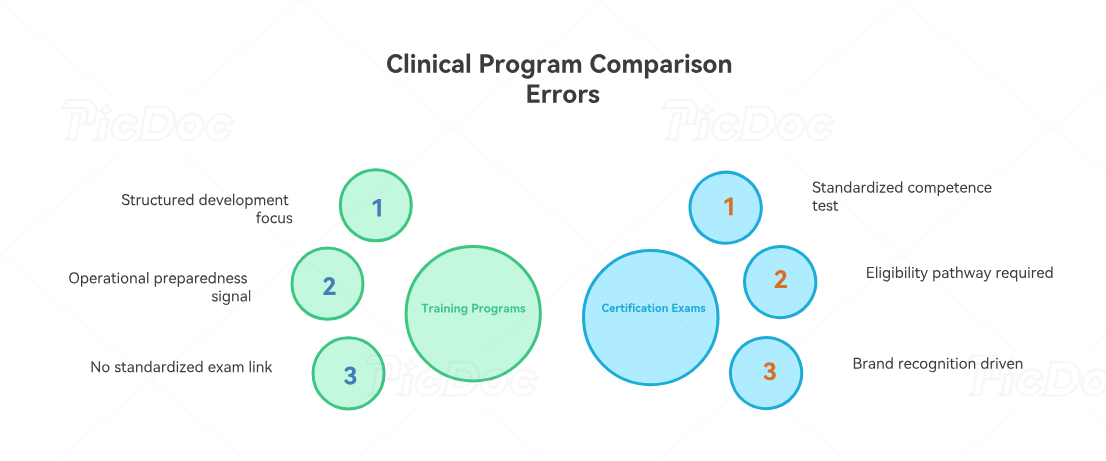
One common mistake is letting brand recognition outweigh fit. Someone sees ACRP or SOCRA discussed frequently in hiring circles and assumes that must be the smartest move, even if they are still weak on the fundamentals of informed consent, patient recruitment, regulatory submissions, drug safety timelines, or clinical trial sponsor responsibilities. That person may be buying credibility before building competence.
Another mistake is assuming course completion and certification exam success send the exact same hiring signal. They do not. Employers may read them differently. Training-forward programs can say, “This person invested in structured development and may be operationally better prepared.” Exam-backed certifications can say, “This person met eligibility and passed a standardized competence assessment.” Those are both useful, but not interchangeable.
A third mistake is ignoring eligibility friction. Official ACRP and SOCRA materials place heavy importance on eligibility pathways and exam readiness. If a professional is too early in their career, or their background does not map cleanly enough yet, forcing the wrong exam path too soon can create frustration, delay, and wasted energy.
The fourth mistake is choosing a credential with no connection to the actual role you want next. Someone targeting pharmacovigilance associate roles, drug safety specialist tracks, medical science liaison paths, research assistant careers, or clinical trial assistant roles should not compare these options in a generic vacuum. The question is always: which one helps this next step?
5. The Smartest Way to Choose Between CCRPS, ACRP, and SOCRA
Use a three-part filter.
First, define your actual problem. If your problem is lack of practical readiness, choose the option that solves readiness. If your problem is lack of recognized external validation, choose the option that solves validation. If your problem is role ambiguity, choose the option with the clearest role alignment. This sounds simple, but most people skip it.
Second, define your career stage honestly. If you are still building fluency in clinical trial protocol development, research compliance and ethics, laboratory best practices, medical monitor responsibilities, or signal detection and management, be careful about overvaluing prestige over preparedness. The market punishes weak execution much faster than it rewards logo collecting.
Third, define your target employer signal. Site-based employers, CROs, sponsors, and hybrid organizations do not always look for the exact same proof points. In some cases, role-specific training with clear operational relevance may be the smartest first credential. In others, standardized certification can be a stronger differentiator. If you are aiming for a mature professional signal after already doing the work, ACRP or SOCRA may make more strategic sense. If you are trying to get into the work, CCRPS may be the more direct launchpad.
The most practical summary is this:
Choose CCRPS when you need structured, role-focused learning that helps you perform better and become more job-ready.
Choose ACRP when you want standardized certification credibility, especially if your role maps well to one of its established credentials and you are ready for that validation model.
Choose SOCRA when you want a broad credential spanning clinical research practice rather than one tightly defined by a single title.
Official sources support the structural distinctions behind that recommendation, while the final “best for” guidance is a practical fit analysis based on those distinctions.
6. FAQs
-
For many true beginners, CCRPS is often the most direct first step because it is training-forward and role-specific. ACRP and SOCRA are excellent options, but they are more naturally aligned with professionals seeking exam-based validation and who are better positioned for eligibility and certification strategy.
-
Often, yes. ACRP offers multiple credentials such as ACRP-CP, CCRC, CCRA, and CPI, which makes it more role-differentiated. SOCRA’s CCRP is broader and less title-specific in how it is positioned on official materials.
-
Yes. That is one of the strongest strategic reasons to consider it. SOCRA positions CCRP as covering human clinical research across pharmaceuticals, biologics, devices, and behavioral research, which can appeal to professionals whose work is not confined to one narrow function.
-
No. CCRPS is more training-and-program oriented, while ACRP and SOCRA are more exam-and-certification oriented in their official positioning. That structural difference should drive the decision more than raw name recognition.
-
According to official provider pages, ACRP credential holders maintain certification every two years, while SOCRA states that CCRP certification is valid for three years before renewal.
-
Choose based on the job-to-be-done. If you need practical readiness, lean toward CCRPS. If you need role-specific certification credibility, lean toward ACRP. If you need a broad cross-setting research credential, lean toward SOCRA. Then pressure-test that choice against your experience level, target role, and actual hiring market.
