
Clinical Research Regulatory Guidelines Worldwide: Definitive Interactive Directory
Clinical research teams working across borders do not struggle because guidelines are impossible to find. They struggle because the rules are spread across different regulators, different approval models, different ethics structures, different safety reporting expectations, and different submission systems. One missed regional requirement can stall activation, trigger preventable amendments, or expose a study to inspection risk. This definitive directory turns that fragmentation into a usable operating map so sponsors, CRAs, CRCs, PIs, and regulatory teams can identify the right authority, the right framework, and the right submission path faster.
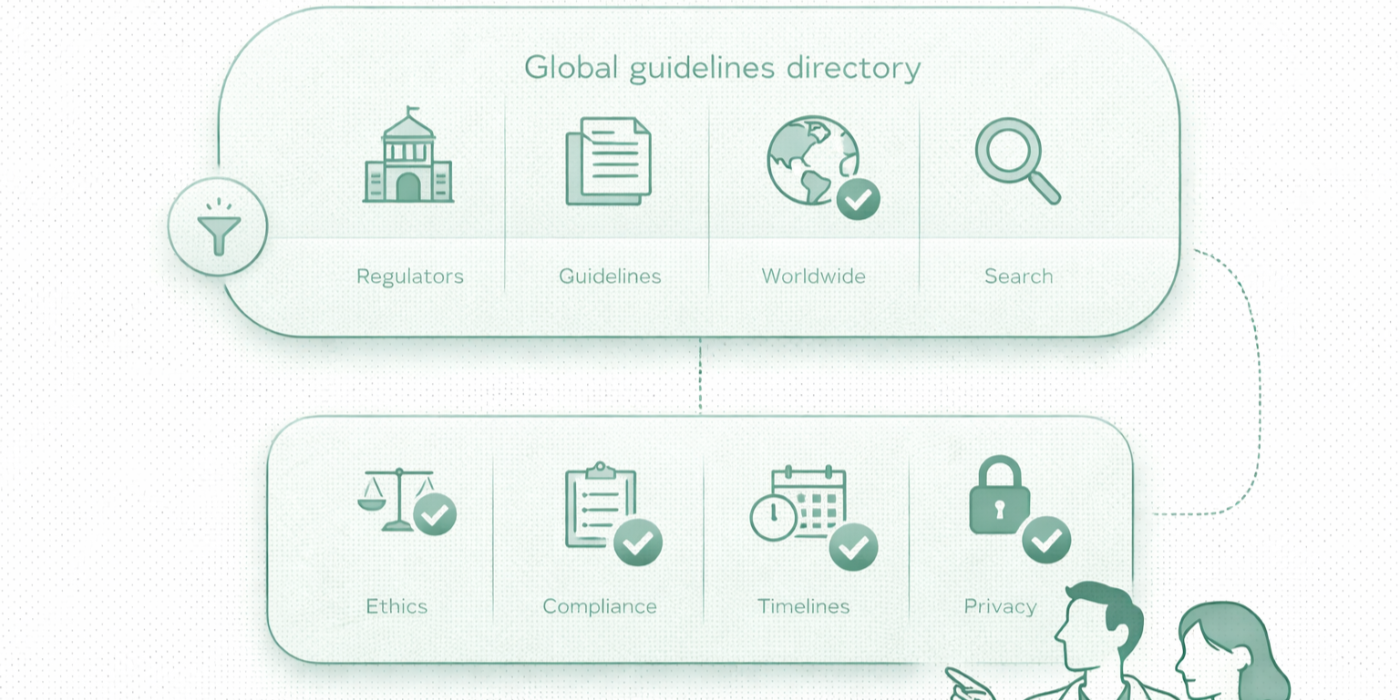
1. Why a Worldwide Regulatory Directory Matters in Modern Clinical Research
Global clinical trials are not governed by one master rulebook. Teams usually work inside a layered system: an international GCP backbone, national or regional drug and device rules, ethics review requirements, safety-reporting obligations, data transparency expectations, and sometimes a country-specific portal or approval workflow. ICH E6(R3) exists to support a unified GCP standard for trials involving human participants, and WHO’s 2024 best-practices guidance pushes countries toward robust, ethical, efficient, and fit-for-context clinical trial systems, but those high-level frameworks do not replace local law.
That is where teams get hurt. A study may be well built scientifically, with strong thinking around randomization techniques, blinding in clinical trials, primary vs. secondary endpoints, placebo-controlled trial design, and sample size planning, yet still slow down because the operational team misunderstands who must approve the trial, which dossier format applies, or whether the regulator expects a portal-based application, an authorization plus ethics route, or a notification model.
A regulatory directory matters because it closes the gap between theory and execution. It helps teams align GCP guidelines mastery, informed consent procedures, clinical trial documentation under GCP, protocol deviation management, and clinical trial audits and inspection readiness with the actual regulator-facing requirements of the countries where they want to run the study.
The other reason this topic matters is that the regulatory picture is changing. The EU now runs under the Clinical Trials Regulation with CTIS as the single-entry system, the UK continues to update its MHRA clinical-trials guidance, ICH E6(R3) has been finalized, WHO has updated its global guidance, and multiple regulators are refining approaches to risk proportionality, decentralized elements, transparency, or application modernization. A team using a stale “global submissions checklist” can make expensive mistakes very quickly.
Clinical Research Regulatory Guidelines Worldwide: Interactive Directory Matrix
Use this high-value map to identify the main authority, framework, and approval logic before you build your country start-up plan.
| Country / Region | Main Authority / System | Key Framework / Rule | Core Submission / Approval Logic | High-Value Operational Note |
|---|---|---|---|---|
| Global / ICH | ICH | ICH E6(R3) GCP | Not a country approval path; foundational cross-border standard | Use as the quality backbone, not a substitute for local law |
| Global / WHO | WHO | WHO Guidance for Best Practices for Clinical Trials | Framework guidance for countries and systems | Useful for policy alignment, quality-by-design, efficiency, and inclusivity thinking |
| United States | FDA | 21 CFR 312, 812, 50, 56 | IND/IDE plus human-subject and IRB requirements | Do not separate investigational product rules from informed consent and IRB obligations |
| European Union / EEA | European Commission / EMA / CTIS | Clinical Trials Regulation (EU) No 536/2014 | Single submission through CTIS with coordinated assessment | From 31 Jan 2025 all EU/EEA trials must run under CTR via CTIS |
| United Kingdom | MHRA | UK clinical trials guidance hub | Authorization route for medicines trials through UK process | Check current UK guidance because MHRA has been actively updating it |
| Canada | Health Canada | Clinical Trial Applications guidance; Food and Drug Regulations | CTA route for pharmaceutical, biologic, and radiopharmaceutical trials | Canada separates practical CTA guidance clearly by application type |
| Australia | TGA | Australian Clinical Trial Handbook; CTN / CTX pathways | Clinical Trial Notification or Clinical Trial Approval pathways | Know which pathway fits the product and risk profile before start-up |
| Japan | PMDA / MHLW | Clinical trials regulatory information and notifications | Regulator-facing application and review process through Japanese framework | Japan requires close attention to local notifications and PMDA procedural materials |
| Switzerland | Swissmedic + Ethics Committee | Swiss clinical trials framework | Approval by Ethics Committee and Swissmedic | Dual approval logic must be built into timelines |
| Singapore | HSA | CTA / CTN / CTC routes and GCP inspection resources | Pathway depends on the product and study type | Do not assume one universal application route in Singapore |
| India | CDSCO | New Drugs and Clinical Trials Rules, 2019 | Clinical trial permissions under NDCTR framework | Use the current rules, not old summary notes copied from legacy decks |
| Brazil | Anvisa | Clinical research manuals and trial dossier guidance | Country-specific dossier and submission procedures | Brazil requires attention to Anvisa manuals, safety, amendments, and dossier instructions |
| South Africa | SAHPRA | SA GCP 2020 + CT guidelines | Regulatory review plus country-specific clinical trial guidelines | South Africa has strong published guidance on investigators, safety, monitoring, and post-trial access |
| China | NMPA / CDE | Drug clinical trial review under NMPA/CDE framework | Applications reviewed through China’s drug-review structure | Monitor NMPA/CDE updates closely because China continues refining review processes |
| New Zealand | Medsafe | Clinical trials guideline consultation and approval guidance | Medsafe-administered approval process | Current guidance has been under modernization, so always check the latest version |
| EU Portal Function | CTIS | EU portal and database | Single-entry point for sponsors and regulators | CTIS workflow training is now an operational requirement, not a nice-to-have |
| Australia Ethics Layer | HREC / institutions | Australian Clinical Trial Handbook | Ethics and institutional approvals interact with TGA pathways | Notification does not mean ethics and site processes disappear |
| US Devices | FDA | 21 CFR 812 | IDE framework for device investigations | Do not run device studies using drug-only assumptions |
| US Drugs | FDA | 21 CFR 312 | IND framework for investigational drugs | Pair IND planning with IRB, consent, and safety obligations early |
| US Human Subjects | FDA | 21 CFR 50 | Informed consent requirements | Consent noncompliance can sink an otherwise strong trial |
| US IRB Oversight | FDA | 21 CFR 56 | IRB review and oversight requirements | IRB logic must be built into activation readiness, not treated as a side task |
| UK Quality / Risk | MHRA | Quality and risk proportionality guidance | Risk-based quality approach within UK trial conduct | Important for modern RBQM planning and proportionate oversight |
| Canada DCT Direction | Health Canada | Draft decentralized clinical trials guidance | Emerging guidance for decentralized elements | Check status before assuming decentralized practices are fully settled |
| Singapore Transparency | HSA | Clinical Trials Register | Public register for ongoing trials in HSA applications database | Transparency obligations are operational, not just public-relations items |
| South Africa Safety | SAHPRA | Safety Reporting During Clinical Trials guidance | Country-specific safety expectations | Do not import another region’s safety process without local validation |
| Brazil Amendments | Anvisa | Manuals for modifications, amendments, suspensions, cancellations | Structured procedural management of trial changes | Brazil change-control planning should start before first submission |
| Switzerland Medicinal Products | Swissmedic | Clinical trial application guidance | Formal authorization procedure at Swissmedic | Application completeness matters because dual review affects timelines |
| Japan PMDA Information | PMDA | Clinical trials regulatory info page | Gateway to regulations and notifications | Use PMDA primary materials, not recycled secondary summaries |
2. The Main Regulatory Systems Every Global Trial Team Should Know
The cleanest way to understand worldwide regulation is to divide it into three layers. First is the international quality layer, where ICH E6(R3) and WHO guidance sit. Second is the legal authority layer, where national or regional regulators such as FDA, MHRA, Health Canada, TGA, PMDA, HSA, Swissmedic, CDSCO, Anvisa, SAHPRA, and NMPA control how a trial may be authorized, amended, monitored, or inspected. Third is the operational layer, where portals, ethics committees, institutional approvals, safety workflows, and country submission mechanics determine whether a study actually gets moving.
In the United States, the most important starting point is that FDA does not treat investigational drugs, devices, consent, and IRB oversight as one blur. The official FDA GCP and clinical-trials page points directly to the regulations teams live under: 21 CFR Part 312 for INDs, 21 CFR Part 812 for IDEs, 21 CFR Part 50 for informed consent, and 21 CFR Part 56 for IRBs. If your team only knows “FDA rules” in the abstract, it is not actually ready for clinical trial sponsor responsibilities, CRA monitoring techniques, serious adverse event procedures, regulatory documents, or inspection readiness.
In the EU/EEA, the center of gravity is the Clinical Trials Regulation and CTIS. The European Commission explains that Regulation (EU) No 536/2014 harmonizes rules, introduces a single submission via a single EU portal, and uses an assessment procedure leading to a single decision. The Commission’s broader clinical-trials page also states that from 31 January 2025 onward, all clinical trials in the EU/EEA must be conducted under the CTR using CTIS. That means teams who still rely on old country-by-country EU assumptions are exposed before they even start.
The UK now has its own MHRA-centered clinical-trials framework, and the practical point is not just that the UK is separate from the EU. It is that MHRA guidance is actively evolving. Its application guidance page was updated in March 2026, and its medicines clinical-trials hub and quality-and-risk-proportionality guidance show the UK’s emphasis on current process, safety, and proportionate oversight. Teams running multinational programs need a living UK playbook, not a post-Brexit placeholder paragraph.
Canada, Australia, and Switzerland are excellent examples of why “common-law country” or “Western regulator” shortcuts are dangerous. Health Canada uses CTA guidance under its drug regulations; Australia runs CTN and CTX pathways with TGA plus ethics and institutional layers; Switzerland requires Ethics Committee and Swissmedic approval for clinical trials. Those are three mature systems, but they are not operationally interchangeable.
Asia adds another layer of complexity. Japan’s PMDA clinical-trials page functions as a gateway to major regulations and notifications, Singapore’s HSA uses CTA, CTN, and CTC routes and maintains a Clinical Trials Register, India’s CDSCO anchors permissions under the New Drugs and Clinical Trials Rules, 2019, and China’s NMPA/CDE structure handles clinical-trial applications through its drug-review system. Those systems matter not just for submissions, but for how you build protocol management, drug safety reporting, aggregate reports in pharmacovigilance, regulatory affairs careers, and clinical data management execution.
3. How to Use This Directory Without Making Costly Regulatory Mistakes
The first mistake teams make is using directories as if they are a substitute for protocol-specific regulatory planning. A directory tells you where to start. It does not tell you whether your trial is drug, device, biologic, radiopharmaceutical, adaptive, decentralized, low-intervention, or mixed-mode in a way that changes the filing logic. It points you toward the primary framework so you can build the real country plan with the right local experts and current primary documents.
The second mistake is confusing ethics review with regulator authorization. In some jurisdictions, both matter and must be synchronized. Switzerland explicitly requires Ethics Committee and Swissmedic approval. Australia’s handbook is built around sponsor, HREC, investigator, and approving-authority roles. The US wraps regulatory requirements together with informed consent and IRB oversight. If your start-up plan separates “regulatory” from “ethics” so completely that nobody owns the integration point, delays become almost guaranteed.
The third mistake is copying safety workflows across countries. That is dangerous. South Africa publishes dedicated safety-reporting guidance. Singapore explicitly lists adverse-event reporting as part of its clinical-trials framework. FDA, Health Canada, MHRA, and PMDA all expect country-specific compliance with their own legal structures. Safety logic has to be localized the same way adverse event reporting techniques, SAE handling, medical monitor oversight, signal detection, and risk management plans are localized.
The fourth mistake is treating portals as admin trivia. CTIS in the EU is not a minor technical detail. It is the single-entry point for sponsors and regulators. Likewise, application systems and structured submission routes in other jurisdictions can determine whether your dossier is even reviewable. When teams underinvest in portal readiness, user roles, document structure, and change-control discipline, they create delays that have nothing to do with science and everything to do with execution.
What is your biggest global regulatory blocker right now?
Choose one. Your answer points to the part of your country-start-up process that is most likely to fail first.
4. The Highest-Impact Regional Differences Sponsors and Study Teams Must Watch
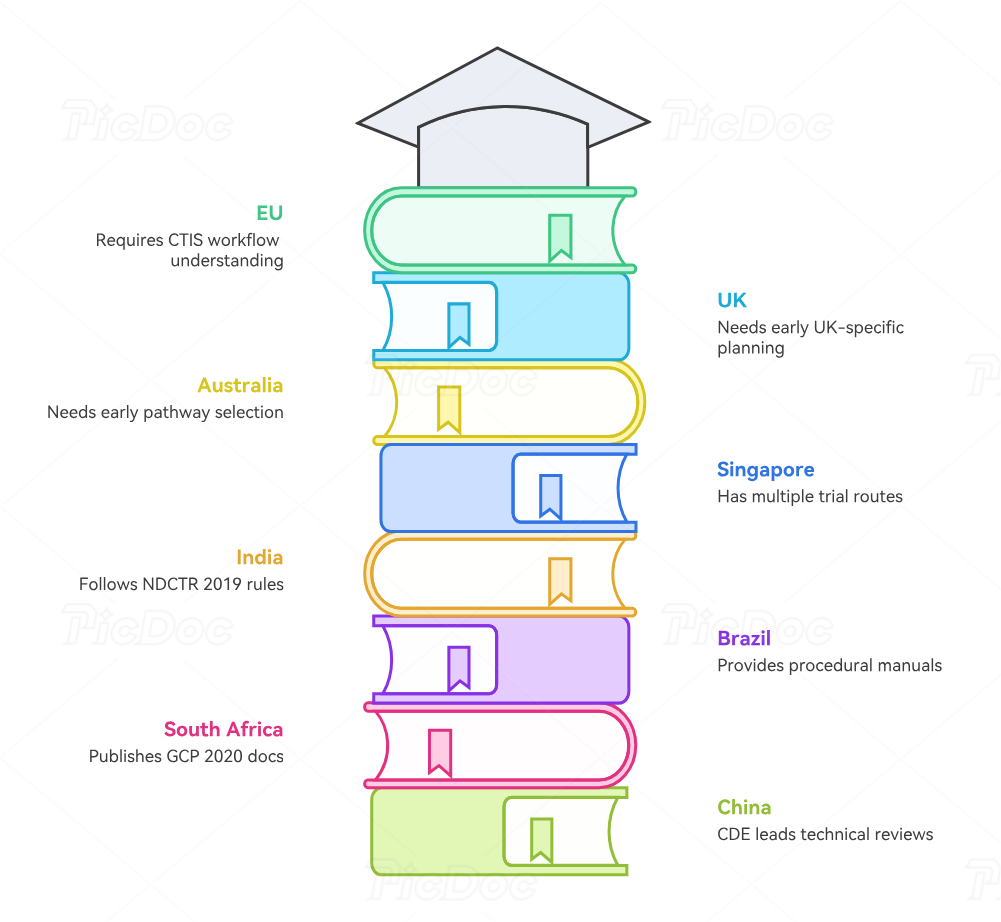
The EU is currently the clearest example of structural change with operational consequences. Under the CTR, the promise is harmonization, one submission path, coordinated assessment, and stronger transparency. That sounds easier than the legacy model, but it is only easier if your team understands CTIS workflow, roles, document handling, and change management. Otherwise, “single portal” becomes a false sense of simplicity.
The UK is important because many global teams still carry over EU habits. That is risky. MHRA’s current materials emphasize the UK’s own authorization process and fresh guidance on quality and risk proportionality. For teams running risk management in clinical trials, vendor management, clinical research project planning, resource allocation, and stakeholder communication, that means UK-specific planning belongs in the first draft, not in the cleanup phase.
Australia and Singapore show why “Asia-Pacific” is too broad to be useful operationally. Australia’s CTN and CTX pathways require early pathway selection and integration with HREC and institutional processes. Singapore’s HSA uses multiple routes as well, including CTA, CTN, and CTC, and also foregrounds GCP inspections, adverse-event reporting, and trial transparency. If your global PMO lumps both countries into one standard package, the regulatory workstream will be weaker than it looks.
India, Brazil, South Africa, and China deserve special respect because teams often oversimplify them from a distance. India’s NDCTR 2019 remains central to current clinical-trial permissions. Brazil’s Anvisa provides procedural manuals for clinical trial dossiers, safety monitoring, amendments, and cancellations. South Africa publishes both SA GCP 2020 and a substantial suite of clinical-trial guidance documents, including investigator, safety, monitoring, and post-trial-access guidance. China’s CDE under NMPA is the technical-review engine for drug clinical-trial applications and remains an active source of regulatory evolution. None of those markets should be approached with a “we’ll localize later” mindset.
5. How to Build an Internal Regulatory Intelligence Workflow From This Directory
Start with a country-framing sheet before your first site is even identified. For each country, record the regulator, the approval path, ethics requirements, submission platform, safety-reporting authority, amendment logic, and primary guidance links. Then map those items to your study design and operational dependencies. This is where smart teams connect the directory to clinical trial amendments, protocol deviations, case report form best practices, data monitoring committee roles, and IND application basics.
Next, assign country owners. One of the worst failure modes in multinational studies is diffuse accountability. Regulatory, safety, clinical operations, and country start-up teams each assume someone else is validating local changes. That creates stale assumptions. The MHRA updates a guidance page. Health Canada opens a consultation. New Zealand consults on revised clinical-trials guidance. NMPA changes review details. If nobody owns horizon scanning, the study plan goes out of date while the team still thinks it is current.
Then build a change log with impact categories. Not every update matters equally. Some changes are informational. Others affect submission timing, dossier structure, safety operations, or decentralized elements. For example, Health Canada’s draft decentralized-clinical-trials guidance is not the same kind of signal as a finalized statutory rule, but it still matters for forward planning. The same logic applies to New Zealand’s guideline consultations and region-specific implementation guidance. High-performing teams classify updates by immediate operational impact instead of dumping everything into one monthly newsletter nobody reads.
Finally, train roles differently. CRAs should know the country-start-up implications that affect site selection and qualification visits, investigator site management, documentation techniques, GCP essentials, and monitoring readiness. CRCs should understand what local approval timing means for activation, consent, safety, and source workflows. Regulatory staff should own primary-source validation. Project managers should own cross-functional escalation. That is how a directory becomes an operating system instead of a reference list.
6. FAQs
-
No. ICH E6(R3) provides a unified GCP standard to support quality and mutual acceptance of trial data, but it does not replace country or regional law. Teams still need to comply with the applicable regulator, approval pathway, ethics structure, and submission mechanics in each jurisdiction.
-
Treating “global GCP compliance” as if it automatically means “country-ready execution.” It does not. The biggest real-world mistake is failing to localize authorization, ethics, safety, amendment, and portal requirements early enough.
-
That the EU Clinical Trials Regulation uses CTIS as the single-entry system and, from 31 January 2025 onward, all EU/EEA clinical trials must be conducted under the CTR using CTIS. That has direct implications for submissions, modifications, and trial governance.
-
Not enough to rely on one shared process. The UK has its own MHRA framework and has been issuing current guidance updates, including on application procedures and risk proportionality. Teams should treat the UK as its own regulatory workstream.
-
All of them do, but India, Brazil, South Africa, China, Japan, and Switzerland are common places where oversimplification causes avoidable delays because teams underestimate local procedural detail, dual approvals, or regulator-specific guidance sets.
-
Review it on a defined cadence, assign country owners, link every entry to the current primary source, and classify updates by operational impact. A directory that is not actively maintained becomes a compliance risk disguised as a resource.
