
Clinical trial amendments look administrative on paper, but in real study operations they are one of the fastest ways to create confusion, site burden, protocol drift, delayed enrollment, budget strain, data inconsistency, and inspection risk. A single amendment can change eligibility, visit schedules, safety procedures, endpoints, informed consent language, vendor workflows, and document control at the same time. That is why research teams that treat amendments like routine paperwork usually suffer downstream damage they could have prevented.
Handled well, amendments protect participants, improve feasibility, correct scientific weaknesses, and keep studies aligned with evolving reality. Handled poorly, they trigger version chaos, retraining failures, deviations, frustrated sites, and costly delays. The operational question is never just what changed. It is how fast, how clearly, and how completely every affected function can adapt without breaking compliance or participant trust.
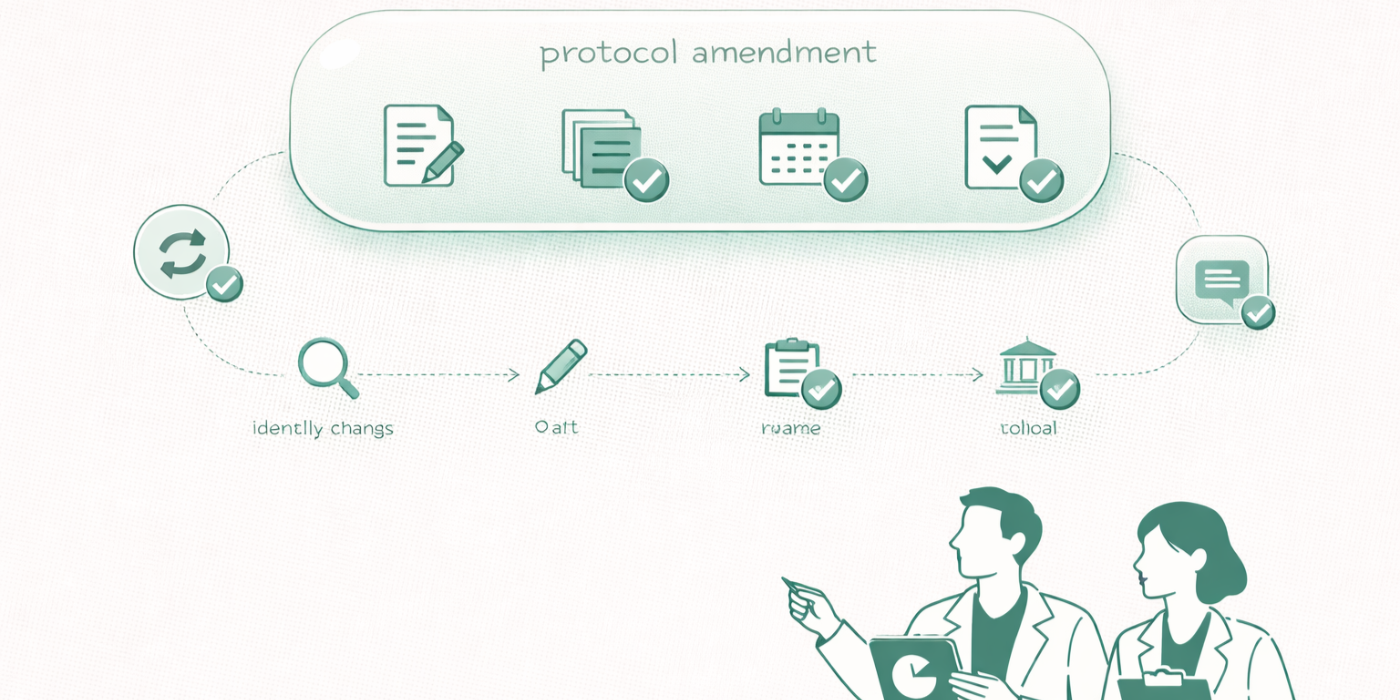
1. What clinical trial amendments are and why they create so much operational pressure
A clinical trial amendment is a formal change to an approved study document set or operational framework, most commonly the protocol, informed consent form, investigator brochure, case report forms, study manuals, recruitment materials, pharmacy instructions, safety monitoring plans, vendor workflows, or associated regulatory documentation. Some amendments are minor and clarifying. Others are substantial enough to alter how the entire study runs.
The reason amendments create so much pressure is that they rarely stay contained. A change to inclusion criteria may affect recruitment messaging, screening logs, site training, consent discussions, database logic, vendor programming, and monitoring priorities all at once. A change to visit windows may affect participant retention, lab timing, budget assumptions, source documentation, and endpoint integrity. What looks like one protocol revision can actually be a multi-system disruption event.
This is why amendments sit at the center of operational discipline in clinical research. Teams that already understand the importance of clinical trial protocol management, managing regulatory documents, GCP compliance strategies for coordinators, and handling clinical trial audits usually handle amendments better because they already think in systems rather than isolated paperwork.
Amendments happen for many reasons. Sometimes early assumptions were wrong and the protocol proves too burdensome in real life. Sometimes recruitment stalls because eligibility is too narrow or the visit schedule is unrealistic. Sometimes new safety information forces changes in monitoring, reporting, or participant communication. Sometimes scientific priorities shift because endpoints, statistical assumptions, or operational feasibility were not as strong as expected. In other cases, regulators, ethics committees, investigators, or sponsors identify issues that can no longer be ignored.
That is why amendments are not automatically signs of poor research. Some are responsible corrections that prevent larger harm later. But frequent or badly justified amendments can also signal weak upfront planning, poor feasibility work, inadequate stakeholder alignment, or a sponsor culture that treats sites and participants as infinitely adaptable. That attitude is dangerous. Every amendment creates friction. Every change taxes training capacity. Every document revision increases the chance that someone uses the wrong version at the wrong time.
This is especially important because amendments influence both participant protection and data reliability. If teams do not align amended procedures with informed consent procedures, patient safety oversight, adverse event handling, and drug safety reporting timelines, they can create the exact kind of preventable compliance and safety failures that inspectors notice quickly.
The deepest operational truth is this: amendments are change-management events disguised as documents. The teams that master them do not just edit files. They control impact, timing, communication, retraining, implementation, and evidence of execution.
| Amendment Trigger or Change Type | Why It Happens | Operational Pain Point | Main Risk if Mishandled | Best Response |
|---|---|---|---|---|
| Inclusion criteria broadened | Recruitment is too slow | Screening teams must relearn eligibility | Wrong participant enrollment | Eligibility retraining and updated screening tools |
| Exclusion criteria tightened | Safety or confounding concerns | Rescreening burden rises | Ineligible participants remain active | Immediate participant impact review |
| Visit schedule change | Protocol burden is unrealistic | Calendars, windows, and reminders must change | Missed visits and deviations | Rebuild visit tools and participant communication |
| New safety lab added | Emerging safety concern | Site workflow and vendor routing change | Safety data gaps | Urgent implementation plan with lab vendor alignment |
| Endpoint revised | Scientific assumptions changed | Data capture and analysis logic shift | Interpretability problems | Cross-functional impact assessment |
| Consent form updated | Risk, procedure, or rights language changed | Reconsent planning becomes urgent | Participants continue without proper reconsent | Participant list review and tracked reconsent |
| Dose adjustment introduced | Tolerability or efficacy issue | Pharmacy and accountability updates needed | Medication errors | Targeted pharmacy retraining |
| Concomitant medication rules changed | Interaction concerns or cleaner data need | Sites must reassess active participants | Protocol violations remain undetected | Medication review sweep |
| Pregnancy monitoring added | Risk profile updated | Additional procedures and source fields needed | Participant protection failure | Immediate safety-focused rollout |
| Sample collection timing changed | Biomarker quality issue | Clock-sensitive logistics become harder | Useless samples and timing deviations | Detailed visit aide updates |
| CRF fields updated | Data gaps or new variables | Database and source alignment strain | Inconsistent records | Version-controlled data mapping |
| Statistical analysis plan aligned to amendment | Endpoints or populations changed | Analysis assumptions shift | Misleading study conclusions | Biostatistics review before rollout |
| Site manual revised | Operational instructions no longer match protocol | Staff rely on outdated job aids | Execution mismatch | Retire old versions aggressively |
| Recruitment material changed | Eligibility or study burden changed | Old materials may still circulate | Misleading recruitment | Recall and replace campaign assets |
| Randomization scheme altered | Balance or power issue | IRT and site instructions change | Allocation errors | System validation plus site re-education |
| Blinding procedure updated | Unblinding risk identified | Role boundaries must be tightened | Bias and data integrity loss | Role-specific retraining |
| Vendor process changed | Lab, imaging, ePRO, or courier failure | Study teams must relearn handoffs | Missed or corrupted study data | Vendor-specific readiness check |
| Remote visit allowance added | Retention or access problem | Source documentation and identity checks shift | Inconsistent remote execution | Remote workflow standardization |
| Diary or ePRO schedule revised | Poor completion rates | Participant instructions must change fast | Missing patient-reported data | Participant-facing retraining language |
| Protocol deviation guidance added | Recurring site confusion | Historical errors may already exist | Deviation underreporting | Trend review plus corrective instruction |
| Safety reporting rule revised | New event classification or timing rule | Teams may apply old reporting logic | Late or incorrect safety reporting | Urgent AE retraining with examples |
| Participant reimbursement changed | Visit burden or retention issue | Finance and site messaging updates required | Participant dissatisfaction or inequity | Clear participant communication plan |
| Investigator brochure updated | New nonclinical or clinical info | Sites may not absorb the true impact | Safety misunderstanding | Targeted risk communication |
| Country-specific amendment handling | Local requirements differ | Implementation timing becomes uneven | Cross-country version confusion | Local tracking matrix |
| Pharmacy manual change | Dispensing or storage process updated | Site pharmacy may lag behind clinic staff | Drug accountability issues | Pharmacy-specific acknowledgment tracking |
| Lab reference range or threshold change | Medical review identified a risk gap | Screening and ongoing review become inconsistent | Unsafe continuation or wrongful exclusion | Medical review checklist update |
| Study closure pathway clarified | Retention or end-of-study confusion | Final visit and record completion may drift | Incomplete closeout data | Closeout workflow harmonization |
2. Why amendments happen, what they usually change, and where they hurt the most
Amendments happen because studies meet reality. Feasibility assumptions turn out to be too optimistic. Investigators identify burdens that were invisible during planning. Recruitment underperforms. Safety observations accumulate. Data reviews expose procedural gaps. Vendors fail. Regulators ask sharper questions. Internal scientific priorities shift. Sometimes this is a sign of good governance, because the team is willing to correct the study instead of pretending the original plan was flawless.
But amendments hurt most in places where multiple teams depend on one version of the truth. Site staff need to know exactly what changed and when to start applying it. CRAs need to verify implementation and documentation. Data teams need forms and databases that match the new rules. Safety teams need event logic that reflects the amended protocol. Investigators need enough clarity to answer participant questions confidently. Participants themselves may need reconsent, new visit explanations, revised burden expectations, or new safety counseling.
That is why amendments are tightly linked to case report form design, primary vs secondary endpoints, placebo-controlled trials, and data monitoring committee roles. When one part changes, downstream assumptions rarely stay untouched.
The worst damage usually comes from underestimating amendment impact. Teams often think only about submission approval and forget the implementation cascade. The protocol gets revised, but visit worksheets remain old. The consent is updated, but not every participant is reconsented on time. The database changes, but source templates do not. The pharmacy receives new guidance, but clinic staff still use old accountability habits. These are not small misses. They are exactly the kind of version-control failures that create inspection exposure and data credibility problems.
Another major pain point is amendment fatigue. Sites handling multiple active studies are often already overloaded. When sponsors push frequent revisions with poor summary language, weak training, or unrealistic turnaround expectations, sites become more error-prone, less responsive, and less trusting. This can hit recruitment and retention indirectly because staff morale affects execution quality far more than sponsors like to admit. Teams that care about effective stakeholder communication, clinical trial resource allocation, vendor management, and clinical trial success rates understand that amendment burden is not just a site nuisance. It is a strategic performance variable.
The most mature teams therefore ask three questions before finalizing any amendment: what changes on paper, what changes in execution, and what changes for participants already in the study. That third question is where many weak teams fail. They think in document sets, not participant journeys. But participants experience amendments through new procedures, revised risks, rescheduled visits, additional blood draws, altered reimbursement, or confusing explanations. If the participant experience is not rethought, the amendment may be technically approved but operationally brittle.
3. How to handle amendments correctly from impact assessment to site implementation
Handling amendments well starts before the final version is even approved. Strong teams conduct impact assessment while the amendment is being shaped, not after it lands. That means mapping every affected artifact, team, system, vendor, and participant population before implementation timelines are promised. If that mapping does not happen, rollout becomes guesswork.
A disciplined amendment process usually begins with cross-functional review. Clinical operations, regulatory, medical, safety, data management, biostatistics, site management, vendors, and quality stakeholders should all evaluate what the amendment changes in practice. This is where teams discover hidden dependencies. A revised endpoint may require database updates and monitoring-plan changes. A new safety test may affect budget, participant scheduling, lab kit forecasting, and informed consent text. A broadened eligibility rule may require revised pre-screening scripts and new recruitment material. Without this review, the protocol becomes a theoretical document rather than an executable one.
The next step is impact categorization. Teams need to distinguish changes that affect participant safety, active participants, future participants, site workflow, pharmacy operations, vendor systems, data structures, and country-specific submissions. Not every amendment element goes live at the same moment or in the same way. Some parts require authority approval first. Some need urgent safety communication. Some require reconsent. Some need system validation before use. This is where good teams protect themselves from chaotic rollout.
Training is where amendment management succeeds or fails. Generic training calls are not enough. Staff need clear summaries of what changed, why it changed, when it becomes effective, who it affects, what they must stop doing, what new documentation is required, and where to find the controlled current version. The best amendment training is role-based. Investigators need medical and participant-facing implications. Coordinators need visit, consent, and workflow implications. Pharmacy needs accountability and dispensing implications. CRAs need verification priorities. Data teams need field and logic changes. This is one reason mastery in essential training under GCP guidelines, managing study documentation, GCP compliance essentials for CRAs, and clinical trial documentation techniques matters so much.
Version control is another non-negotiable area. Old tools must be retired decisively. Study teams should know which visit worksheets, consent forms, manuals, logs, pharmacy tools, and participant materials are obsolete. Keeping old documents “for convenience” is how sites accidentally use superseded materials. That creates deviations, consent issues, and audit findings. Mature teams replace version ambiguity with version certainty.
Participant management must also be deliberate. Amendment handling is not complete when sites receive the documents. It is complete when affected participants have been identified, contacted if necessary, reconsented if required, scheduled correctly under the new rules, and documented appropriately. This is especially critical for amendments affecting risk, burden, safety procedures, or continued eligibility. Teams aligned with patient safety oversight, research compliance and ethics mastery, adverse event reporting techniques, and regulatory and ethical responsibilities for principal investigators are far more likely to get this right.
Monitoring after implementation is equally important. CRAs should not assume implementation occurred simply because training records exist. They need to verify that amended procedures are actually happening, new forms are used, impacted participants were handled correctly, and old habits have stopped. Amendment implementation should produce observable evidence, not just documentation of intention.
4. The most common amendment mistakes that create deviations, delays, and inspection findings
One of the biggest mistakes is drafting amendments reactively without diagnosing the root problem. If recruitment is struggling, teams may rush to broaden criteria when the real issue is poor site selection, weak patient communication, or unrealistic referral assumptions. If retention is weak, they may cut visits without addressing travel burden, scheduling friction, or participant confusion. A bad amendment can solve the symptom and worsen the actual cause.
Another common mistake is writing amendments clearly for authors but poorly for operators. Some amendment packages explain the revised text but not the practical implication. Sites do not just need redlines. They need operational translation. What changes tomorrow morning at 8 a.m.? What should screeners do differently? Which participants are affected? Which logs change? What is the effective date per country or per site? If those answers are vague, deviations follow.
A third mistake is weak reconsent planning. Teams often know that consent must be updated, but they do not build a participant-level plan showing who requires reconsent, by when, before which procedures, and how delayed or unreachable participants will be handled. This is where administrative sloppiness turns into ethical and inspection risk. Consent is not a document storage exercise. It is proof that ongoing participation reflects current information.
A fourth mistake is ignoring legacy data and mixed-version periods. Amendments often create transitional states where some participants were assessed under the old schedule and others under the new one. Some countries implement sooner. Some sites lag behind approval. Unless teams define how this mixed state will be documented and interpreted, data review becomes messy and monitoring becomes inconsistent. This connects directly to stronger thinking in biostatistics, case report forms, randomization techniques, and blinding, because study integrity depends on understanding when the study changed and how that affects comparability.
Another major error is failing to align vendors and systems before sites are told to implement. If the central lab kit instructions are outdated, the ePRO schedule is not reprogrammed, the EDC still reflects old rules, or the IRT logic lags behind the protocol, sites are pushed into impossible execution. Sponsors sometimes talk about site noncompliance when the deeper truth is sponsor-side implementation failure.
Poor communication pacing also causes damage. Some teams dump dense amendment packets on sites without summary tools, impact grids, or prioritization. Others dribble out clarifications after rollout has already started, leaving staff unsure which message is authoritative. High-performing teams reduce confusion by giving sites a clean amendment summary, an implementation checklist, role-based training, effective dates, and a clear escalation path for questions.
Finally, many organizations fail to learn from their own amendment history. If the same types of amendments keep recurring, the issue may be weak feasibility, poor protocol authorship, inadequate stakeholder review, or lack of frontline site input during design. Teams that never analyze amendment patterns often repeat the same operational mistakes study after study. Those that do analyze them get better at writing more realistic protocols in the first place.

5. How strong amendment management improves study quality, site trust, and participant protection
Good amendment management does more than reduce paperwork mistakes. It strengthens the overall credibility of the study. When teams assess impact early, communicate clearly, retrain precisely, and verify implementation thoroughly, they protect both participant safety and data quality. Sites notice this. Participants feel it. Monitors can document it. Inspectors can see it.
It also improves site trust. Sites are far more willing to support difficult studies when sponsors treat amendments with respect instead of dumping the burden downstream. A sponsor that communicates clearly, updates materials promptly, explains rationale honestly, and acknowledges operational impact earns more goodwill than one that behaves as though protocol revisions are effortless. This matters because site trust affects responsiveness, recruitment effort, retention effort, and overall study morale.
There is also a strategic benefit. Teams that manage amendments well are usually better at stakeholder communication, resource allocation, vendor management, and clinical research project management. They think beyond approval mechanics and focus on controlled execution. That mindset improves the whole study, not just the amendment episode.
For participants, the benefit is even more direct. Good amendment handling reduces the chance of outdated risk explanations, unnecessary burden, scheduling confusion, missed safety procedures, or conflicting instructions from different staff members. Participants rarely see the internal amendment packet, but they feel the quality of its implementation immediately. Clear reconsent, coherent visit planning, and confident site communication build trust. Confusion destroys it.
Amendment discipline also sharpens careers. Coordinators who can operationalize revised procedures without chaos become invaluable. CRAs who can verify implementation intelligently become stronger monitors. Investigators who understand amendment impact beyond signatures lead safer, more organized studies. This is why amendment competence fits naturally alongside career growth in clinical research coordinator roles, how to become a CRC, CRA career paths, and quality assurance specialist roadmaps.
The long-term lesson is simple. Every amendment is a stress test of the study team’s operational maturity. Weak teams edit text. Strong teams manage controlled change.
6. FAQs
-
A clinical trial amendment is a formal revision to approved study documents or procedures, most often involving the protocol, informed consent form, safety procedures, eligibility criteria, visit schedule, endpoints, or operational instructions. It can be minor and clarifying or substantial enough to affect participant management, study execution, and data interpretation across the trial.
-
No. Some amendments are responsible corrections that improve participant safety, feasibility, scientific clarity, or regulatory alignment. The problem is not the existence of an amendment by itself. The problem is frequent, poorly justified, or badly implemented amendments that create operational instability, site fatigue, and compliance risk.
-
The biggest danger is the gap between document approval and real implementation. Teams may think the work is done once the amendment is approved, but the true risk begins when sites, vendors, systems, and participants must transition to the new version. Failures in reconsent, retraining, version control, or safety procedure rollout can create serious ethical, operational, and inspection problems.
-
Everyone involved in the study can be affected, but the impact is especially strong on active participants, site coordinators, investigators, CRAs, pharmacy staff, safety teams, regulatory teams, and vendors. Each group experiences the amendment differently, which is why role-based communication and implementation planning are so important.
-
Sites should review the amendment summary carefully, identify exactly which participants and workflows are affected, complete role-specific training, retire superseded documents, confirm updated tools are available, and track reconsent or scheduling changes tightly. The best sites do not treat amendment rollout as passive reading. They treat it as a controlled operational transition.
-
The strongest approach is early impact assessment, clear cross-functional planning, role-specific training, aggressive version control, participant-level tracking for affected cases, and post-implementation verification by monitoring teams. Deviations usually happen not because the amendment exists, but because teams underestimate the number of downstream actions required to implement it correctly.
