
Running out of time during a clinical research certification exam can cost you questions you already know how to answer. Long clinical scenarios, confusing regulatory terminology, and multiple plausible answer choices can consume valuable minutes, leaving straightforward questions unanswered. Effective time management helps you protect both accuracy and completion.
This guide explains how to calculate your question-by-question time budget, recognize time-consuming exam traps, prioritize difficult scenarios, and build reliable pacing through timed practice. You'll also learn how to apply GCP examination strategies while maintaining sound clinical research decision-making.

1. Calculate Your Clinical Research Certification Exam Time Budget Before Starting
Your first time-management decision should happen before answering the first question. You need to know the number of questions, total examination time, navigation rules, review functionality, and whether unanswered responses receive any credit.
Clinical research certification assessments vary by provider and credential. The format used for a clinical research coordinator certification may differ from assessments covering CRA monitoring responsibilities, research assistant competencies, or clinical project management.
Check the current instructions for your specific assessment. Pay particular attention to whether the platform allows you to flag questions, return to previous items, review completed answers, or submit early.
Calculate your working time per question
A useful budgeting formula is:
Working seconds per question = (Total examination minutes − Reserved review minutes) × 60 ÷ Number of questions
Suppose a practice assessment contains 90 questions and allows 120 minutes.
If you reserve 12 minutes for final review, you have 108 minutes available for answering and revisiting questions.
That produces an average working allowance of 72 seconds per question.
This calculation covers both the initial attempt and any time spent revisiting difficult questions. Spending the entire 72 seconds on every first attempt would leave no time for a second pass.
This distinction becomes especially important when facing SAE reporting scenarios, protocol deviation questions, and clinical trial data integrity cases, where additional reasoning may be necessary.
Divide your available time into three passes
For the illustrative 90-question, 120-minute assessment, consider this allocation:
First pass — 75 minutes: Attempt all 90 questions, answering straightforward items quickly and marking difficult ones.
Second pass — 33 minutes: Return to flagged questions, resolve uncertainties, and complete unanswered items.
Final review — 12 minutes: Check response completeness, marked questions, and accidental selection errors.
The first pass therefore allows approximately 50 seconds per question on average. Some questions may require 15 seconds, while longer clinical cases may consume more.
Candidates familiar with investigator responsibilities, clinical trial monitoring, and ethical research requirements can often answer straightforward knowledge questions more rapidly, preserving time for complex scenarios.
Establish objective pacing checkpoints
Using the same 90-question example, your first-pass checkpoints would be:
Question 18: approximately 15 minutes elapsed.
Question 36: approximately 30 minutes elapsed.
Question 54: approximately 45 minutes elapsed.
Question 72: approximately 60 minutes elapsed.
Question 90: approximately 75 minutes elapsed.
These targets offer early warning when you fall behind.
If you reach Question 36 after 42 minutes, your first-pass pace is already 12 minutes behind. You should respond by applying stricter time limits to uncertain questions instead of trying to rush every remaining answer.
Practice these checkpoints with clinical research exam strategies, GCP monitoring exercises, safety assessment questions, and clinical research quality scenarios.
Recognize your most expensive question types
Long questions are only one source of wasted time. Candidates also lose minutes repeatedly checking straightforward answers, confusing similar regulatory definitions, and trying to resolve uncertainties beyond the information provided.
For example, a question about informed consent requirements may present a complicated patient history even though the decisive issue is whether consent preceded a study-specific procedure.
Similarly, a clinical data correction question may include multiple EDC fields when the answer depends on preserving an accurate audit trail.
Learning to recognize the decisive information is one of the most effective ways to preserve examination time.
| Clinical Research Certification: 30-Scenario Exam Time-Saving Matrix | |||
|---|---|---|---|
| Time-Consuming Situation | Fast Decision Technique | When to Flag or Revisit | Relevant Study Resource |
| 1. Long clinical vignette | Read the final question first, then identify the decisive clinical facts. | Flag when essential information requires repeated interpretation. | Exam strategy |
| 2. SAE classification question | Identify seriousness criteria before considering causality. | Return if event classification remains uncertain. | Safety reporting |
| 3. Consent signed late | Compare consent timing with the first study-specific activity. | Flag if an emergency consent exception is involved. | Consent ethics |
| 4. Protocol deviation scenario | Determine whether an immediate participant hazard exists. | Revisit when the authorization sequence is unclear. | Protocol adherence |
| 5. Investigator versus sponsor duties | Identify who holds the stated responsibility. | Flag when delegated work complicates accountability. | Investigator duties |
| 6. Competing regulatory answers | Locate the jurisdiction, guideline, and precise requirement in the stem. | Revisit if the question combines distinct frameworks. | Compliance |
| 7. Source versus EDC discrepancy | Prioritize accurate evidence and traceable corrections. | Flag when both records may contain errors. | Data integrity |
| 8. Risk-based monitoring | Identify participant safety and critical data risks. | Return if several monitoring approaches are defensible. | Monitoring |
| 9. IRB/IEC approval question | Determine whether prior review is required. | Flag when an immediate-hazard exception is relevant. | Ethics review |
| 10. Medical causality assessment | Separate temporal association from suspected causal relationship. | Revisit when the available evidence is incomplete. | Safety assessment |
| 11. Eligibility criteria | Match each fact directly to the relevant criterion. | Flag conflicting laboratory or screening information. | Site oversight |
| 12. Delegation log problem | Check qualifications, assignment, and oversight. | Return when task authorization remains ambiguous. | Training requirements |
| 13. Investigational product issue | Identify product control, accountability, and authorized disposition. | Flag when stability evidence is decisive. | Trial logistics |
| 14. Protocol visit-window calculation | Write the anchor date and permitted window. | Flag if multiple date conventions affect the answer. | Trial timelines |
| 15. AE reporting timeline | Identify reporting party, clock trigger, and recipient. | Revisit if the stem changes jurisdiction or event category. | PV concepts |
| 16. Clinical endpoint interpretation | Identify primary endpoint, comparator, and effect measure. | Flag numerical interpretation requiring several steps. | Medical monitoring |
| 17. Research budget variance | Identify actual, budgeted, and variance amounts. | Return if multiple budget categories interact. | Budget management |
| 18. Recruitment percentage | Identify numerator, denominator, and requested rate. | Flag if screening and enrolment totals are mixed. | Recruitment operations |
| 19. Data query resolution | Determine the reliable record and authorized correction path. | Revisit if supporting source evidence is insufficient. | Source records |
| 20. CAPA question | Distinguish correction, root cause, and prevention. | Flag if the question asks about effectiveness verification. | Quality systems |
| 21. CRO versus sponsor oversight | Separate transferred work from sponsor accountability. | Return if several contracts or vendors are involved. | Sponsor and CRO |
| 22. Missing essential document | Identify required evidence and appropriate remediation. | Flag if retention requirements differ by jurisdiction. | Essential records |
| 23. Inspection finding | Identify the actual noncompliance and evidence gap. | Return if impact assessment is the central question. | Audit readiness |
| 24. Off-label information request | Identify the purpose, context, and authorized response pathway. | Flag when promotional and scientific roles overlap. | Medical compliance |
| 25. Emergency unblinding | Identify clinical necessity and authorized procedures. | Revisit if competing safety and blinding concerns arise. | Safety protocols |
| 26. Patient confidentiality incident | Identify containment, escalation, and privacy obligations. | Flag if specific legal notification deadlines are tested. | Privacy compliance |
| 27. Two plausible correct choices | Compare them against the exact action requested. | Mark when neither choice can be eliminated confidently. | Exam mistakes |
| 28. Negative-wording question | Mark EXCEPT, LEAST, FALSE, or NOT before reading options. | Revisit if the selected choice does not match the negative instruction. | Question interpretation |
| 29. Repeated answer changing | Change an answer when a specific new reason justifies it. | Avoid unproductive review loops near the deadline. | Exam readiness |
| 30. Final unanswered questions | Check remaining items and apply the exam's scoring rules. | Prioritize unanswered questions before optional polishing. | Final-pass strategy |
2. Use the Three-Pass Question Strategy to Finish the Exam Without Rushing
The three-pass method separates straightforward questions from those requiring additional investigation. It prevents a particularly difficult scenario from consuming time intended for several other questions.
This approach is valuable in clinical research certification assessments, CRA examination preparation, clinical research coordinator testing, and clinical project management assessments.
First pass: Capture straightforward answers efficiently
Begin by reading the final sentence of each question to understand what you need to determine.
A clinical scenario may describe a patient's medical history, investigational product, screening results, and previous study visits. The actual question might ask only who should receive an SAE notification.
Identifying the requested action before reading the details makes the scenario easier to process.
Use a simple decision sequence:
Identify the subject: safety, consent, protocol, documentation, monitoring, or quality.
Identify the responsible professional.
Locate the decisive detail.
Select the best-supported answer or mark the question for review.
For example, a question involving investigator responsibilities may include extensive clinical information even though the decisive issue concerns accountability for delegated tasks.
Similarly, a question involving trial documentation may be resolved quickly by identifying an undocumented alteration or unreliable audit trail.
Second pass: Allocate time according to difficulty
Your flagged questions will have different levels of difficulty.
A question where you are choosing between two plausible answers may require only 20 additional seconds. A complex medical safety assessment or clinical trial budget problem may require significantly more.
Separate flags into two categories:
Quick-review flags: Questions where you identified a likely answer but need to confirm one distinction.
Deep-review flags: Questions involving unfamiliar concepts, calculations, multiple regulatory requirements, or incomplete reasoning.
Resolve the quick-review questions first if doing so helps secure answers efficiently. Then allocate the remaining second-pass time to deeper problems.
Candidates with a strong grasp of GCP protocol adherence, investigator oversight, and safety reporting requirements should be able to resolve many quick-review questions using a single governing principle.
Third pass: Prevent avoidable administrative errors
The last few minutes deserve a specific checklist.
Confirm that every question has a recorded answer where appropriate under the scoring rules. Check whether flagged items remain unresolved. Review any questions where you may have misunderstood negative wording or selected the adjacent option.
If the examination does not penalize wrong answers, completing every item is generally advantageous. If negative marking applies, use the actual scoring rules to guide your decisions.
Spend the remaining review time on answers you can improve using identifiable evidence.
For instance, discovering that you confused SAE seriousness with severity is a reason to reconsider a response. Simply feeling uncomfortable about a previously selected answer provides little useful information.
When should you skip a difficult question?
Use an adjustable time threshold, based on your working seconds per question.
In the illustrative 90-question, 120-minute assessment, consider flagging an unresolved first-pass item after approximately 50 seconds.
Before moving on, record a provisional answer if the platform permits and if that fits the scoring rules.
Your goal is to protect the remaining question budget. Spending four minutes on one item may consume the time required for several straightforward GCP compliance questions or research operations questions.
The exact threshold should be tested through mock examinations and adjusted to your personal reading speed.
3. Answer Clinical Scenarios Faster by Recognizing Regulatory Decision Patterns
Many clinical research questions become easier once you identify the governing principle.
The most productive speed improvement comes from recognizing recurring decision patterns across GCP monitoring, protocol compliance, clinical safety, and data governance.
Pattern 1: Participant safety and urgent escalation
Consider a question describing unexpected hospitalization during investigational treatment.
Before evaluating the answer choices, identify whether the event may meet an SAE criterion and whether the question concerns medical care, investigator notification, sponsor reporting, or regulatory reporting.
These responsibilities have different decision points.
A useful sequence is:
Recognize the possible serious event → protect the participant → identify applicable reporting obligations → document and follow up.
The exact sequence of actions depends on what has already occurred and what the question asks.
Reviewing GCP adverse event reporting, medical monitoring plans, and pharmacovigilance exam topics helps candidates identify the appropriate reporting pathways quickly.
Pattern 2: Informed consent and participant rights
When a question concerns consent, determine whether the participant received understandable information, made a voluntary decision, and completed the required process before relevant trial procedures.
Pay particular attention to outdated forms, missing signatures, inadequate explanations, and changes to safety information.
Candidates should distinguish an administrative consent documentation error from a more fundamental failure in the consent process.
Use research ethics guidance, patient education resources, and investigator GCP responsibilities to strengthen these distinctions.
Pattern 3: Protocol deviations and authorized changes
Questions about protocol deviations frequently turn on whether an immediate hazard exists.
Routine protocol changes generally follow applicable approval requirements. Immediate-hazard situations may require necessary action to protect participants, followed by appropriate notifications and documentation.
When two answers appear plausible, locate the condition determining whether advance approval is required.
This approach is useful for protocol adherence assessments, site oversight scenarios, and clinical trial quality management.
Pattern 4: Data integrity and documentation corrections
Clinical trial documentation questions commonly evaluate whether corrections preserve accurate, attributable, and reconstructable records.
When examining answer choices, look for actions that would obscure the original entry, erase its history, or misrepresent when information was recorded.
A reliable answer will address verification, authorized correction, and traceability.
This pattern frequently appears in clinical trial data integrity, monitoring visit scenarios, and quality assurance questions.
Pattern 5: Accountability and delegation
Determine whether the scenario concerns who performs a task or who remains accountable for oversight.
Investigators may delegate appropriate trial activities to qualified personnel while retaining relevant supervisory responsibilities. Sponsors maintain appropriate oversight of transferred trial-related activities.
This distinction is frequently tested using several apparently reasonable answer choices.
Prepare through investigator responsibility guidance, clinical project leadership, research assistant task boundaries, and CRO versus sponsor responsibilities.
Pattern 6: Numerical questions and quantitative interpretation
Some certifications assess recruitment rates, visit scheduling, budget variances, trial timelines, or basic clinical evidence interpretation.
Write down the quantities before calculating.
For a recruitment conversion question, distinguish screened participants from enrolled participants. For a budget variance question, identify the budgeted amount and actual spending. For a visit-window problem, establish the correct anchor date.
Practicing these distinctions through clinical trial timelines, principal investigator budget management, trial logistics, and medical data interpretation can reduce avoidable calculation errors.
What Steals the Most Time During Your Certification Exam?
Select your biggest challenge and submit to reveal a targeted pacing strategy.
Submit
Please select an answer above to see your study recommendation.
Read the final question before the clinical vignette. Identify the decision being tested, then scan for participant risk, responsible party, and decisive evidence. Practice ten cases while recording reading time separately from answer time.
Compare the remaining answers against the exact wording of the question. Prioritize the applicable regulatory responsibility, required action, and scenario timing. If the distinction remains unresolved within your first-pass budget, flag the item for later review.
Spend ten minutes daily practicing recruitment percentages, budget variances, visit windows, and safety reporting decision timelines. Write the relevant quantities or triggering event before choosing an answer.
During practice, record why you selected an answer. Change it during review only when you identify a specific overlooked fact, mistaken rule, or calculation error. Track whether answer changes improve or reduce your score.
Reserve review time before beginning. Use an adjustable first-pass limit and mark unresolved questions. Practice timed checkpoints at 20%, 40%, 60%, and 80% of the assessment to detect pacing problems before the final section.
4. Eliminate Time-Wasting Exam Habits Without Sacrificing Accuracy
Good time management depends on recognizing when additional thinking is valuable and when it is simply repeating the same uncertainty.
This distinction matters especially for candidates preparing for CRA examinations, clinical research coordinator assessments, pharmacovigilance exams, and clinical project manager certification.
Stop rereading the entire scenario
If a question is difficult, identify what information is missing from your reasoning.
Ask yourself whether the problem concerns the governing regulation, the responsible party, the event classification, or the order of actions.
Then reread only the relevant part of the stem.
For example, if you are uncertain about an SAE reporting question, focus on the event circumstances, who became aware, and the reporting requirement.
If you are uncertain about a source documentation question, focus on the original record, correction method, and audit trail.
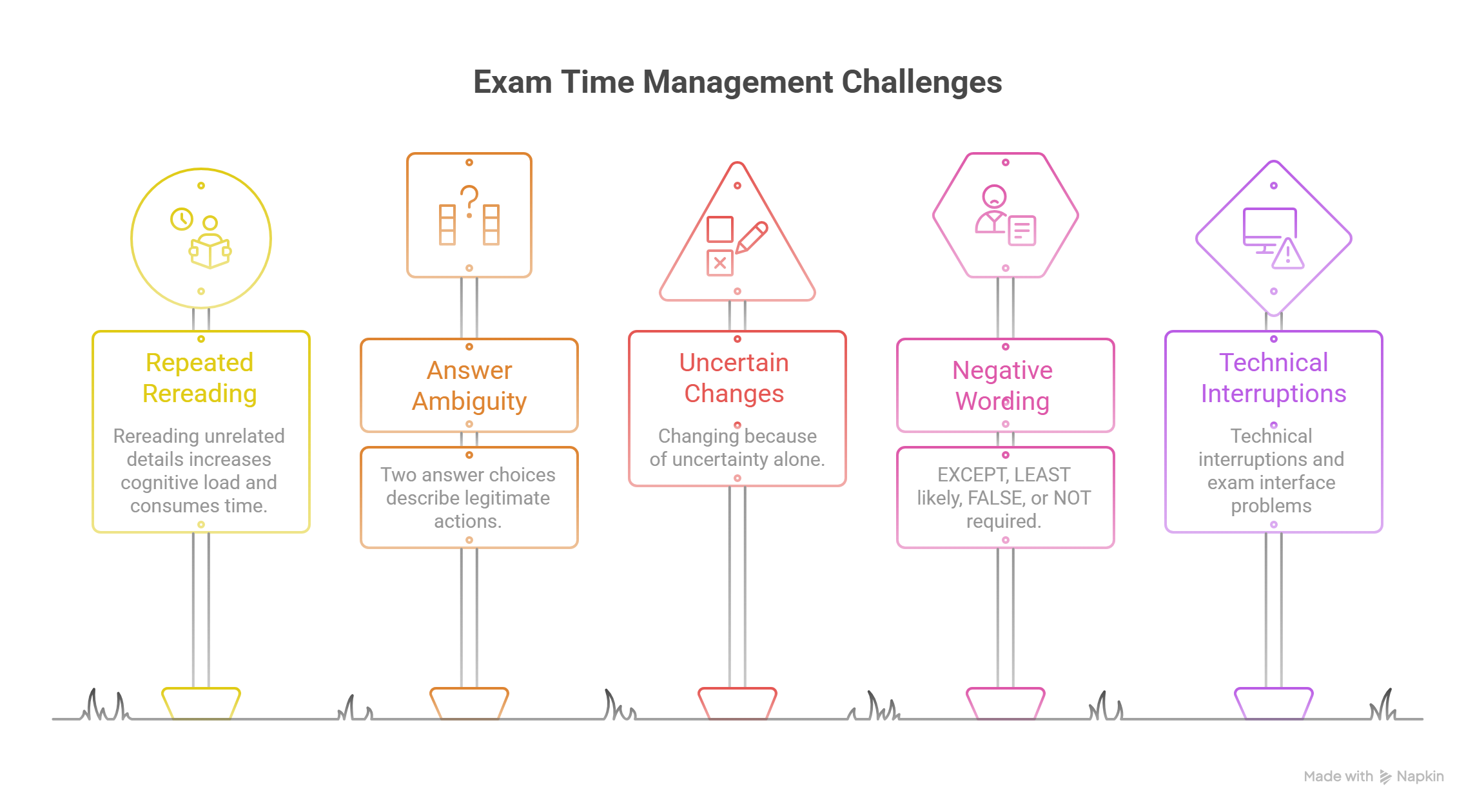
Repeatedly rereading unrelated details increases cognitive load and consumes time.
Use a deliberate tie-breaker when two answers appear correct
Suppose two answer choices describe legitimate actions. One involves notifying the investigator; the other involves updating study documentation.
The correct selection depends on the question's wording, the immediate risk, and the stage of the incident.
Ask three questions:
Which action directly answers the examination stem?
Which professional is accountable at this stage?
Does the scenario require an urgent action before routine follow-up?
These questions help resolve ambiguity in medical monitoring assessments, investigator responsibility scenarios, and clinical research ethics questions.
Develop a rule for changing answers
During your mock examinations, record how often you change an answer and whether the change improves accuracy.
Separate answer changes into three categories: correcting a clearly misread question, applying newly remembered knowledge, and changing because of uncertainty alone.
The first two can provide a sound reason to reconsider. The third should trigger a quick check of your evidence and remaining time.
This approach is particularly important in clinical trial safety questions, monitoring assessments, and quality assurance cases, where similar terminology can prompt unnecessary doubt.
Handle negative wording systematically
Questions containing EXCEPT, LEAST likely, FALSE, or NOT required deserve special attention.
Before evaluating the options, rewrite the task mentally in plain language.
For example, “Which action is NOT consistent with GCP?” asks you to identify the noncompliant action.
You can then evaluate each option against GCP ethical principles, protocol requirements, and data integrity expectations.
Before moving on, confirm that your selected response satisfies the negative wording.
Prepare for technical interruptions and exam interface problems
Familiarity with the assessment platform can prevent avoidable delays.
Before exam day, verify device requirements, browser compatibility, identification procedures, permitted materials, network requirements, and technical support instructions.
If a practice environment is available, rehearse selecting an answer, marking a question, navigating forward and backward, and submitting the assessment.
During a real technical interruption, follow the provider's procedures for reporting the incident and requesting assistance. If permitted, record the approximate interruption time and any relevant error details.
Avoid assuming that an interrupted timer will automatically reset or that the examination platform will preserve every response. These policies depend on the provider.
Candidates should review certification program expectations, exam preparation guidance, and the current instructions supplied by their assessment provider.
5. Follow a 7-Day Timed Practice Plan to Build Speed and Exam Endurance
Timed practice should reveal which tasks consume the most time, how accurately you answer under pressure, and whether your pacing remains consistent through the final questions.
A useful practice plan progresses from short classification drills to unfamiliar mixed assessments.
Use the following schedule alongside clinical research examination resources, research assistant training materials, CRA monitoring preparation, and GCP competency guidance.
Day 1: Measure your baseline time per question
Complete 30 unfamiliar questions and record how long you spend on each.
Calculate the average response time, median response time, and number of questions exceeding your planned first-pass allowance.
The median helps reveal your typical pace, while the average reflects the additional impact of unusually slow items.
If most questions take 45 seconds but three clinical scenarios take four minutes each, your main problem is handling extreme time sinks.
Categorize these scenarios using adverse event reporting guidance, protocol adherence resources, trial data integrity principles, and medical safety assessment techniques.
Day 2: Practice recognizing the decisive question
Use 20 mixed clinical scenarios.
Before selecting an answer, identify the subject, responsible professional, and action being requested.
Set a short recognition target, such as 10–15 seconds, without forcing yourself to finish the entire question during that interval.
This exercise is especially useful for investigator responsibilities, clinical research ethics, clinical monitoring situations, and site operations.
Record how often you correctly identify the issue before examining the answer choices.
Day 3: Practice choosing between two plausible answers
Collect 15 questions where two answer choices appear defensible.
For each question, write the specific rule, responsibility, or sequence that determines the correct response.
Use a limited review window and flag any item that remains unresolved.
Prioritize GCP safety reporting, investigator oversight, clinical quality management, and protocol deviations.
Your target is to improve the quality of the deciding reason, along with the time needed to reach it.
Day 4: Complete numerical and timeline micro-drills
Spend 30–40 minutes practicing short calculations and time-related regulatory questions.
Include recruitment conversion rates, visit-window dates, budget variances, milestone delays, and adverse event reporting classifications.
For numerical problems, record the relevant values and units before calculating. For safety reporting, identify the responsible party and the event that starts the applicable clock.
Practice through clinical trial milestone management, research budgeting, trial logistics coordination, and pharmacovigilance reporting concepts.
Day 5: Simulate a complete three-pass assessment
Choose an unfamiliar question set and apply your planned first-pass time limit.
Mark difficult items, complete the initial pass, revisit unresolved questions, and finish with a final completeness check.
Record how much time you actually spent on each pass.
Compare your performance with Day 1. Determine whether accuracy remained stable while your completion time improved.
Include questions from GCP monitoring, medical monitoring, research ethics, and clinical research quality systems.
Day 6: Identify and correct pacing weaknesses
Review every question that exceeded your intended time allowance.
Classify the cause:
Slow reading or difficulty locating the decisive information.
Weak knowledge of the tested regulation or concept.
Confusion between professional responsibilities.
Unnecessary answer changes or repeated checking.
Calculation errors or difficulty organizing numerical information.
Assign a targeted drill to each problem.
For example, weak data integrity knowledge requires concept revision, while repeated confusion about sponsor versus CRO responsibilities may benefit from a responsibility matrix.
Day 7: Complete a final unfamiliar timed mock
Use the assessment format closest to the one specified by your provider.
Measure four outcomes: overall accuracy, unanswered items, time spent per question, and accuracy after revisiting flagged answers.
Compare these results with the first diagnostic.
A useful improvement is completing more questions within the deadline while preserving or increasing accuracy. Reducing time at the cost of repeated participant safety errors or GCP compliance mistakes indicates that further practice is needed.
Build a personal examination performance dashboard
Keep a short record containing the date, number of questions, total time, percentage correct, unanswered count, flagged count, and final review time.
Add separate performance measures for clinical trial monitoring, pharmacovigilance, protocol compliance, and clinical project management when relevant to your credential.
Averages become more useful when reviewed alongside the slowest questions. Your goal is consistent decision-making across the complete assessment, including the final section when fatigue and time pressure increase.
6. Frequently Asked Questions About Clinical Research Certification Exam Time Management
-
Calculate your working allowance using the total permitted time, number of questions, and planned review reserve.
For example, 90 questions in 120 minutes with 12 minutes reserved for final review produces an average working allowance of 72 seconds per question.
This includes first-pass answering and revisiting difficult items. A first-pass target around 50 seconds could preserve time for follow-up analysis.
The exact budget should match your provider's requirements and your demonstrated speed during practice.
Use clinical research exam strategies, CRC examination time management, CRA exam preparation, and GCP practice resources.
-
Flagging difficult questions can preserve time for straightforward items, provided the examination platform permits returning to previous questions.
Set a first-pass threshold and move on when further analysis is unlikely to produce a confident answer within your remaining budget.
Where appropriate, select a provisional answer before flagging, taking the exam's scoring rules into account.
This strategy is especially useful for lengthy safety assessment scenarios, clinical monitoring questions, protocol deviation cases, and clinical research project management problems.
-
Compare your actual elapsed time with your planned checkpoint.
Calculate how much first-pass time remains and adjust your approach to unresolved questions. Apply stricter flagging rules and avoid repeatedly checking answers already supported by clear reasoning.
Preserve an appropriate final review reserve whenever possible.
A pacing problem is easier to correct at Question 20 than at Question 80.
Develop this skill through clinical research test-taking practice, research coordinator exam strategies, and mixed GCP monitoring scenarios.
-
Read the final question first to identify the decision required.
Then locate the facts that determine the answer: participant risk, event classification, accountable professional, applicable requirement, and sequence of actions.
Avoid spending equal attention on every detail in the vignette.
For example, a scenario involving hospitalization may be testing SAE reporting, while a scenario involving conflicting dates may test data integrity.
Practice with clinical trial safety oversight, GCP investigator duties, and protocol adherence questions.
-
Your decision should follow the assessment's scoring rules and navigation requirements.
When incorrect answers carry no penalty, completing every question generally offers an advantage over leaving answers blank.
A reasonable strategy is to complete straightforward items efficiently, revisit uncertain questions, and check for unanswered items before submission.
Use timed simulations involving clinical research ethics, investigator accountability, clinical safety reporting, and trial data management to establish a suitable balance.
-
A useful starting point is approximately 5–10% of the total examination time, adjusted according to the assessment length and platform functionality.
For a 120-minute practice exam, reserving 12 minutes represents 10% of the available time.
The final review should focus on unanswered questions, marked uncertainties, negative-wording errors, and accidental selection mistakes.
Use your mock examination results to determine whether this reserve is sufficient.
Candidates can develop the technique through CRA examination strategy, CRC time management practice, and clinical certification examination guidance.
