How To Get a Pharmacovigilance Certification in Georgia: Everything You Need to Know in 2026–27
Georgia professionals planning a drug-safety career in 2026–27 need more than a certificate download. The strongest route combines pharmacovigilance training with clinical-trial safety monitoring, adverse-event reporting, and global regulatory compliance, followed by case-based proof for employers. Georgia’s growing life-sciences ecosystem supports opportunities across sponsors, CROs, hospitals, manufacturers, and remote safety teams, yet applicants still lose interviews through weak narratives, shallow database knowledge, and generic resumes. This guide provides a decision framework, practical roadmap, and direct access to clinical-research career opportunities.
1. What a Pharmacovigilance Certification Means for Georgia Professionals
A pharmacovigilance certification documents structured training in the detection, assessment, documentation, communication, and prevention of medicine-related safety problems. Effective programs connect drug-safety fundamentals with ethical patient-safety principles, clinical-data integrity, investigator responsibilities, and regulatory submission knowledge. Employers may still assess your academic background, healthcare experience, writing ability, analytical judgment, and familiarity with safety systems, so the certificate should become one layer of a broader professional profile.
Georgia candidates typically use a professional PV credential as evidence of job-related training. Pharmacy practice follows a separate state framework administered through the Georgia Board of Pharmacy, including pharmacist licensure, pharmacy permits, renewals, and continuing-education requirements. A nurse, pharmacist, physician, research coordinator, biology graduate, public-health professional, or career changer should therefore match the credential to the intended role rather than treating every safety position as a pharmacy-practice job.
The most accessible entry roles often include drug-safety associate, pharmacovigilance associate, safety case processor, medical-information specialist, intake specialist, regulatory-safety coordinator, and clinical-trial safety assistant. Progression can lead toward signal management, aggregate reporting, risk management, compliance, auditing, safety science, vendor oversight, or leadership. Candidates can explore clinical-research professional associations, compare pathways through the global career-opportunity map, evaluate compensation with the clinical-research salary tool, attend oncology research conferences, and build relationships through clinical-research communities.
Georgia offers a meaningful regional base because its life-sciences network includes pharmaceutical, biotechnology, medical-device, research, healthcare, and public-health organizations. The state’s economic-development agency identifies Georgia operations associated with organizations such as UCB, Takeda, Boehringer Ingelheim, and Boston Scientific. That ecosystem can support safety-adjacent work in Atlanta, Athens, Johns Creek, Peachtree City, and hybrid or remote environments. Candidates should still search by function—drug safety, patient safety, medical information, product surveillance, safety operations, and regulatory affairs—because many suitable positions omit the word “pharmacovigilance” from the title.
| Evaluation Point | What Strong Training Should Cover | Proof to Demand | Failure Signal | CCRPS Resources |
|---|---|---|---|---|
| 1. Credential purpose | A defined pathway into safety operations, regulatory affairs, or advanced PV work. | Published outcomes, syllabus, learning hours, assessment method, and certificate-verification process. | Promises of automatic employment or state licensure. | Review PV certification and verify accreditation. |
| 2. 2026–27 relevance | Current FDA reporting systems, E2B(R3), evolving ICH guidance, and electronic submissions. | Dated curriculum updates and continued access to revised lessons. | Materials centered solely on legacy terminology or paper workflows. | Study global compliance and regulatory submissions. |
| 3. ICSR lifecycle | Intake, validation, triage, data entry, coding, narrative writing, QC, submission, and follow-up. | A full case-processing exercise from source document to completed record. | Definitions without end-to-end case practice. | Learn safety monitoring and AE compliance. |
| 4. Minimum case criteria | Identification of a patient, reporter, suspect product, and reportable event. | Exercises separating valid cases, invalid cases, product complaints, and inquiries. | Students memorize four criteria without applying them to ambiguous reports. | Practice data verification and data integrity. |
| 5. Seriousness assessment | Death, life-threatening events, hospitalization, disability, congenital anomalies, and medically important events. | Case scenarios requiring defensible seriousness decisions. | Seriousness is confused with clinical intensity. | Review reporting rules and patient-safety ethics. |
| 6. Expectedness | Comparison against the appropriate reference safety information and reporting context. | Exercises using labels, investigator brochures, and company reference documents. | Expectedness decisions rely on personal medical assumptions. | Strengthen protocol literacy and GCP responsibilities. |
| 7. Causality | Temporal relationships, dechallenge, rechallenge, alternative causes, medical history, and concomitant therapy. | Documented reasoning for related, unrelated, and indeterminate cases. | Every reported event is automatically labelled product-related. | Build review skills and medical-monitor awareness. |
| 8. Day-zero determination | Recognition of the date on which minimum reportable information first reaches the organization. | Inbox, call-center, literature, partner, and affiliate examples. | Reporting clocks begin after internal confirmation or data entry. | Master timelines and information handoffs. |
| 9. Expedited timelines | Application of seven-day, fifteen-day, and follow-up requirements in the correct regulatory setting. | Timed classification drills with documented rationale. | One reporting deadline is applied to every safety case. | Study IND requirements and global timelines. |
| 10. MedDRA coding | Lowest-level term selection, preferred-term review, medical concept preservation, and version awareness. | Coding exercises with verbatim terms and quality-review feedback. | Students receive vocabulary definitions without coding practice. | Improve data review and quality controls. |
| 11. Drug coding | Suspect, interacting, and concomitant product classification with indication and dosing context. | Cases involving brands, generics, combination products, and incomplete product information. | Drug names are entered without role or indication analysis. | Protect data integrity and connect medical compliance. |
| 12. Narrative writing | Chronological, medically coherent, objective summaries containing relevant positive and negative information. | Before-and-after narratives reviewed against a scoring rubric. | Narratives copy raw source text or omit clinical chronology. | Develop communication and documentation discipline. |
| 13. Follow-up strategy | Targeted requests for outcome, dates, tests, treatment, medical history, and reporter clarification. | A follow-up questionnaire designed from a deficient initial report. | Generic requests seek every possible data field. | Strengthen follow-up communication and stakeholder collaboration. |
| 14. Duplicate detection | Comparison of patient characteristics, event dates, products, reporters, and narrative details. | Near-duplicate records requiring merge, link, or separation decisions. | Matching depends on a single field such as initials. | Apply verification methods and quality management. |
| 15. Literature surveillance | Search strategy, article assessment, case identification, source documentation, and clock management. | A published article converted into one or more safety records. | Literature monitoring is reduced to keyword searching. | Use research resources and review global obligations. |
| 16. Clinical-trial safety | AE, SAE, SUSAR, sponsor, investigator, site, IRB, and ethics-committee responsibilities. | Workflow mapping from site awareness through sponsor assessment and submission. | Postmarketing terminology is applied to every clinical-trial case. | Explore trial safety and investigator duties. |
| 17. Postmarketing safety | Spontaneous reports, solicited reports, patient programs, market research, and product complaints. | Source-specific intake and reporting scenarios. | Every post-approval source follows an identical workflow. | Build PV foundations and report compliantly. |
| 18. Signal detection | Case series review, disproportionality concepts, medical assessment, validation, prioritization, and escalation. | A mini signal-assessment memo supported by case evidence. | Database counts are presented as proof of causation. | Study safety signals and review evidence critically. |
| 19. Aggregate reporting | Purpose and structure of periodic benefit-risk and development safety reports. | Exercises converting case trends into an aggregate safety conclusion. | Students memorize report names without understanding data inputs. | Learn periodic obligations and control report quality. |
| 20. Risk management | Safety concerns, routine minimization, additional measures, effectiveness indicators, and lifecycle updates. | A concise risk-minimization proposal linked to a defined safety concern. | Risk plans are treated as static filing documents. | Connect safety strategy and cross-functional leadership. |
| 21. Safety databases | Field logic, workflow states, audit trails, queries, case locking, submissions, and reconciliation. | Database simulations, screenshots, guided demonstrations, or structured sandbox exercises. | “Database experience” means watching a short software video. | Understand audit trails and workflow quality. |
| 22. Reconciliation | Comparison of safety, clinical, medical-information, product-complaint, and partner datasets. | A discrepancy log with ownership, status, due dates, and resolution evidence. | Reconciliation is described without source-to-source exercises. | Master cross-checking and control deadlines. |
| 23. SOP literacy | Reading procedures, identifying controlled steps, documenting deviations, and escalating conflicts. | An SOP-based case exercise with traceable decisions. | Students learn regulations while ignoring company procedures. | Handle deviations and apply quality systems. |
| 24. Quality control | Critical-field review, narrative consistency, coding accuracy, source verification, and submission readiness. | A documented QC checklist and corrected sample case. | Quality is treated as a final grammar check. | Protect critical data and verify case content. |
| 25. Audit readiness | Traceability, inspection conduct, CAPA, root-cause analysis, evidence retrieval, and response discipline. | A mock finding with root cause, correction, prevention, owner, and effectiveness check. | Audit preparation consists of memorizing definitions. | Prepare for PV inspections and design CAPA controls. |
| 26. Privacy and confidentiality | Minimum-necessary access, secure handling, redaction, controlled transfer, and appropriate discussion boundaries. | Exercises identifying privacy risks in source documents and communications. | Real patient data appears in classroom assignments or public portfolios. | Apply ethical safeguards and secure research data. |
| 27. Global awareness | FDA, ICH, EU GVP, local affiliates, partner agreements, and country-specific reporting differences. | Country-comparison exercises and local-versus-global case decisions. | A single-country workflow is presented as universally applicable. | Compare global systems and expand professional reach. |
| 28. Practical assessment | Case classification, narrative writing, coding, follow-up, QC, signal thinking, and compliance decisions. | Scored assignments with feedback and transparent passing criteria. | The certificate depends solely on passive video completion. | Inspect the syllabus and review course FAQs. |
| 29. Career translation | PV-focused resumes, interview cases, role targeting, professional language, and networking strategy. | Sample deliverables, resume support, interview preparation, and portfolio guidance. | Career support consists of a generic job-board link. | Locate career markets and build industry relationships. |
| 30. Continued access | Refresher materials, regulatory updates, templates, webinars, and evolving technology guidance. | A written access policy and clear update process. | Course access expires before learners can revisit complex modules. | Find ongoing education and maintain professional learning. |
2. How to Earn a Pharmacovigilance Certification in Georgia Step by Step
Step 1: Select a target role before selecting a course. A nursing professional may leverage clinical assessment, a pharmacist may emphasize medication knowledge, a research coordinator may build on protocol-adherence experience, and a data professional may connect existing skills to clinical-data review. Review clinical-research career opportunities, compare compensation through the salary comparison tool, and study professional-association directories before paying tuition. Your intended role determines the depth of training you need.
Step 2: Audit your eligibility and transferable skills. Build a two-column inventory showing what you already possess and what the role requires. Clinical backgrounds contribute terminology, patient assessment, medication knowledge, and documentation. Research backgrounds contribute GCP responsibilities, site-operations knowledge, monitoring awareness, protocol-deviation management, and research communication skills. Career changers should emphasize analytical writing, quality control, regulated workflows, deadline management, and confidential information handling.
Step 3: Choose a curriculum that reflects 2026–27 operations. At minimum, the program should cover individual case safety reports, seriousness, expectedness, causality, Day 0, expedited reporting, MedDRA, product coding, narratives, follow-up, literature surveillance, signal detection, aggregate reporting, risk management, quality control, audits, and safety databases. Training should also connect IND and NDA submissions, pharmacovigilance inspection readiness, clinical-trial safety practices, data-integrity responsibilities, and global compliance requirements.
This currency check has become especially important for the 2026–27 cycle. FDA states that postmarketing ICSRs submitted through ESG NextGen for covered human drugs, biologics, and certain combination products must use E2B(R3) beginning October 1, 2026. A course that teaches only legacy submission concepts can leave graduates unable to discuss the operational changes employers are implementing.
Step 4: Complete the training as a practitioner. For every major module, create an output you could explain in an interview: a case-intake checklist, seriousness assessment, Day-zero analysis, follow-up request, narrative, coding rationale, QC checklist, reconciliation tracker, signal memo, or CAPA record. Use fictionalized information and maintain the same confidentiality standards taught through ethical GCP principles. Complement the formal program with free clinical-research webinars, professional communities, regulatory-affairs learning, and safety-monitoring guidance.
Step 5: Pass the assessment and verify the credential. Save the certificate, credential-verification link, syllabus, training-hour record, assessment result, and major project outputs. The current CCRPS pharmacovigilance course page describes an online program with case-based lessons, assessments, downloadable tools, and a verifiable certificate; applicants should confirm the latest tuition, access terms, curriculum, accreditation, and completion requirements directly before enrolling.
Step 6: Translate the credential into employer evidence. Replace vague resume statements such as “knowledge of pharmacovigilance” with defensible capabilities: “classified simulated ICSRs for validity, seriousness, expectedness, and reporting priority,” or “created chronological safety narratives and targeted follow-up requests from incomplete source information.” Connect those examples to adverse-event compliance, quality-management strategies, trial-timeline control, remote monitoring discipline, and regulatory-submission knowledge.
3. Skills Georgia Employers Expect You to Demonstrate
Entry-level candidates frequently focus on remembering regulatory vocabulary. Hiring teams gain greater confidence from accurate decision-making under incomplete information. A strong candidate can read a report, identify whether the minimum case criteria exist, determine the potential seriousness, isolate missing information, establish the correct internal priority, and write a coherent narrative. Build these abilities through AE-reporting guidance, clinical-safety monitoring, medical-monitor responsibilities, data-review techniques, and protocol-adherence training.
Build these six competency groups
Case-processing competency: You should understand intake channels, minimum criteria, source classification, duplicate checks, coding, narratives, follow-up, QC, submission status, and closure. Practice cases containing missing dates, conflicting medical history, multiple products, vague outcomes, and reporters who cannot be recontacted.
Regulatory competency: Learn how premarketing and postmarketing requirements differ, why seven-day and fifteen-day timelines exist, how company procedures operationalize regulations, and where global PV compliance changes the workflow. Strengthen adjacent knowledge through IND/NDA submission guidance, investigator GCP duties, medical-liaison compliance, and research-assistant training requirements.
FDA’s MedWatch program receives voluntary and mandatory reports involving medical products, while the agency’s adverse-event monitoring system supports postmarketing surveillance for drugs and therapeutic biologics. FDA guidance also describes IND safety-reporting obligations and calendar-based expedited timelines. Candidates should understand the purpose and workflow of these systems while avoiding the claim that reviewing a public reporting database proves causation.
Medical-writing competency: A safety narrative should preserve chronology, distinguish facts from assessment, capture clinically relevant tests and treatment, identify outcomes, and avoid unsupported causal language. Build precision through research communication strategies, clinical-data verification, ethical patient-safety principles, medical-monitor oversight, and protocol-adherence guidance.
Quality competency: Safety operations run against clocks, controlled procedures, audit trails, reconciliations, and inspection expectations. Learn how to document a correction, raise a deviation, determine root cause, propose CAPA, track effectiveness, and retrieve evidence. The strongest preparation combines PV audit techniques, quality-management strategies, protocol-deviation handling, trial-milestone management, and project close-out controls.
Technology competency: Learn the logic behind a safety database even when you lack access to a commercial platform. Understand structured fields, workflow states, queries, role permissions, audit trails, case locking, reporting clocks, acknowledgements, submission status, and reconciliation. Employers can train software navigation faster than they can repair weak case judgment, so demonstrate both data-integrity awareness and workflow-quality discipline.
Communication competency: PV teams coordinate with affiliates, vendors, study sites, medical reviewers, regulatory staff, call centers, product-quality teams, and clinical operations. Practice concise escalations, targeted follow-up, handoff notes, and deadline-risk warnings. The same communication discipline appears in investigator-meeting strategies, research-team collaboration, trial-logistics coordination, clinical-project leadership, and site-operations oversight.
What is blocking your Georgia pharmacovigilance career right now?
Choose the closest answer to receive a focused next step.
4. How to Choose a Certification Without Wasting Time or Money
Begin with curriculum evidence. A trustworthy program should state what students learn, how they are assessed, how long access lasts, what support is included, how the credential can be verified, and how often regulatory content is updated. Compare the published syllabus against PV safety best practices, global compliance responsibilities, audit and inspection techniques, IND/NDA submission knowledge, and adverse-event reporting requirements.
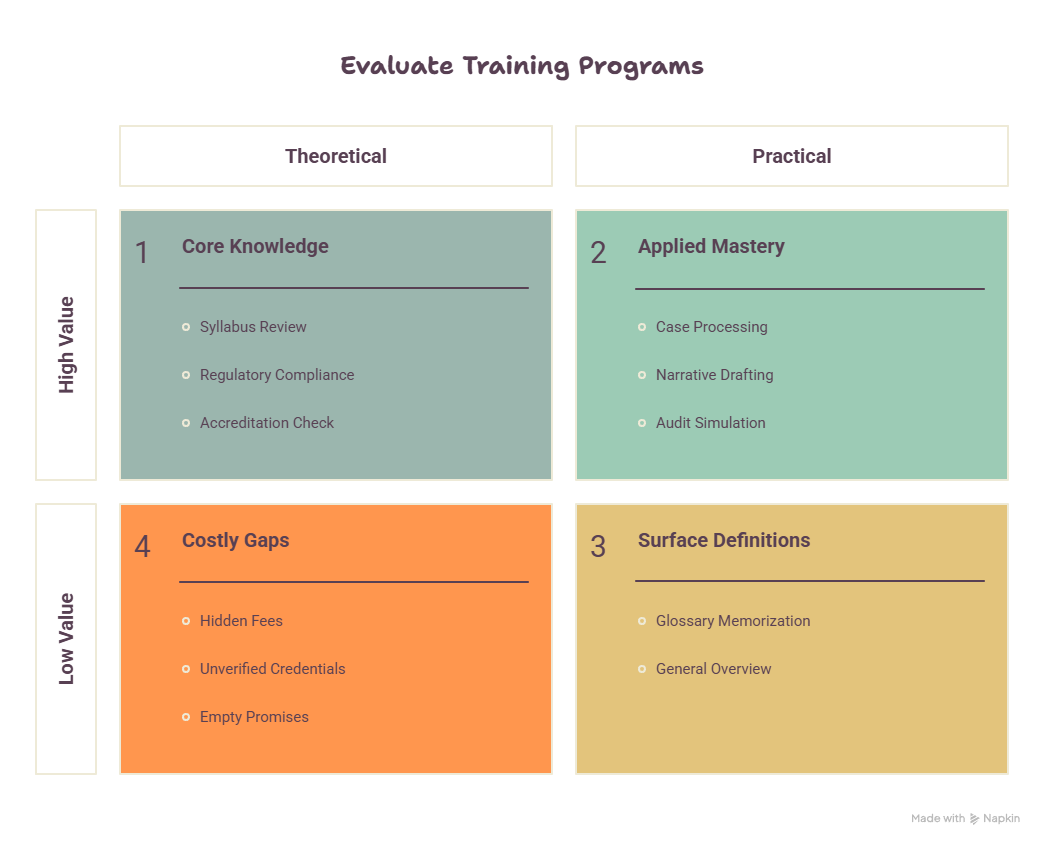
Then inspect practical depth. A program that names MedDRA, signal detection, and case processing may still provide only surface-level definitions. Ask whether students classify cases, establish Day 0, identify missing information, draft narratives, select follow-up questions, detect duplicates, conduct QC, reconcile records, and respond to mock audit findings. Look for the same applied thinking required in clinical-data verification, quality-management systems, protocol-deviation handling, trial-timeline management, and project close-out procedures.
Evaluate the complete cost rather than tuition alone. Include exam fees, retakes, software access, textbooks, renewal requirements, mentorship, career support, and the value of continued course access. A lower fee becomes expensive when the curriculum leaves major competency gaps. A higher fee needs evidence of deeper assessments, reusable templates, current updates, instructor access, or career support. Review the provider’s accreditation information, course syllabus, eligibility guidance, training FAQs, and pharmacovigilance program description before committing.
Treat employment promises carefully. Certification can strengthen knowledge, vocabulary, confidence, and screening credibility. Hiring still depends on role fit, transferable experience, application quality, location, interview performance, technical evidence, and employer demand. Improve your odds by using the career-opportunity map, joining clinical-research communities, exploring professional associations, attending specialist conferences, and maintaining skills through free training resources.
5. A 90-Day Georgia Pharmacovigilance Career Plan
Days 1–15: Position the target
Select two primary job titles and three adjacent titles. For example, target pharmacovigilance associate and drug-safety associate while including safety intake specialist, medical-information associate, and regulatory-safety coordinator. Analyze 20 vacancies and record repeated requirements involving case processing, MedDRA, narratives, follow-up, timelines, databases, quality control, and communication. Use the global career map, salary comparison tool, professional-association directory, researcher community directory, and free training directory.
Days 16–30: Complete foundational modules
Study the ICSR lifecycle, minimum criteria, seriousness, expectedness, causality, Day 0, expedited reporting, coding, narratives, and follow-up. Create a one-page reference sheet that links each decision to a source or SOP concept. Reinforce your learning through pharmacovigilance training guidance, AE-reporting compliance, clinical-safety oversight, ethical GCP principles, and investigator safety responsibilities.
Days 31–45: Build a private skills portfolio
Create three fully fictional cases. Case one can involve a valid non-serious spontaneous report with missing outcome information. Case two can involve a serious clinical-trial event requiring expectedness and causality analysis. Case three can combine a product complaint, medication error, multiple suspect products, and possible duplication. For each case, prepare an intake summary, validity decision, seriousness rationale, timeline, narrative, follow-up request, coding rationale, and QC checklist. Apply data-integrity principles, quality-management controls, data-verification methods, protocol-deviation practices, and audit-readiness techniques.
Days 46–60: Rebuild your resume and LinkedIn profile
Place your target function in the headline. Write a summary that connects your existing background with safety competencies. Add a certification section containing the exact credential name, provider, completion date, verification information, and relevant training scope. Convert course activity into evidence: case assessment, narrative writing, coding logic, regulatory timelines, QC, reconciliation, and audit readiness. Borrow accurate terminology from clinical-safety monitoring, global PV compliance, regulatory submissions, clinical-project quality, and medical compliance.
Days 61–75: Build a Georgia and remote employer map
Create six employer categories: pharmaceutical and biotechnology companies, CROs and safety vendors, hospitals and academic research centers, medical-device organizations, healthcare communication vendors, and public-health or regulatory contractors. Search Atlanta first, then broaden to Athens, Augusta, Johns Creek, Peachtree City, surrounding states, and nationwide remote roles. Compare nearby career ecosystems through the Alabama pharmacovigilance guide, Tennessee GCP guide, North Carolina GCP guide, South Carolina GCP guide, and Florida-accessible national career resources.
Days 76–90: Apply selectively and prepare for case interviews
Prioritize roles where you meet roughly two-thirds of the core requirements and can explain the remaining gaps. Tailor the resume’s opening section to each vacancy, mirror accurate terminology, and record every application. Prepare concise examples covering an incomplete case, missed deadline risk, data discrepancy, quality error, difficult follow-up, and urgent escalation. Use investigator-meeting communication, team-management principles, trial-logistics coordination, remote monitoring discipline, and data-review strategies to structure credible interview answers.
6. Frequently Asked Questions About Pharmacovigilance Certification in Georgia
-
Georgia employers generally evaluate pharmacovigilance candidates through education, relevant experience, professional training, technical competency, and employer-specific requirements. The Georgia Board of Pharmacy separately regulates pharmacists, pharmacies, permits, renewals, and related practice matters. Candidates pursuing safety work can strengthen their profile through pharmacovigilance certification, GCP knowledge, and adverse-event compliance training.
-
Completion depends on curriculum depth, assessment requirements, weekly study time, and previous clinical knowledge. A focused learner may progress through an online program within several weeks, while someone balancing full-time work may need several months. Reserve additional time for case-processing practice, regulatory-submission study, quality-management exercises, and career preparation.
-
Pharmacists often bring strong medication knowledge, therapeutic-area familiarity, patient-safety awareness, and clinical terminology. They still need to demonstrate PV-specific workflows such as minimum case validation, Day-zero determination, narratives, MedDRA coding, follow-up, reporting timelines, and quality control. Useful preparation includes drug-safety training, global compliance education, AE-reporting guidance, and audit-readiness training.
-
Life-science, public-health, nursing, research, data, regulatory, and quality backgrounds can support entry into selected PV roles. The candidate needs a credible bridge between prior experience and safety operations. Build that bridge through research-assistant training, clinical-data verification, protocol-adherence knowledge, quality-management skills, and a portfolio of fictional safety cases.
-
Certification can improve structured knowledge, screening credibility, interview language, and confidence. Employment outcomes also depend on role selection, transferable experience, application quality, location, interview performance, and market demand. Increase your probability through professional networking communities, clinical-research associations, career-market research, free professional webinars, and targeted applications.
-
Many safety workflows can be performed through controlled digital systems, including intake, case processing, medical review support, quality control, reconciliation, literature surveillance, aggregate-report support, and vendor coordination. Remote eligibility depends on employer policy, jurisdiction, security, system access, and employment arrangements. Strengthen remote readiness through data-integrity training, remote-monitoring practices, global compliance knowledge, and cross-functional communication.
