
The Ultimate Guide to Getting Your Good Clinical Practice (ICH-GCP) Certification in North Carolina: Everything You Need to Know in 2026-27
North Carolina is one of the smartest places to turn ICH-GCP certification into clinical research momentum because the state blends academic medical centers, CRO density, biotech growth, sponsor activity, hospital research, and biomanufacturing expansion. The fastest path is to pair clinical research certification in North Carolina, GCP monitoring skills, investigator responsibility knowledge, protocol deviation handling, and clinical trial data integrity with proof that you can protect subjects, document cleanly, and support trial quality.
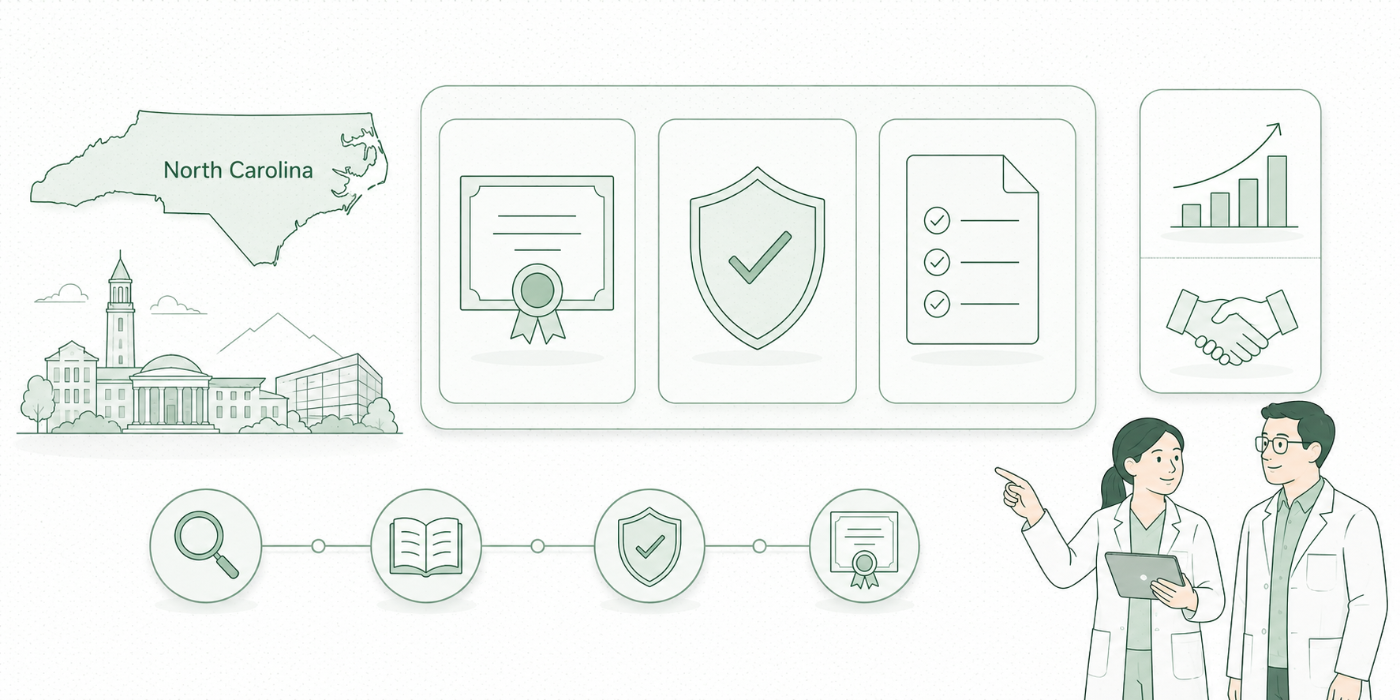
1. Why ICH-GCP Certification Matters in North Carolina in 2026-27
North Carolina candidates face a market where “I completed GCP” sounds weak unless it turns into operational language. The state has a deep life-sciences base; NCBiotech says North Carolina is home to about 840 life sciences companies directly employing 75,000 people, while the Research Triangle is widely known for CRO strength and clinical research infrastructure. That means an ICH-GCP certificate should help you compete for CRC roles, CRA pathways, clinical trial assistant roles, regulatory coordination, and pharmacovigilance careers with clear evidence of readiness.
The Research Triangle gives North Carolina a special advantage for ICH-GCP candidates because CROs, sponsors, vendors, academic sites, and hospital research programs often need people who understand both site execution and sponsor expectations. Work in the Triangle describes the region as having seven of the top 10 global CROs operating there and calls the Triangle the birthplace of CROs through Quintiles, now IQVIA. For job seekers, this creates practical demand for people who can handle remote monitoring, trial timeline management, clinical data review, quality management, and clinical operations leadership.
ICH-GCP certification also matters because the standard itself has moved forward. ICH E6(R3) gives a unified GCP standard for clinical trials and emphasizes participant protection, reliable results, proportionate quality management, and fit-for-purpose trial conduct. FDA published final guidance for ICH E6(R3) in September 2025 and explained that the update supports technology, innovation, and evolving clinical trial methods. A North Carolina candidate preparing for 2026-27 should connect that update to virtual clinical trials, trial technology innovations, risk-based monitoring, GCP compliance self-assessment, and global regulatory guidelines.
The pain point is brutally common: candidates pass a GCP course, add one line to the resume, and still lose interviews because they cannot explain what they would do when a subject signs the wrong consent version, misses a required assessment, reports a hospitalization, has conflicting source and EDC data, or triggers a protocol deviation. A stronger candidate turns certification into decision-making proof by studying SAE reporting procedures, clinical trial amendments, adverse event reporting compliance, site monitoring visit preparation, and patient safety in GCP.
| Career Situation | Best GCP Focus | Pain Point It Fixes | Proof to Build | CCRPS Resource |
|---|---|---|---|---|
| Entry-level CRC applicant in Raleigh-Durham | Consent, eligibility, visit windows, source notes | Your interest sounds real, but your execution proof looks thin | Build a mock screening-to-visit checklist | CRC retention strategies |
| Research assistant moving into trials | GCP principles, documentation, subject protection | Your academic research experience needs regulated-trial language | Translate past research tasks into GCP-controlled workflows | research assistant communication |
| Nurse targeting hospital-based studies | AE capture, SAE escalation, consent, protocol windows | Your clinical strength needs trial-specific documentation discipline | Create a safety escalation and follow-up map | SAE reporting procedures |
| Pharmacy technician entering research | IP accountability, concomitant meds, protocol restrictions | Your medication knowledge needs GCP framing | Prepare an IP accountability and deviation example | protocol deviation examples |
| CRA aspirant with site exposure | SDV/SDR, monitoring findings, escalation, CAPA | You know site tasks but need sponsor-side judgment | Build a monitoring follow-up letter and issue log | risk-based monitoring |
| Remote CRA candidate | Remote review, EDC trends, query logic, communication trails | Your resume says remote-ready without showing remote control | Map remote findings into action items and escalation notes | remote monitoring visits |
| Clinical trial assistant applicant | TMF, tracking, version control, follow-up discipline | You risk sounding administrative instead of trial-literate | Build a mock TMF tracker and action-item log | clinical trial templates |
| Regulatory coordinator candidate | IRB submissions, amendments, essential docs, training logs | Your binder knowledge needs inspection-ready structure | Create an amendment and version-control tracker | clinical trial amendments |
| Pharmacovigilance applicant | Seriousness, causality input, follow-up, reconciliation | You know safety vocabulary but need workflow confidence | Practice a case intake-to-reporting pathway | pharmacovigilance best practices |
| Data coordinator or EDC support applicant | ALCOA-C, audit trails, query responses, database lock | You know systems but need data-integrity credibility | Build a source-to-EDC query workflow | data review and verification |
| Candidate near Duke or UNC research environments | Academic-site workflow, consent, documentation, safety | You need to look prepared for complex investigator-led studies | Prepare examples around consent, source, and IRB follow-up | investigator-initiated trials |
| Candidate targeting CRO operations | Monitoring, metrics, escalation, timeline recovery | Your application lacks delivery-pressure signals | Create examples around issue ownership and study milestones | trial timeline management |
| Candidate targeting sponsor-side roles | Sponsor oversight, vendor control, monitoring strategy | Your site knowledge needs governance language | Explain how oversight prevents data and safety drift | sponsor responsibilities |
| Quality assurance candidate | CAPA, SOP adherence, root cause, audit readiness | You cite compliance without proving inspection thinking | Build a deviation-to-CAPA example with preventive action | quality management strategies |
| Public health graduate | Ethics, recruitment, consent, retention, participant trust | Your population-health value needs trial operations structure | Frame recruitment as access, comprehension, and documentation | patient education resources |
| Biology or biomedical science graduate | Protocol literacy, endpoints, eligibility, specimen handling | Your science degree needs patient-facing trial proof | Create a protocol-to-visit workflow summary | trial start-up checklist |
| Medical assistant moving into site work | Vitals, source documentation, visit checklists, patient flow | Your care experience needs regulated accuracy | Build a mock source note and visit worksheet | site monitoring guide |
| Candidate near Charlotte clinical sites | Hospital research, recruitment, documentation, safety reporting | You need a plan outside the Triangle-heavy job conversation | Target site roles, hospital research offices, and hybrid support roles | career opportunity map |
| Candidate near Winston-Salem or Greensboro | Academic health systems, coordinator work, regulatory support | You need to prove readiness across smaller but serious research markets | Prepare a role-specific application map by site type | professional associations directory |
| Candidate comparing nearby states | Transferable GCP expectations across regional employers | You apply too narrowly and miss nearby opportunities | Build a North Carolina plus Virginia/South Carolina/Tennessee plan | Virginia certification guide |
| Candidate seeking oncology research roles | Consent, eligibility, safety, RECIST/data awareness, protocol intensity | You underestimate how documentation-heavy oncology trials can be | Practice eligibility and SAE scenarios | oncology research conferences |
| Candidate targeting cardiovascular trials | Endpoint documentation, safety, source consistency, follow-up | Your application lacks therapeutic-area focus | Create a cardiovascular visit and endpoint documentation map | cardiovascular trial sites |
| Candidate targeting neurology trials | Assessment windows, rater consistency, subject follow-up | You need stronger specialty logic for complex assessments | Prepare examples around visit-window control and scale documentation | neurology trial sites |
| Project coordinator moving toward PM | Milestones, vendor communication, risk logs, close-out | You track tasks without showing study-level ownership | Build a milestone dashboard and risk register | project close-out procedures |
| Candidate unsure which certification to choose | Role fit, outcome depth, employer relevance, scenario practice | You risk paying for a credential that fails during interviews | Compare courses against real job descriptions | certificate programs compared |
| Candidate seeking salary growth | Specialization, measurable competence, role progression | You ask for better pay before proving higher-value judgment | Pair certification with portfolio proof and targeted applications | clinical research salary tool |
2. How to Choose the Right ICH-GCP Certification for North Carolina Roles
Choose your ICH-GCP certification by matching the course to the role you want, the evidence you need, and the local employers you plan to approach. A CRC candidate should focus on informed consent, eligibility, visit execution, source documentation, AE capture, patient retention, and site operations. A CRA candidate should focus on risk-based monitoring, remote and on-site monitoring, data verification, and investigator meeting execution. A PV candidate should prioritize safety monitoring, global PV compliance, and SAE reporting.
The best ICH-GCP training forces you to understand the chain of accountability. A protocol becomes scheduled site work. Site work becomes source documentation. Source documentation becomes EDC data. EDC data becomes review, queries, monitoring findings, safety reconciliation, and inspection evidence. When that chain breaks, the problem can become a deviation, a safety risk, a data-integrity issue, or a sponsor escalation. Study this chain through protocol deviation guidance, adverse event compliance, clinical trial amendments, sponsor responsibilities, and GCP compliance self-assessment.
North Carolina candidates should also use geography intelligently. The Raleigh-Durham-Chapel Hill corridor can support CRO, sponsor, academic-site, data, regulatory, and clinical operations pathways. Charlotte can support hospital-based research, multispecialty site work, and clinical operations support. Winston-Salem and Greensboro can support academic medical research, coordinator roles, regulatory support, and specialty clinical trials. Wilmington and other regional markets may offer site-level opportunities where strong GCP knowledge helps candidates stand out quickly. Compare your plan with South Carolina clinical research certification, Virginia clinical research certification, Tennessee clinical research certification, Georgia clinical research certification, and Florida clinical research certification if you are open to regional mobility.
A certificate should also prepare you for modern trial language. ICH E6(R3) highlights quality culture, critical-to-quality factors, proportionate approaches, participant engagement, and technology-aware conduct. That shifts interview expectations. Hiring teams may ask how you would prioritize monitoring findings, protect participants in a decentralized component, document telehealth assessments, maintain audit trails, or handle data from multiple systems. Your answer gets stronger when you can connect virtual trials, trial technology innovations, clinical trial data review, quality management, and ethical patient safety.
3. What You Should Know Before Enrolling in ICH-GCP Training
Before enrolling, define your target role in one sentence. “I want to work in clinical research” is too broad for serious career movement. Better targets include “CRC at an academic medical center,” “CTA at a CRO,” “regulatory coordinator for hospital research,” “PV associate in safety operations,” “data coordinator supporting EDC cleaning,” or “CRA after site experience.” Each path requires a different study emphasis across patient retention, clinical trial budget awareness, remote monitoring, regulatory submissions, and project milestones.
You should also know what employers really test. They rarely care that you can recite a definition of GCP. They care whether you can protect a participant, preserve data credibility, escalate safety issues, document decisions, follow protocol instructions, and prevent repeat errors. Build short answers for high-pressure scenarios: wrong consent version, missing signature, screening lab outside range, prohibited medication discovered late, SAE reported after a weekend, repeated missed visit windows, EDC source mismatch, untrained sub-investigator, expired lab certification, and incomplete delegation log. Build these answers with informed consent ethics, investigator responsibilities, clinical trial data integrity, deviation CAPA guidance, and site monitoring visit steps.
Your study plan should turn every GCP topic into one resume line, one interview story, and one portfolio artifact. For consent, create a consent version-control checklist. For safety, create an AE-to-SAE escalation map. For data integrity, create a source-to-EDC correction example. For deviations, create a tracker with issue, root cause, immediate correction, CAPA, owner, and due date. For monitoring, create a mock follow-up letter. These artifacts make your training visible and can be supported by clinical trial templates, trial start-up checklists, GCP compliance self-assessment, patient education resources, and free clinical research training.
The last thing to check before paying for training is whether the course helps with ICH E6(R3) language. A 2026-27 candidate should be comfortable with quality by design, critical-to-quality factors, proportionality, data governance, computerized systems, sponsor oversight, and participant-centered conduct. This is especially useful in North Carolina because CRO, sponsor, academic, and site roles may touch complex trial models. Duke Health, for example, maintains a searchable clinical trials directory, which reflects the kind of active research ecosystem where documentation, consent, safety reporting, and data quality become daily work. Pair training with clinical research ethics resources, regulatory guideline directories, clinical research communities, clinical research associations, and certificate program comparisons.
What is your biggest ICH-GCP career blocker in North Carolina right now?
4. Step-by-Step Plan to Get ICH-GCP Certified and Job-Ready
Begin with a seven-day foundation sprint. On days one and two, learn the purpose of GCP, the roles of sponsors, investigators, monitors, IRBs, CROs, and site teams, plus the ethical foundation behind every trial requirement. On days three and four, focus on informed consent, eligibility, visit windows, source documentation, AEs, SAEs, and protocol compliance. On days five and six, study monitoring, EDC queries, audit trails, deviations, CAPA, essential documents, and training records. On day seven, connect each topic to your target role through investigator responsibilities, sponsor responsibilities, GCP monitoring, adverse event reporting, and protocol deviation correction.
Move into a 14-day scenario sprint. Each day, write one answer to a real clinical research problem. If a participant signs an outdated consent form, your answer should include participant protection, immediate escalation, documentation, IRB/sponsor communication per process, re-consent, deviation assessment, and staff retraining. If an SAE occurs, cover awareness date, seriousness, source documentation, investigator assessment, sponsor reporting, follow-up, and reconciliation. If source and EDC conflict, cover source verification, query response, correction method, audit trail, and root cause. Strengthen this sprint with SAE procedures, deviation CAPA guidance, clinical trial amendments, data review skills, and GCP self-assessment.
Then build a portfolio that matches the jobs you want. A CRC portfolio should include a screening log, consent tracker, visit checklist, AE log, deviation log, and retention plan. A CRA portfolio should include a monitoring visit agenda, issue log, follow-up letter, SDV/SDR plan, and risk summary. A regulatory portfolio should include an essential document checklist, amendment tracker, IRB submission map, training log, and version-control template. A PV portfolio should include a seriousness decision tree, follow-up request template, case intake workflow, reconciliation checklist, and escalation map. Use trial templates, start-up checklist tools, patient education directories, quality management strategies, and project close-out procedures.
Your resume should prove that certification changed how you work. Replace weak phrasing like “Completed GCP certification” with stronger bullets such as “Trained in ICH-GCP principles covering informed consent, AE/SAE escalation, protocol compliance, source documentation, EDC query logic, deviation documentation, CAPA awareness, and inspection readiness.” Then tailor your applications to role type. Site applications should emphasize patient-facing discipline and documentation. CRO applications should emphasize tracking, monitoring support, escalation, and deadlines. Regulatory applications should emphasize version control, IRB support, and essential documents. Safety applications should emphasize case intake, seriousness, follow-up, and reconciliation. Support the search with career opportunity mapping, salary tools, professional associations, online communities, and certificate comparisons.

5. How to Turn ICH-GCP Certification Into North Carolina Career Momentum
North Carolina career momentum comes from targeting the right lane. Lane one is site-facing: CRC, assistant CRC, research assistant, regulatory coordinator, clinical trial assistant, and data coordinator. Lane two is CRO or sponsor-facing: CTA, project coordinator, in-house CRA support, start-up associate, safety associate, and document specialist. Lane three is specialization: oncology, cardiovascular, neurology, infectious disease, device, decentralized trials, gene therapy, cell therapy, or data operations. A smart candidate connects ICH-GCP training with cardiovascular trial site expertise, neurology trial capabilities, oncology research conferences, infectious disease trial sites, and global trial country trends.
The state’s broader biopharma expansion also raises the value of clinical research fluency. Biogen announced in 2025 that it would invest an additional $2 billion in North Carolina’s Research Triangle Park manufacturing operations, and Fujifilm Biotechnologies opened a major Holly Springs facility with plans tied to biologics manufacturing growth. Manufacturing roles differ from clinical operations roles, but the same ecosystem benefits candidates who understand regulated documentation, quality systems, patient safety, protocol evidence, and sponsor expectations. Build your story around quality management, clinical trial data integrity, clinical trial sponsor responsibilities, regulatory affairs mastery, and global regulatory compliance.
Networking should be specific and useful. A message that says “I’m interested in clinical research opportunities” creates little signal. A stronger message says you are completing ICH-GCP training, targeting CRC or CTA roles in North Carolina, and studying how sites prevent consent, safety, and documentation errors. Ask focused questions: “Which GCP mistakes create the most rework for new coordinators?” “What should an entry-level CTA understand about TMF tracking before joining a CRO?” “How do monitors prefer sites to prepare for visit-window or EDC issues?” These questions show you have studied monitoring visits, remote monitoring, data verification, protocol deviation handling, and clinical research communities.
Run your job search like a study start-up plan. Week one: pick one primary role, rewrite your resume, update LinkedIn, and prepare a role-specific portfolio. Week two: build a list of North Carolina sites, CROs, hospitals, vendors, and sponsor offices. Week three: apply with targeted language and send focused networking messages. Week four: practice scenario interviews and refine weak answers. Keep the process moving with CRA exam time management, free clinical research training, clinical research salary comparison, professional association directories, and top clinical research certificate comparisons.
6. FAQs
-
Yes. ICH-GCP certification is useful for North Carolina candidates because the state has a strong life-sciences and clinical research ecosystem, especially around the Research Triangle. The credential becomes strongest when paired with applied knowledge of North Carolina clinical research certification, patient safety, investigator responsibilities, site monitoring, and data integrity.
-
Core ICH-GCP training can often be completed quickly, but career-ready confidence takes extra practice. Give yourself time to study scenarios around consent, eligibility, safety, source documentation, monitoring findings, EDC queries, deviations, and CAPA. Strengthen your preparation with SAE reporting, protocol deviation examples, clinical trial amendments, risk-based monitoring, and GCP compliance tools.
-
ICH-GCP certification is valuable for CRCs, assistant CRCs, research assistants, CTAs, regulatory coordinators, data coordinators, in-house CRA support staff, pharmacovigilance associates, and project coordinators. Each path uses GCP differently, so match your study to CRC strategies, CRA monitoring skills, regulatory affairs, pharmacovigilance compliance, and project milestone management.
-
Yes, but the certificate should come with proof that you understand trial execution. Build a small portfolio with a consent checklist, AE/SAE escalation map, deviation tracker, source-to-EDC workflow, mock follow-up letter, and essential document tracker. Use clinical trial templates, trial start-up checklists, patient education resources, quality management guidance, and clinical research communities to make that proof stronger.
-
Yes. ICH E6(R3) is the current major GCP update, and FDA published final guidance in September 2025. Candidates should understand quality by design, proportionate trial conduct, critical-to-quality factors, computerized systems, data governance, sponsor oversight, and participant protection. Build that knowledge through trial technology innovations, virtual trial trends, remote monitoring, data review, and global regulatory guidelines.
-
Place ICH-GCP certification near the top if you are entry-level or switching careers, then support it with role-specific bullets. Mention informed consent, AE/SAE escalation, protocol compliance, source documentation, EDC query logic, deviation documentation, CAPA awareness, and inspection readiness. Pair it with North Carolina certification targeting, career opportunity mapping, salary research, clinical research associations, and certificate program comparison.
