How To Get a Pharmacovigilance Certification in Kansas: Everything You Need to Know in 2026–27
A pharmacovigilance credential can help Kansas professionals move into drug-safety operations, adverse-event case processing, clinical-trial safety, medical review support, and regulatory compliance. Career progress depends on choosing training that develops measurable abilities in adverse-event reporting, clinical-trial safety monitoring, global pharmacovigilance compliance, GCP certification in Kansas, and clinical data integrity. This guide explains how to evaluate programs, complete practical training, build Kansas-relevant experience, and convert the credential into interviews during 2026–27.
1. Understand What a Pharmacovigilance Certification Must Prove
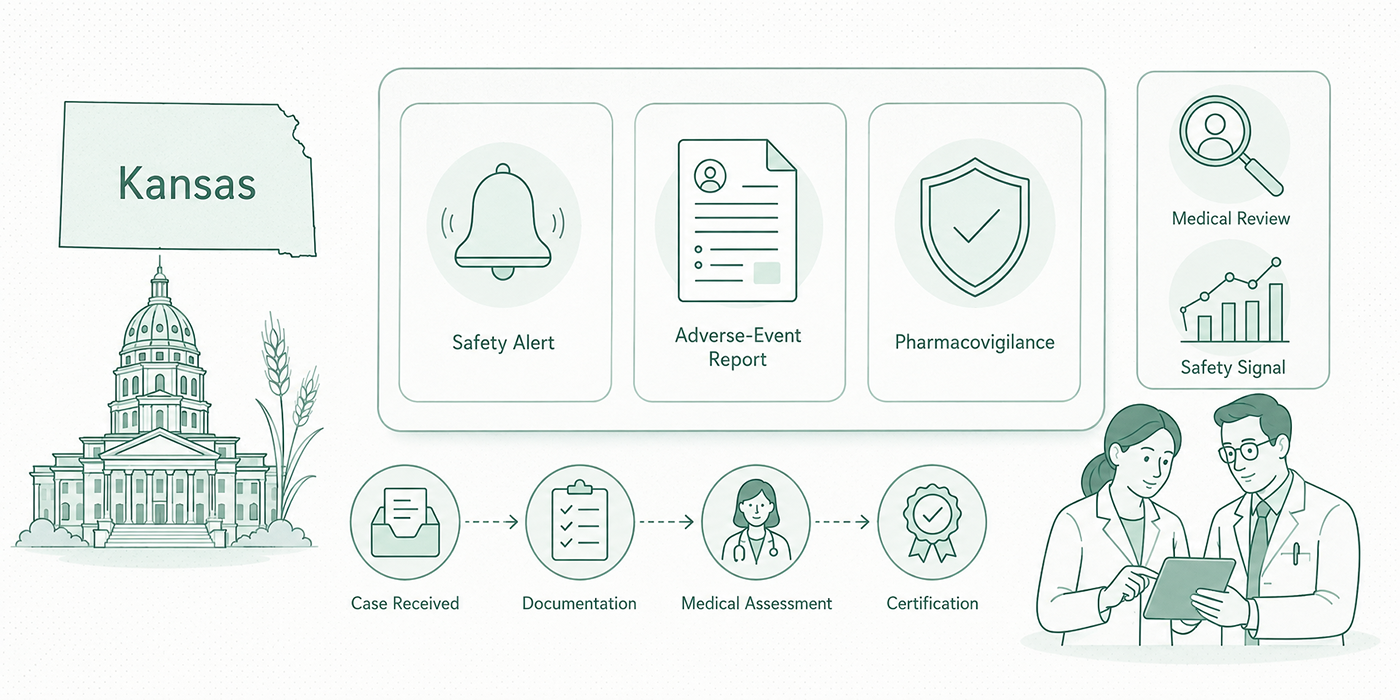
Pharmacovigilance professionals collect, evaluate, document, communicate, and help prevent medicine-related safety problems across clinical development and postmarketing use. Entry-level work may involve validating reports, classifying seriousness, coding medical information, writing case narratives, requesting follow-up, checking duplicates, reconciling safety data, and supporting regulatory safety reporting. More advanced responsibilities include signal assessment, aggregate safety analysis, inspection preparation, and medical safety oversight.
Kansas regulates healthcare professions such as pharmacy, nursing, medicine, and allied health through designated state boards. In practice, a pharmacovigilance course credential functions as specialized employer-facing evidence, while pharmacists, nurses, physicians, and other regulated practitioners remain responsible for maintaining any license attached to their original profession. A Kansas pharmacist entering drug safety, for example, must distinguish the professional value of pharmacovigilance training from the separate state requirements governing pharmacist licensure.
Three credential terms require careful separation:
A course certificate documents completion of an educational program.
A professional certification usually includes defined competencies, formal assessment, verification, and sometimes renewal requirements.
A state license grants legal authority to perform a regulated occupation within the state.
Request written clarification from every provider. Ask how the credential is verified, whether the assessment is proctored, which competencies are tested, how long verification remains available, and whether graduates receive feedback on practical work. A polished badge carries limited hiring value when the provider cannot explain what a learner had to demonstrate.
Your program should reflect the regulatory environment employers will use during 2026–27. ICH adopted the E6(R3) Principles and Annex 1 in January 2025, strengthening risk-proportionate quality management, participant protection, clear responsibilities, and fit-for-purpose trial processes. Training should connect these expectations with ethical GCP conduct, investigator responsibilities, risk-based monitoring, clinical data verification, and research quality management.
Current technical training also needs E2B(R3). FDA began accepting E2B(R3) postmarketing ICSR submissions in January 2024, while the E2B(R2) implementation period continues through September 30, 2026. FDA’s March 2026 final E2D(R1) guidance additionally addresses safety information originating from social media, market-research programs, patient-support programs, and other increasingly used postapproval sources. A 2026–27 course should explain how modern sources enter controlled case-intake workflows, how data are mapped into structured fields, and how teams preserve traceability, reporting compliance, and audit readiness.
Kansas Pharmacovigilance Certification: 30-Point Program Audit
| Program Requirement | What the Course Should Teach | Evidence You Should Produce | Failure Risk | CCRPS Skill Resource |
|---|---|---|---|---|
| 1. Credential transparency | Exact credential type, assessment method, verification process, expiration, and retake terms | Published credential policy and verifiable graduate record | Employers cannot determine what completion proves | Compare training resources |
| 2. Current GCP framework | ICH E6(R3), participant protection, proportionality, quality by design, and risk-based controls | Risk assessment of a fictional clinical study | Outdated checklist-based knowledge | Study Kansas GCP certification |
| 3. ICSR validity | Identifiable reporter, identifiable patient, suspected product, and adverse event | Validity decisions for ambiguous case scenarios | Valid reports may be missed or invalid records processed | Master adverse-event reporting |
| 4. Report-source classification | Spontaneous reports, studies, literature, patient programs, market research, and digital sources | Source-classification decision tree | Incorrect routing and inconsistent reporting treatment | Review safety-monitoring practices |
| 5. Day-zero determination | Initial awareness, receipt dates, follow-up awareness, and clock-start documentation | Reporting timeline worksheet | Late submissions despite medically accurate processing | Control clinical timelines |
| 6. Seriousness assessment | Death, life threat, hospitalization, disability, congenital anomaly, and medically important events | Criterion-specific seriousness rationales | Expedited reports may be delayed or overclassified | Strengthen reporting compliance |
| 7. Severity distinction | Clinical intensity versus regulatory seriousness | Scenario set separating severe events from serious events | Basic terminology errors during interviews and case review | Understand safety terminology |
| 8. Expectedness | Correct use of reference safety information and listedness sources | Expectedness worksheet identifying the exact reference version | Incorrect expedited-reporting decisions | Review safety compliance |
| 9. Causality reasoning | Temporality, dechallenge, rechallenge, alternatives, confounding, and biological plausibility | Structured causality assessment with limitations | Unsupported conclusions and inconsistent medical review | Study medical safety oversight |
| 10. Medical coding | Accurate term selection, hierarchy awareness, version control, and escalation | Coding exercises with written rationales | Poor coding obscures patterns during aggregate review | Improve data-review accuracy |
| 11. Case narrative writing | Chronology, clinical relevance, treatments, tests, outcomes, and source attribution | Edited narrative with tracked corrections | Reviewers cannot reconstruct the clinical course efficiently | Strengthen research documentation |
| 12. Follow-up prioritization | Questions targeting medically significant missing information | Case-specific follow-up questionnaire | Teams collect low-value details while decisive gaps remain | Build precise follow-up habits |
| 13. Duplicate management | Patient, reporter, product, dates, events, study identifiers, and narrative comparisons | Duplicate assessment and merge rationale | Inflated event counts and distorted signal evaluation | Protect data integrity |
| 14. E2B(R3) data structure | Structured safety fields, controlled terminology, attachments, validation, and acknowledgments | Field-mapping or simulated XML validation exercise | Training fails to match current submission workflows | Develop structured data skills |
| 15. Clinical-trial safety | AE, SAE, suspected adverse reactions, investigator reporting, sponsor review, and unblinding controls | End-to-end trial safety workflow | Development and postmarketing responsibilities become confused | Review investigator obligations |
| 16. Postmarketing safety | Spontaneous reports, follow-up, periodic review, emerging risks, and labeling implications | Postapproval case and escalation assessment | Knowledge remains limited to clinical trials | Study postmarketing compliance |
| 17. Literature surveillance | Search strategy, screening, case identification, documentation, and reconciliation | Literature-screening log with inclusion decisions | Reportable cases and emerging evidence may be overlooked | Connect surveillance with safety |
| 18. Signal detection | Case-series review, disproportionality awareness, clinical patterns, and data limitations | Mini signal-detection exercise | Case processing remains disconnected from safety meaning | Build signal-management skills |
| 19. Signal validation | Evidence quality, novelty, biological plausibility, duplicates, confounding, and alternative explanations | Signal-validation memo | Weak patterns may be escalated without disciplined review | Ground decisions in patient safety |
| 20. Aggregate reporting | DSUR concepts, periodic benefit-risk evaluation, line listings, interval analysis, and cumulative review | Mock aggregate summary | Experience remains confined to single cases | Connect safety with submissions |
| 21. Benefit-risk assessment | Frequency, severity, preventability, uncertainty, exposure, alternatives, and risk minimization | Evidence-based benefit-risk recommendation | Conclusions outrun the available evidence | Apply ethical safety principles |
| 22. SOP literacy | Controlled documents, versioning, responsibilities, deviations, training, and governance | Process map linked to SOP control points | Theoretical knowledge cannot be operationalized | Develop quality-system literacy |
| 23. Reconciliation | Comparison of safety, clinical, product-complaint, and vendor records | Reconciliation tracker with discrepancy resolution | Reportable information remains trapped between systems | Improve record traceability |
| 24. Deviation management | Documentation, impact assessment, escalation, ownership, and recurrence prevention | Completed deviation report | Compliance failures are closed without solving the cause | Handle deviations systematically |
| 25. CAPA development | Root cause, correction, corrective action, preventive action, and effectiveness checks | CAPA plan for a late-reporting scenario | Recurring errors survive superficial remediation | Build defensible CAPAs |
| 26. Audit readiness | Evidence retrieval, interview conduct, observation response, commitments, and remediation | Mock inspection-response package | The learner understands tasks yet cannot prove compliance | Prepare for PV inspections |
| 27. Privacy and confidentiality | Minimum-necessary data, redaction, role-based access, secure remote work, and portfolio boundaries | De-identified case packet and access-control plan | Training artifacts expose protected or proprietary information | Preserve controlled research data |
| 28. Practical assessment | Timed case review, narrative editing, follow-up, coding, and escalation | Graded work with individual feedback | A multiple-choice score creates weak employment evidence | Benchmark training depth |
| 29. Portfolio support | Ethical construction of fictional, original, de-identified work samples | ICSR packet, signal memo, workflow map, and CAPA | The graduate has a credential without interview proof | Present professional work clearly |
| 30. Kansas career strategy | Academic centers, hospitals, research sites, CROs, vendors, sponsors, and remote employers | Target-employer map and 90-day application plan | Applications remain broad, reactive, and poorly matched | Explore research career opportunities |
Selection standard: Prioritize a program that evaluates realistic work. Course length, video volume, downloadable slides, and marketing claims provide limited insight into whether you can make accurate, traceable, deadline-sensitive safety decisions.
2. Choose the Right Pharmacovigilance Program in Kansas
Start with the syllabus rather than the tuition page. A job-aligned program should move from case intake through medical review, quality control, submission, follow-up, reconciliation, signal work, and inspection readiness. Training limited to definitions may help you discuss pharmacovigilance, while employers need evidence that you can apply safety-reporting rules, protect clinical data integrity, follow regulated workflows, manage quality risks, and support audit responses.
Ask the provider for one anonymized assignment example. A worthwhile assessment might give you a poorly documented safety report and require you to determine validity, seriousness, day zero, missing information, coded concepts, expectedness, follow-up, and escalation. Another exercise may require you to edit an incoherent narrative or evaluate several cases for a possible safety signal. These tasks reveal whether the program teaches judgment under realistic constraints.
Examine instructor qualifications at the task level. Relevant experience can include case processing, medical review, signal management, aggregate reporting, literature surveillance, safety-database operations, quality assurance, SOP development, regulatory submissions, or inspections. Ask who grades your work, how feedback is delivered, and whether you can revise an assignment after receiving comments. Detailed correction is especially important for case narratives, safety assessments, data verification, and deviation investigations.
Evaluate the program’s technology claims carefully. Entry-level learners rarely need mastery of every commercial safety platform. They do need to understand work queues, field logic, controlled terminology, validation rules, attachments, audit trails, role-based access, reconciliation, and E2B(R3) transmission. A course that repeatedly displays software screenshots may still provide little practical value when learners never complete a simulated case.
Calculate total investment using six variables: tuition, examination fees, retakes, software or textbook charges, access duration, and the cost of missing instructor feedback. A low-priced course can become expensive when you must purchase separate training to acquire GCP knowledge, regulatory fundamentals, medical-monitoring context, quality-system competence, and interview-ready work samples.
Kansas learners can also use university-based clinical research education to strengthen adjacent skills. The University of Kansas offers a clinical trials management graduate certificate, while KU Medical Center offers graduate-level clinical research education focused on patient-oriented research methods. These programs serve broader clinical-research development, so candidates seeking a dedicated drug-safety role should verify how much direct pharmacovigilance content, ICSR practice, and signal work each option contains.
Compare your prospective course with pathways available in Colorado, Arkansas, California, and Delaware. The comparison helps expose missing curriculum elements, weak assessment policies, or vague credential claims.
3. Complete Your Certification With a 12-Week Skills Plan
Use weeks one and two to build your regulatory map. Learn where investigators, sponsors, CROs, vendors, medical monitors, regulators, and marketing authorization holders enter the safety process. Connect investigator GCP responsibilities, medical-monitor oversight, site-operations controls, CRA monitoring duties, and global PV obligations. Create a one-page responsibility chart showing who receives, assesses, submits, follows up, reconciles, and closes each safety record.
Use weeks three and four for intake and triage. Process fictional reports from a patient email, healthcare-professional call, literature article, clinical study, support program, and online post. For each scenario, identify the four validity elements, receipt date, source category, seriousness, missing data, suspected product, event terms, and escalation route. Record every assumption. Reviewers trust visible reasoning more than unexplained answers.
Use weeks five and six for complete case development. Practice medical coding, chronology, narrative construction, concomitant therapy review, laboratory interpretation, dechallenge, rechallenge, and targeted follow-up. Compare your work against the standards behind clinical-trial data review, protocol adherence, trial logistics, adverse-event compliance, and data-integrity oversight.
Use weeks seven and eight to move beyond individual cases. Build a fictional case series and examine clinical similarity, timing, product exposure, duplicates, confounding, reporting bias, missing denominators, and alternative explanations. Write a one-page signal memo with a proportional recommendation. This exercise helps you discuss safety evidence without overstating weak patterns.
Use weeks nine and ten for quality systems. Design a case-processing workflow, a reconciliation checklist, a deviation form, and a CAPA plan. Include ownership, deadlines, escalation criteria, documentation requirements, and effectiveness checks. Use pharmacovigilance inspection guidance, protocol-deviation methods, research quality strategies, trial timeline controls, and project-management leadership to test whether your controls address the actual failure mechanism.
Use weeks eleven and twelve to complete the assessment and create employment evidence. Revise weak assignments, request instructor feedback, build a portfolio, update your résumé, and practice technical interview responses. Join selected clinical-research associations, participate in focused clinical-research communities, review free training resources, explore the clinical-research career map, and benchmark target roles through the clinical-research salary tool.
What is blocking your pharmacovigilance career in Kansas?
Select the barrier creating the most friction. Your result will identify the highest-priority action.
4. Build Kansas-Relevant Pharmacovigilance Experience
Create an original portfolio with fictional, fully de-identified data. Real patient records, employer procedures, sponsor templates, database screenshots, internal emails, and proprietary case details should remain outside your materials. A safe portfolio demonstrates decision quality while following patient-safety ethics, clinical data-integrity rules, protocol-documentation standards, quality-management controls, and inspection-readiness expectations.
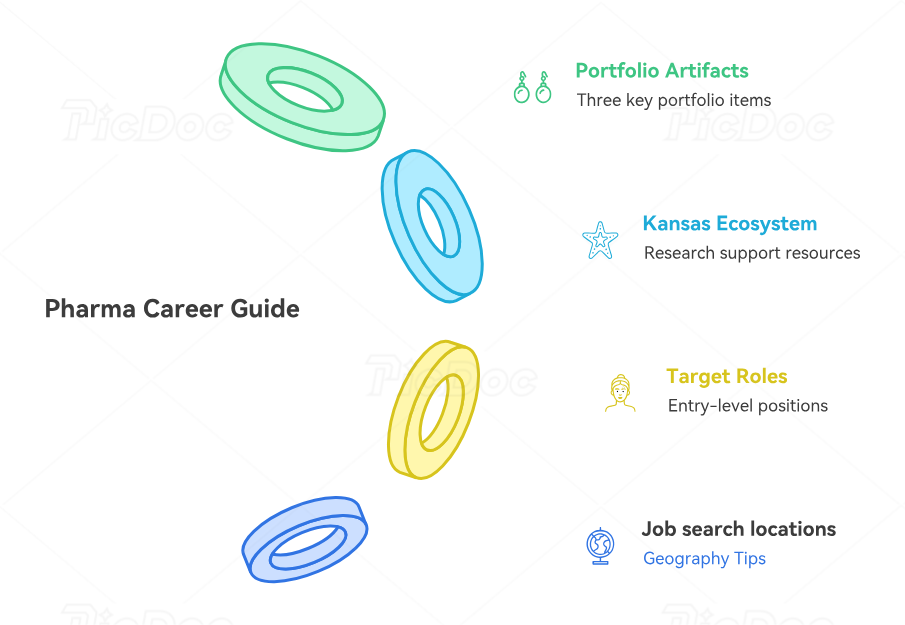
Your first portfolio artifact should be a complete ICSR packet. Include the original fictional source, case-validity assessment, seriousness decision, day-zero rationale, expectedness source, medical coding, chronological narrative, follow-up questions, duplicate check, and quality-control record. Add a revision note explaining what you changed after review. This shows that you can accept feedback and strengthen a regulated record.
Your second artifact should be a signal-assessment memo. Use several fictional reports involving medically related events. Evaluate case quality, timing, exposure, duplicates, confounders, underlying disease, biological plausibility, reporting bias, and missing information. State whether the evidence supports continued monitoring, targeted follow-up, formal validation, or another proportionate action. A cautious, traceable conclusion carries more credibility than an aggressive claim built on weak data.
Your third artifact should address quality failure. Create a scenario in which report submissions became late because staff recorded awareness dates inconsistently. Develop the correction, root cause, corrective action, preventive action, owner, deadline, training requirement, process metric, and effectiveness check. Draw from deviation-management techniques, trial timeline management, pharmacovigilance audits, project leadership, and clinical quality systems.
Kansas provides a useful clinical-research ecosystem for developing adjacent experience. The University of Kansas Cancer Center operates a centralized Clinical Trials Office covering study implementation, regulatory compliance, project management, data coordination, research assurance, monitoring, auditing, quality oversight, investigator-initiated trials, and staff education. Its Clinical Research Center in Fairway supports trial participants and research teams. These functions create relevant pathways into safety documentation, quality, regulatory work, data review, study coordination, and clinical operations.
Candidates can target clinical research coordinator, research assistant, regulatory coordinator, data coordinator, research nurse, quality specialist, medical-information associate, safety coordinator, and clinical-trial project roles. These positions may build direct exposure to site monitoring, investigator meetings, clinical data verification, patient retention, and regulatory submissions. Each experience can support a later move into dedicated pharmacovigilance when documented accurately.
Broaden your geography intelligently. Search across Kansas City, Overland Park, Fairway, Lawrence, Topeka, and Wichita, while confirming whether an employer’s Kansas City listing refers to Kansas or Missouri. Include remote positions only when the employer explicitly permits Kansas-based employees. Remote safety work requires reliable deadline management, secure data handling, clear written handoffs, and scheduled overlap with dispersed teams.
5. Turn the Certification Into Interviews and Job Offers
Begin with a job-family map. Search for pharmacovigilance associate, drug safety associate, safety case processor, adverse-event specialist, clinical safety coordinator, safety operations specialist, literature-surveillance associate, medical-information specialist, safety data specialist, and junior signal-management roles. Add adjacent openings involving regulatory affairs, clinical operations, medical monitoring, research quality, and clinical data review.
Analyze 25–30 job descriptions before finalizing your résumé. Record how often employers request ICSR processing, medical terminology, GCP, narrative writing, coding, safety databases, literature surveillance, E2B, quality control, reporting timelines, signal support, and remote communication. This evidence tells you which capabilities deserve prominent placement and which gaps require additional practice.
Use transparent résumé language. Coursework should appear as training, simulation, or assessed project work. Strong examples include:
Evaluated fictional safety reports for case validity, seriousness, expectedness, causality, reporting timelines, missing information, and escalation requirements.
Developed structured case narratives, targeted follow-up questions, duplicate assessments, coding rationales, and quality-control documentation during assessed pharmacovigilance training.
Completed a simulated signal review examining clinical similarity, temporal patterns, confounding, duplicate risk, exposure limitations, reporting bias, and evidence gaps.
Designed a CAPA addressing late safety submissions through root-cause analysis, process controls, ownership, retraining, metrics, and effectiveness verification.
Your professional profile should include a precise headline, safety-focused summary, credential-verification information, and featured work samples. Participate selectively in clinical-research professional associations and online research communities. Share concise original analyses of case-quality problems, follow-up strategy, source classification, or CAPA design while preserving confidentiality.
Prepare for technical interviews around decision points. You should be able to explain:
The minimum information required for a valid ICSR
The difference between seriousness and severity
How day zero is determined
How expectedness is assessed
Which missing information deserves immediate follow-up
How duplicates affect signal review
Which elements belong in a strong case narrative
How you would respond to uncertain causality
When a case pattern deserves escalation
How a late report should be investigated and prevented
Support your preparation with adverse-event reporting guidance, clinical-trial safety practices, global regulatory compliance, GCP certification in Kansas, and pharmacovigilance inspection techniques.
Run a 90-day campaign with weekly metrics. Track applications, recruiter screens, hiring-manager interviews, technical assessments, final interviews, and offers. A weak screening rate usually points toward targeting or résumé alignment. Frequent technical rejection indicates gaps in applied knowledge or explanation. Final-stage rejection may involve competition, communication, schedule requirements, compensation, or role fit. Measure the stage where momentum breaks and direct improvement there.
6. Frequently Asked Questions About Pharmacovigilance Certification in Kansas
-
Kansas state boards license regulated healthcare professionals, including pharmacists, nurses, physicians, and several allied health occupations. Pharmacovigilance course credentials are generally used as specialized evidence for employers. Professionals who maintain a clinical practice must continue satisfying the licensing requirements attached to that profession.
Before enrolling, determine whether the provider awards a completion certificate, examination-based certification, or continuing-education credit. Compare the program with Kansas GCP requirements, pharmacovigilance compliance standards, adverse-event reporting duties, and safety-monitoring responsibilities.
-
Online completion is practical when the course provides accessible lessons, clear examination windows, instructor support, practical assignments, and secure credential verification. Check whether live sessions conflict with your schedule and whether recordings remain available. Review course-access limits before paying, since short access periods can restrict revision and portfolio development.
Combine online study with free clinical-research webinars, professional research communities, clinical-research associations, remote monitoring practices, and clinical career opportunities.
-
Healthcare education can strengthen medical terminology, disease knowledge, medication familiarity, and causality reasoning. Entry pathways may also be available to candidates from biology, biotechnology, public health, clinical research, regulatory affairs, health information, data management, and related scientific disciplines.
Candidates without a clinical degree should build targeted foundations through research-assistant training, protocol-adherence education, GCP ethics, clinical data review, and adverse-event reporting. Their work samples should show accurate application of these concepts.
-
Completion time depends on curriculum depth, prior scientific knowledge, weekly availability, assessment difficulty, and instructor-feedback cycles. A learner with clinical-research or healthcare experience may progress faster through foundational material. A career changer may need additional time for medical terminology, GCP, clinical-trial structure, and regulatory concepts.
Evaluate the outcomes rather than the calendar length. Completion should leave you able to assess validity, seriousness, expectedness, causality, day zero, follow-up, duplicates, narratives, signals, deviations, and CAPAs. Use safety-monitoring training, quality-management guidance, audit-preparation techniques, and regulatory-submission education to assess your readiness.
-
GCP is highly relevant to clinical-trial safety because it defines ethical and scientific expectations for participant protection, responsibilities, records, protocol compliance, data reliability, and safety communication. ICH E6(R3) gives additional weight to quality by design, proportionality, risk-based processes, and fit-for-purpose systems.
Connect Kansas GCP certification with investigator responsibilities, medical-monitor oversight, remote and on-site monitoring, and clinical data integrity.
-
A focused entry-level portfolio should include one complete fictional ICSR packet, one corrected narrative, one targeted follow-up plan, one duplicate assessment, one literature-screening log, one signal memo, one workflow diagram, and one CAPA exercise. Include assumptions, references, limitations, reviewer comments, and revision history.
Review each artifact against data-integrity expectations, pharmacovigilance audit standards, protocol-deviation methods, patient-safety principles, and clinical data-review practices.
