
How To Get a Pharmacovigilance Certification in Louisiana: Everything You Need to Know in 2026–27
Louisiana professionals pursuing drug-safety careers in 2026–27 need a pathway that converts regulatory knowledge into practical evidence. Effective preparation combines clinical-trial safety monitoring, adverse-event reporting compliance, global pharmacovigilance requirements, and inspection-ready quality practices. Louisiana’s life-sciences network creates potential routes through biotechnology, healthcare, academic research, manufacturing, animal health, regulatory operations, and remote safety teams. This guide explains how to evaluate programs, build employer-ready skills, avoid weak credentials, and create a focused certification-to-career strategy.
1. Understand What Pharmacovigilance Certification Means in Louisiana
A pharmacovigilance certification documents structured training in detecting, evaluating, recording, communicating, and reducing safety risks associated with medicinal products. A career-focused curriculum should connect clinical-trial safety practices, adverse-event reporting requirements, ethical patient-safety principles, clinical-data integrity, and regulatory submission processes. Employers then examine whether candidates can apply those principles to incomplete reports, conflicting source records, urgent reporting clocks, and tightly controlled workflows.
Pharmacovigilance training and Louisiana pharmacy licensure serve separate purposes. The Louisiana Board of Pharmacy regulates pharmacy practice and maintains credential pathways for pharmacists, interns, pharmacy technicians, candidates, and licensed facilities. A pharmacovigilance certificate should therefore be presented as specialized drug-safety education rather than authorization to practice pharmacy. Licensed healthcare professionals should maintain the credentials required for their existing profession while developing safety expertise through the Louisiana GCP certification guide, investigator GCP responsibilities, medical-monitor safety oversight, and medical regulatory compliance.
Louisiana’s life-sciences opportunity extends beyond a single metropolitan area. Louisiana Economic Development maintains a statewide directory of bioscience innovators organized across Acadiana, Bayou, Capital, Central, Northeast, Northwest, and Southeast regions. Its sector strategy highlights scientific research, biotechnology startups, established institutions, commercialization, and collaborative innovation. Candidates can investigate these markets through the clinical-research career map, worldwide salary comparison tool, professional-association directory, and clinical-research community directory.
Recent investment also shows why candidates should search beyond traditional human-pharmaceutical roles. In February 2026, Louisiana Economic Development announced that animal-health biotechnology company Akston had opened a manufacturing facility in Caddo Parish as part of a $7 million expansion. Louisiana also supports biotechnology, tissue engineering, wound-care products, biomedical research, and university-linked innovation. That breadth creates adjacent routes into product surveillance, medical information, quality systems, safety intake, complaint handling, regulatory documentation, and vendor operations. Candidates should combine clinical-safety monitoring, quality-management skills, clinical-data verification, and trial-logistics knowledge when targeting these employers.
Entry-level searches should include pharmacovigilance associate, drug-safety associate, safety intake specialist, ICSR processor, medical-information associate, product-surveillance analyst, literature-surveillance associate, clinical-safety coordinator, reconciliation analyst, PV quality assistant, and regulatory-safety specialist. Some Louisiana opportunities may use medical-device, biotechnology, biologics, animal-health, research-compliance, or product-quality language. Broaden the search through the clinical-research career-opportunity map, free research-training directory, researcher networking communities, professional associations, and specialist research conferences.
| Evaluation Point | What High-Value Training Should Deliver | Evidence to Request | Costly Warning Sign | Supporting CCRPS Resources |
|---|---|---|---|---|
| 1. Career alignment | A clear connection between course modules and case processing, safety operations, compliance, quality, signal management, or medical review support. | A module-to-role map showing which responsibilities each lesson develops. | One credential is marketed as complete preparation for every PV position. | Explore career markets and compare salaries. |
| 2. ICSR lifecycle | End-to-end training in intake, validation, assessment, coding, narratives, QC, submission, follow-up, and closure. | A complete simulated case processed from source receipt to final quality review. | ICSR processing receives one brief theory lesson. | Study safety monitoring and AE reporting. |
| 3. Minimum case criteria | Application of identifiable patient, identifiable reporter, suspect product, and adverse-event requirements. | Ambiguous source reports requiring valid, invalid, and follow-up decisions. | Students memorize four criteria without applying them. | Develop verification skills and protect data integrity. |
| 4. Day-zero determination | Recognition of when the reporting clock begins across sites, vendors, affiliates, literature sources, and call centers. | Timestamped exercises involving delayed transfer and incomplete information. | The clock begins after medical review or database entry. | Master reporting timelines and manage safety handoffs. |
| 5. Seriousness assessment | Application of death, life-threatening status, hospitalization, disability, congenital anomaly, intervention, and medically important event criteria. | Borderline cases requiring written seriousness rationales. | Seriousness and clinical intensity are treated as interchangeable. | Review reporting rules and patient-safety ethics. |
| 6. Expectedness assessment | Comparison against the correct reference safety information for the product and reporting context. | Exercises using labels, investigator brochures, and controlled reference documents. | Expectedness relies on the learner’s general medical familiarity. | Strengthen protocol literacy and review investigator duties. |
| 7. Causality reasoning | Assessment of chronology, dechallenge, rechallenge, alternative causes, medical history, and concomitant therapy. | Written reasoning for related, unrelated, and indeterminate scenarios. | Every event following exposure is automatically considered related. | Understand medical oversight and evaluate clinical evidence. |
| 8. Expedited reporting | Application of appropriate timelines according to seriousness, expectedness, causality, source, study status, and jurisdiction. | Timed classification drills supported by regulatory rationale. | One deadline is applied to every safety case. | Study IND submissions and global requirements. |
| 9. MedDRA coding | Concept preservation, lowest-level term selection, preferred-term review, hierarchy awareness, and version control. | Verbatim-to-code exercises with documented quality feedback. | MedDRA appears only as a glossary term. | Improve data review and strengthen quality controls. |
| 10. Product coding | Accurate classification of suspect, interacting, and concomitant products with formulation, indication, and exposure context. | Cases involving brands, generics, combination products, and incomplete drug information. | Products are entered without assessing their role. | Preserve structured data and connect medical compliance. |
| 11. Safety narratives | Chronological, factual, medically coherent summaries that remain consistent with structured case fields. | Before-and-after narratives assessed against a transparent rubric. | Raw source text is pasted into a disorganized paragraph. | Develop research communication and documentation discipline. |
| 12. Follow-up strategy | Prioritization of information capable of changing validity, seriousness, causality, outcome, or reporting obligations. | A focused follow-up questionnaire based on an incomplete report. | Every blank field generates a long generic request. | Improve stakeholder communication and strengthen follow-up methods. |
| 13. Duplicate detection | Comparison of patient details, products, reporters, dates, geography, events, and narrative content. | Near-duplicate cases requiring merge, link, or separation decisions. | Duplicate review relies on initials or one matching field. | Apply verification techniques and build review controls. |
| 14. Literature surveillance | Search strategy, article screening, case identification, Day 0, source retention, and reporting workflow. | A published article converted into one or more safety records. | Literature surveillance is reduced to basic keyword searching. | Use research resources and review global obligations. |
| 15. Clinical-trial safety | Understanding of AE, SAE, SUSAR, sponsor, investigator, site, IRB, and ethics-committee responsibilities. | A mapped workflow from site awareness through sponsor assessment and regulatory reporting. | Postmarketing terminology is applied to every trial case. | Master trial safety and investigator obligations. |
| 16. Postmarketing safety | Distinction among spontaneous reports, solicited sources, patient programs, market research, and product complaints. | Source-specific intake and reporting exercises. | Every post-approval source follows the same process. | Review AE compliance and apply safety ethics. |
| 17. Medication errors | Assessment of intercepted errors, errors reaching patients, adverse outcomes, misuse, overdose, and occupational exposure. | Scenarios requiring source classification and reporting decisions. | Medication errors are ignored whenever no adverse event is reported. | Examine safety scenarios and document compliantly. |
| 18. Product complaints | Recognition of information requiring coordination between pharmacovigilance and product-quality functions. | A combined complaint and adverse-event workflow exercise. | Product-quality and safety information remain disconnected. | Build quality systems and preserve traceability. |
| 19. Signal detection | Case-series review, data-mining concepts, validation, prioritization, medical assessment, and escalation. | A concise signal-assessment memo supported by traceable evidence. | High report volume is described as proof of causation. | Study safety signals and evaluate evidence quality. |
| 20. Aggregate reporting | Understanding of report purpose, data inputs, interval analysis, cumulative review, and benefit-risk conclusions. | An exercise converting case trends into an aggregate safety assessment. | Report acronyms are memorized without understanding data flow. | Learn periodic obligations and control report quality. |
| 21. Risk management | Safety concerns, routine controls, additional minimization measures, effectiveness indicators, and lifecycle updates. | A risk-minimization proposal linked to a defined safety concern. | Risk-management plans are treated as static filing documents. | Connect safety strategy and cross-functional leadership. |
| 22. Safety database logic | Fields, workflow states, queries, audit trails, locks, permissions, submissions, acknowledgements, and tracking. | Sandbox activities, guided simulations, or detailed workflow exercises. | Database training consists entirely of watching a demonstration. | Understand audit trails and control workflows. |
| 23. Reconciliation | Comparison across safety, clinical, medical-information, product-quality, vendor, and partner records. | A discrepancy tracker with ownership, deadlines, evidence, and resolution status. | Reconciliation appears only as a definition. | Master cross-source review and control deadlines. |
| 24. SOP literacy | Ability to follow controlled procedures, document deviations, resolve conflicts, and escalate uncertainty. | An SOP-driven case exercise with traceable decisions. | Regulations receive attention while company procedures are ignored. | Handle deviations and apply quality systems. |
| 25. Case quality control | Review of critical fields, source consistency, coding, chronology, narrative accuracy, and submission readiness. | A completed QC checklist and corrected fictional case. | Quality review focuses mainly on spelling and grammar. | Protect critical data and verify case content. |
| 26. Audit readiness | Traceability, evidence retrieval, inspection interviews, findings, root-cause analysis, CAPA, and effectiveness checks. | A mock inspection finding resolved through a documented CAPA. | Audit preparation depends on memorized terminology. | Prepare for inspections and design CAPA controls. |
| 27. Privacy and confidentiality | Minimum-necessary access, secure transfer, redaction, controlled storage, and responsible case discussion. | Exercises identifying privacy risks in documents and communications. | Real patient information appears in student assignments. | Apply ethical safeguards and secure research data. |
| 28. E2B(R3) readiness | Structured safety-data transmission, validation, acknowledgements, error handling, attachments, and submission tracking. | Lessons updated for FDA’s 2026 electronic-reporting requirements. | The program relies entirely on legacy submission content. | Understand electronic submissions and track regulatory change. |
| 29. Practical assessment | Scored demonstrations of case decisions, writing, coding, follow-up, QC, and compliance reasoning. | Assignments, feedback, grading criteria, and transparent passing standards. | The certificate unlocks after passive video completion. | Develop applied skills and continue learning. |
| 30. Career translation | PV-focused resume support, portfolio guidance, scenario interviews, employer targeting, and professional networking. | Sample deliverables and career tools designed for safety positions. | Career support consists of access to a general job board. | Target suitable employers and build industry relationships. |
2. Follow the Louisiana Pharmacovigilance Certification Process Step by Step
Step 1: Select a target job family
Choose the work you want to perform before comparing course prices. Entry-level case-processing positions prioritize intake, case validity, seriousness, coding, narratives, follow-up, and quality control. Compliance roles require deeper familiarity with global pharmacovigilance obligations, PV audits and inspections, clinical-research quality systems, regulatory submissions, and clinical-data integrity. Signal management and aggregate reporting commonly require additional medical, epidemiological, statistical, or benefit-risk experience.
Review at least 20 suitable vacancies before enrolling. Record the titles, educational expectations, source types, systems, therapeutic areas, responsibilities, and experience levels that recur. Use the clinical-research career map, salary comparison tool, professional-association directory, clinical-research communities, and free training directory to separate employer demand from course-provider marketing.
Step 2: Audit your transferable experience
Pharmacists may bring pharmacology, medication reconciliation, interaction awareness, clinical terminology, and patient counseling. Nurses may contribute patient assessment, medical documentation, escalation judgment, and communication. Clinical research coordinators often understand site-monitoring visits, protocol-deviation management, patient-retention operations, trial-budget processes, and GCP adverse-event reporting.
Biology graduates, public-health professionals, research assistants, medical writers, laboratory professionals, veterinarians, animal-science graduates, data analysts, and quality specialists can also construct credible entry pathways. Louisiana’s biotechnology, animal-health, academic, healthcare, and manufacturing activity rewards candidates who can connect scientific knowledge with regulated safety processes. Useful transferable evidence includes following controlled procedures, protecting confidential information, detecting inconsistent records, writing factual summaries, meeting deadlines, and escalating risks. Fill gaps through research-assistant training, protocol-adherence guidance, research-team communication, and clinical-data verification.
Step 3: Verify the program’s regulatory currency
A 2026–27 curriculum should cover minimum case criteria, Day 0, seriousness, expectedness, causality, expedited reporting, MedDRA, product coding, narrative writing, follow-up, duplicate detection, literature surveillance, trial safety, postmarketing reporting, signal management, aggregate reports, risk management, reconciliation, CAPA, audits, and database workflows. Compare every syllabus with clinical-trial safety practices, adverse-event compliance, global regulatory requirements, inspection-readiness techniques, and IND/NDA submission knowledge.
Electronic safety reporting is especially important during 2026–27. As of April 1, 2026, qualifying IND safety reports for serious and unexpected suspected adverse reactions must be submitted electronically to FDA’s Adverse Event Monitoring System using E2B(R3) through database-to-database transmission or the Safety Reporting Portal. For postmarketing ICSRs, FDA permits continued E2B(R2) submissions through September 30, 2026 during the transition period. Training should explain structured fields, controlled terminology, validation, acknowledgements, transmission errors, attachments, follow-up messages, and submission tracking.
Step 4: Convert each module into applied evidence
After learning minimum case criteria, evaluate five ambiguous reports and defend each conclusion. After seriousness training, classify borderline events and cite the applicable criterion. After narrative training, convert disorganized source information into a chronological medical account. After quality training, inspect a deliberately flawed fictional case using clinical-data integrity principles, data-review techniques, quality-management controls, PV inspection expectations, and trial-timeline management.
Passive familiarity creates a damaging interview gap. A candidate may recognize terms such as ICSR, SUSAR, MedDRA, CAPA, and PBRER while remaining unable to determine whether a report is valid, serious, internally consistent, or submission-ready. Practical exercises expose weak reasoning before an employer does. Your portfolio should show the decision made, the evidence considered, the uncertainty identified, the follow-up required, and the quality checks applied.
Step 5: Complete the assessment and preserve verification evidence
Retain the certificate, syllabus, course-version date, learning-hour record, assessment result, verification details, assignment feedback, and access terms. Organize these materials into case processing, regulatory knowledge, medical writing, quality control, and inspection readiness. Connect the record with the Louisiana GCP certification guide, ethical research principles, investigator responsibilities, clinical-safety oversight, and medical regulatory compliance.
Step 6: Translate training into employer-facing capability
“Completed pharmacovigilance certification” communicates little about performance. Stronger resume evidence explains that you assessed simulated ICSRs for validity and seriousness, drafted chronological safety narratives, created targeted follow-up requests, applied coding logic, completed case-quality reviews, and evaluated reporting timelines. Support each claim through adverse-event reporting knowledge, global PV compliance, clinical-project quality, clinical-data review, and inspection-readiness techniques.
3. Build the Pharmacovigilance Skills Louisiana Employers Can Test
Case intake, validation, and triage
Safety information may arrive through calls, emails, medical records, scientific publications, study-site correspondence, patient-support programs, partner transfers, and product complaints. Candidates should identify reportable information, establish Day 0, preserve source evidence, initiate the correct workflow, and document missing details. Practice through AE-reporting guidance, clinical-trial safety monitoring, trial-logistics coordination, clinical-data verification, and research protocol adherence.
Useful exercises contain uncertainty. The reporter may describe “a serious reaction” without providing a diagnosis. A product may appear under a misspelled trade name. Patient identifiability may depend on age, sex, and clinical context. Dates may conflict between an intake email and a hospital record. The learner must separate verified facts, reporter statements, assumptions, missing information, reportability, urgency, and follow-up priorities.
Seriousness, expectedness, and causality
These assessments answer distinct questions and should be documented separately. Seriousness involves defined regulatory outcomes. Expectedness requires comparison against the applicable reference safety information. Causality considers timing, dechallenge, rechallenge, alternative explanations, medical history, and concomitant treatment. Develop this reasoning through medical-monitor responsibilities, investigator GCP duties, ethical patient-safety principles, clinical-safety monitoring, and regulatory submission education.
Confusing severity with seriousness creates an immediate compliance risk. Intense symptoms may remain non-serious under the regulatory criteria, while a clinically moderate event may qualify as serious because it results in hospitalization or requires intervention to prevent a serious outcome. Interview-ready candidates can identify the applicable criterion, explain the supporting evidence, flag uncertainty, and describe the required escalation.
Medical writing and targeted follow-up
A strong safety narrative preserves chronology, exposure, onset, symptoms, investigations, treatment, hospitalization, medical history, concomitant products, dechallenge, rechallenge, outcome, and reporter assessment. It should remain consistent with structured case fields. Build this discipline through research communication strategies, clinical-data review, data-integrity responsibilities, protocol-adherence training, and medical-monitor oversight.
Follow-up should prioritize information capable of changing assessment or reporting. High-value questions often concern exact onset dates, hospitalization, diagnostic findings, treatment, outcome, dosing, indication, medical history, alternative causes, and reporter causality. A generic request covering every empty field can frustrate reporters, reduce response quality, and delay access to the most consequential information.
Coding, structured data, and database workflows
MedDRA coding requires faithful representation of the reported concept, appropriate term selection, hierarchy awareness, and version control. Product coding requires accurate product identification, formulation, indication, exposure, and role. Database competence includes workflow states, queries, audit trails, case locks, permissions, submissions, acknowledgements, and reconciliation. These capabilities connect with clinical-data integrity, quality-management systems, data-verification practices, trial-milestone management, and PV audit preparation.
Candidates without access to a commercial safety platform can still demonstrate structured workflow knowledge. Create fictional case forms containing source data, controlled fields, workflow status, queries, review checkpoints, correction history, submission status, acknowledgements, and reconciliation records. Describe the experience accurately as training in database concepts and structured case workflows.
Quality management and inspection readiness
One incorrect Day 0, undocumented correction, delayed partner transfer, unresolved reconciliation difference, or inconsistent narrative can create compliance exposure. Quality preparation should combine pharmacovigilance audit techniques, clinical-research quality management, protocol-deviation handling, clinical-trial timeline control, and project close-out procedures.
Practice responding to a mock inspection finding. Document the issue, immediate correction, affected records, systemic scope, root cause, preventive action, responsible owner, completion deadline, and effectiveness check. Ending the analysis at “human error” leaves the process weakness unresolved. The stronger response identifies why the procedure, training, system, workload, review step, or ownership structure allowed the error to occur or remain undetected.
What is blocking your Louisiana pharmacovigilance career?
Choose the obstacle costing you the most time. Your result will identify the highest-priority action.
4. Compare Certification Costs, Timelines, and Provider Quality
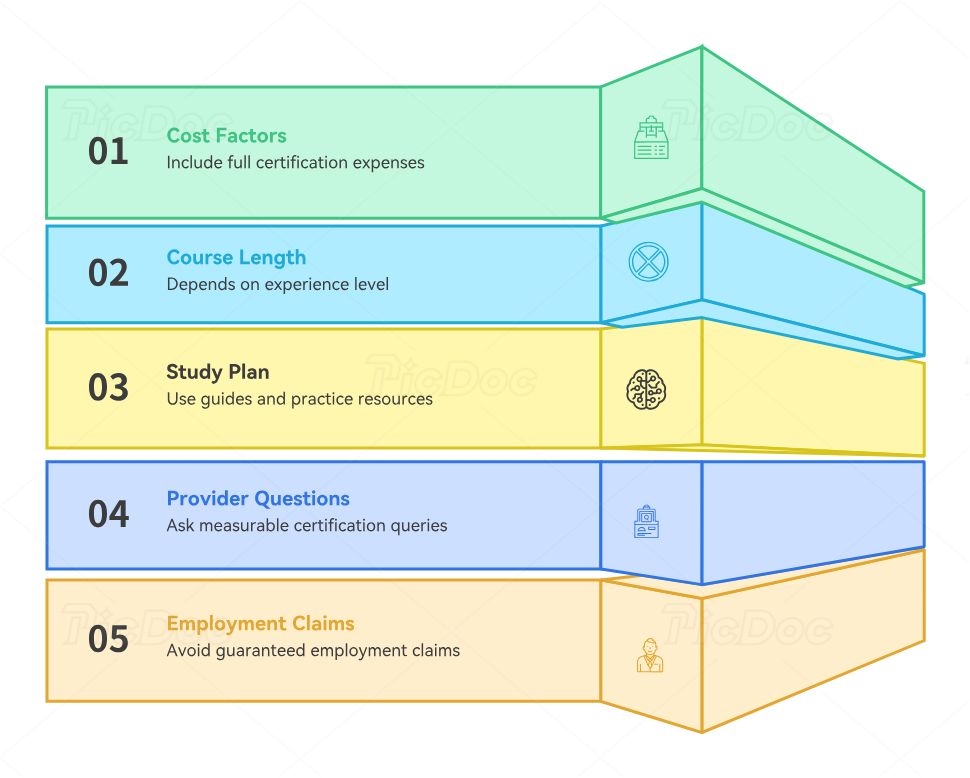
Calculate the full cost of certification rather than comparing tuition alone. Include examination fees, retakes, textbooks, software access, renewal requirements, mentorship, career services, and the duration of course access. A low fee becomes expensive when graduates require separate instruction in adverse-event reporting, global PV compliance, pharmacovigilance inspections, clinical-safety monitoring, and regulatory submissions.
Course length should reflect curriculum depth and your starting point. Clinical research professionals may progress quickly through GCP concepts while requiring additional practice in MedDRA, literature surveillance, aggregate reporting, and electronic submissions. Career changers may need more time for medical terminology, clinical chronology, seriousness assessment, and case narratives. Build the study plan around the Louisiana GCP certification guide, free clinical-research webinars, ethical research principles, protocol-adherence guidance, and clinical-data review practice.
Ask providers questions that force measurable answers:
How many complete safety cases will I process?
Who evaluates my narratives and case decisions?
Does the curriculum cover FDA’s current E2B(R3) requirements?
Will I practice Day-zero, seriousness, expectedness, and causality decisions?
Are MedDRA coding exercises included?
Will I complete quality-control and reconciliation activities?
Does the course distinguish clinical-trial and postmarketing workflows?
Are literature cases, medication errors, and product complaints covered?
How is the certificate verified?
How long will I retain access to updated materials?
Are examination retakes included?
Does career support address pharmacovigilance positions specifically?
Compare every answer with clinical-research quality systems, inspection-readiness expectations, trial-safety responsibilities, clinical-data integrity, and medical-monitor oversight.
Treat guaranteed-employment claims as a major warning. Certification can strengthen structured knowledge, technical vocabulary, interview confidence, and screening credibility. Hiring decisions also reflect education, transferable experience, practical evidence, application quality, location, communication, and employer demand. Strengthen the complete profile through clinical-research communities, professional associations, career-market research, salary benchmarking, and continuing education resources.
5. Use a 90-Day Louisiana Pharmacovigilance Career Plan
Days 1–15: Define your market position
Choose two primary job titles and three adjacent titles. Review at least 20 Louisiana, Gulf Coast, and remote vacancies. Track recurring requirements involving ICSRs, narratives, MedDRA, literature, medical review, quality control, reconciliation, safety databases, product complaints, and regulatory timelines. Use the clinical-research career map, salary comparison tool, professional-association directory, research community directory, and free training directory.
Divide potential employers into biotechnology companies, pharmaceutical and biologics organizations, animal-health businesses, medical-device manufacturers, hospitals, universities, academic research centers, CROs, medical-information providers, safety vendors, and regulatory consultancies. Louisiana Economic Development’s bioscience directory allows candidates to explore organizations across multiple state regions, which can reveal employers missed by searches limited to New Orleans or Baton Rouge.
Days 16–30: Master foundational decisions
Study minimum case criteria, Day 0, seriousness, expectedness, causality, reporting priority, coding, narrative structure, follow-up, and duplicate detection. Create a one-page decision guide supported by adverse-event reporting requirements, clinical-trial safety practices, global PV compliance, medical-monitor responsibilities, and investigator GCP duties.
Days 31–45: Build three fictional safety-case packets
Create one spontaneous postmarketing report, one serious clinical-trial event, and one complex case involving a medication error, product complaint, literature source, or possible duplicate. Include an intake summary, minimum-criteria decision, Day-zero analysis, seriousness rationale, expectedness review, causality information, coding explanation, narrative, follow-up questions, and QC checklist. Apply clinical-data integrity, data-verification methods, quality-management controls, protocol-deviation practices, and PV audit-readiness techniques.
Use fictional patients, reporters, healthcare professionals, institutions, and products. Add an educational-use statement confirming that the portfolio contains no real patient information. A well-built portfolio allows an employer to inspect your reasoning without creating privacy, confidentiality, or intellectual-property concerns.
Days 46–60: Rebuild your resume and LinkedIn profile
Place the target function in the headline. Connect your existing background with safety operations in the summary. Add the exact credential title, provider, completion date, learning hours, and verification details. Translate coursework into carefully scoped evidence aligned with clinical-safety monitoring, global PV compliance, regulatory submissions, quality-management practices, and medical regulatory compliance.
Keep every claim defensible. A candidate who watched a database demonstration can state that they trained in safety-database workflow concepts, including queries, audit trails, workflow states, and submission tracking. Claiming operational expertise with a commercial platform creates an immediate weakness when technical interviewers ask about specific fields, workflow transitions, errors, and quality checks.
Days 61–75: Build a focused professional network
Join relevant clinical-research communities, explore professional associations, attend free research webinars, review oncology research conferences, and investigate global career opportunities. Ask professionals about team structure, source types, case ownership, review stages, quality expectations, and the mistakes that lengthen onboarding.
Specific questions generate stronger conversations than generic job requests. Ask how intake, case processing, medical review, and QC are divided. Ask which abilities distinguish successful entry-level processors. Ask how product complaints flow between quality and safety teams. Candidates interested in Louisiana’s animal-health or biotechnology sectors can ask how safety responsibilities differ across product types.
Days 76–90: Apply selectively and prepare for case scenarios
Apply where your evidence addresses most core responsibilities. Tailor the first third of the resume to each vacancy. Prepare six interview examples involving an incomplete report, urgent escalation, inconsistent records, deadline risk, a quality error, and difficult follow-up. Structure your responses using trial-logistics principles, research-team communication, trial-timeline management, clinical-data review, and clinical-project leadership.
Expand the search across nearby markets through the Texas GCP certification guide, Arkansas pharmacovigilance guide, Mississippi GCP certification guide, Alabama pharmacovigilance guide, and Oklahoma GCP certification guide.
6. Frequently Asked Questions About Pharmacovigilance Certification in Louisiana
-
The Louisiana Board of Pharmacy regulates pharmacy practice and publishes credential pathways for pharmacists, pharmacy interns, pharmacy technicians, candidates, and facilities. A professional PV certificate serves as specialized safety training and does not replace any license required to practice pharmacy or another regulated healthcare profession. Build role-specific knowledge through the Louisiana GCP certification guide, adverse-event reporting guidance, global PV compliance, and clinical-safety monitoring.
-
The timeline depends on curriculum depth, assessment requirements, previous clinical knowledge, and weekly study capacity. A useful plan should reserve time for case processing, narrative writing, coding, follow-up, quality control, and interview preparation. Supplement formal coursework with free clinical-research webinars, clinical-data review practice, quality-management education, PV inspection training, and regulatory submission knowledge.
-
Pharmacists bring medication knowledge, therapeutic familiarity, clinical terminology, interaction awareness, and patient-safety experience. They should add PV-specific abilities involving minimum case validation, Day 0, seriousness, expectedness, causality, MedDRA, narratives, follow-up, and reporting workflows. Useful preparation includes clinical-trial safety guidance, global regulatory compliance, AE-reporting requirements, medical-monitor responsibilities, and PV audit readiness.
-
Life-science, biotechnology, animal-health, public-health, clinical-research, regulatory, laboratory, data, quality, and medical-writing backgrounds can support entry into selected safety roles. The applicant needs evidence connecting previous work with regulated documentation, confidential information, data review, deadline management, and risk escalation. Build that bridge through research-assistant training, protocol-adherence guidance, clinical-data verification, research communication skills, and clinical-research quality management.
-
Louisiana’s official life-sciences strategy includes biotechnology startups, established institutions, research activity, and statewide bioscience resources. A February 2026 expansion in Caddo Parish involved an animal-health biotechnology manufacturing operation, while other state organizations work in tissue engineering, biological research, wound-care products, and related scientific fields. Candidates should search for animal-health safety, veterinary pharmacovigilance, biologics safety, product surveillance, quality complaints, medical information, and regulatory-safety roles. Strengthen preparation through clinical-safety monitoring, data-integrity guidance, global PV compliance, and quality-management practices.
-
Relevant positions may include pharmacovigilance associate, drug-safety associate, safety intake specialist, ICSR processor, medical-information associate, literature-surveillance associate, product-surveillance analyst, clinical-safety coordinator, reconciliation analyst, and PV quality assistant. Search through the clinical-research career map, compare compensation with the salary tool, join researcher communities, explore professional associations, and attend free career-building webinars.
-
Many safety activities can be performed within controlled digital environments, including intake, case processing, literature surveillance, quality control, reconciliation, medical-review support, and aggregate-report assistance. Eligibility depends on employer jurisdiction, data-security controls, system-access policies, and employment arrangements. Demonstrate remote readiness through clinical-data integrity, remote monitoring discipline, global PV compliance, research-team communication, and trial-timeline management.
