
The Ultimate Guide to Getting Your Good Clinical Practice (ICH-GCP) Certification in Louisiana: Everything You Need to Know in 2026-27
Louisiana clinical research teams need people who can protect participants, follow protocol, and keep trial documentation inspection-ready under real pressure. A strong ICH-GCP credential helps you connect clinical research certification in Louisiana, ethical conduct and patient safety in GCP, investigator responsibilities under GCP, GCP compliance self-assessment, and clinical research career opportunities into one practical career signal.
1. Why ICH-GCP Certification Matters in Louisiana in 2026-27
Good Clinical Practice certification matters in Louisiana because clinical research work is extremely detail-sensitive. A coordinator who uses the wrong consent version, a research assistant who misses an adverse event follow-up, or a CRA who cannot explain a monitoring finding can create sponsor concern, protocol risk, participant-safety questions, and delayed database milestones. That is why Louisiana candidates should treat ICH-GCP training, clinical research certification in Louisiana, site monitoring visits, clinical trial data integrity, and quality management strategies as one connected skill set.
The Louisiana research environment can include academic medical centers, hospital systems, oncology programs, public health research, pediatrics, emergency medicine, behavioral studies, metabolic disease research, and community-based enrollment challenges. That mix rewards professionals who understand both compliance and people. GCP helps you speak the language of consent, protocol adherence, source documentation, adverse event reporting, delegation, monitoring, privacy, and audit readiness. A strong candidate can connect protocol deviations, serious adverse events, clinical trial amendments, clinical trial sponsor responsibilities, and remote and on-site monitoring without sounding theoretical.
In 2026-27, ICH-GCP readiness also means understanding technology-enabled trials, risk-based quality, decentralized workflows, electronic systems, participant diversity, and clearer documentation standards. Louisiana candidates who want CRC, CRA, regulatory, pharmacovigilance, data, or project roles need more than a certificate download. They need proof that they can prevent mistakes before those mistakes become findings. Pairing clinical trial templates, clinical research ethics resources, patient education resources, clinical research professional associations, and free clinical research training resources gives your certification stronger career value.
| # | Louisiana GCP Signal | Why It Matters | Best Action Before You Apply | CCRPS Resource to Strengthen It |
|---|---|---|---|---|
| 1 | Clinical research foundation | Employers want candidates who understand trial workflow before they touch consent, source, or EDC tasks. | Map the path from protocol to screening, enrollment, visits, monitoring, closeout, and archiving. | Louisiana clinical research certification guide |
| 2 | Participant protection | GCP credibility begins with protecting rights, safety, privacy, and welfare throughout the study. | Practice explaining consent quality, privacy controls, and escalation responsibilities. | ethical conduct and patient safety in GCP |
| 3 | Investigator oversight | Delegated tasks still require qualified staff, documented training, supervision, and PI accountability. | Build a delegation-log checklist covering training, dates, signatures, scope, and updates. | investigator responsibilities under GCP |
| 4 | Consent version control | Wrong consent versions can trigger findings, re-consent needs, enrollment delays, and participant confusion. | Create a consent review checklist for date, version, signature, timing, and documentation. | clinical research ethics resources |
| 5 | Protocol deviation handling | Deviation management shows whether you can detect problems, document causes, escalate properly, and prevent repeats. | Practice classifying deviations by safety impact, data impact, preventability, and corrective action. | protocol deviation examples and corrective actions |
| 6 | Adverse event documentation | Safety notes need enough detail for medical review, sponsor assessment, and follow-up decisions. | Practice recording onset, severity, causality, action taken, outcome, and ongoing follow-up. | adverse event reporting compliance |
| 7 | SAE escalation confidence | Serious events demand urgency, accuracy, documentation discipline, and protocol-specific reporting awareness. | Build a mock SAE escalation checklist for investigator, sponsor, IRB, and source-note actions. | SAE definition and reporting procedures |
| 8 | Source documentation quality | Source documentation proves what happened, who did it, when it happened, and why the data can be trusted. | Practice corrections, late entries, attribution, chronology, and source-to-EDC traceability. | clinical trial data integrity |
| 9 | Monitoring visit readiness | Monitoring visits expose consent errors, missing source, unresolved queries, training gaps, and document issues. | Prepare pre-visit, visit-day, and post-visit responsibilities for site staff. | site monitoring visits for coordinators |
| 10 | Remote monitoring discipline | Hybrid review requires clean uploads, privacy controls, secure access, and clear action tracking. | Learn how to organize remote source access and respond to findings without losing context. | remote and on-site monitoring visits |
| 11 | Risk-based quality mindset | Modern GCP expects teams to prioritize risks that threaten participant safety and critical data. | List critical-to-quality factors before memorizing low-impact administrative details. | risk-based monitoring strategies |
| 12 | Essential document control | Training logs, approvals, correspondence, CVs, licenses, and delegation records must stay current. | Build a regulatory binder map for startup, conduct, and closeout documents. | clinical trial templates directory |
| 13 | Protocol amendment handling | Amendments can affect consent, IRB submissions, staff training, recruitment, scheduling, and EDC logic. | Create an amendment impact tracker covering subjects, staff, systems, documents, and vendors. | clinical trial amendments |
| 14 | Sponsor communication | Sponsors trust sites that escalate early, document clearly, and close action items without repeated chasing. | Prepare email templates for deviations, missing documents, AE questions, and monitoring responses. | clinical trial sponsor responsibilities |
| 15 | Query resolution skill | Unresolved queries slow data cleaning and reveal weak source-to-EDC habits. | Practice tracing values from source notes to EDC entries to query responses. | clinical trial data review and verification |
| 16 | Patient retention awareness | Louisiana sites may face transportation, storm disruption, work schedules, rural distance, and trust barriers. | Create retention ideas tied to reminders, flexible scheduling, respectful education, and visit planning. | patient retention strategies for CRCs |
| 17 | Budget and visit-window awareness | CRC work often touches procedures, reimbursements, invoices, missed visits, and sponsor billing logic. | Learn how visit schedules connect to required procedures and study payments. | clinical trial budget management for CRCs |
| 18 | Pharmacovigilance connection | Safety information loses value when site notes, medical review, and reporting pathways fail to connect. | Learn how AE and SAE data moves from site documentation into safety review. | clinical trial safety monitoring and pharmacovigilance |
| 19 | Audit-readiness habits | Audit-ready teams document decisions while work happens, avoiding frantic reconstruction later. | Keep inspection questions for consent, safety, training, deviations, documents, and data. | audit and inspection techniques |
| 20 | Startup workflow understanding | Site startup requires document discipline before enrollment pressure exposes missing approvals and training gaps. | Use a startup checklist for approvals, logs, training, contracts, systems, and investigator files. | startup checklist generator |
| 21 | Technology-enabled trial readiness | eConsent, EDC, eTMF, wearables, portals, and remote review create access, privacy, and audit-trail pressure. | Practice explaining system training, version control, access review, and data traceability. | clinical trial technology innovations |
| 22 | Regulatory affairs bridge | GCP becomes stronger when you understand how trial conduct supports IND/NDA credibility. | Learn how protocol compliance, safety, and data quality affect regulatory submissions. | IND/NDA submissions mastery |
| 23 | Role targeting | A certificate performs better when matched to CRC, CRA, regulatory, safety, data, or project roles. | Choose one target role before writing your resume and interview examples. | clinical research certificate programs compared |
| 24 | Community and networking proof | Networking works better when you share practical workflows instead of asking generic job questions. | Post useful checklists, case reflections, and lessons from GCP practice. | clinical research communities directory |
| 25 | Salary and title calibration | Louisiana roles can differ across hospital, academic, CRO, sponsor, and remote operations settings. | Compare job titles before deciding whether CRC, CRA, data, safety, or regulatory fits best. | clinical research salary comparison tool |
| 26 | Renewal planning | GCP credibility is stronger when your training date, refresher plan, and updated guideline awareness are clear. | Track completion date, provider, refresher deadline, and new ICH-GCP updates. | free clinical research training resources |
2. How to Choose the Right GCP Certification Path in Louisiana
Choose your Louisiana ICH-GCP path by role, responsibility, and evidence. A beginner needs a course that explains trial language clearly and connects it to clinical research certification in Louisiana, clinical trial patient education resources, clinical research ethics resources, research assistant communication strategies, and clinical trial templates. A working CRC needs deeper practice with visit windows, enrollment, informed consent, source notes, AE follow-up, and monitor action items. A CRA candidate needs source-data review, risk-based monitoring, follow-up letters, site coaching, escalation, and issue closure.
The right course should help you answer five practical questions. How does GCP protect participants? How does protocol compliance protect data credibility? How do deviations, adverse events, serious adverse events, amendments, and queries move through a trial team? What remains under investigator responsibility after delegation? How would you prepare for a monitoring visit or audit? These answers should connect naturally to investigator responsibilities, adverse event reporting, SAE procedures, clinical trial amendments, and GCP monitoring techniques.
Course length alone should never drive the decision. A short refresher may suit someone already working in trials. A new Louisiana candidate usually needs scenario practice, checklists, vocabulary, role expectations, and mock documentation. For site roles, pair GCP with site monitoring visit preparation, patient retention strategies, budget management for CRCs, handling protocol deviations for CRCs, and clinical trial startup checklists. For CRA-track candidates, pair GCP with risk-based monitoring, data review and verification, remote monitoring mastery, investigator meeting strategies, and CRA exam time management.
3. What Louisiana Research Teams Want to See After Certification
A GCP certificate starts the conversation, and applied proof keeps it moving. Louisiana research teams need to know whether you can use GCP when a visit runs late, a participant misses a window, a consent version changes, a lab value needs review, a monitor asks for clarification, or a safety note lacks follow-up detail. Turn training into proof by building a small portfolio around protocol deviations, source documentation and data integrity, clinical trial safety monitoring, monitoring visit workflows, and quality management strategies.
Your portfolio can be compact: one deviation worksheet, one AE documentation checklist, one informed-consent version-control example, one monitoring-visit preparation checklist, one delegation-log explanation, and one mock query response. That collection gives interviewers proof that you can think beyond definitions. Use the clinical trial templates directory, GCP compliance self-assessment, startup activity checklist generator, clinical trial cost estimator, and clinical trial sample size calculator to build more operational awareness.
Interview answers should show judgment. Explain how you would handle a participant signing an outdated consent form, a study visit outside the allowed window, an unreported adverse event, a missing investigator signature, a temperature excursion, or an unresolved EDC query. Strong answers connect participant protection, protocol compliance, documentation, escalation, and prevention. Louisiana candidates who combine clinical research certification in Louisiana, clinical research salary comparisons, clinical research career opportunities, clinical research associations, and clinical research communities can position themselves with confidence.
What is your biggest Louisiana ICH-GCP certification blocker right now?
Choose one. Your answer points to the fastest skill gap to fix before you apply or interview.
4. How to Turn GCP Training into Real Trial Competence
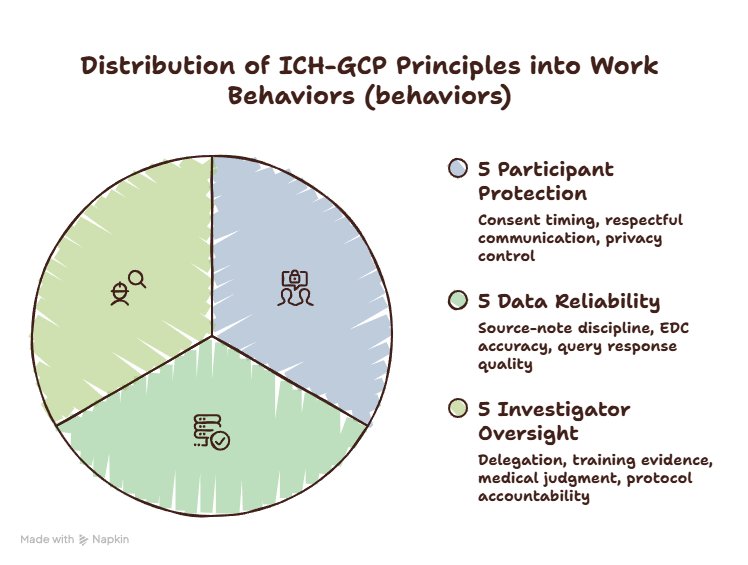
The fastest way to make ICH-GCP useful is to translate each principle into a work behavior. Participant protection becomes consent timing, respectful communication, privacy control, safety follow-up, and escalation. Data reliability becomes source-note discipline, EDC accuracy, query response quality, audit trails, and documentation that can be understood months later. Investigator oversight becomes delegation, training evidence, medical judgment, protocol accountability, and supervision. These behaviors connect ethical conduct in GCP, investigator responsibilities, adverse event reporting, data integrity, and clinical trial safety monitoring.
Use scenarios because scenarios expose gaps that quizzes hide. Take one consent scenario, one deviation scenario, one AE scenario, one monitoring scenario, and one amendment scenario. For each, write what happened, why it matters, who must know, what must be documented, what timeline applies, and what prevention step should follow. This turns passive reading into interview-ready judgment. Strong scenarios can be built from protocol deviation corrective actions, clinical trial amendments, site monitoring visit steps, clinical trial data review, and GCP compliance self-assessment.
Then build a vocabulary bridge. Replace “GCP certified” with language that shows operational understanding: “trained in participant protection, consent documentation, protocol compliance, adverse event documentation, source-data quality, and monitoring support.” Replace “detail-oriented” with “I check visit windows, protocol-required assessments, missing signatures, lab review documentation, unresolved queries, and training evidence before they become findings.” This language pairs well with remote monitoring mastery, risk-based monitoring, quality management in clinical research, clinical trial PM milestones, and clinical trial sponsor best practices.
Louisiana candidates should also prepare for site-specific pressure. Storm seasons can disrupt visits, transportation gaps can affect retention, rural distance can weaken follow-up, and high-volume clinics can make documentation feel secondary during busy days. GCP competence means planning around those realities without losing compliance. Use patient retention strategies, clinical trial budget management, clinical trial site operations oversight, startup activity checklists, and clinical trial technology innovations to show practical awareness.
5. 30-Day Louisiana ICH-GCP Certification Action Plan
Days 1-5 should be about orientation and role targeting. Pick your track first: CRC, CRA, regulatory, pharmacovigilance, data management, project coordination, or research assistant. Then list the GCP responsibilities attached to that track. A CRC target should prioritize consent, visits, source, AEs, retention, and monitoring support. A CRA target should prioritize site readiness, SDV/SDR, risk, follow-up, escalation, and query management. A regulatory target should prioritize submissions, amendments, essential documents, training logs, and approval tracking. Use clinical research certification in Louisiana, certificate programs compared, clinical research career opportunities, clinical research salary benchmarks, and clinical research professional associations to choose deliberately.
Days 6-15 should be your certification and notes phase. Complete the GCP course, then rewrite every major topic into a practical checklist. Consent becomes a version-control and documentation checklist. Safety becomes an AE/SAE recognition and escalation checklist. Data becomes source-to-EDC and query-resolution guidance. Oversight becomes delegation, training, and PI responsibility notes. Monitoring becomes pre-visit, visit-day, and post-visit action items. Anchor those notes in AE reporting compliance, SAE procedures, data integrity responsibilities, monitoring visit guidance, and clinical trial templates.
Days 16-23 should be application practice. Create five mock work samples: a deviation note, an AE checklist, a monitoring prep list, an amendment impact tracker, and a query response example. These give you concrete material for interviews and networking conversations. Build them using protocol deviation CAPA guidance, clinical trial amendment handling, data review and verification, startup activity checklists, and GCP compliance self-assessment.
Days 24-30 should be positioning. Update your resume with applied wording: “GCP-trained in participant protection, protocol compliance, adverse event documentation, source-data quality, essential documents, and monitoring support.” Add a skills section for consent support, documentation, query response, safety reporting awareness, regulatory communication, and version control. Prepare interview answers for five pain points: enrollment delays, missing source, deviation escalation, AE follow-up, and monitor action items. Then use clinical research communities, clinical research associations, free training resources, CRA exam time management, and collaboration strategies for research assistants to keep momentum.
6. FAQs About ICH-GCP Certification in Louisiana
-
Many Louisiana research roles value GCP training, especially roles connected to clinical trial conduct, oversight, documentation, safety, monitoring, or participant interaction. The exact requirement can depend on employer, sponsor, funding source, institution, and study type. The stronger move is to earn GCP early and pair it with clinical research certification in Louisiana, ethical conduct in GCP, investigator responsibilities, GCP compliance self-assessment, and free training resources.
-
Basic GCP training can often be completed quickly, while real job readiness takes longer because you must apply the rules to consent, documentation, safety, monitoring, and protocol scenarios. Plan for course completion plus one to two weeks of practical exercises if you want the certificate to help in interviews. Use protocol deviation examples, adverse event reporting, SAE reporting procedures, data integrity guidance, and monitoring visit steps to convert training into usable skill.
-
Beginners should understand the basic clinical trial workflow: protocol, IRB review, consent, screening, enrollment, visits, source documentation, safety reporting, monitoring, query resolution, closeout, and archiving. That context makes GCP easier because every principle has an operational purpose. Start with clinical research certification in Louisiana, clinical trial templates, patient education resources, clinical research ethics resources, and research assistant communication strategies.
-
GCP certification helps CRA candidates when it is paired with monitoring-specific skill. Hiring teams want to hear how you would review source, identify deviations, evaluate consent documentation, follow up on findings, assess site risk, and communicate with coordinators and investigators. Pair your certificate with risk-based monitoring strategies, remote and on-site monitoring, clinical trial data review, investigator meeting strategies, and CRA exam time management.
-
Many organizations use a recurring refresher cycle, and some sponsors, institutions, or funding sources can set specific expectations. Track your certificate date, provider, training version, refresher deadline, and ICH-GCP updates affecting your role. Renewal becomes more valuable when you update your skills in quality management strategies, GCP monitoring techniques, clinical trial safety monitoring, regulatory compliance in pharmacovigilance, and free clinical research webinars.
-
The biggest mistake is leaving the certificate as a resume line without building evidence. A better approach is to create small proof assets: a deviation workflow, AE checklist, consent documentation checklist, monitoring prep list, and data-query response sample. Those assets show applied judgment. Build them with protocol deviation corrective actions, adverse event compliance, clinical trial templates, site monitoring visit guidance, and GCP self-assessment.
