How To Get a Pharmacovigilance Certification in Michigan: Everything You Need to Know in 2026-27
A pharmacovigilance certification can help Michigan professionals enter drug safety, clinical safety operations, adverse-event processing, medical information, and regulatory compliance. Strong preparation combines structured coursework with clinical trial safety monitoring, adverse event reporting compliance, global pharmacovigilance requirements, and ICH-GCP certification in Michigan.
This guide explains how to choose credible training, build practical evidence, approach Michigan employers, and turn a certificate into a defensible 2026-27 career strategy.
1. Understand What Pharmacovigilance Certification Means in Michigan
Pharmacovigilance covers the detection, collection, evaluation, communication, and prevention of safety problems associated with medicines and other regulated healthcare products. Daily work can include processing individual case safety reports, evaluating seriousness, requesting follow-up information, coding adverse events, reviewing literature, supporting signal detection, preparing aggregate reports, and maintaining inspection-ready documentation.
A pharmacovigilance certificate is a professional training credential. Michigan’s Board of Pharmacy separately licenses pharmacists, pharmacy technicians, pharmacies, manufacturers, and other pharmacy-related activities. A drug-safety position requiring pharmacist practice may therefore demand an active professional license, while many pharmacovigilance operations roles assess scientific education, clinical knowledge, safety training, writing ability, and relevant experience.
This distinction protects you from a costly career mistake. Searching indefinitely for a state-issued “Michigan pharmacovigilance license” delays the skills employers actually examine: safety case processing, investigator safety responsibilities, patient protection under GCP, and pharmacovigilance inspection readiness.
Know which roles your certification can support
Potential entry-level and transitional roles include:
Drug Safety Associate
Pharmacovigilance Associate
Safety Case Processor
Adverse Event Intake Specialist
Clinical Safety Coordinator
Medical Information Associate
Literature Surveillance Associate
Safety Quality Specialist
Product Complaint Specialist
Pharmacovigilance Operations Associate
Clinical Trial Safety Assistant
Safety Data Coordinator
Each role uses a different mixture of clinical data review, research protocol adherence, medical terminology, regulatory interpretation, case documentation, and cross-functional research communication.
A nursing professional may have an advantage in clinical assessment, medical history collection, and patient communication. A pharmacist may bring medication knowledge, therapeutic context, and interaction awareness. A clinical research coordinator may already understand site monitoring preparation, protocol deviation management, sponsor communication, and adverse-event escalation.
Science graduates can compete by building stronger evidence in medical terminology, structured case processing, regulatory timelines, and essential research-assistant competencies. Quality professionals may transition through deviation investigation, corrective actions, vendor oversight, and clinical research quality management.
Prepare for the 2026-27 FDA safety environment
The FDA implemented the Adverse Event Monitoring System, or AEMS, as a centralized platform for adverse-event information, consumer complaints, regulatory misconduct reports, and related safety submissions. The agency also introduced an AEMS public dashboard and electronic-submission resources. Training completed in 2026-27 should explain the evolving AEMS environment alongside established MedWatch and safety-reporting concepts.
MedWatch remains an important reporting route for healthcare professionals, patients, and consumers. FDA Form 3500 supports voluntary reporting by healthcare professionals, while Form 3500B is designed for patients and consumers. Reports can cover adverse events, product-use errors, quality problems, and therapeutic failures involving regulated medical products.
A credible course should therefore teach more than the names of FDA systems. You should understand how a report becomes an evaluable case, how follow-up improves medical usefulness, how case quality affects signal detection, and how global reporting obligations influence local workflows.
| Skill Area | What Strong Training Should Teach | Practical Evidence You Should Produce | Career Risk When the Skill Is Missing | CCRPS Resource |
|---|---|---|---|---|
| 1. Pharmacovigilance lifecycle | How safety information moves from intake through processing, medical review, submission, surveillance, and risk action. | A complete safety-workflow map showing owners, handoffs, and quality controls. | You may memorize terminology without understanding how safety departments operate. | Safety monitoring best practices |
| 2. Valid ICSR criteria | How to identify an identifiable patient, identifiable reporter, suspected product, and adverse event. | A worksheet classifying reports as valid, invalid, or awaiting clarification. | Valid cases may be missed, while non-cases may consume processing resources. | Adverse-event compliance |
| 3. Day-zero determination | How receipt dates, organizational awareness, minimum criteria, and follow-up affect regulatory clocks. | A timeline exercise covering initial receipt, transfer, validation, and submission deadlines. | Incorrect day-zero decisions can produce late-reporting findings. | Clinical trial timeline management |
| 4. Seriousness assessment | How to evaluate death, life-threatening events, hospitalization, disability, congenital anomaly, and medically important events. | A decision log explaining the criterion selected for each simulated event. | Expedited cases may be routed or submitted incorrectly. | Medical monitor safety oversight |
| 5. Severity versus seriousness | How clinical intensity differs from regulatory seriousness criteria. | A comparison exercise using mild, moderate, and severe events with different outcomes. | Interview answers may reveal weak regulatory reasoning. | Patient-safety principles |
| 6. Expectedness | How to compare an event with the correct reference safety information. | A documented expectedness assessment using a mock label or investigator brochure. | Incorrect reference documents can distort reportability and aggregate analysis. | Investigator GCP responsibilities |
| 7. Causality assessment | How timing, alternative explanations, dechallenge, rechallenge, disease history, and biological plausibility influence assessment. | Three concise causality rationales with supporting and conflicting evidence. | Unsupported conclusions can slow medical review and weaken case credibility. | Clinical safety oversight |
| 8. Case intake | How to capture spontaneous, solicited, literature, study, digital, and product-complaint reports. | Completed intake forms based on simulated telephone, email, and web reports. | Critical facts may be lost before the case reaches processing. | Research communication strategies |
| 9. Follow-up strategy | How to prioritize medically and regulatorily significant missing information. | Targeted follow-up questions for hospitalization, pregnancy, death, and medication-error cases. | Generic questionnaires may burden reporters while producing little useful evidence. | Patient communication strategies |
| 10. Narrative writing | How to produce chronological, medically coherent, concise, and traceable case narratives. | A final narrative built from disorganized source notes and conflicting dates. | Medical reviewers may spend excessive time reconstructing the event. | Research documentation discipline |
| 11. MedDRA concepts | How reported information maps to appropriate medical terminology without adding unsupported interpretation. | A coding log documenting selected terms and rejected alternatives. | Poor coding weakens retrieval, trend analysis, and signal review. | Clinical data review skills |
| 12. Product coding | How to distinguish suspected, interacting, and concomitant products and standardize names. | A coding exercise covering generic names, brands, formulations, and combination products. | Inconsistent product data can compromise case retrieval and reconciliation. | Clinical data integrity |
| 13. Duplicate detection | How to compare patient details, events, reporters, products, countries, and dates. | A duplicate-assessment form for several closely matched reports. | Duplicate submissions may inflate apparent case counts. | Data verification techniques |
| 14. Quality control | How to review consistency across dates, coding, seriousness, products, narratives, and assessments. | A quality review of a deliberately flawed ICSR. | Errors may remain undetected until submission, audit, or inspection. | Clinical quality management |
| 15. Clinical-trial safety | How protocol requirements, investigator reporting, sponsor assessment, and expedited reporting connect. | A clinical safety flowchart covering investigator-to-sponsor escalation. | Postmarketing knowledge alone may leave major clinical safety gaps. | GCP safety reporting |
| 16. Postmarketing surveillance | How spontaneous reports, literature, patient-support programs, and other sources contribute to surveillance. | A source-classification matrix with handling and follow-up requirements. | Different report sources may be processed using the wrong rules. | Global PV compliance |
| 17. Literature surveillance | How to screen publications for reportable cases and relevant safety findings. | An inclusion-and-exclusion log for abstracts and full-text articles. | Reportable literature cases or emerging risks may be overlooked. | Research training resources |
| 18. Signal detection | How case series, disproportionality, clinical review, literature, and external evidence contribute to signal evaluation. | A basic signal-validation memo with limitations and next steps. | Case frequency may be interpreted without sufficient clinical context. | Safety signal monitoring |
| 19. Benefit-risk thinking | How disease severity, treatment effect, alternatives, uncertainty, and preventability shape safety decisions. | A one-page structured benefit-risk assessment. | Safety findings may be discussed without their therapeutic context. | Ethics and patient safety |
| 20. Aggregate reporting | How individual cases contribute to periodic benefit-risk and development safety reports. | An outline showing data sources, analyses, and major report sections. | Career progression into aggregate safety roles becomes difficult. | Regulatory reporting compliance |
| 21. Risk management | How identified risks, potential risks, missing information, and risk-minimization measures are managed. | A simplified risk-management table with monitoring actions and success measures. | Signal findings may remain disconnected from practical risk reduction. | Pharmacovigilance risk controls |
| 22. Reconciliation | How safety records are compared with clinical, medical-information, quality, and product-complaint systems. | A reconciliation tracker with discrepancies, owners, aging, and closure evidence. | Cases may remain missing or inconsistent across functional systems. | Data integrity responsibilities |
| 23. Product complaints | How to identify safety information embedded within quality complaints and device-malfunction reports. | A classification exercise involving mixed complaint and adverse-event scenarios. | Safety information may remain trapped inside a separate quality workflow. | Quality management strategies |
| 24. Privacy and confidentiality | How to manage identifiable health information, controlled access, redaction, and secure escalation. | A de-identification and information-routing exercise. | Careless handling can create privacy, contractual, and reputational exposure. | Ethical research conduct |
| 25. Deviations and CAPA | How to investigate late cases, missed follow-up, coding errors, and procedural failures. | A root-cause analysis and measurable corrective-action plan. | Recurring failures may survive superficial retraining responses. | Deviation handling |
| 26. Audit readiness | How procedures, training records, metrics, case evidence, vendor oversight, and CAPAs support inspection readiness. | A mock inspection-request tracker and evidence checklist. | Teams may struggle to retrieve defensible records under time pressure. | PV audits and inspections |
| 27. Safety database literacy | How case fields, workflow states, audit trails, queries, submissions, and access controls function. | A database-field and workflow-mapping exercise. | You may struggle with systems-based interview questions despite knowing theory. | Clinical data verification |
| 28. Cross-functional escalation | How safety teams communicate with clinical, medical, regulatory, quality, data, legal, and vendor stakeholders. | An escalation email, decision log, and concise meeting summary. | Technically accurate findings may fail to reach the right decision-maker. | Clinical team leadership |
2. Choose a Pharmacovigilance Certification That Builds Employable Skills
Begin with the curriculum and assessments. A polished certificate design, impressive acronym, or short completion promise provides little protection against a weak learning experience. Employers need evidence that you can interpret imperfect information, document your reasoning, meet timelines, and recognize situations requiring escalation.
The ICH efficacy guideline portfolio includes the E2 clinical safety data-management series. A serious pharmacovigilance program should place individual case reporting, postapproval safety management, periodic evaluation, pharmacovigilance planning, and development safety reporting within that wider framework.
Your program should also acknowledge the current GCP standard. ICH has published E6(R3), including Annex 2, as the international ethical, scientific, and quality framework for clinical trials involving human participants. Safety professionals working with clinical studies need to understand how GCP investigator duties, protocol compliance, remote monitoring processes, and clinical data integrity influence safety information.
Inspect the curriculum before paying
Request a detailed syllabus and look for direct coverage of:
Pharmacovigilance terminology and lifecycle responsibilities
ICSR validity and report classification
Seriousness, severity, expectedness, and causality
Initial receipt and day-zero rules
Clinical-trial and postmarketing reporting
MedWatch and the FDA AEMS environment
MedDRA principles and product coding
Narrative writing and medical chronology
Follow-up strategy and reporter communication
Duplicate detection and case quality control
Literature surveillance
Signal detection and validation
Aggregate safety reports
Risk-management principles
Safety agreements and reconciliation
Product complaints and medication errors
Deviations, root-cause analysis, and CAPA
Audit, inspection, and vendor oversight
Privacy and confidential-data handling
A candidate targeting clinical safety should combine these subjects with medical monitor responsibilities, investigator meeting strategy, GCP monitoring techniques, and adverse-event reporting requirements.
Demand practical assessment
Multiple-choice questions can confirm vocabulary. They rarely prove that you can process a case containing incomplete dates, conflicting statements, multiple products, uncertain causality, and a potentially serious outcome.
Strong assessments may require you to:
Determine whether a report meets minimum validity criteria.
Identify the initial receipt date and reporting clock.
Classify seriousness with a written rationale.
Separate severity from seriousness.
Compare the event with reference safety information.
Draft medically focused follow-up questions.
Write a chronological case narrative.
Select and defend medical terminology.
Review a case for quality-control defects.
Investigate a late case and propose corrective actions.
These exercises align with clinical trial data verification, pharmacovigilance audit preparation, quality management practices, and safety-monitoring expectations.
Evaluate instructor access and feedback
Ask who reviews practical work and whether the feedback explains the reasoning behind corrections. “Incorrect” is insufficient when the learning objective involves judgment. Useful feedback should identify why a case was valid, why a hospitalization met seriousness criteria, why a follow-up question lacked priority, or why a narrative introduced unsupported interpretation.
Before enrolling, ask:
Are instructors experienced in drug safety or clinical research?
Will a subject-matter expert review my case exercises?
Does the course address current FDA reporting changes?
Are both clinical-trial and postmarketing workflows taught?
How long will I retain access?
Are course updates included?
Are reassessment fees disclosed?
Does the certificate document training hours or competencies?
Is career support specific to pharmacovigilance roles?
Can I review a sample assignment?
Supplement structured study through the CCRPS free-training directory, clinical research professional associations, online clinical research communities, and the global clinical research career map.
Match the program to your background
A registered nurse may need less foundational medical terminology and more case-processing, coding, regulatory-timeline, and aggregate-reporting practice. A pharmacist may need deeper training in safety databases, global requirements, signal management, and pharmacovigilance inspections.
A clinical research coordinator should build on patient retention experience, site monitoring preparation, protocol deviation handling, and trial logistics coordination.
A recent graduate may need a broader foundation covering clinical development, documentation, medical terminology, research-assistant training, and research-team communication.
3. Follow a Step-by-Step Michigan Certification and Career Plan
Step 1: Select two target roles
Collect 15 to 20 current job descriptions for two closely related positions. Drug Safety Associate and Safety Case Processor make a logical pairing. Clinical Safety Coordinator and Clinical Research Coordinator may also share transferable requirements.
Create a spreadsheet with columns for:
Required degree
Preferred professional background
Years of experience
Safety responsibilities
Clinical-trial responsibilities
Regulations and guidelines
Database requirements
Medical writing expectations
Therapeutic-area preferences
Quality and audit duties
Location and residency restrictions
Use the clinical research career-opportunity map, worldwide salary comparison tool, professional association directory, and clinical researcher community directory to understand the wider market.
This analysis prevents indiscriminate applications. A résumé aimed simultaneously at case processing, signal science, medical monitoring, regulatory submissions, and clinical project management often communicates no clear professional identity.
Step 2: Complete Michigan GCP preparation
Clinical pharmacovigilance depends on understanding trial conduct, investigator obligations, source documentation, participant protection, protocol requirements, and sponsor oversight. Complete ICH-GCP certification in Michigan before or alongside your safety training.
Regional candidates can also review GCP certification in Ohio, GCP certification in Indiana, GCP certification in Illinois, and GCP certification in Wisconsin when planning a broader Great Lakes job search.
Step 3: Turn each module into a deliverable
Passive viewing produces fragile knowledge. Every major module should generate a portfolio artifact or decision tool.
After studying case validity, classify ten fictional reports. After learning seriousness, document the criteria behind each decision. After narrative training, transform unstructured notes into a chronological medical summary. After studying quality control, review a case containing deliberate date, coding, and consistency defects.
Build at least these six privacy-safe samples:
ICSR validity and day-zero worksheet
Seriousness, expectedness, and causality assessment
Targeted follow-up questionnaire
Complete adverse-event narrative
Case quality-control checklist
Late-report root-cause analysis and CAPA
You can expand the portfolio through clinical data review exercises, protocol compliance scenarios, clinical trial safety guidance, and data-integrity responsibilities.
Use fictional or fully de-identified cases. Employer procedures, sponsor documents, patient information, database screenshots, and confidential trial records should remain outside your portfolio.
Step 4: Practice decision-based interviews
Interviewers may ask definitions, yet stronger interviews quickly move into scenarios:
A reporter provides a drug name and hospitalization but no clear adverse event. What do you do?
Two reports may describe the same patient. Which fields do you compare?
A source document conflicts with a previously entered event date. How do you proceed?
A case arrives near a reporting deadline with incomplete medical information. What receives priority?
A product complaint includes dizziness and a fall. Which workflows may apply?
A case was submitted late. How would you investigate the cause?
A reporter refuses further contact. How do you document the follow-up attempt?
A severe headache caused no hospitalization or disability. How would you discuss severity and seriousness?
Build answers through adverse-event reporting principles, medical monitor oversight, audit and inspection preparation, and ethical patient-safety requirements.
Step 5: Build a role-specific résumé
Replace vague statements such as “knowledge of pharmacovigilance” with defensible evidence:
Evaluated simulated reports against the four minimum ICSR criteria.
Applied seriousness, expectedness, and causality frameworks to fictional safety cases.
Prepared targeted follow-up questions based on medically significant missing information.
Produced chronological case narratives from unstructured source material.
Reviewed mock cases for date, product, coding, narrative, and assessment consistency.
Created a reconciliation tracker covering safety, clinical, and product-complaint records.
Completed training in ICH safety principles, FDA reporting pathways, GCP, and case quality.
Connect transferable experience with remote and on-site monitoring, risk-based monitoring, clinical project quality, and research protocol adherence.
What Is Blocking Your Pharmacovigilance Career in Michigan?
Choose the challenge costing you the most progress. Your result identifies the highest-value next step.
4. Convert Your Certification Into Michigan Pharmacovigilance Opportunities
Michigan offers a broader healthcare and life-sciences environment than candidates may recognize when searching only for the exact title “Pharmacovigilance Associate.” The Michigan Economic Development Corporation highlights the state’s life-sciences and medical-device activity, while state-backed funding includes support for Michigan-based life-sciences and medical-device ventures.
Michigan also scheduled a healthcare and life-sciences round of its PitchMI competition in Detroit for October 2026, reflecting continued attention to companies in the sector. This activity can create safety-adjacent demand across clinical research, medical technology, product quality, regulatory affairs, and postmarket surveillance, although individual hiring levels vary by employer and product pipeline.
Search four employment channels
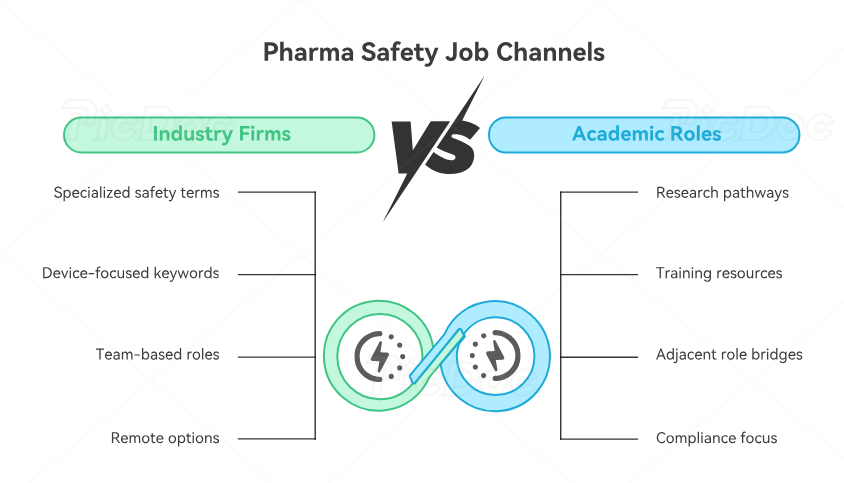
1. Pharmaceutical, biotechnology, and medical-device organizations
Search company career pages for terms such as:
Drug safety
Pharmacovigilance
Clinical safety
Postmarket surveillance
Adverse events
Medical information
Product complaints
Regulatory operations
Safety systems
Clinical quality
Risk management
Complaint investigation
Medical-device organizations may use “postmarket surveillance,” “vigilance,” “complaint handling,” or “medical-device reporting” more frequently than “pharmacovigilance.” Your understanding of clinical trial safety monitoring, quality management, data integrity, and regulatory compliance remains relevant across these environments.
2. Academic medical centers and clinical research program
Michigan Medicine and the University of Michigan support clinical and translational research across multiple therapeutic areas. The Michigan Institute for Clinical & Health Research provides training and infrastructure for research professionals, including fundamental training resources and experiential pathway programs.
Academic research can create pathways through clinical research coordination, regulatory support, trial operations, research quality, participant safety, and data management. These roles can build the experience needed to move toward medical monitor safety oversight, GCP monitoring, clinical data verification, and adverse-event compliance.
3. Contract research organizations and safety vendors
CROs and pharmacovigilance service providers often divide work into specialized teams: intake, processing, quality control, submissions, literature, aggregate reporting, signal management, and project coordination.
Entry-level applicants should search for:
Safety Operations Assistant
Drug Safety Coordinator
Case Processing Associate
Safety Intake Specialist
Medical Information Representative
Literature Screening Associate
Safety Quality Associate
Clinical Trial Assistant
Regulatory Operations Coordinator
Your application should demonstrate comfort with controlled processes, trial milestone management, remote monitoring workflows, clinical project leadership, and inspection-ready documentation.
4. Remote and Great Lakes regional employers
A remote listing may restrict eligible states, require occasional travel, specify working hours, or require proximity to a regional office. Check these details before investing time in an application.
Expand your search through Michigan, Ohio, Indiana, Illinois, Wisconsin, and national remote employers. Review Ohio GCP preparation, Indiana GCP training, Illinois GCP certification, and Wisconsin GCP certification when positioning yourself for regional work.
Use adjacent roles strategically
Your first position may provide safety-relevant experience under another title. Useful bridges include:
Clinical Research Coordinator
Clinical Trial Assistant
Medical Information Associate
Product Complaint Coordinator
Regulatory Affairs Assistant
Quality Assurance Specialist
Clinical Data Coordinator
Research Compliance Coordinator
Patient Safety Associate
Research Assistant
A coordinator can translate experience with site monitoring visits, protocol deviation handling, patient retention, and investigator responsibilities into safety-relevant evidence.
A quality professional can demonstrate controlled documentation, deviation investigation, trend analysis, CAPA, change control, and inspection preparation. A medical-information professional can highlight accurate intake, medically focused questioning, product knowledge, escalation, and patient-safety communication.
Network through technical contribution
Join clinical research associations, participate in researcher communities and forums, attend free clinical research webinars, and track relevant oncology research conferences.
Useful questions include:
Which case-processing errors create the most rework for your team?
Which entry-level safety skills are hardest to teach after hiring?
How does your organization separate intake, processing, quality control, and medical review?
Which adjacent role provides the strongest route into drug safety?
How is your team adapting to current FDA safety-system changes?
Which privacy-safe work samples would demonstrate readiness?
These questions communicate preparation and create a useful professional conversation.
5. Plan Your Timeline, Costs, and Return on Certification
A realistic pharmacovigilance pathway includes coursework, practical exercises, portfolio development, résumé alignment, networking, applications, and interview preparation. Completing a course quickly has limited value when the learner cannot defend case decisions.
Use a 12-week study and career schedule
Weeks 1-2: Clinical research and GCP foundations
Study clinical development, trial phases, safety stakeholders, informed consent, investigator duties, source documentation, and reporting pathways. Use Michigan GCP certification guidance, investigator GCP responsibilities, ethical trial conduct, and protocol adherence training.
Weeks 3-5: Individual case safety reporting
Concentrate on validity, day zero, seriousness, severity, expectedness, causality, intake, follow-up, narrative writing, coding, duplicates, and quality control. Reinforce the material through adverse-event reporting compliance, clinical safety monitoring, data verification skills, and clinical data integrity.
Weeks 6-7: Postmarketing and signal work
Study spontaneous reports, literature surveillance, aggregate reporting, signal validation, benefit-risk assessment, and risk management. Connect these topics with global pharmacovigilance compliance, medical monitor responsibilities, patient-safety principles, and regulatory compliance for medical professionals.
Weeks 8-9: Quality, CAPA, and inspection readiness
Study procedural compliance, late cases, deviations, root causes, corrective actions, reconciliation, vendor oversight, metrics, audits, and inspection evidence. Use pharmacovigilance audit techniques, clinical quality management, protocol deviation guidance, and clinical project close-out practices.
Weeks 10-12: Employment conversion
Finish your portfolio, revise your résumé, conduct mock interviews, join targeted professional communities, and begin focused applications. Use the clinical research salary tool, career-opportunity map, professional association directory, and online community directory.
Calculate the full cost
Compare:
Tuition
Examination fees
Reassessment charges
Course-extension costs
Required books or software
Instructor access
Assignment feedback
Career-support depth
Certificate renewal requirements
Time needed to complete practical exercises
A low-cost course can offer strong value when it contains rigorous instruction and applied assessment. A costly course can offer weak value when it relies on passive videos and a basic final quiz.
Request the syllabus, assignment descriptions, completion conditions, refund policy, access period, and full fee schedule before enrolling.
Watch for warning signs
Avoid programs built around:
Guaranteed job claims
Guaranteed salary claims
Unclear instructor qualifications
No case-processing exercises
No coverage of ICH safety principles
Outdated FDA reporting information
Hidden certificate or reassessment fees
Pressure-based enrollment tactics
Testimonials without verifiable learning outcomes
Claims that certification automatically replaces experience
Your return comes from the combined package: training, work samples, transferable experience, GCP knowledge, safety-monitoring competence, regulatory understanding, and inspection readiness.
6. FAQs About Pharmacovigilance Certification in Michigan
-
Many pharmacovigilance operations positions use employer-defined educational and experience requirements. Michigan professional licensing applies separately when a role requires practice as a pharmacist or another licensed healthcare professional. The Michigan Board of Pharmacy provides the state’s official pharmacy licensing information.
Review each vacancy carefully. Case processing, safety intake, literature surveillance, medical information, and quality roles may accept scientific, clinical, research, or regulatory backgrounds. Medical-review positions may require a specific healthcare qualification.
Build a broader foundation through Michigan GCP training, adverse-event compliance, patient-safety principles, and global PV requirements.
-
Candidates enter pharmacovigilance from nursing, medicine, pharmacy, biology, biotechnology, public health, clinical research, medical information, regulatory affairs, quality assurance, and data management.
Your strongest entry route depends on your existing evidence. Nurses may align with safety intake and clinical follow-up. Science graduates may target case processing and literature surveillance. Coordinators can translate site monitoring experience, protocol deviation management, data review, and investigator communication into safety-relevant skills.
-
Completion time depends on curriculum depth, assessment requirements, prior experience, and weekly study hours. Evaluate the work required alongside the advertised duration.
A short course containing case exercises, feedback, and applied assessment may provide more value than a longer program built around passive viewing. Plan additional time for GCP preparation, clinical safety practice, portfolio development, and pharmacovigilance interview preparation.
-
Online training can give Michigan residents access to specialized safety education without relocation. Its value depends on curriculum quality, instructor expertise, practical assessment, course updates, and your ability to demonstrate applied skills
Strengthen online study through the free clinical research training directory, clinical research associations, researcher communities, and remote monitoring guidance.
-
Include skills you can explain through examples:
ICSR validity assessment
Day-zero determination
Seriousness and expectedness
Causality assessment
Follow-up strategy
Case narrative writing
MedDRA concepts
Duplicate detection
Case quality control
Literature surveillance
Reconciliation
Regulatory timelines CAPA and inspection readiness
Pair the keywords with evidence from safety-monitoring training, adverse-event reporting, data-integrity practice, and PV audit preparation.
-
A coordinator may already understand protocol requirements, source documentation, participant communication, adverse-event collection, investigator assessment, sponsor escalation, and reporting deadlines.
Translate those responsibilities into precise safety language. Explain how you identified reportable information, gathered missing clinical details, documented investigator assessments, maintained confidentiality, and supported sponsor timelines.
Close remaining gaps through CRC site-monitoring guidance, protocol deviation training, clinical trial data review, and formal safety-monitoring education.
