
The Ultimate Guide to Getting Your Good Clinical Practice (ICH-GCP) Certification in Illinois: Everything You Need to Know in 2026-27
Illinois is one of the strongest Midwest markets for clinical research professionals who understand GCP as daily trial judgment. Chicago’s hospital systems, academic centers, oncology programs, CRO activity, and community-based research networks need people who can protect participants, document cleanly, escalate risk, and keep studies inspection-ready. This guide breaks down how to choose an ICH-GCP certification, use it for Illinois roles, avoid weak training, and turn your certificate into stronger clinical research career proof.
1. Why ICH-GCP Certification Matters in Illinois in 2026-27
Illinois clinical research teams operate in a high-pressure environment where participant safety, protocol compliance, and clean documentation must survive busy clinic schedules, complex eligibility criteria, sponsor requests, monitor findings, EDC queries, and tight startup timelines. A candidate studying Good Clinical Practice monitoring techniques, clinical trial data integrity, investigator responsibilities under GCP, and ethical conduct and patient safety can explain the real purpose of ICH-GCP: protecting trial participants while making the data trustworthy enough for regulatory, sponsor, and medical decisions.
The Illinois market rewards people who can move from theory into site behavior. A new CRC may need to confirm consent version control, coordinate visit windows, identify protocol deviations, and document participant communication. A CRA may need to evaluate source quality, spot repeated site risk, and push for corrective actions before findings multiply. A regulatory assistant may need to maintain IRB approvals, training logs, delegation records, and essential documents. A safety associate may need to understand AE and SAE escalation discipline. Those career paths become clearer when you connect ICH-GCP training with site monitoring visits, protocol deviation corrective actions, serious adverse event reporting, and clinical trial safety monitoring.
The painful part for many Illinois applicants is that they earn a certificate and still sound vague in interviews. They say they understand GCP, then struggle when asked how to handle a missed assessment, a late AE note, an outdated consent form, a PI oversight gap, or an EDC query that reveals inconsistent source. Hiring teams hear the difference between memorized definitions and usable judgment. Strong preparation should make you fluent in risk-based monitoring strategies, clinical trial amendments, adverse event reporting compliance, and quality management strategies.
A useful ICH-GCP certification also helps career switchers translate previous experience into clinical research language. Healthcare administration becomes visit coordination and documentation discipline. Nursing support becomes participant safety awareness and escalation judgment. Lab experience becomes specimen handling awareness and protocol adherence. Data work becomes audit trail respect and query logic. Project coordination becomes milestone control and risk communication. To build this translation, pair GCP with clinical research career opportunities, clinical research salary comparisons, collaboration strategies for research assistants, and best clinical research certificate programs compared.
2. How to Choose the Right ICH-GCP Certification Program in Illinois
Choose an ICH-GCP certification program by asking one practical question: will this training help you make better decisions inside a real trial? The right course should teach participant rights, informed consent, investigator responsibilities, essential documents, protocol compliance, safety reporting, monitoring expectations, data integrity, and quality management. The certificate should help you discuss ethical conduct and patient safety, clinical trial sponsor responsibilities, investigator-initiated trials, and clinical research ethics resources in language that feels useful to a site, sponsor, CRO, or academic research office.
A strong course should make scenario-based thinking unavoidable. You should come away ready to answer what happens when a participant signs the wrong consent version, a visit window is missed, a lab value becomes clinically significant, a monitor finds inconsistent source, or a PI signs off without clear oversight evidence. Illinois employers value candidates who can explain the action, the documentation, the escalation path, and the prevention step. That kind of preparation comes from pairing ICH-GCP with protocol deviations and CAPA, adverse event reporting compliance, clinical trial data review, and remote and on-site monitoring mastery.
Use five filters before enrolling. First, the course should align with current ICH-GCP expectations and modern clinical trial conduct. Second, it should connect principles to job functions such as CRC, CRA, regulatory, safety, data, and project support. Third, it should include enough practical examples to help you speak clearly in interviews. Fourth, it should help you understand inspection-ready documentation. Fifth, it should strengthen your next career move instead of giving you a certificate with no plan behind it. Compare training value through clinical research certificate programs compared, free clinical research training resources, clinical trial templates, and global regulatory guidelines.
Illinois learners should also think about role fit. A CRC candidate needs the language of consent, retention, visit coordination, source documentation, and protocol compliance. A CRA candidate needs monitoring language, risk review, issue tracking, site communication, and escalation. A regulatory assistant needs IRB, version control, essential documents, and approval history. A safety candidate needs AE/SAE awareness, pharmacovigilance workflows, and audit readiness. Build that role fit through patient retention strategies, risk-based monitoring mastery, managing global regulatory compliance, and pharmacovigilance audits and inspections.
3. What Illinois Employers Expect After You Earn ICH-GCP Certification
Illinois employers expect certified candidates to understand the relationship between patient protection and data credibility. A participant who receives rushed consent, unclear visit instructions, or inconsistent follow-up can lose trust. A trial record with weak source, missing signatures, late safety notes, or vague correction history can lose credibility. A certified candidate should be able to explain how GCP protects both. That expectation connects directly to clinical trial patient education resources, patient retention strategies for CRCs, clinical trial data integrity, and budget management for principal investigators.
The interview pressure usually appears through scenarios. A hiring manager may ask how you would respond if the participant missed a required assessment, if a concomitant medication was undocumented, if a consent form was updated by the IRB, if a monitor flagged a repeated deviation, or if an SAE came through near the end of the day. Your answer should include immediate risk assessment, communication, documentation, escalation, corrective action, and prevention. Prepare those answers through SAE reporting procedures, clinical trial safety monitoring, handling protocol deviations, and quality management strategies.
Employers also expect team communication. Clinical research depends on handoffs between coordinators, investigators, nurses, regulatory staff, monitors, data teams, safety teams, vendors, and sponsors. Weak communication creates repeated questions, unclear accountability, missed deadlines, and avoidable findings. Strong communication says what happened, why it matters, who was informed, what document supports it, what remains pending, and what will prevent recurrence. Improve that skill through collaboration and communication for research assistants, leadership and team management, conducting investigator meetings, and project close-out procedures.
Your resume should turn the certificate into proof. Add “ICH-GCP certified” with the completion date, then list practical skills: informed consent support, participant protection, protocol compliance, source documentation, AE/SAE awareness, essential documents, delegation logs, monitoring readiness, EDC query support, and audit preparedness. For stronger positioning, build one line that maps your certificate to your target job. CRC applicants can emphasize patient-facing compliance; CRA applicants can emphasize monitoring readiness; regulatory applicants can emphasize document control; safety applicants can emphasize reporting discipline. Support the next step with clinical research salary data, professional clinical research associations, online clinical research communities, and clinical research career opportunities.
What is your biggest ICH-GCP certification blocker in Illinois right now?
Choose one. Your answer points to the fastest practical fix.
4. Step-by-Step Path to Getting ICH-GCP Certified in Illinois
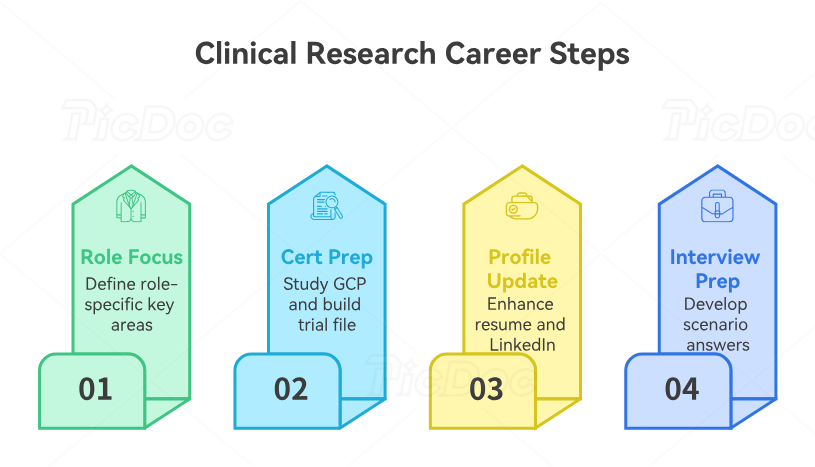
Start with your target role. An Illinois CRC candidate should focus on consent, visit flow, source documentation, eligibility support, participant communication, and deviation prevention. A CRA candidate should focus on monitoring readiness, risk-based review, site communication, data verification, issue escalation, and follow-up letters. A regulatory assistant should focus on IRB documents, approvals, version control, essential files, training logs, and delegation evidence. A safety candidate should focus on AE/SAE seriousness, reporting timelines, narrative quality, and pharmacovigilance workflows. Clarify your path through clinical research career opportunities, clinical research certification in Michigan, clinical research certification in Indiana, and clinical research certification in Iowa.
Next, study ICH-GCP actively. Keep a short “trial judgment file” while completing your course. Create sections for informed consent, protocol compliance, source documentation, safety reporting, investigator oversight, essential documents, and monitoring readiness. Under each section, write one interview answer and one real site action. For example, under informed consent, explain how you would confirm the current IRB-approved version, document the consent process, answer participant questions without coercion, and escalate any irregularity. Then reinforce the file with clinical trial amendments, protocol deviation examples, IND application basics, and clinical trial sponsor responsibilities.
After certification, update your resume and LinkedIn profile quickly. Add the certificate, completion date, and a compact skill cluster tied to the job you want. A strong line could read: “ICH-GCP certified with training in informed consent principles, participant safety, protocol compliance, source documentation, AE/SAE awareness, essential documents, and monitoring readiness.” Under experience, translate previous work into clinical research proof. Scheduling becomes visit coordination. Chart handling becomes source documentation. Customer service becomes participant communication. Team updates become escalation and handoff discipline. Build stronger positioning with clinical research salary comparisons, clinical research professional associations, online clinical research communities, and free clinical research training resources.
Then prepare five scenario answers before applying heavily. One should cover a consent issue, one eligibility issue, one protocol deviation, one AE/SAE escalation, and one monitoring finding. Keep each answer structured: identify the risk, protect the participant, document the facts, notify the correct person, follow the protocol or SOP, and prevent recurrence. This makes your certification feel practical instead of decorative. For stronger interview preparation, study remote and on-site monitoring visits, risk-based monitoring strategies, clinical trial data review, and CRA exam time management.
5. Common GCP Certification Mistakes Illinois Candidates Should Avoid
The first mistake is choosing a course only because it is fast. Fast training can help when the content is current, practical, and role-aligned. Weak fast training leaves you with a certificate and no usable language for consent problems, documentation gaps, safety escalation, monitoring findings, or PI oversight issues. Illinois candidates should choose training that strengthens trial conduct, not surface familiarity. A stronger foundation includes GCP compliance self-assessment, ethical patient safety principles, investigator responsibilities, and adverse event reporting compliance.
The second mistake is ignoring documentation until a monitoring visit exposes the problem. In clinical research, undocumented work becomes hard to defend. A coordinator may have called the participant, checked the chart, clarified a medication, noticed an AE, or contacted the PI, but the trial record must still show what happened and why. Poor documentation creates pain during monitoring, audits, database lock, sponsor review, and inspections. Build habits around contemporaneous notes, complete source, version control, correction clarity, delegation evidence, and query rationale. Deepen those habits through clinical trial data integrity, clinical trial data review, clinical trial templates, and project close-out procedures.
The third mistake is treating patient experience as separate from GCP. Participants stay engaged when communication is clear, visit burden is managed, consent is respectful, privacy is protected, and follow-up feels organized. Patient confusion can lead to missed visits, incomplete diaries, retention problems, avoidable deviations, and safety blind spots. A certified candidate with patient-centered discipline becomes more valuable because they reduce operational risk at the participant level. Connect this skill with clinical trial patient education resources, patient retention strategies, patient influencers in clinical research, and Gen Z clinical trial expectations.
The fourth mistake is getting certified and waiting for confidence to appear. Confidence comes from application. After certification, apply to roles, review job descriptions, join research communities, practice scenario answers, improve your resume, and study one disease-area workflow. Oncology, infectious disease, neurology, cardiovascular, and decentralized trials each carry different documentation and safety pressure. Your certificate becomes stronger when you can show a direction. Build that next layer with oncology clinical research conferences, neurology clinical trial sites, cardiovascular clinical trial sites, and infectious disease clinical research sites.
6. FAQs About Getting ICH-GCP Certification in Illinois
-
Many Illinois clinical research roles strongly prefer GCP training because it supports informed consent, participant safety, protocol compliance, and data credibility. Requirements vary by employer, role, sponsor, and trial type, but CRC, CRA, regulatory, safety, data, and research assistant applicants benefit from having current ICH-GCP training. The certificate becomes more powerful when paired with site monitoring knowledge, investigator responsibilities, clinical trial safety monitoring, and clinical research career planning.
-
Many learners can complete GCP training quickly, but job readiness takes focused practice after the certificate. Spend extra time on informed consent, source documentation, protocol deviations, AE/SAE escalation, monitoring expectations, essential documents, and investigator oversight. A rushed certificate may help you apply; practical understanding helps you perform. Support your preparation with protocol deviation examples, SAE reporting guidance, GCP monitoring techniques, and clinical trial data integrity.
-
ICH-GCP certification is valuable for clinical research coordinators, clinical research associates, regulatory assistants, research assistants, safety associates, data coordinators, project assistants, and PI support professionals. Each role uses GCP differently, but the shared foundation is participant protection, clean documentation, safety awareness, and protocol discipline. Build role alignment through patient retention strategies, risk-based monitoring strategies, global regulatory guidelines, and clinical project timeline management.
-
List the certificate name, provider, and completion date, then add role-specific skills such as ICH-GCP, informed consent, source documentation, protocol compliance, AE/SAE awareness, essential documents, monitoring readiness, EDC query support, and audit preparedness. Under experience, connect those skills to tasks you can explain. A stronger resume also reflects clinical research salary expectations, professional association involvement, clinical research networking communities, and certificate program comparison.
-
After GCP, study the workflow tied to your target role. CRC candidates should study consent, recruitment, retention, visit scheduling, source documentation, and deviation prevention. CRA candidates should study monitoring, SDV/SDR, risk-based review, site communication, and escalation. Regulatory candidates should study IRB submissions, essential documents, approvals, and version control. Safety candidates should study AE/SAE reporting, pharmacovigilance, and inspection readiness. Build the next step through clinical trial startup checklists, pharmacovigilance best practices, remote monitoring mastery, and quality management strategies.
