
Missouri offers a practical entry point into drug safety through its pharmaceutical, biotechnology, clinical-research, healthcare, diagnostic, and biomanufacturing sectors. Success requires more than completing an online course. Employers need evidence that you can apply clinical-trial safety monitoring, meet adverse-event reporting requirements, support global pharmacovigilance compliance, and maintain inspection-ready safety documentation.
This 2026–27 guide explains how to select credible training, develop verifiable skills, navigate Missouri’s life-sciences market, and turn certification into a competitive job application.
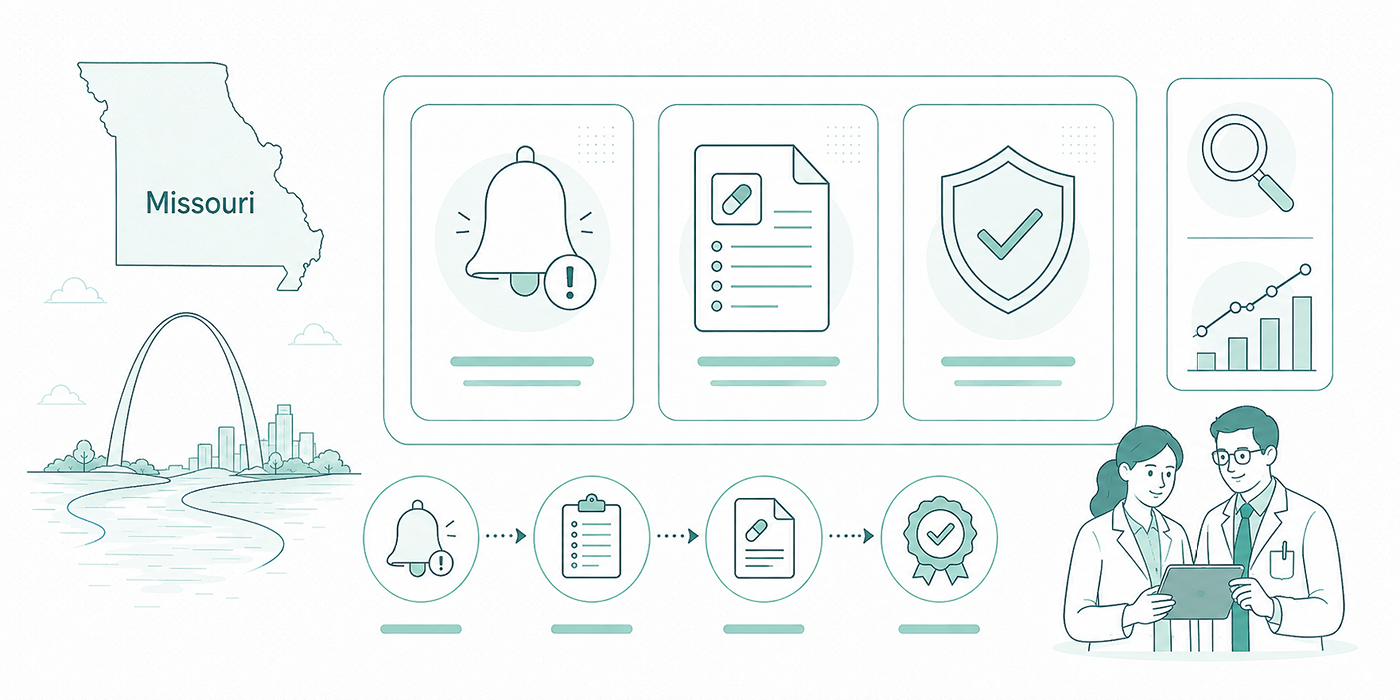
1. Understand What Pharmacovigilance Certification Means in Missouri
Pharmacovigilance professionals collect, validate, assess, process, report, analyze, and communicate safety information involving medicines and biological products. Their work may cover individual case safety reports, serious adverse events, literature surveillance, safety-data reconciliation, signal management, aggregate reports, risk-management activities, quality control, vendor oversight, and regulatory submissions.
These responsibilities connect directly with clinical-trial safety best practices, medical-monitor safety oversight, investigator responsibilities under GCP, ethical patient-safety principles, and clinical-trial data integrity. The ICH E2 guideline family supplies internationally harmonized standards covering expedited safety reporting, electronic ICSR transmission, post-approval reporting, pharmacovigilance planning, and development safety updates.
Missouri’s Division of Professional Registration maintains licensing boards for regulated professions such as medicine, nursing, and pharmacy. Its public profession directory does not identify pharmacovigilance as a separately licensed occupation. A PV certificate therefore functions as professional competency evidence, while roles requiring licensed medical, nursing, or pharmacy practice may carry additional eligibility requirements.
This distinction should influence your training decision. A valuable credential must demonstrate that you can evaluate case validity, distinguish seriousness from severity, assess expectedness, identify missing information, plan follow-up, draft a medically coherent narrative, and document decisions. Pairing PV training with a Missouri ICH-GCP certification pathway, adverse-event reporting knowledge, research-protocol adherence, and clinical data-verification skills creates a stronger employment foundation.
Missouri’s main pharmacovigilance career markets
St. Louis offers pharmaceutical, biotechnology, diagnostic, academic-research, healthcare, consulting, and biomanufacturing pathways. Missouri Partnership identifies the St. Louis API Innovation Center, Cortex Innovation District, pharmaceutical operations, and health-innovation organizations as parts of the state’s expanding life-sciences ecosystem. Recent biotechnology expansions have also added laboratory and research infrastructure in Cortex.
Washington University School of Medicine reports that more than 1,000 clinical studies begin each year, while its clinical-trial directory includes hundreds of active trials. Saint Louis University also operates a Clinical Trials Office that supports industry-sponsored studies, regulatory operations, study systems, contracts, budgets, and trial administration. These environments create experience pathways involving site-monitoring procedures, clinical safety documentation, protocol-deviation management, and investigator-meeting coordination.
Kansas City supports pharmaceutical manufacturing, animal health, healthcare, clinical research, laboratory science, regulatory affairs, and safety operations. Missouri’s broader biomanufacturing strategy specifically connects the Kansas City Animal Health Corridor with St. Louis and Columbia research assets. Human pharmacovigilance and veterinary pharmacovigilance have different regulations, reporting pathways, terminology, and authorities, so candidates should choose training aligned with their target sector.
Columbia provides pathways through the University of Missouri, its School of Medicine, healthcare facilities, translational research, and research-support operations. MU states that its clinical-trial infrastructure supports more than 500 trials and provides study coordination, data collection, laboratory processing, regulatory guidance, and trial-management services.
Remote and hybrid employers may recruit Missouri residents for centralized case processing, medical review, literature surveillance, safety writing, quality control, safety systems, aggregate reporting, vendor oversight, and signal support. Remote roles demand strong written escalation, productivity tracking, documentation discipline, and independent quality control. Develop these capabilities through remote monitoring techniques, clinical-research quality management, trial timeline management, and global regulatory compliance.
Missouri Pharmacovigilance Certification and Career Matrix: 28 Candidate Pathways
| Candidate Background | Realistic Initial Target | Certification Priority | Portfolio Evidence to Build | Hiring Weakness to Correct |
|---|---|---|---|---|
| Life-sciences bachelor’s graduate | Junior safety associate or PV coordinator | Drug development, ICSR lifecycle, terminology, reporting timelines | Three simulated cases covering serious, nonserious, and invalid reports | Listing academic modules without showing operational judgment |
| PharmD graduate | Case processor, medical-information associate, drug-safety associate | Clinical assessment, medication chronology, MedDRA, narrative writing | Complete ICSR with coding rationale, follow-up, and documented QC | Assuming medication expertise proves safety-database competence |
| Licensed pharmacist | Product safety, medical information, postmarketing safety | Medication errors, product complaints, postmarketing reporting | Complaint-to-safety assessment with escalation rationale | Using dispensing language without translating it into PV terminology |
| Registered nurse | Safety intake, SAE follow-up, clinical safety specialist | Seriousness, clinical chronology, source attribution, patient follow-up | De-identified SAE narrative and targeted follow-up questionnaire | Describing patient care without explaining documentation controls |
| Physician | Medical-review support or safety-physician pathway | Causality, medical assessment, benefit-risk, aggregate evidence | Medical review memo identifying competing explanations and data gaps | Pursuing leadership roles before learning operational case workflows |
| International medical graduate | Safety medical review, case assessment, medical writing | U.S. reporting rules, MedDRA, inspection traceability, safety systems | Case-series assessment with clearly documented conclusions | Leaving international experience untranslated for U.S. hiring teams |
| Clinical research coordinator | SAE coordinator, reconciliation associate, clinical safety specialist | Site-to-sponsor reporting, source review, protocol timelines | SAE workflow linked to site-monitoring expectations | Emphasizing recruitment while underdeveloping safety ownership |
| Clinical research associate | Safety liaison, reconciliation specialist, PV operations associate | AE verification, escalation, deviations, corrective action | Safety finding based on risk-based monitoring principles | Reporting visit volume without explaining safety decisions |
| Research assistant | Safety intake, trial assistant, junior operations support | Documentation, confidentiality, medical terminology, source handling | Workflow informed by research-assistant training requirements | Applying without a safety-focused work sample |
| Clinical data manager | AE-SAE reconciliation, safety-data management, systems support | Data consistency, coding dictionaries, data lineage, discrepancy resolution | Reconciliation plan using clinical data-verification methods | Discussing database locks without explaining patient-safety risk |
| Biostatistician | Safety analytics, aggregate review, signal support | Event rates, exposure adjustment, data validation, interpretation | Safety-analysis plan with assumptions and interpretation limits | Providing statistical output without clinical context |
| Epidemiologist | Signal detection, pharmacoepidemiology, risk-management support | Confounding, reporting bias, observed-versus-expected analysis | Signal-assessment brief with competing hypotheses | Treating spontaneous-report counts as incidence rates |
| Public-health graduate | Safety surveillance, signal support, risk communication | Population risk, reporting bias, evidence limitations, communication | Public safety-data analysis with a limitations section | Discussing population health without product-level decisions |
| Medical writer | Case narratives, safety summaries, aggregate-report support | Chronology, medical consistency, traceability, concise conclusions | Patient narrative and short aggregate-safety section | Producing elegant prose that obscures missing information |
| Regulatory-affairs professional | Safety submissions, labeling support, regulatory coordination | FDA pathways, reporting standards, health-authority responses | Submission map informed by IND and NDA requirements | Knowing document names without understanding source-case quality |
| Quality-assurance professional | PV quality, compliance, vendor oversight, inspection readiness | SOPs, deviations, CAPA, training controls, root-cause analysis | Mock audit using PV inspection techniques | Repeating standards without applying risk-based judgment |
| Laboratory scientist | Biologics safety, clinical-development support, laboratory-event review | Laboratory abnormalities, clinical relevance, causality, escalation | Assessment linking abnormal results to reportability | Prioritizing mechanism while leaving reporting decisions unclear |
| Biomedical engineer | Combination-product safety, complaint review, device vigilance | Malfunctions, use errors, clinical consequences, investigation quality | Technical complaint-to-vigilance decision tree | Describing engineering failure without evaluating patient impact |
| Health-information specialist | Safety operations, source review, coding-quality support | Privacy, traceability, record consistency, terminology mapping | Redacted source-review checklist and discrepancy tracker | Presenting records expertise without performing safety assessment |
| Oncology research professional | Oncology safety, SAE management, medical-review support | Disease progression, treatment-emergent events, laboratory trends | Complex chronology informed by the oncology research landscape | Failing to separate underlying disease from treatment risk |
| Neurology research professional | CNS safety, special-interest event monitoring, case review | Baseline symptoms, disease fluctuation, cognitive and behavioral events | Case assessment informed by the neurology trial environment | Under-documenting baseline neurological status |
| Cardiovascular research professional | Cardiac safety, adjudication support, clinical safety | Event definitions, diagnostics, temporal relationships, risk factors | Assessment supported by the cardiovascular research landscape | Using broad event labels without objective evidence |
| Infectious-disease professional | Vaccine safety, anti-infective safety, surveillance | Underlying infection, concomitant therapies, special-interest events | Assessment informed by infectious-disease trial settings | Underestimating confounding from the underlying disease |
| Veterinary or animal-health professional | Veterinary pharmacovigilance or animal-health product safety | Species-specific safety, exposure, product complaints, applicable authorities | Veterinary case-intake and escalation workflow | Applying human-drug reporting pathways to animal-health cases |
| Career changer without clinical experience | Safety intake, documentation support, junior operations | Anatomy, terminology, drug development, GCP, privacy | Foundation workbook and two controlled case exercises | Skipping the clinical foundation required for accurate processing |
| Career returner | PV coordinator, contract processor, quality-support associate | Current regulations, current technology, documentation refresh | Recent portfolio supported by current refresher training | Allowing an employment gap to dominate the application |
| Remote-work applicant | Central case processing, literature surveillance, case QC | Written escalation, productivity controls, remote documentation | Remote handoff protocol and daily case tracker | Leading with location preference rather than technical competence |
| Experienced PV professional | Operations lead, vendor manager, quality or governance role | Metrics, inspection readiness, capacity planning, team quality | Governance model based on clinical leadership principles | Reporting team size without quantifying quality improvement |
Scroll horizontally on smaller screens to review all five columns.
2. Choose a Missouri Pharmacovigilance Certification That Fits Your Target Role
Begin by selecting one role family. A course designed for ICSR processing will have different learning outcomes from training built for signal detection, medical review, aggregate reporting, safety systems, quality assurance, or veterinary pharmacovigilance.
Case processing and safety operations
Candidates targeting drug-safety associate, PV case processor, safety coordinator, or ICSR specialist positions need practical training in:
Minimum criteria for a valid case
Initial receipt dates and Day Zero
Seriousness and severity
Expectedness and listedness
Causality information
Follow-up planning
Duplicate detection
Narrative writing
MedDRA coding fundamentals
Case quality control
Submission timelines
Clinical-trial and postmarketing workflows
The curriculum should connect these decisions with adverse-event reporting standards, clinical-trial safety monitoring, investigator safety responsibilities, clinical data-integrity controls, and Missouri GCP preparation.
Signal detection and risk evaluation
Signal-focused candidates need training in case-series construction, reporting biases, data quality, disproportionality concepts, clinical plausibility, temporal relationships, class effects, exposure context, confounding, and evidence synthesis.
A signal course should require learners to explain why a potential association deserves further evaluation, which data weaken the hypothesis, and which follow-up actions could resolve uncertainty. Relevant supporting knowledge includes risk-based monitoring, global PV compliance, medical-monitor oversight, clinical data review, and clinical-research quality management.
Aggregate reporting and safety writing
Candidates targeting aggregate reports, safety narratives, regulatory writing, or benefit-risk support should study:
Case-series summaries
Data-lock points
Cumulative exposure
Important identified risks
Important potential risks
Missing information
Reference safety information
Risk minimization
Benefit-risk conclusions
Cross-functional review controls
Choose training that requires substantial writing. A completed safety summary, narrative, or case-series assessment provides stronger evidence than a certificate based solely on recorded lectures. Support this specialization with regulatory submission knowledge, global pharmacovigilance compliance, medical-monitor responsibilities, and clinical-trial timeline management.
PV quality, audits, and inspections
Quality-focused candidates need training in SOP governance, deviations, CAPA, training records, reconciliation, audit trails, vendor oversight, computerized-system controls, inspection conduct, metrics, and root-cause analysis.
An effective quality course should require learners to identify the actual compliance risk, determine contributing factors, design proportionate corrective actions, and define measurable effectiveness checks. Build these competencies through pharmacovigilance audit techniques, protocol-deviation management, quality-management strategies, project close-out procedures, and clinical-trial milestone controls.
Eight tests for evaluating a certification provider
Role alignment: The syllabus should match the work performed in your target position.
Regulatory currency: Materials should reflect current FDA, ICH, and electronic-reporting requirements.
Practical exercises: Learners should complete cases, narratives, coding tasks, follow-up plans, QC reviews, or signal assessments.
Instructor credibility: Faculty should have direct PV, clinical safety, regulatory, medical-review, quality, or inspection experience.
Corrective feedback: Assessments should explain why an answer creates clinical, reporting, or data-integrity risk.
Credential verification: Employers should be able to verify the learner, course, issuer, and completion date.
Version control: The provider should display when modules were updated.
Career translation: The training should help candidates convert learning into portfolio evidence and interview explanations.
Warning signs include vague “global recognition” claims, guaranteed employment, absent instructor biographies, outdated regulatory modules, minimal assessment, and zero case-processing practice. Compare any proposed syllabus with clinical safety-monitoring requirements, PV inspection expectations, global regulatory obligations, GCP reporting requirements, and medical-monitor safety functions.
Missouri candidates can compare neighboring regional pathways through the Kansas GCP certification guide, Illinois GCP certification guide, Iowa GCP certification guide, Kentucky GCP certification guide, and Oklahoma GCP certification guide.
3. Build the Technical Skills Missouri Employers Can Verify
Master case validity and intake control
A valid ICSR generally requires an identifiable patient, an identifiable reporter, a suspect product, and an adverse event. You should also know how to preserve the original source, identify the initial receipt date, document follow-up attempts, detect potential duplicates, and escalate incomplete reports.
Practice across spontaneous reports, clinical-trial cases, literature reports, patient-support programs, product complaints, medical-information contacts, and partner-company exchanges. Strengthen your accuracy through adverse-event reporting guidance, research-protocol adherence, trial logistics coordination, clinical data verification, and research-assistant training.
Learn clinical and regulatory assessment
You should be able to distinguish seriousness from symptom intensity, identify the applicable seriousness criterion, determine expectedness against the correct reference document, document causality information, and recognize situations requiring urgent escalation.
Your assessment must separate source-reported facts from company conclusions. It should also identify alternative explanations, relevant medical history, concomitant products, diagnostic evidence, treatment, outcomes, dechallenge information, and rechallenge information.
These skills align with medical-monitor safety oversight, investigator GCP duties, ethical trial conduct, site-monitoring practices, and Missouri GCP certification preparation.
Understand MedDRA and structured case processing
Your certification should introduce MedDRA hierarchy, coding conventions, preferred-term selection, medical context, split concepts, specificity, and quality review. It should also cover patient history, suspect and concomitant products, therapy dates, indications, dosage, event onset, treatment, laboratory findings, outcomes, reporter comments, and company assessment.
A strong narrative presents a clear chronology, preserves uncertainty, attributes information correctly, and highlights clinically meaningful gaps. Build narrative quality through clinical-trial data integrity, remote and on-site monitoring, site-operations oversight, protocol-deviation management, and quality-management controls.
Prepare for E2B(R3) and FDA’s AEMS environment
FDA requires applicable commercial IND safety ICSRs to be submitted to the Adverse Event Monitoring System in E2B(R3) format, with the requirement effective April 1, 2026. FDA’s current implementation information also permits applicable postmarketing E2B(R2) submissions through September 30, 2026. Beginning October 1, 2026, ICSRs routed through ESG NextGen are scheduled to use E2B(R3).
Your course should therefore address:
E2B(R3) data elements
Structured case transmission
Controlled terminology
Null values
Case versions
Follow-up reports
Acknowledgement messages
Transmission errors
Duplicate management
Attachments
Source traceability
Data migration risks
AEMS submission pathways
ESG NextGen readiness
A curriculum built around old screenshots and E2B(R2)-only workflows leaves a significant 2026–27 skills gap. Combine current electronic-reporting knowledge with global PV compliance, regulatory submission mastery, PV inspection preparation, clinical safety monitoring, and clinical-project quality management.
Create a practical pharmacovigilance portfolio
Complete at least these 12 pieces:
A valid serious case
A valid nonserious case
An invalid report with a follow-up plan
A patient narrative
A seriousness assessment
An expectedness assessment
A MedDRA coding rationale
A duplicate-search worksheet
A case QC checklist
An AE-to-SAE reconciliation exercise
A deviation and CAPA assessment
A short signal-evaluation brief
Use fictional or fully de-identified data. Add a version number, completion date, assumptions, unresolved questions, decision rationale, escalation path, and final QC result. This demonstrates the discipline expected in clinical data review, PV audit preparation, research-team communication, investigator meetings, and clinical-research quality management.
What Is Blocking Your Missouri Pharmacovigilance Career?
Choose the closest challenge to reveal your highest-priority action for the next 30 days.
4. Follow a Step-by-Step Missouri Certification and Employment Plan
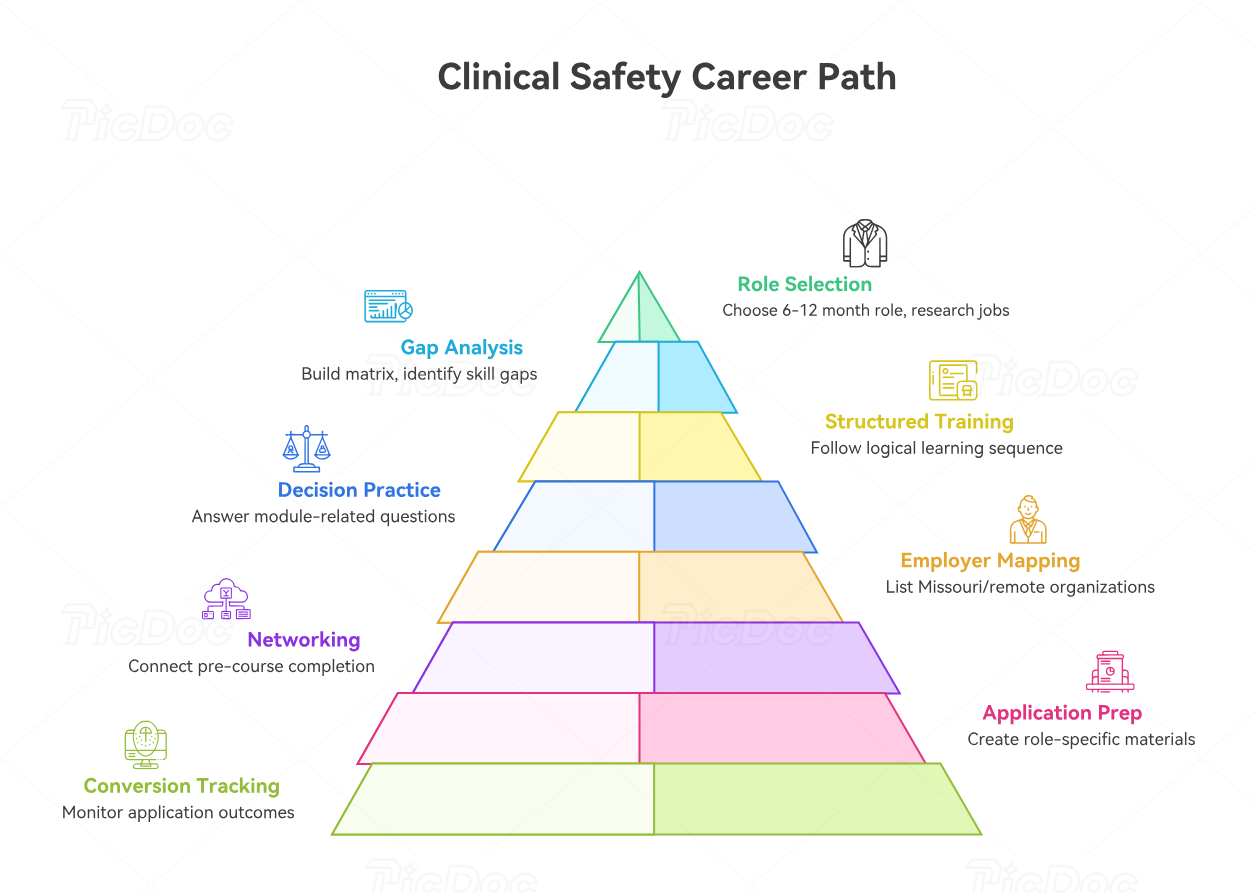
Step 1: Select one role you can pursue within 6–12 months
Suitable targets may include drug-safety associate, case processor, SAE coordinator, clinical safety specialist, literature-surveillance associate, safety-data reconciliation associate, medical-information specialist, PV quality coordinator, or veterinary safety associate.
Collect 20 current job descriptions from Missouri and remote employers. Record education, experience, therapeutic area, reporting type, regulations, systems, coding requirements, and recurring responsibilities. Expand your research through the clinical-research career map, salary comparison tool, professional-association directory, clinical-research community directory, and free training directory.
Step 2: Build a competency-gap matrix
Use four columns:
Knowledge
Practiced skill
Verifiable evidence
Interview example
Rate every requirement:
0: Unfamiliar
1: Can define it
2: Can perform it with guidance
3: Can perform it independently and explain the associated risks
This process exposes expensive gaps. You may understand seriousness criteria while lacking a complete assessment. You may know MedDRA terminology while lacking a coding rationale. You may have clinical experience while lacking a safety-focused interview story.
Close those gaps through clinical data-review training, research-assistant preparation, trial logistics coordination, protocol-adherence guidance, and GCP monitoring techniques.
Step 3: Complete training in a logical order
A strong sequence is:
Drug-development lifecycle
Medical terminology and clinical documentation
ICH-GCP
Pharmacovigilance system structure
AE, ADR, SAE, SUSAR, seriousness, severity, expectedness, and causality
ICSR intake and validity
Follow-up and case processing
MedDRA and medicinal-product coding concepts
Narrative writing
Duplicate detection
FDA reporting pathways
E2B(R3), AEMS, and ESG NextGen
Signal management
Aggregate reporting
Deviations, CAPA, audits, and inspections
Support your formal course with Missouri GCP certification preparation, clinical safety-monitoring guidance, adverse-event reporting requirements, medical-monitor responsibilities, and global PV compliance.
Step 4: Study through decisions
After each module, answer:
Does the report meet minimum case criteria?
Which date establishes initial receipt?
Which seriousness criterion applies?
Which reference determines expectedness?
Which information remains missing?
Which questions could change reportability?
Does the narrative distinguish source facts from assessment?
Could another report be a duplicate?
Which error creates the greatest patient or compliance risk?
Who should receive the escalation?
Which control could have prevented the error?
Practice with protocol-deviation scenarios, site-monitoring workflows, remote-monitoring strategies, clinical data-verification methods, and investigator safety responsibilities.
Step 5: Create a Missouri employer map
Divide target organizations into:
Pharmaceutical and biotechnology sponsors
CROs and safety-service vendors
Academic medical centers and hospitals
Diagnostic and health-technology organizations
Biomanufacturing and API organizations
Regulatory and quality consultancies
Medical-information and patient-support providers
Animal-health and veterinary pharmaceutical companies
Research opportunities across St. Louis, Kansas City, Columbia, and remote teams. BioSTL provides bioscience workforce resources and career connections, while Missouri Partnership describes statewide assets spanning research, pharmaceuticals, diagnostics, biomanufacturing, healthcare, and the Kansas City Animal Health Corridor.
Evaluate therapeutic activity through the cardiovascular clinical-trial directory, neurology research directory, oncology research directory, infectious-disease site directory, and clinical-trial patient-education directory.
Step 6: Begin networking before course completion
Use clinical-research professional associations, online researcher communities, free research webinars, clinical career resources, and Missouri bioscience networks.
Ask focused questions:
Which processing errors cause the greatest rework?
Which entry-level skill takes longest to teach?
How is your team handling E2B(R3)?
Which quality metrics receive leadership attention?
Which portfolio sample would help a candidate without database access?
How do human and veterinary safety pathways differ?
Which therapeutic-area knowledge creates immediate value?
Step 7: Build role-specific application materials
Your application package should include:
A targeted résumé
A tailored cover letter
Credential verification
An optimized LinkedIn profile
One relevant portfolio sample
A concise technical-skills section
A record of continuing education
Match the work sample to the vacancy. Use an ICSR exercise for case processing, a CAPA assessment for quality, a narrative for medical writing, a discrepancy analysis for reconciliation, and a signal brief for surveillance.
Track applications using the same discipline applied in clinical-trial timeline management, project quality management, clinical-trial leadership, trial budget management, and patient-retention planning.
Step 8: Measure conversion instead of application volume
Track:
Applications submitted
Referrals obtained
Recruiter screens
Hiring-manager interviews
Technical interviews
Rejections
Rejection reasons
Offers
Time between stages
Performance by résumé version
Thirty poorly matched applications can hide the source of failure. Ten targeted applications with portfolio evidence create better diagnostic data. Review your results weekly and adjust role targeting, résumé language, technical preparation, or networking strategy.
5. Turn the Certification Into Missouri Interviews and Job Offers
A résumé should translate training into observable tasks. Replace “completed pharmacovigilance certification” with a statement such as:
Processed simulated individual case safety reports from intake through quality review, including validity assessment, seriousness classification, expectedness review, follow-up planning, narrative writing, duplicate evaluation, coding rationale, and documented QC.
A clinical research coordinator could write:
Reconciled adverse-event information across source records, electronic data-capture fields, safety correspondence, and sponsor queries while escalating discrepancies within protocol-defined timelines.
A pharmacist could write:
Evaluated medication histories, suspect and concomitant products, dose chronology, medication errors, treatment response, and missing clinical information to support structured safety assessments.
A quality professional could write:
Investigated simulated case-processing deviations, documented contributing factors, designed corrective and preventive actions, and established measurable effectiveness checks.
A laboratory professional could write:
Assessed laboratory abnormalities for clinical significance, temporal association, alternative causes, follow-up requirements, and safety escalation.
These claims become stronger when supported by clinical safety-monitoring expertise, protocol-deviation management, risk-based monitoring skills, PV inspection preparation, and global regulatory knowledge.
Prepare six high-value interview stories
Develop examples covering:
Identifying missing or conflicting information
Escalating a patient-safety or quality concern
Managing a deadline with incomplete data
Correcting an error while preserving traceability
Communicating with a difficult stakeholder
Improving a repeatable process
Structure each response around risk, evidence, decision, action, and outcome. This sequence works for CRA monitoring scenarios, research-team communication, investigator-meeting situations, clinical-project leadership, and site-operations oversight.
Prepare for technical screening
Expect questions involving:
Valid-case criteria
Seriousness and severity
Expectedness and relatedness
Initial receipt and Day Zero
Follow-up priorities
Fatal or life-threatening events
Source-document discrepancies
Duplicate reports
Narrative quality
MedDRA coding
Literature cases
Clinical-trial and spontaneous reports
Product complaints
Pregnancy exposure
Medication error
Overdose, misuse, and abuse
AE-to-SAE reconciliation
E2B(R3)
AEMS
Signal validation
CAPA
Inspection readiness
Describe simulated work accurately. Explain your assumptions, decision process, escalation pathway, and quality controls. Precise scope builds trust and protects your professional credibility.
Search adjacent titles such as safety coordinator, PV associate, drug-safety associate, case-processing specialist, medical-information specialist, SAE specialist, clinical-trial assistant, clinical safety associate, safety-data analyst, literature-surveillance associate, complaint specialist, and quality-compliance coordinator.
Compare opportunities through the clinical-research salary tool, career-opportunity map, professional-association directory, research community directory, and free training resources.
6. Frequently Asked Questions
-
Missouri’s professional-registration directory does not list pharmacovigilance as a separately licensed occupation. Employers establish education, experience, and competency requirements for safety-processing, quality, writing, data, and operations positions.
A separate clinical license may be required when a role includes regulated medical, nursing, or pharmacy responsibilities. Review the job description and distinguish the PV certificate from any underlying healthcare license.
Build your compliance foundation through Missouri GCP certification guidance, investigator GCP responsibilities, ethical patient-safety principles, adverse-event reporting compliance, and clinical safety-monitoring guidance.
-
Life-sciences graduates, public-health professionals, coordinators, data managers, statisticians, medical writers, laboratory scientists, quality specialists, regulatory professionals, and biomedical engineers can enter roles aligned with their existing capabilities.
Candidates with limited clinical exposure should strengthen medical terminology, anatomy, drug development, source-document interpretation, privacy, and adverse-event concepts. Useful resources include research-assistant training requirements, protocol-adherence guidance, trial-logistics coordination, free clinical-research webinars, and clinical data-review training.
-
Online training can provide credible preparation when it includes current regulatory content, assessed assignments, instructor feedback, identity verification, practical case exercises, and a verifiable credential.
Review the evidence produced by the course. Case-validity decisions, seriousness assessments, narratives, follow-up plans, coding exercises, QC reviews, and final examinations provide useful interview material.
Compare the syllabus with clinical safety best practices, global PV compliance, PV audit expectations, clinical data-integrity principles, and adverse-event reporting requirements.
-
Completion time depends on your clinical foundation, weekly study capacity, course depth, assessment requirements, and portfolio development.
A practical ten-week plan could use:
Weeks 1–2: Drug development, medical terminology, GCP, and PV foundations
Weeks 3–4: Validity, seriousness, expectedness, and causality
Weeks 5–6: Case processing, narratives, coding, duplicates, and follow-up
Weeks 7–8: E2B(R3), AEMS, signals, aggregate concepts, and quality
Weeks 9–10: Portfolio, résumé, employer mapping, and interview practice
Support this schedule with Missouri GCP training, clinical data-review skills, remote-monitoring knowledge, quality-management strategies, and safety-oversight guidance.
-
Prioritize case validity, seriousness, expectedness, follow-up, narrative writing, source traceability, MedDRA fundamentals, duplicate management, quality control, submission timelines, reconciliation, and professional written communication.
E2B(R3) competence carries immediate value because FDA’s electronic safety-reporting environment is transitioning during 2026. Applicable commercial IND safety ICSRs have required E2B(R3) submission to AEMS since April 1, 2026, while the wider ESG NextGen transition is scheduled to reach another major milestone on October 1, 2026.
Connect these skills with adverse-event reporting guidance, global PV regulations, PV audit preparation, medical-monitor responsibilities, and clinical-project quality management.
-
Missouri’s Kansas City region belongs to a major animal-health ecosystem, creating additional pathways involving veterinary medicines, vaccines, diagnostics, product complaints, and animal-safety surveillance. Missouri’s statewide biomanufacturing strategy explicitly highlights the Kansas City Animal Health Corridor as one of its core life-sciences assets.
Veterinary pharmacovigilance requires sector-specific regulations, authorities, terminology, species knowledge, and reporting procedures. Candidates targeting human-drug employers should prioritize human ICSR requirements, MedDRA, E2B(R3), clinical-trial safety, and postmarketing reporting.
Both pathways benefit from clinical data-integrity principles, global safety compliance, risk-based monitoring, quality-management strategies, and regulatory submission knowledge.
