
The Ultimate Guide to Getting Your Good Clinical Practice (ICH-GCP) Certification in Indiana: Everything You Need to Know in 2026-27
Getting your ICH-GCP certification in Indiana in 2026-27 is a practical career move when you connect it to real trial work: informed consent, source documentation, safety reporting, protocol deviations, investigator oversight, and inspection readiness. Indiana’s clinical research market rewards people who understand both the ethics and operations of modern trials, especially if they can show role-specific skills through clinical research certification in Indiana, GCP monitoring techniques, protocol deviation handling, and adverse event reporting compliance.
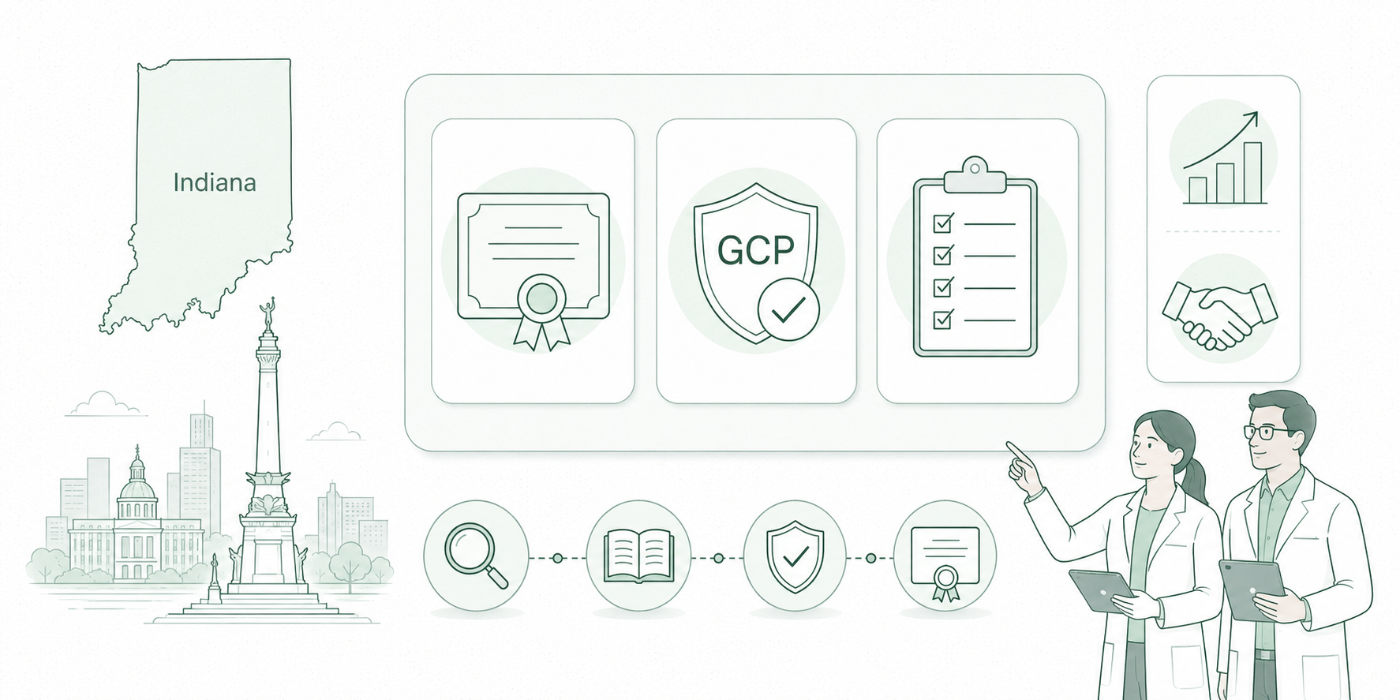
1. Why ICH-GCP Certification Matters in Indiana in 2026-27
Indiana is a serious clinical research state because the career pathway runs through academic medicine, hospital systems, pharma, site networks, public health studies, device research, oncology trials, and decentralized trial operations. That means a certificate only works when it proves you understand how patient safety, data integrity, sponsor expectations, and site execution connect. A candidate who studies Good Clinical Practice certification in Alabama, compares GCP certification in Alaska, reviews GCP certification in Arizona, and builds from clinical research certificate program comparisons will make a stronger decision than someone who buys the shortest course available.
The biggest mistake Indiana applicants make is treating ICH-GCP as a checkbox. Hiring managers care about whether you can protect subjects, recognize reportable events, document trial activity cleanly, and escalate risk before a monitor, sponsor, IRB, or inspector finds it first. That is why your study plan should include ethical conduct and patient safety in GCP, investigator responsibilities under GCP, clinical trial data integrity, serious adverse event reporting, and clinical trial sponsor responsibilities.
For 2026-27, ICH-GCP preparation should feel more operational than academic. Modern trial teams need people who understand electronic systems, remote monitoring, risk-based oversight, decentralized procedures, protocol amendments, and documentation trails. A coordinator in Indianapolis, a research assistant in Bloomington, a CRA covering Midwest sites, or a regulatory specialist supporting multi-site studies must speak the same quality language. Use mastering remote and on-site monitoring visits, risk-based monitoring strategies, clinical trial amendments, clinical trial data review and verification, and quality management strategies to turn certification into proof of readiness.
| Candidate / Career Goal | Best GCP Focus | Indiana Career Use Case | Common Failure Mode | Best CCRPS Next Step |
|---|---|---|---|---|
| New clinical research applicant | Core GCP principles, consent, documentation | Entry-level site assistant, research assistant, coordinator trainee | Certificate listed with no practical language | Build an Indiana clinical research certification plan |
| Future clinical research coordinator | Consent workflow, source notes, deviations, visit windows | Hospital, academic, oncology, specialty clinic roles | Weak understanding of site execution pressure | Strengthen CRC patient retention skills |
| Future CRA | SDV, SDR, monitoring reports, site issue escalation | Regional monitoring across Midwest sites | Memorizing GCP without monitor-level judgment | Master remote and on-site monitoring |
| Regulatory affairs beginner | IRB submissions, essential documents, amendments | Start-up support, regulatory binder control, document tracking | Confusing approval status, version control, and implementation timing | Study regulatory submission fundamentals |
| Research nurse | Safety assessment, consent, protocol-specific procedures | Patient-facing trial roles in hospital systems | Charting clinically without trial-grade source clarity | Sharpen adverse event reporting |
| Pharmacovigilance candidate | AE/SAE definitions, timelines, causality, follow-up | Safety intake, case processing, sponsor/CRO safety roles | Missing seriousness, expectedness, or reporting clock triggers | Learn safety monitoring best practices |
| Data management candidate | ALCOA+, query logic, audit trails, clean source | EDC support, query resolution, database lock preparation | Seeing data as entry work instead of evidence control | Improve data review skills |
| Principal investigator support staff | Delegation, oversight, training, protocol accountability | Academic and physician-led trial offices | Assuming sponsor oversight replaces investigator oversight | Review investigator responsibilities |
| Site start-up specialist | Feasibility, contracts, budgets, activation documents | Indiana site network or CRO start-up roles | Activation delays from missing document dependencies | Use a start-up checklist generator |
| Clinical project manager | Milestones, risk logs, vendor control, escalation | Trial delivery roles across sponsor, CRO, academic teams | Tracking timelines without quality risk context | Master trial timelines and milestones |
| Oncology research applicant | Eligibility, consent, safety follow-up, protocol intensity | Cancer center and specialty site roles | Underestimating complex visit schedules and safety documentation | Explore oncology research resources |
| Device trial candidate | Protocol adherence, device accountability, procedure documentation | Medtech and academic device studies | Applying drug-trial habits without device-specific controls | Review regulatory guideline directories |
| Public health research assistant | Human subjects protection, consent, privacy, recruitment ethics | University, community, and population health studies | Recruiting fast while weakening documentation quality | Use patient education resources |
| Remote trial operations candidate | eConsent, telehealth visits, remote data capture, documentation | Decentralized and hybrid trial support roles | Assuming remote work lowers documentation standards | Study virtual clinical trial trends |
| Clinical research assistant | Visit prep, filing, logs, source collection, scheduling | First site role after certification | Doing tasks without understanding why they matter | Improve research assistant communication |
| Quality assurance candidate | CAPA, audit readiness, inspection trails, SOP control | Site quality, sponsor quality, CRO quality support | Finding issues without building preventive fixes | Study clinical research quality management |
| Career changer from healthcare | Translate patient care into protocol-safe execution | Nursing, pharmacy, lab, allied health transition | Relying on healthcare experience without trial vocabulary | Use free training resources strategically |
| Career changer from admin | Document control, scheduling, communication, compliance tracking | Study assistant, regulatory assistant, site operations support | Sounding organized but unfamiliar with GCP risk | Practice with trial templates and SOPs |
| Pharmacy graduate | Investigational product accountability, safety, protocol procedures | IP accountability, site pharmacy, sponsor support | Knowing medicines without documenting trial accountability | Understand sponsor and IP responsibilities |
| International graduate in Indiana | U.S. trial operations, HIPAA-aware documentation, role mapping | Entry-level site/CRO applications | Listing foreign experience without translating it into U.S. GCP terms | Map clinical research career opportunities |
| Experienced CRC moving up | Risk escalation, metrics, delegation oversight, protocol leadership | Senior CRC, lead CRC, site manager pathway | Staying task-based instead of evidence-based | Add budget and site management skills |
| CRC moving into CRA work | Monitoring logic, site performance, source verification, issue trends | CRA bridge pathway | Thinking like a site only and missing sponsor oversight expectations | Study risk-based monitoring |
| Graduate student | Ethics, protocol design, participant protection, research conduct | Academic studies, assistantships, investigator-initiated research | Strong theory with weak operational controls | Learn investigator-initiated trial basics |
| Clinical trial recruiter | Consent boundaries, inclusion/exclusion, fair recruitment | Patient recruitment and community outreach roles | Overselling studies or weakening informed consent neutrality | Study modern recruitment trends |
| Inspection-readiness support | Essential documents, audit trails, training records, CAPA | QA, regulatory, site operations | Preparing binders late instead of maintaining readiness daily | Run a GCP compliance self-assessment |
| Candidate targeting sponsor roles | Oversight, vendor management, protocol quality, data review | Sponsor operations, clinical trial associate, project support | Knowing site tasks but missing sponsor accountability | Learn sponsor roles and best practices |
| Candidate targeting global research | ICH harmonization, ethics, records, regulatory alignment | Global CRO, sponsor, and remote clinical operations roles | Assuming local training covers global expectations | Compare top clinical trial countries |
2. How to Choose the Right ICH-GCP Certification Path in Indiana
Choose your ICH-GCP certification based on the role you want within six to twelve months. A future CRC needs site execution strength: consent notes, eligibility checks, visit windows, source documentation, and deviation prevention. A future CRA needs monitoring judgment: what to verify, what to escalate, how to read site patterns, and how to document follow-up. A regulatory candidate needs document control, IRB logic, amendments, version history, and training records. Compare GCP certification in Arkansas, GCP certification in California, GCP certification in Colorado, GCP certification in Connecticut, and GCP certification in Delaware to understand how location pages frame the same core credential around different markets.
The best ICH-GCP course for Indiana should cover ICH E6(R3), informed consent, investigator oversight, essential documents, source data, electronic systems, safety reporting, protocol deviations, monitoring, quality-by-design, and records retention. It should also help you explain your knowledge in job language. “Completed GCP training” is weak. “Trained in ICH-GCP principles, informed consent documentation, AE/SAE reporting, protocol deviation prevention, essential document control, and risk-based monitoring concepts” is stronger. Reinforce the certificate with handling protocol deviations for CRCs, site monitoring visits for coordinators, clinical trial budget management, project close-out procedures, and leadership in clinical trial teams.
Your certificate should also match the level of proof you need. Entry-level applicants need vocabulary and scenario confidence. Experienced healthcare workers need translation: how nursing, pharmacy, lab, or admin experience becomes trial value. Current research staff need upgrade value: E6(R3), modern monitoring, electronic systems, decentralized trial procedures, and quality risk management. People applying in Indianapolis, West Lafayette, Bloomington, Fort Wayne, South Bend, or remote CRO roles should pair ICH-GCP with clinical research professional associations, best online communities for clinical researchers, clinical research salary tools, free clinical research webinars, and global career opportunity mapping.
3. What Indiana Employers Expect You to Know After GCP Training
Indiana employers expect ICH-GCP certification to translate into safer trial behavior. You should know that informed consent is a process, not a signature event. You should understand that source documentation tells the story of what happened, who did it, when it happened, and whether it matched the protocol. You should recognize that protocol deviations are preventable risk signals, not embarrassing paperwork. Strong candidates can discuss informed consent ethics through GCP principles, protocol deviation examples, clinical trial amendments, SAE reporting procedures, and site monitoring visit workflows.
You should also know how trial teams fail in real life. A subject signs the wrong consent version. A lab is collected outside the visit window. A coordinator documents “no adverse events” without asking targeted protocol questions. A delegation log is updated after work was performed. A monitor finds missing training after enrollment began. A data query reveals source inconsistency across visits. These problems can damage data credibility and patient protection. Study interactive GCP compliance self-assessment, directory of clinical trial templates, clinical trial data integrity for PIs, quality management strategies, and GCP monitoring techniques so your answers sound operational.
A practical Indiana interview answer should connect patient safety, protocol compliance, and documentation. For example: “If I noticed a missed assessment, I would confirm the protocol requirement, document what occurred, notify the PI or delegated supervisor, follow site SOPs, assess whether it meets deviation reporting criteria, support corrective action, and make sure the issue is reflected accurately in source and trial records.” That answer proves judgment. Build similar answers using CRA exam time management techniques, conducting investigator meetings, clinical trial data review, regulatory affairs mastery, and pharmacovigilance audit techniques.
What is your biggest ICH-GCP certification blocker in Indiana right now?
Choose one. Your answer points to the fastest way to turn certification into career proof.
4. How to Turn GCP Certification Into a Clinical Research Job in Indiana
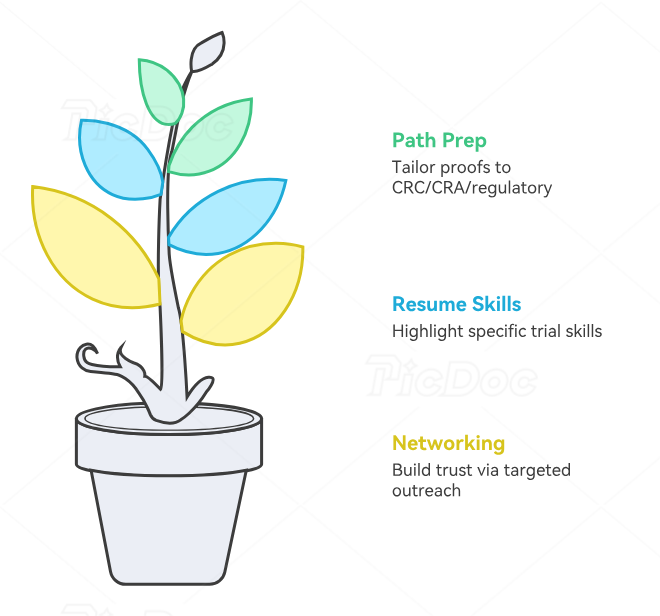
The strongest Indiana strategy is to turn your certificate into a role-specific proof package. For a CRC path, prepare resume bullets around visit coordination, consent support, source documentation, eligibility checks, query response, patient retention, and deviation prevention. For a CRA path, prepare bullets around monitoring plans, SDV/SDR concepts, issue escalation, follow-up letters, site performance trends, and remote monitoring. For regulatory, focus on IRB submissions, essential documents, version control, training logs, and amendment implementation. Strengthen each path with clinical research certification in Ohio, clinical research certification in Michigan, clinical research certification in Kentucky, clinical research certification in Illinois-style neighboring market research, and clinical research certification in Iowa.
Your resume should never rely on “ICH-GCP certified” as the only proof. Use a “Clinical Research Skills” section with direct trial language: ICH-GCP, informed consent process, source documentation, essential documents, AE/SAE awareness, protocol deviation tracking, EDC query support, monitoring readiness, privacy, and audit readiness. Then match those skills to job descriptions. When a posting says “regulatory documentation,” your resume should mention essential documents and IRB workflows. When it says “patient visits,” mention visit windows, source notes, eligibility, and retention. Use patient retention strategies, clinical trial patient education resources, trial start-up checklist tools, clinical trial cost estimator skills, and sample size calculator awareness to add practical language.
Networking also matters because many entry-level research roles are trust-based. Join clinical research associations, attend webinars, follow Indiana research institutions, connect with CRCs and CRAs, and ask specific questions about workflows rather than asking for a job immediately. A good outreach message says: “I recently completed ICH-GCP training and I’m building practical skill around consent documentation, protocol deviations, and AE reporting. I’m targeting CRC assistant roles in Indiana and would value one workflow tip you wish new applicants understood.” That sounds prepared. Support that approach with professional association directories, clinical research communities, clinical research ethics resources, global clinical research sites directories, and cardiovascular clinical trial site expertise.
5. Mistakes That Make GCP Certification Weak on a Resume
A weak GCP resume sounds passive. It lists certificates, education, and vague interest in research. A strong GCP resume shows the work you are ready to support. Replace “knowledge of Good Clinical Practice” with “trained in ICH-GCP principles covering informed consent, participant protection, source documentation, protocol deviation awareness, AE/SAE reporting, and essential document control.” Replace “interested in clinical trials” with “prepared to support protocol-compliant visit coordination, regulatory documentation, EDC query follow-up, and monitoring readiness.” Use CRA certification in Wisconsin, CRA certification in Wyoming, CRA certification in Missouri, CRA certification in Maryland, and CRA certification in Europe to study how CRA language differs from general GCP language.
Another mistake is ignoring role alignment. A CRC resume should lead with patient-facing operations. A regulatory resume should lead with document control. A pharmacovigilance resume should lead with safety intake and timelines. A data resume should lead with EDC, query logic, audit trails, and clean documentation. A project support resume should lead with trackers, milestones, vendors, and escalation. Your ICH-GCP certificate becomes more valuable when every bullet points toward a clear job family. Build that clarity through pharmacovigilance best practices, global pharmacovigilance compliance, clinical project timelines, PI budget management essentials, and clinical trial site operations oversight.
The final mistake is failing to prepare for scenario interviews. Indiana employers may ask what you would do if a participant reports a hospitalization, if a consent form is incomplete, if eligibility is unclear, if a visit is outside the window, or if source does not match EDC. Your answer should show calm escalation, documentation, protocol review, PI involvement, and prevention. Practice with protocol deviation corrective actions, SAE reporting procedures, GCP patient safety principles, clinical trial amendments, and site monitoring visit strategy. That preparation makes the certificate sound alive in the interview.
6. FAQs About ICH-GCP Certification in Indiana
-
Many Indiana clinical research employers expect GCP training for roles that touch human subjects research, trial documentation, safety reporting, monitoring, or regulatory files. The exact requirement depends on the employer, study type, sponsor, and role. For entry-level applicants, ICH-GCP certification helps prove you understand participant protection and data integrity before you touch a protocol. Pair it with clinical research certification in Indiana, investigator responsibilities, GCP compliance self-assessment, and adverse event reporting for stronger proof.
-
Most focused ICH-GCP training can be completed quickly, but career-ready preparation takes longer because you must understand how GCP applies during consent, eligibility review, visit documentation, safety reporting, protocol deviations, monitoring, and close-out. A smart plan is to finish the course, then spend one to two weeks building scenario answers and resume bullets. Use CRA exam time management, clinical trial templates, monitoring visit guidance, and quality management resources.
-
Online ICH-GCP certification can be acceptable when it covers recognized GCP principles, current expectations, practical responsibilities, and documentation standards. The stronger question is whether the course helps you perform in interviews and early role tasks. Look for training that explains participant rights, informed consent, investigator duties, source data, essential documents, safety reporting, protocol compliance, electronic records, and monitoring. Strengthen online training with free clinical research resources, clinical research communities, professional associations, and clinical research ethics resources.
-
Common paths include clinical research assistant, clinical research coordinator, regulatory assistant, clinical trial assistant, site start-up assistant, data coordinator, pharmacovigilance assistant, research nurse support, and entry-level CRO roles. The best target depends on your background. Healthcare workers often move toward CRC or research nurse pathways. Admin candidates can target regulatory or site operations. Science graduates may fit data, safety, or coordinator roles. Build a path using clinical research salary comparisons, interactive career maps, CRC retention strategies, and CRA monitoring strategies.
-
Many organizations require periodic GCP refreshers, often based on sponsor, institutional, SOP, or role-specific requirements. Even when a certificate has no immediate expiration concern, refreshing your knowledge is smart when guidelines, technology, trial designs, or employer expectations change. For 2026-27, refresh your knowledge around E6(R3), decentralized trial conduct, electronic systems, quality-by-design, and proportionate risk management. Use virtual clinical trial trends, top clinical trial technology innovations, risk-based monitoring, and data integrity guidance.
-
Yes, especially when you combine certification with role-specific proof. Employers need to see that you understand what can go wrong in a trial and how you would respond. Build a small proof package: a resume skills section, five scenario answers, a list of trial documents you understand, and a short explanation of your target role. Use clinical research certification in Indiana, clinical research certification in Ohio, clinical research certification in Kentucky, and clinical research certification in Michigan to compare regional positioning.
