
The Ultimate Guide to Getting Your Good Clinical Practice (ICH-GCP) Certification in Arkansas: Everything You Need to Know in 2026-27
Getting ICH-GCP certified in Arkansas has become a practical career move for anyone trying to enter clinical research, move from healthcare into trials, or prove they can work safely around protocols, patients, source documents, and sponsor expectations. A strong clinical research certification in Arkansas should connect directly to GCP responsibilities, patient safety, adverse event reporting, and real site execution.

1. Why ICH-GCP Certification Matters in Arkansas in 2026-27
Arkansas clinical research teams need people who understand the difference between completing training and actually protecting trial quality. A certificate helps only when it proves you can read a protocol, document cleanly, recognize consent risk, escalate safety issues, and avoid the small mistakes that become inspection findings. That is why a serious ICH-GCP learning path should sit beside site monitoring skills, protocol deviation control, clinical trial data integrity, and GCP monitoring techniques.
The Arkansas learner usually falls into one of five groups: a healthcare worker trying to enter research, a CRC needing stronger documentation judgment, a CRA candidate trying to speak sponsor language, a regulatory assistant handling essential documents, or a site leader responsible for audit readiness. Each group needs the same foundation, yet each group applies it differently. A nurse entering trials must translate clinical instincts into protocol discipline. A coordinator must turn busy clinic days into clean source, timely queries, and controlled deviations. A CRA must evaluate site risk without confusing activity with quality. That is why pairing clinical research coordinator certification in nearby markets with CRA certification guidance, risk-based monitoring, and remote monitoring mastery gives applicants a wider view than a basic certificate alone.
The biggest pain point in Arkansas is credibility. Many candidates say they are “GCP trained,” yet they freeze when asked how they would document late consent, a missed procedure, an unreported AE, or a PI oversight gap. Hiring managers hear the certificate claim constantly. They remember the candidate who can explain SAE reporting procedures, clinical trial amendments, sponsor responsibilities, and quality management strategies in operational language.
2. What Arkansas Professionals Should Learn Before Choosing a GCP Certification
Before choosing a GCP certificate, Arkansas professionals should ask one hard question: will this training help me make better decisions inside a real trial? A useful course should move beyond definitions and teach how GCP shows up in consent, eligibility, visit windows, investigational product accountability, delegation, source corrections, safety reporting, monitoring, and documentation. That means the best preparation combines clinical research certification planning, investigator responsibility basics, protocol deviation examples, adverse event reporting compliance, and site operations oversight.
The certification itself should be treated as the beginning of a credibility stack. Start with ICH-GCP principles, then learn the daily tools that prove compliance: screening logs, delegation logs, training logs, consent notes, source templates, AE worksheets, deviation forms, CAPA plans, query reports, monitoring letters, and regulatory binder indexes. A candidate who can discuss clinical trial start-up activities, clinical trial amendments, clinical trial data review, remote and on-site monitoring, and quality management strategies sounds ready for trial work faster than someone who only says, “I completed GCP.”
Arkansas learners also need to understand the difference between compliance vocabulary and compliance behavior. Vocabulary says “informed consent.” Behavior confirms the participant had enough time, the correct approved form was used, the right person obtained consent, the process happened before trial procedures, and the source note supports the story. Vocabulary says “deviation.” Behavior identifies the root cause, documents impact, escalates when needed, protects the participant, and prevents recurrence. This practical layer is where handling protocol deviations, patient retention strategies, clinical trial budget management, and GCP compliance self-assessment become career tools.
The strongest route is to choose training that includes scenario thinking. A good Arkansas candidate should be able to answer questions like: what would you do if a subject completed a study procedure before signing consent, a lab was drawn outside the protocol window, an SAE was discovered after hours, a coordinator performed a task before delegation was updated, or a monitor found missing source for a primary endpoint? These are the questions behind real hiring confidence, and they connect directly to SAE definitions, CRA monitoring skills, data integrity responsibilities, and clinical trial safety monitoring.
3. Arkansas Career Paths That Reward Real ICH-GCP Competence
ICH-GCP certification can support several Arkansas career paths, yet each path rewards a different kind of proof. A clinical research coordinator needs patient-facing discipline, scheduling control, visit documentation, and communication with investigators. A CRA needs site evaluation, source data verification judgment, monitoring follow-up, and risk prioritization. A regulatory specialist needs document control, IRB awareness, version accuracy, and start-up organization. A safety associate needs AE logic, narrative clarity, and reporting discipline. A project coordinator needs timeline control, milestone tracking, and cross-functional follow-through. Each path is strengthened by CRC strategies, CRA mastery, regulatory affairs training, pharmacovigilance best practices, and project milestone management.
For healthcare professionals in Arkansas, GCP certification can turn clinical experience into research-ready language. Patient care experience is valuable, but hiring teams want evidence that you can follow a protocol even when routine care habits pull you in another direction. A trial visit has rules that ordinary clinic workflows may never require: eligibility confirmation before enrollment, protocol-defined assessments, controlled windows, documented informed consent, investigational product accountability, and sponsor-ready source. That is why candidates should study site monitoring visit expectations, clinical trial site operations, clinical trial data review, and collaboration strategies for research assistants.
For entry-level applicants, the hardest barrier is the “experience required” loop. The way around it is to build a proof package around GCP scenarios, not a generic resume line. Add a certification, then create interview examples around consent timing, protocol deviation handling, AE escalation, query response, patient retention, and regulatory binder maintenance. Use free clinical research training resources, compare clinical research certificate programs, review global regulatory guidelines, and study clinical research career opportunities until your answers sound like trial operations rather than classroom memorization.
For experienced research staff, the value is different. GCP certification becomes a way to refresh judgment under updated expectations, especially around quality by design, proportionality, technology, decentralized elements, and data governance. Senior coordinators, lead CRAs, project managers, and site managers should connect certification to quality management, remote monitoring, technology innovations, global compliance, and clinical trial close-out.
What is your biggest ICH-GCP certification blocker in Arkansas right now?
Choose one. Your answer points to the fastest career fix.
4. How to Choose the Right ICH-GCP Certification for Arkansas Roles
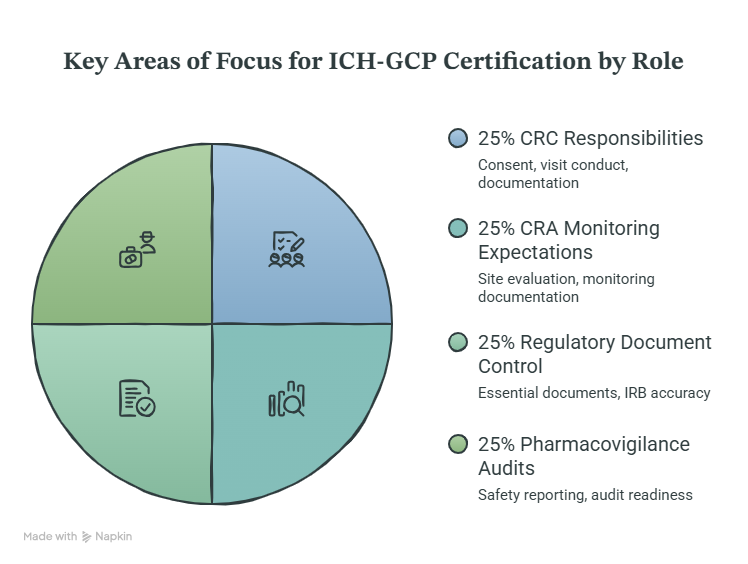
Choose an ICH-GCP certification by testing the course against the job you want. If you want a CRC role, the course should strengthen consent, visit conduct, source documentation, subject safety, and coordinator-sponsor communication. If you want a CRA role, it should support site evaluation, monitoring documentation, risk-based thinking, follow-up letters, and issue escalation. If you want regulatory or safety roles, it should help with essential documents, IRB-facing accuracy, AE logic, safety reporting, and audit readiness. Match the certificate to CRC responsibilities, CRA monitoring expectations, regulatory document control, pharmacovigilance audits, and clinical trial safety monitoring.
The course should also prepare you for modern trial realities. In 2026-27, GCP competence involves more than paper binders and traditional monitoring visits. Candidates should understand electronic systems, audit trails, remote data review, hybrid trial elements, decentralized touchpoints, data privacy expectations, risk-based quality controls, and proportional documentation. This is where studying virtual clinical trials, clinical trial technology innovations, risk-based monitoring strategies, global regulatory guidelines, and quality management strategies gives your certification practical weight.
Avoid choosing a course only because it is fast. Speed helps when the training is focused, structured, and scenario-based. Speed hurts when it leaves you unable to explain what happens after a missed visit window, a late lab review, a mislabeled specimen, an unreported hospitalization, or a monitor finding that keeps repeating. The right certificate should make your answers sharper in interviews, your daily work cleaner at sites, and your judgment safer around participants. That is why serious learners should study protocol deviation corrective actions, SAE reporting procedures, clinical trial amendments, and data integrity responsibilities.
5. A Practical 30-Day Arkansas ICH-GCP Study and Career Plan
Use the first week to build your GCP foundation around participant protection. Study informed consent, investigator oversight, IRB approval, protocol compliance, confidentiality, safety reporting, and essential documentation. Then write a one-page “GCP decision sheet” that explains what you would do when consent is late, eligibility is unclear, an AE is discovered, or a study visit falls outside the window. Support that sheet with GCP patient safety principles, investigator responsibilities, adverse event reporting, protocol deviation handling, and GCP compliance self-assessment.
Use the second week to learn trial documentation. Create sample source notes for screening, consent, baseline visit, AE follow-up, missed procedure, and phone contact. Build a mini regulatory binder index with training logs, delegation logs, IRB approvals, protocol versions, investigator CVs, lab documents, correspondence, and monitoring letters. This makes your certification visible because employers can see how you think. Pair your practice with clinical trial start-up tools, site monitoring visit preparation, clinical trial data review, and project close-out procedures.
Use the third week to connect GCP to the role you want in Arkansas. CRC candidates should practice patient scheduling, retention calls, visit checklists, and deviation prevention. CRA candidates should practice monitoring observations, follow-up letter language, source verification logic, and risk ranking. Regulatory candidates should practice document version control and approval tracking. Safety candidates should practice AE narratives and SAE escalation. Project candidates should practice timeline tracking and stakeholder communication. Strengthen this week with patient retention strategies, remote monitoring mastery, pharmacovigilance best practices, project milestone management, and clinical trial leadership essentials.
Use the fourth week to turn certification into job-market proof. Update your resume with specific GCP skills instead of a vague training line. Add bullets around informed consent support, source documentation, AE awareness, protocol deviation control, regulatory file maintenance, query response, and monitoring readiness. Prepare five interview stories using the structure: issue, risk, action, documentation, prevention. Then network through clinical research professional associations, explore online clinical research communities, compare clinical research salaries, review certificate program options, and map your next step through clinical research career opportunities.
6. FAQs About ICH-GCP Certification in Arkansas
-
Many Arkansas research roles expect GCP training because it shows you understand participant protection, protocol compliance, documentation, safety reporting, and investigator oversight. Requirements can depend on employer, sponsor, study type, and funding source, so the smarter move is to treat certification as baseline proof rather than a final qualification. Pair it with Arkansas clinical research certification guidance, GCP investigator responsibilities, patient safety principles, and site monitoring preparation.
-
Many learners can complete basic GCP training quickly, but real career readiness takes longer because you need scenario practice. A practical target is 30 days: one week for GCP principles, one week for documentation, one week for role-specific workflows, and one week for resume and interview proof. The goal is to speak clearly about SAE reporting, protocol deviations, clinical trial amendments, and clinical trial data integrity.
-
Certification helps you enter the conversation, but hiring teams usually want proof that you can apply GCP under pressure. For CRC roles, build examples around consent, visits, documentation, retention, and deviations. For CRA roles, build examples around monitoring, risk, source review, and follow-up. Use CRC retention strategies, CRA risk-based monitoring, remote monitoring techniques, and clinical trial data review to build stronger interview stories.
-
Healthcare workers should study the points where clinical care and research rules diverge. Focus on informed consent timing, protocol-required procedures, visit windows, eligibility criteria, documentation standards, AE capture, investigational product control, and sponsor communication. Your clinical background becomes more valuable when you can connect it to GCP compliance, site operations oversight, clinical trial safety monitoring, and collaboration strategies for research assistants.
-
The biggest mistake is listing the certificate without showing operational judgment. Employers want to know how you would handle a late consent issue, missing source, unresolved query, repeat deviation, SAE escalation, monitoring finding, or outdated protocol version. Turn the certificate into proof by practicing deviation corrective actions, quality management strategies, clinical trial sponsor communication, and regulatory guideline awareness.
-
Write resume bullets around actions and risk control. Use phrases such as informed consent support, source documentation review, AE awareness, deviation tracking, regulatory binder maintenance, query response, protocol version control, monitoring readiness, and participant safety. Add a small project portfolio if you are entry-level: sample source notes, a mock delegation log, a deviation/CAPA example, and a monitoring readiness checklist. Strengthen your positioning with training resource directories, career opportunity mapping, salary comparison tools, and professional association networking.
