The Ultimate Guide to Getting Your Good Clinical Practice (ICH-GCP) Certification in Oregon: Everything You Need to Know in 2026-27
Oregon clinical research rewards people who can protect participants, document cleanly, manage remote workflows, and keep trials inspection-ready under pressure. A strong Good Clinical Practice certification, practical clinical research certification in Oregon, and sharp command of ethical conduct and patient safety can help you compete for CRC, CRA-track, regulatory, safety, data, and site operations roles across Oregon’s research ecosystem.
For 2026-27, ICH-GCP training deserves extra attention because ICH E6(R3) modernizes GCP around risk-proportionate quality, participant safety, reliable data, and technology-enabled trial conduct, while FDA has also announced final E6(R3) Good Clinical Practice guidance for industry.
1. Why ICH-GCP Certification Matters in Oregon in 2026-27
Oregon candidates need ICH-GCP certification because clinical research hiring has moved beyond basic interest. Employers want people who understand investigator responsibilities, protocol deviations, serious adverse event reporting, clinical trial data integrity, and GCP monitoring techniques well enough to reduce risk from the first week on the job.
Oregon’s research environment includes academic medicine, specialty clinics, community hospitals, decentralized follow-up, patient registries, rural access challenges, and sponsor-driven timelines. OHSU lists actively recruiting studies through its clinical studies platform, and Providence describes clinical trials as studies designed to answer questions about safety and effectiveness through collaboration with patients and healthy volunteers. That makes practical knowledge of patient education resources, patient retention strategies, site monitoring visits, remote and on-site monitoring, and clinical trial start-up activities highly valuable.
The hidden pain point for many Oregon applicants is that they finish GCP training and still sound generic in interviews. They say they know “ethics” and “compliance,” while hiring managers listen for consent version control, visit-window discipline, source-to-EDC traceability, AE triage, delegation boundaries, IP accountability, deviation prevention, CAPA strength, and sponsor communication. That is why certification should connect directly to clinical trial data review, risk-based monitoring, quality management strategies, trial amendments, and GCP compliance self-assessment.
A strong Oregon pathway also helps people outside traditional research backgrounds. Nurses can translate patient safety into adverse event reporting compliance, pharmacy professionals can show investigational product discipline, public health graduates can support recruitment and retention, administrative professionals can manage essential documents, and data-focused candidates can build clean query habits. The right GCP plan ties these backgrounds to clinical trial safety monitoring, clinical trial templates, clinical research career opportunities, and CCRPS vs ACRP vs SOCRA comparisons.
| # | Learner Profile | Best Oregon Career Target | GCP Skill to Master | Proof to Build After Certification |
|---|---|---|---|---|
| 1 | New graduate in biology, psychology, public health, or health sciences | Clinical research assistant | Participant protection and consent basics | Mock informed consent checklist with version-control notes |
| 2 | Nurse moving into research | Clinical research nurse | AE reporting, SAE escalation, clinical follow-up | AE-to-SAE decision tree with reportability prompts |
| 3 | Medical assistant or LPN | CRC assistant | Visit flow, source documentation, protocol schedule discipline | Visit-window tracker tied to site monitoring visit expectations |
| 4 | Pharmacy technician or pharmacist | Investigational product support | IP accountability, storage logs, temperature excursions | IP accountability worksheet with deviation triggers |
| 5 | Public health professional | Recruitment and retention coordinator | Ethical outreach, consent comprehension, follow-up design | Recruitment script using patient education resources |
| 6 | Data entry or EHR specialist | Clinical data coordinator | Data review, query closure, audit trail awareness | Query response examples with source justification |
| 7 | Research assistant | Academic research coordinator support | Delegation logs, training files, IRB communication discipline | Regulatory binder index aligned with investigator responsibilities |
| 8 | Experienced CRC | Lead CRC | Deviation prevention, CAPA strength, sponsor escalation | CAPA template based on protocol deviation examples |
| 9 | CRC aiming for CRA roles | CRA trainee | Monitoring techniques, SDR/SDV judgment, issue aging | Mock monitoring follow-up letter |
| 10 | Remote-work seeker | In-house CRA or CTA | eTMF, tracker ownership, remote review, follow-up emails | Open-action tracker using remote monitoring logic |
| 11 | Quality or compliance specialist | Clinical quality associate | Quality management, root cause, risk controls | Risk register for enrollment, safety, consent, and data risks |
| 12 | Regulatory coordinator | Clinical regulatory specialist | Essential documents, approvals, amendments, version control | Submission tracker using clinical trial amendments |
| 13 | Hospital operations professional | Site operations coordinator | Site operations oversight and cross-functional ownership | Responsibility matrix for PI, sub-I, CRC, lab, pharmacy, imaging |
| 14 | Lab professional | Specimen processing coordinator | Protocol-specific sample timing, processing, shipping, documentation | Specimen workflow checklist with sample rejection triggers |
| 15 | Pharmacovigilance beginner | Drug safety associate | Safety monitoring, narratives, follow-up questions | SAE narrative outline with missing-information prompts |
| 16 | Audit or inspection support professional | Inspection readiness associate | Evidence traceability, document control, readiness files | Audit checklist using audit and inspection techniques |
| 17 | Project coordinator | Clinical trial project assistant | Milestones, escalation, vendor follow-up, meeting minutes | Timeline tracker based on clinical trial milestones |
| 18 | Finance or billing background | Clinical trial budget assistant | Visit billing evidence, invoice support, pass-through costs | Budget tracker using trial budget management |
| 19 | Physician practice manager | PI office research lead | Data integrity and PI oversight evidence | Monthly PI oversight note template |
| 20 | Admin career changer | Clinical trial assistant | Essential document filing, action items, study communication | eTMF filing map with naming conventions |
| 21 | Social worker or patient navigator | Participant support specialist | Retention risk, transportation barriers, informed communication | Retention map using CRC retention strategies |
| 22 | Technology or EDC user | EDC support specialist | Audit trails, access control, edit checks, query aging | Query aging dashboard with risk categories |
| 23 | Oncology clinic professional | Oncology CRC assistant | Eligibility precision, safety urgency, cycle-window adherence | Eligibility source checklist for inclusion/exclusion criteria |
| 24 | Cardiology, diabetes, neurology, or pulmonary clinic staff | Specialty trial coordinator | Endpoint consistency, labs, concomitant meds, device data | Endpoint collection checklist with source location map |
| 25 | Student seeking volunteer experience | Research intern | GCP vocabulary, confidentiality, protocol literacy | One-page study workflow summary and weekly learning log |
| 26 | Site leader preparing for sponsor feasibility | Feasibility and start-up contributor | Recruitment realism, staffing capacity, training readiness | Feasibility worksheet using start-up checklist logic |
| 27 | Professional comparing credentials | Best-fit certification decision | Role alignment, credential fit, applied competence | Comparison notes using CCRPS vs ACRP vs SOCRA |
| 28 | Oregon applicant targeting regional or remote roles | Hybrid CRC, CTA, or CRA-track candidate | Communication, documentation, remote follow-up, trial risk control | Portfolio page linking consent, safety, deviation, data, and monitoring samples |
2. What a Strong ICH-GCP Certification Should Teach Oregon Candidates
A high-value ICH-GCP certification should begin with the core promise of GCP: protect participants while producing credible clinical trial data. That foundation must cover ethical conduct and patient safety, investigator responsibilities, clinical trial sponsor roles, regulatory guidelines worldwide, and GCP compliance self-assessment through real operational scenarios.
The 2026-27 version of GCP training should also reflect the direction of ICH E6(R3), which encourages flexible, risk-based, proportionate approaches to clinical trial conduct, design, and technology use. FDA’s E6(R3) page also describes the guidance as embracing innovations in trial design, conduct, and technology. In practical terms, Oregon candidates should be able to identify which issues threaten safety, rights, primary endpoints, informed consent, or data reliability, then document escalation through risk-based monitoring strategies, quality management strategies, clinical trial data review, and remote monitoring visits.
Informed consent needs more than textbook coverage. A job-ready Oregon candidate can spot the errors that create findings: wrong consent form version, missing signature, consent after a research-only procedure, unclear interpreter documentation, missed re-consent after an amendment, vulnerable-population safeguards handled loosely, or a staff member obtaining consent outside delegated authority. Strengthen this area with patient education resources, trial amendment handling, protocol deviation corrective actions, and site monitoring visit preparation.
Safety reporting should feel clear before you touch a participant chart. The practical test is whether you can separate medical history, adverse event, serious adverse event, expected event, unrelated event, worsening baseline condition, protocol-defined endpoint, and urgent safety communication. Oregon sites may manage patients across academic centers, community practices, telehealth touchpoints, and outside emergency visits, so the safety trail must stay clean. Pair your GCP study with SAE reporting procedures, adverse event reporting compliance, clinical trial safety monitoring, and pharmacovigilance audit readiness.
Data integrity deserves the same seriousness. Hiring teams want candidates who understand source notes, EHR extracts, EDC entries, lab reports, eligibility worksheets, imaging reports, ePRO data, device data, audit trails, role permissions, and query responses. The question behind every data point is simple: can another qualified person reconstruct what happened? Build this skill through clinical trial data integrity, data review and verification skills, GCP monitoring techniques, and the directory of clinical trial templates.
3. How to Choose the Right ICH-GCP Certification Path in Oregon
Start with the role you want, then choose training that builds the exact evidence that role demands. A future CRC needs consent, visit scheduling, source, safety, retention, and deviation judgment. A future CRA needs monitoring language, SDV/SDR judgment, site communication, issue escalation, and CAPA review. A regulatory coordinator needs approvals, amendments, IRB files, essential documents, and version control. A safety candidate needs AE/SAE logic, narratives, timelines, and follow-up ownership. Use clinical research certification in Oregon, certificate program comparisons, clinical research professional associations, and free clinical research training resources.
Your best certification path should also fit Oregon’s geography and hiring reality. Portland-area academic and specialty research may expose you to complex protocols, while community and rural settings may demand stronger communication, retention, logistics, and participant follow-up skills. OHSU’s clinical trials page points people to study-specific contacts and ResearchMatch for research participation interest, which shows how participant connection and study navigation are part of the real ecosystem. Build your plan around patient retention strategies, clinical trial patient education resources, clinical trial start-up activities, and collaboration strategies for research assistants.
Avoid choosing a course only because it promises speed. Fast training helps only when the knowledge becomes interview evidence. Before applying, build a mini-portfolio with five assets: consent checklist, deviation/CAPA example, AE/SAE escalation map, query response sample, and monitoring follow-up letter. Those assets make your Good Clinical Practice certification in California, Good Clinical Practice certification in Idaho, Good Clinical Practice certification in Nevada, and Oregon-focused credential language stronger because they show applied competence.
The fastest path usually follows a sequence: learn GCP principles, translate them into role-specific tasks, create documentation samples, update your resume around risk reduction, and network with a specific ask. Use best online clinical research communities, the interactive clinical research career map, clinical research salary comparison, and clinical research certification in Oregon to make each step practical.
What is your biggest ICH-GCP career blocker in Oregon right now?
Choose one. Your answer points to the fastest practical fix.
4. Oregon Career Map: Where ICH-GCP Certification Turns Into Roles
Oregon’s clinical research career map includes academic medical centers, health systems, specialty practices, research institutes, sponsor vendors, CROs, and remote operations teams. OHSU’s trial listings and research volunteer pages show active study participation pathways and research support opportunities, while Providence describes research and clinical trials across medical and volunteer collaboration. For candidates, this means GCP training should connect directly to clinical research certification in Oregon, clinical trial patient education, site operations oversight, and clinical trial start-up activities.
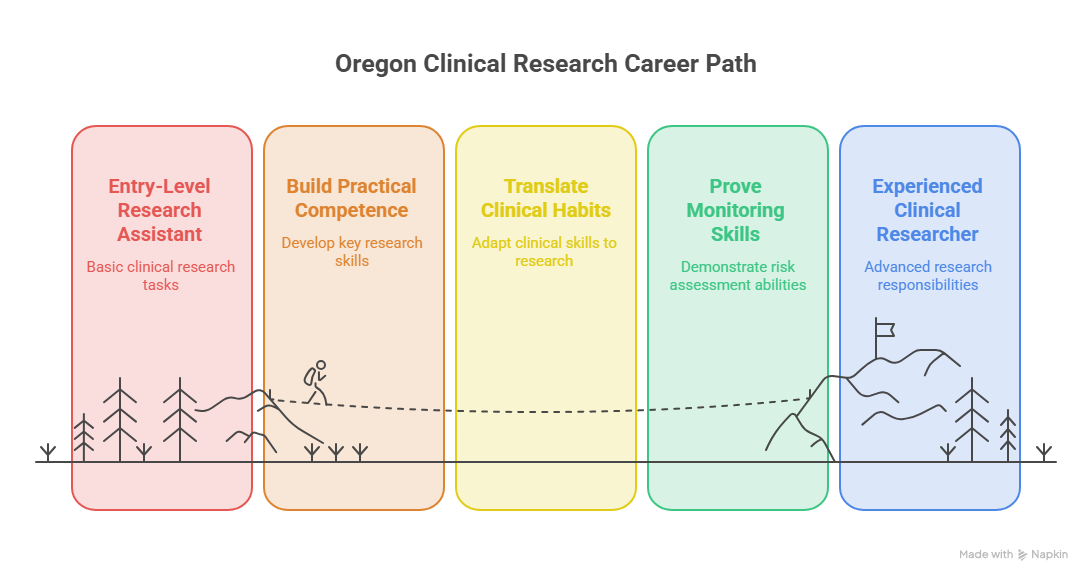
Entry-level Oregon roles often include clinical research assistant, CRC assistant, regulatory assistant, data coordinator, trial operations assistant, recruitment coordinator, and clinical trial assistant. These roles reward practical competence: keeping visit schedules clean, preparing source documents, maintaining regulatory binders, tracking training, logging action items, supporting recruitment, and routing safety concerns quickly. Build that competence with collaboration and communication strategies, site monitoring visit preparation, patient retention strategies, and clinical trial budget management.
Clinical professionals can move faster because they already understand patient care. The challenge is translating clinical habits into research-compliant documentation. A nurse should show safety follow-up and AE/SAE judgment. A pharmacist should show IP accountability and storage control. A lab professional should show specimen timing, shipping, and chain-of-custody discipline. A public health worker should show ethical recruitment and retention awareness. Strengthen those claims with SAE reporting procedures, adverse event reporting compliance, clinical trial safety monitoring, and patient education resources.
For CRA-track and remote roles, Oregon candidates need to prove they can think like monitors and trial operations teams. That means spotting source gaps, documenting issue history, aging action items, communicating without vague emails, and understanding when risk belongs at site, sponsor, monitor, PI, or vendor level. Build this through remote and on-site monitoring, risk-based monitoring strategies, clinical trial data review, project milestone management, and clinical trial sponsor responsibilities.
5. A 30-Day Oregon ICH-GCP Study and Portfolio Plan
Use days 1-7 to master the GCP foundation. Study participant rights, informed consent, investigator responsibilities, sponsor responsibilities, IRB/ethics review, protocol compliance, essential documents, and trial oversight. Then create a one-page responsibility map showing what the PI, sub-investigator, CRC, monitor, sponsor, IRB, pharmacy, lab, imaging team, and participant each own. Support the work with investigator responsibilities under GCP, clinical trial sponsor roles, ethical conduct and patient safety, and clinical research regulatory guidelines.
Use days 8-14 to practice documentation. Create a mock informed consent checklist, delegation log review, visit-window tracker, protocol deviation worksheet, and CAPA response. Each document should show decision logic, evidence needed, responsible owner, escalation path, and prevention step. This is where GCP becomes employable because you prove you can prevent small errors from becoming inspection findings. Use protocol deviation corrective actions, clinical trial templates, site monitoring visit steps, and the GCP compliance self-assessment tool.
Use days 15-21 for safety and data. Build an AE/SAE decision tree, mock SAE narrative outline, source-to-EDC traceability example, query response sample, and missing-data follow-up note. Treat each artifact like something a coordinator, CRA, data manager, or safety associate would review. Study SAE reporting procedures, adverse event reporting compliance, clinical trial safety monitoring, clinical trial data integrity, and clinical trial data review.
Use days 22-30 to turn certification into job momentum. Rewrite your resume bullets around risk reduction: “tracked consent version control,” “prepared source documentation for monitoring,” “supported visit-window compliance,” “maintained essential document readiness,” “answered EDC queries with source rationale,” or “created safety follow-up tracker.” Then build an employer and networking list using clinical research career opportunities, clinical research salary comparison, clinical research networking communities, and clinical research professional associations.
Your outreach should prove seriousness in one sentence. Try this: “I completed GCP training and built sample tools for consent tracking, deviation triage, AE/SAE escalation, query documentation, and monitoring follow-up.” That sentence gives a site manager, recruiter, coordinator, or CRA a reason to keep reading because it speaks in trial-risk language. Keep improving through free clinical research training resources, certificate program comparisons, CRA monitoring mastery, and clinical research certification in Oregon.
6. FAQs About ICH-GCP Certification in Oregon
-
ICH-GCP certification gives you the foundation, while job-ready proof helps you win interviews. Build a portfolio with a consent checklist, deviation/CAPA sample, AE/SAE escalation map, source documentation sample, and query-response example. Pair your training with clinical research certification in Oregon, site monitoring visit knowledge, protocol deviation management, and clinical trial data integrity.
-
Start with participant protection, informed consent, investigator responsibilities, sponsor responsibilities, protocol compliance, documentation standards, safety reporting, and data integrity. Then study risk-based monitoring, quality management, remote review, and decentralized follow-up. Use ethical conduct and patient safety, investigator responsibilities under GCP, clinical trial sponsor roles, risk-based monitoring, and quality management strategies.
-
ICH E6(R3) strengthens the move toward risk-proportionate quality, flexible trial conduct, technology-aware systems, and reliable data generation. FDA’s E6(R3) final guidance page describes flexible, risk-based approaches and innovation in trial design, conduct, and technology. For Oregon candidates, that means training should connect to remote monitoring visits, clinical trial data review, GCP compliance self-assessment, and regulatory guidelines worldwide.
-
CRC assistant, clinical research coordinator, clinical research nurse, regulatory coordinator, data coordinator, clinical trial assistant, recruitment coordinator, quality associate, in-house CRA, and CRA trainee roles all benefit. Nurses should lean into adverse event reporting and SAE procedures, admin candidates should lean into clinical trial start-up, and data candidates should lean into data review and verification.
-
Yes. Remote and hybrid clinical research roles value documentation discipline, eTMF awareness, query management, issue tracking, action-item follow-up, and risk-based communication. Build proof around monitoring follow-up letters, query responses, open-action trackers, and source-to-EDC logic. Study remote and on-site monitoring visits, GCP monitoring techniques, risk-based monitoring strategies, and clinical trial data review.
-
A beginner can stand out by creating evidence that mirrors real trial work: a regulatory binder index, informed consent checklist, visit-window tracker, deviation report, SAE decision tree, and participant follow-up script. Add a short explanation of how each tool protects participants, reduces site risk, or supports reliable data. Use clinical trial templates, patient education resources, clinical trial start-up activities, and CRC retention strategies.
