The Ultimate Guide to Getting Your Good Clinical Practice (ICH-GCP) Certification in Nevada: Everything You Need to Know in 2026-27
Nevada clinical research candidates in 2026-27 need more than a certificate line; they need proof that they can protect participants, prevent documentation gaps, and think clearly under site pressure. ICH E6(R3) reached Step 4 in 2025, FDA’s E6(R3) GCP guidance was issued in September 2025, and NIH confirms that GCP training consistent with ICH E6(R3) meets NIH expectations.
For Nevada candidates targeting CRC, CRA, regulatory, data, safety, or trial operations roles, Good Clinical Practice training, clinical research certification in Nevada, investigator responsibilities under GCP, ethical trial conduct, and site monitoring visit preparation can turn “I am certified” into “I am ready to work.”
1. Why ICH-GCP Certification Matters for Nevada Clinical Research Careers
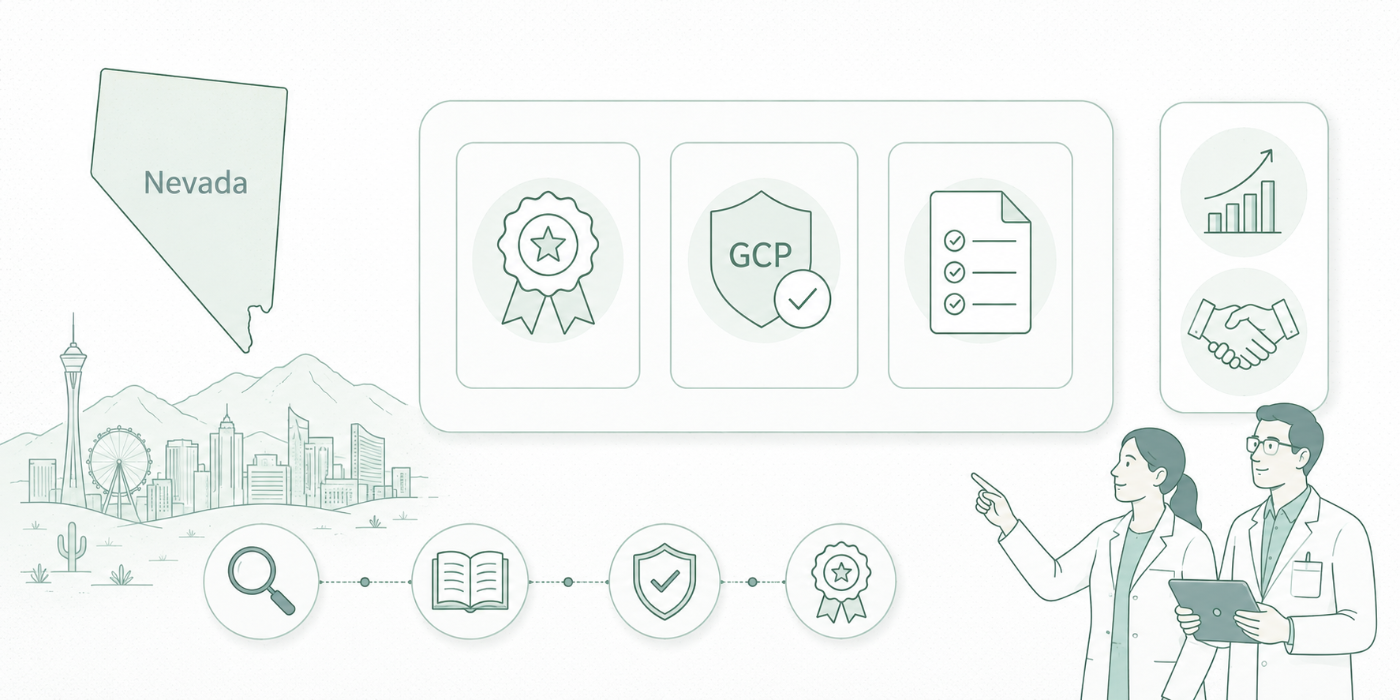
ICH-GCP certification matters in Nevada because clinical research hiring is increasingly built around risk. Sites, sponsors, CROs, hospitals, and research networks need staff who understand informed consent, source documentation, participant safety, delegation, protocol adherence, safety reporting, and data credibility. A candidate who can speak about protocol deviations, serious adverse event reporting, clinical trial amendments, clinical trial sponsor responsibilities, and clinical trial data integrity instantly sounds safer to hire.
Nevada also attracts candidates from healthcare, hospitality, administration, pharmacy, public health, data, and patient-facing work who want to enter clinical research without wasting months applying blindly. ICH-GCP gives these candidates a shared operating language: participant rights, investigator oversight, monitoring, documentation, safety escalation, and quality management. The strongest candidates connect certification to practical skills through risk-based monitoring strategies, GCP monitoring techniques, clinical trial data review, quality management strategies, and clinical research career opportunities.
The painful part is that many candidates finish GCP training and still sound vague in interviews. They say they understand compliance, yet struggle when asked what they would do if a participant signed the wrong consent version, a lab result appeared after the investigator left, a monitor identified repeated late signatures, or an SAE was reported late. That gap can cost interviews. Strong preparation means turning adverse event reporting, handling protocol deviations for CRCs, remote and on-site monitoring, clinical trial templates, and GCP compliance self-assessment into scenario-ready proof.
| Candidate Situation | Nevada Career Use Case | GCP Skill to Prove | Best CCRPS Resource to Pair With It |
|---|---|---|---|
| New graduate entering clinical research | Research assistant, clinical trial assistant, site support | Consent basics, documentation habits, participant protection | Nevada clinical research certification |
| Healthcare worker switching careers | CRC, patient recruitment, hospital trial support | Protocol adherence, visit timing, safety escalation | patient retention strategies |
| Medical assistant moving into trials | Patient-facing CRC assistant or research coordinator pathway | Source note accuracy, vitals documentation, visit flow | site monitoring visit preparation |
| Research nurse candidate | Patient visits, safety follow-up, protocol procedures | AE documentation, consent protection, escalation timing | adverse event reporting compliance |
| Aspiring Clinical Research Coordinator | Site operations roles in private sites or hospital programs | Source documentation, delegation logs, query response | handling protocol deviations |
| Current CRC seeking promotion | Lead CRC, site supervisor, startup coordinator | Deviation prevention, audit readiness, enrollment quality | CRC budget management |
| Aspiring CRA | Monitoring roles with CROs, sponsors, or regional site networks | SDV, SDR, issue escalation, site communication | risk-based monitoring mastery |
| Entry-level CRA candidate | Bridge from CRC, CTA, data, or research assistant work | Monitoring notes, follow-up letters, CAPA awareness | remote and on-site monitoring |
| Clinical trial assistant | TMF support, tracker maintenance, sponsor communication | Essential document completeness and inspection readiness | clinical trial templates directory |
| Regulatory affairs beginner | IRB packets, startup documents, amendment tracking | Version control, approval timing, document discipline | clinical trial amendments |
| Data coordinator | EDC support, query management, database lock support | ALCOA-C, source consistency, audit trail awareness | clinical trial data review |
| Pharmacovigilance candidate | Safety associate, case processor, trial safety support | AE/SAE seriousness, expectedness, follow-up | pharmacovigilance best practices |
| Quality assurance candidate | Internal audits, SOP support, CAPA documentation | Root cause thinking, corrective action evidence | clinical research quality management |
| Project management track candidate | Study coordination across timelines, vendors, and deliverables | Milestone tracking, issue logs, risk prioritization | clinical trial timelines |
| Principal investigator support staff | Investigator office, academic team, private practice trial support | PI oversight, delegation, safety accountability | investigator responsibilities under GCP |
| Candidate targeting sponsor roles | Clinical operations associate, vendor support, trial manager assistant | Sponsor oversight, quality systems, vendor accountability | clinical trial sponsor roles |
| Candidate with pharmacy background | Investigational product accountability and pharmacy trial support | IP storage, dispensing records, temperature excursions | GCP monitoring techniques |
| Candidate with lab background | Specimen processing, central lab coordination, biosample tracking | Chain of custody, lab manual compliance, deviation prevention | protocol deviation examples |
| Remote clinical research candidate | Remote CTA, data review, site support, monitoring assistant roles | Remote documentation, EDC discipline, escalation notes | remote monitoring mastery |
| Career changer from administration | Clinical trial assistant or research operations support | Tracker accuracy, meeting minutes, document version control | research assistant communication |
| Candidate targeting oncology trials | High-complexity site roles with stricter safety demands | Eligibility evidence, safety reporting, visit timing | oncology clinical research resources |
| Candidate targeting decentralized trials | Hybrid visits, remote data capture, telehealth trial support | Remote consent awareness, vendor documentation, eSource habits | virtual clinical trials |
| Study startup candidate | Feasibility, activation, IRB packet coordination | Startup sequencing, approval tracking, site readiness | startup checklist generator |
| Candidate preparing for interviews | CRC, CTA, CRA, regulatory, data, and safety interviews | Scenario answers tied to GCP judgment | certificate programs compared |
| Candidate building a portfolio | Proof-based job applications and stronger networking | Mock logs, checklists, query examples, deviation summaries | GCP compliance self-assessment |
| Candidate planning salary growth | Move from entry roles into CRC, CRA, QA, PM, or regulatory tracks | Role-specific proof and continuous compliance learning | clinical research salary tool |
| Candidate trying to network smarter | Referrals, informational interviews, community visibility | Sharing practical GCP lessons without confidentiality risk | clinical research communities |
2. Who Should Get ICH-GCP Certified in Nevada?
ICH-GCP certification is useful for anyone involved in trial conduct, participant interaction, regulatory coordination, clinical data, safety reporting, monitoring, site operations, or sponsor oversight. That includes clinical research coordinators, clinical trial assistants, research nurses, CRAs, regulatory assistants, data coordinators, safety associates, quality staff, project coordinators, and investigators. Nevada candidates should connect clinical research certification in Nevada, GCP compliance training, clinical research assistant communication, free clinical research training resources, and clinical research professional associations to one target role.
CRC-track candidates should use ICH-GCP to prove that they can manage site pressure without creating preventable risk. That means knowing visit windows, informed consent support, AE documentation, EDC query response, source note quality, sponsor communication, participant retention, and monitoring visit preparation. Nevada candidates entering this lane should study site monitoring visits, effective patient retention, clinical trial budget management, handling protocol deviations, and adverse event reporting compliance.
CRA-track candidates need to translate GCP into monitoring judgment. A hiring manager wants to know whether you can spot risk patterns, review source data, identify missing evidence, write useful follow-up, communicate with site staff, and separate isolated mistakes from systemic quality problems. Your training should connect risk-based monitoring strategies, remote and on-site monitoring, clinical trial data review, conducting investigator meetings, and CRA exam time management to practical monitoring examples.
Regulatory, safety, data, and project-management candidates should use ICH-GCP to show that they understand the full trial system. Regulatory work demands version control, amendment tracking, IRB documentation, approval timing, and essential-document discipline. Safety work demands AE/SAE seriousness, expectedness, causality, follow-up, and reporting awareness. Data work demands source consistency, query discipline, audit trails, and database lock readiness. Project support demands timelines, vendor awareness, issue tracking, and quality planning. Build this foundation through clinical trial amendments, IND application basics, pharmacovigilance best practices, clinical trial data integrity, and clinical trial timelines.
3. What Your ICH-GCP Training Should Teach in 2026-27
Strong ICH-GCP training should teach judgment, documentation, escalation, and prevention. Definitions help with an exam, while workplace readiness comes from knowing how GCP applies when a visit runs late, a participant reports a symptom after leaving, a consent form changes, a sponsor asks for missing evidence, or a monitor identifies repeated errors. FDA describes E6(R3) updates as supporting modern trial designs, data sources, technology, quality by design, risk-based quality management, clarified responsibilities, proportionality, relevance, and critical thinking. Candidates should connect that direction with patient safety principles, investigator oversight, clinical trial safety monitoring, quality management strategies, and sponsor responsibilities.
Modern Nevada trial teams may deal with hybrid visits, electronic consent, telehealth follow-ups, EDC queries, ePRO tools, remote monitoring, wearable data, decentralized trial elements, and vendor-managed platforms. Strong GCP training should help you ask better questions: Who is responsible? What is the critical data? What threatens participant safety? What threatens data credibility? What evidence needs to exist? What must be escalated? These questions connect virtual clinical trials, clinical trial technology innovations, interactive startup checklists, clinical trial sample size tools, and clinical trial cost estimation to real operational thinking.
The most valuable learning happens when you practice failure modes. A participant signed the previous consent version. A lab kit expired. A temperature excursion occurred. An AE was mentioned in a follow-up call and documented late. A query was answered without enough source support. A visit was completed outside the protocol window. A delegation log was incomplete. Each case tests whether you understand participant protection, source credibility, escalation, correction, and prevention. Build examples from SAE reporting procedures, protocol deviation corrective actions, clinical trial templates, GCP compliance self-assessment, and project close-out procedures.
What is your biggest ICH-GCP certification blocker in Nevada right now?
4. How to Turn ICH-GCP Certification Into Nevada Job-Ready Proof
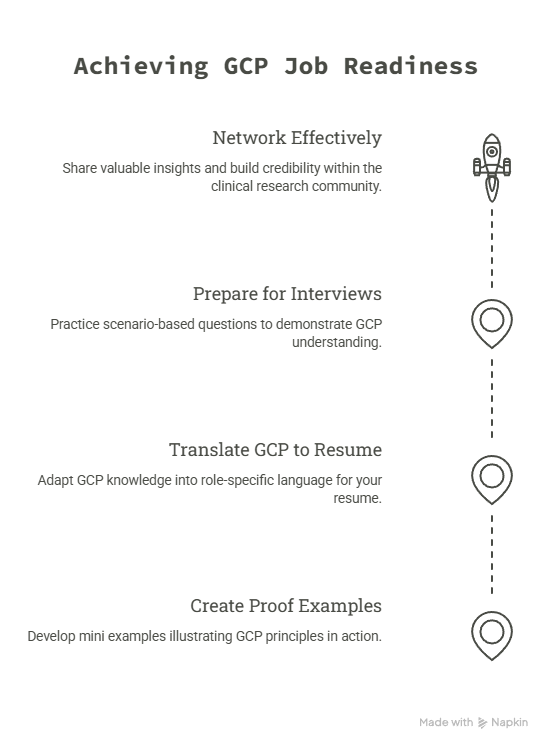
A certificate becomes powerful when you can explain what it helps you prevent. Nevada hiring teams want fewer avoidable errors, cleaner source documentation, safer participant interactions, stronger query responses, better visit readiness, and staff who know when to escalate. After finishing certification, create five mini proof examples: informed consent risk, eligibility risk, AE/SAE risk, protocol deviation risk, and data integrity risk. Build those examples with adverse event reporting, SAE reporting procedures, protocol deviation examples, clinical trial data integrity, and GCP monitoring skills.
Your resume should translate GCP into role-specific language. For a CRC role, highlight informed consent support, visit windows, participant communication, source documentation, AE escalation, and monitoring visit readiness. For a CRA role, highlight source review, risk identification, site follow-up, action-item tracking, and monitoring communication. For regulatory roles, highlight IRB support, essential documents, amendments, version control, and approval tracking. Use site monitoring visit preparation, risk-based monitoring, clinical trial amendments, templates and SOP resources, and clinical research professional associations.
Interview preparation should be scenario-heavy. Prepare clear answers for: “What would you do if a participant signed the wrong consent version?” “How would you respond if an SAE was reported late?” “How would you handle repeated protocol deviations?” “What would you check before a monitoring visit?” “How would you explain GCP to a new site team member?” Strong answers should include participant safety, documentation accuracy, protocol respect, escalation pathway, and prevention. Review ethical conduct, investigator responsibilities, quality management, clinical trial data review, and clinical research career opportunities.
Your networking should also become more precise. Posting “GCP certified and open to work” is weak because it gives hiring teams no proof of judgment. Posting a useful lesson about preventing consent version errors, preparing for a monitoring visit, responding to queries, organizing a deviation log, or documenting participant contact creates a stronger signal. Use online clinical research communities, clinical research professional associations, free webinars and training resources, certificate program comparisons, and clinical research salary planning to build visible credibility.
5. Nevada Career Strategy After ICH-GCP Certification
Nevada candidates should choose a role cluster before applying widely. Site operations candidates should focus on patient scheduling, consent support, visit windows, source notes, retention, deviations, and monitoring preparation. Monitoring candidates should focus on source review, risk patterns, site communication, follow-up letters, and escalation. Regulatory candidates should focus on IRB packets, consent versions, essential documents, amendments, and approvals. Safety candidates should focus on AE/SAE logic, timelines, narratives, follow-up, and compliance. Build the plan with clinical research certification in Nevada, patient retention strategies, remote monitoring mastery, regulatory affairs mastery, and pharmacovigilance audits.
A practical 90-day plan works better than scattered applications. In the first 30 days, complete ICH-GCP certification, study core trial roles, and rewrite your resume around trial-relevant proof. In days 31-60, practice scenario answers, create a mini portfolio, and apply to roles that match one clear lane. In days 61-90, network with site leaders, recruiters, CRAs, CRCs, regulatory professionals, and clinical operations staff while sharing useful, confidentiality-safe content. Support this plan through clinical trial startup tools, clinical trial project management, quality management strategies, clinical trial templates, and clinical research networking communities.
The strongest Nevada applicants also build a simple proof portfolio. Include a mock monitoring visit checklist, a sample deviation root-cause summary, a query response example, a consent version-control checklist, a safety reporting decision tree, and a short explanation of how GCP protects participants and data credibility. This gives employers evidence of judgment before they interview you. Use GCP compliance self-assessment, interactive startup checklists, clinical trial budget management, clinical trial data review, and project close-out procedures to make the portfolio more practical.
Application quality matters more than application volume. A CRC resume should show patient interaction, scheduling, protocol adherence, source documentation, EMR familiarity, and escalation. A CRA resume should show monitoring logic, source review, site communication, issue follow-up, and risk identification. A regulatory resume should show IRB documentation, amendments, essential documents, tracker discipline, and version control. A safety resume should show AE/SAE documentation, seriousness, expectedness, timelines, and follow-up. Build each version with Nevada clinical research certification guidance, pharmacovigilance best practices, clinical trial data integrity, sponsor responsibilities, and clinical research career opportunities.
6. FAQs About Getting ICH-GCP Certified in Nevada
-
Many Nevada clinical research employers prefer or require GCP training for roles involving participants, trial documentation, monitoring, regulatory work, data review, or safety reporting. Even when a job posting uses flexible language, certification helps prove that you understand participant protection, protocol compliance, source documentation, AE/SAE escalation, and audit readiness. Pair it with clinical research certification in Nevada, ethical conduct in GCP, investigator responsibilities, and GCP compliance self-assessment.
-
The biggest benefit goes to candidates entering CRC, CRA, CTA, regulatory, data, safety, research nurse, quality, and site operations roles. Career changers from healthcare, pharmacy, lab, public health, administration, and documentation-heavy backgrounds can use ICH-GCP certification to show clinical trial readiness. A smart plan connects site monitoring visits, clinical trial data review, pharmacovigilance best practices, and clinical research certification in Nevada.
-
Many candidates can complete focused ICH-GCP training quickly, while job readiness takes extra practice. Give yourself time to study consent, safety reporting, deviations, monitoring, source documentation, and inspection logic. After completion, spend another week building resume bullets, portfolio examples, and interview responses. Use protocol deviation corrective actions, SAE reporting procedures, clinical trial amendments, and clinical trial templates.
-
Study role-specific execution. CRC candidates should focus on visits, retention, source notes, consent support, and deviation prevention. CRA candidates should focus on monitoring, SDV/SDR, risk review, follow-up, and escalation. Regulatory candidates should focus on IRB submissions, amendments, essential documents, and approval tracking. Safety candidates should focus on AE/SAE logic. Start with patient retention strategies, risk-based monitoring, regulatory guidelines worldwide, and adverse event reporting compliance.
-
Place it near your clinical research skills, then support it with proof bullets. Add competencies such as informed consent support, source documentation, AE/SAE escalation, monitoring readiness, query management, protocol deviation prevention, and essential document awareness. Stronger bullets can come from clinical trial data integrity, GCP monitoring techniques, quality management strategies, and clinical research salary planning.
-
You can compete more effectively when the certificate is paired with transferable proof. Healthcare, pharmacy, lab, administrative, public health, hospitality, customer service, and documentation-heavy experience can translate well when connected to patient communication, confidentiality, accuracy, scheduling, compliance, and escalation. Strengthen your profile with clinical research certification Nevada guidance, research assistant communication strategies, free clinical research training resources, and clinical research career opportunities.
