The Ultimate Guide to Getting Your Good Clinical Practice (ICH-GCP) Certification in Pennsylvania: Everything You Need to Know in 2026-27
Pennsylvania is one of the strongest places to turn Good Clinical Practice training into real clinical research opportunity because the state has dense academic, hospital, oncology, transplant, device, and community trial activity. For candidates targeting clinical research certification in Pennsylvania, CRC roles, CRA pathways, or trial safety careers, ICH-GCP certification gives you the operating language employers expect before they trust you near consent, source data, safety reporting, or sponsor communication.
1. Why Pennsylvania Is a Serious Market for ICH-GCP Certification in 2026-27
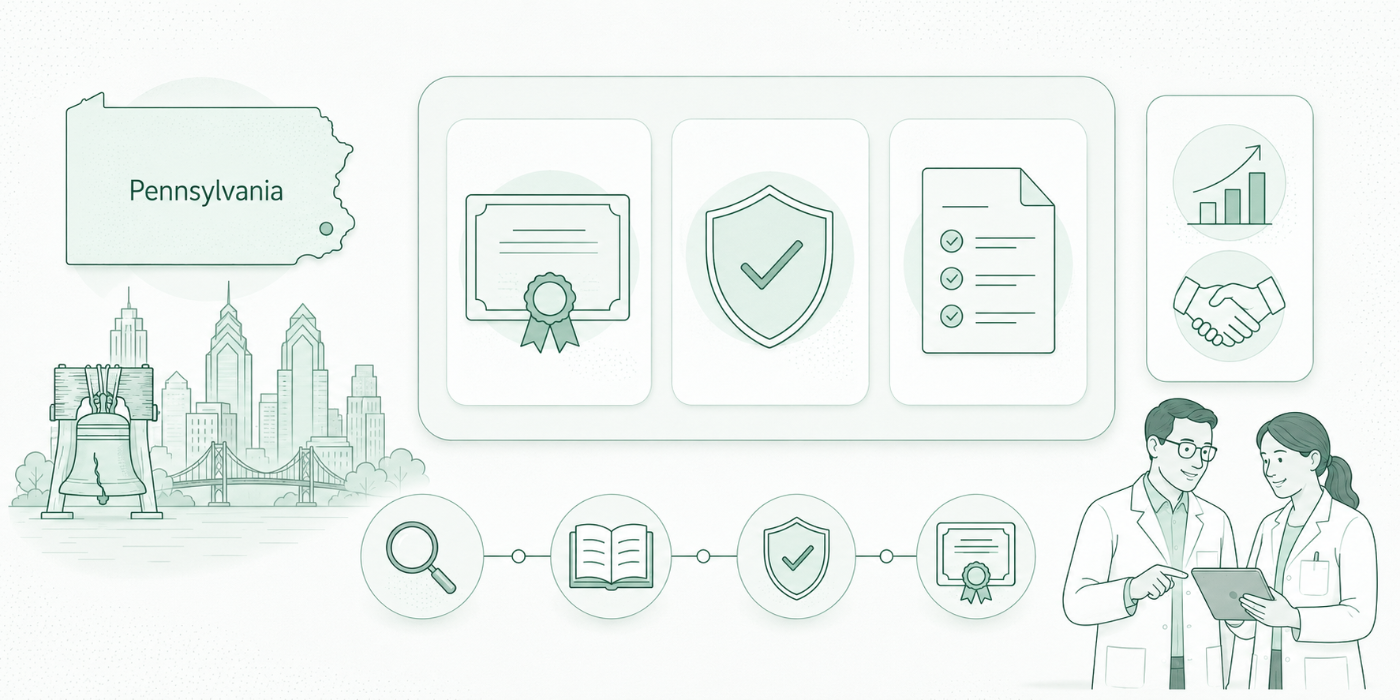
Pennsylvania gives clinical research candidates a valuable advantage: the state has multiple research-heavy ecosystems rather than one narrow job lane. Philadelphia has academic medicine, oncology, gene therapy, device research, rare disease work, and large hospital networks. Pittsburgh has major clinical trial infrastructure, transplant research, oncology, aging research, and university-affiliated research operations. Central Pennsylvania and surrounding regions add community-based trial sites, specialty practices, and hybrid trial roles that support patient recruitment, site documentation, trial startup, and GCP compliance. Penn Medicine describes its clinical trials as covering areas such as cancer, rare diseases, epilepsy, heart failure, and stroke, while its clinical research professionals page frames CRPs as integral members of the research team.
This makes ICH-GCP certification especially useful for Pennsylvania candidates because hiring teams need people who can enter a regulated environment with judgment. A strong applicant can explain informed consent timing, protocol-required assessments, source-to-EDC consistency, delegation boundaries, adverse event escalation, investigational product accountability, and inspection readiness. A weak applicant lists “GCP certified” and still struggles when asked what to do if a subject signs an outdated consent form, misses a safety lab, reports hospitalization, or has conflicting source data. The gap between those two candidates is where protocol deviation knowledge, SAE reporting skill, investigator responsibility training, and clinical trial data integrity start paying off.
ICH-GCP also matters more in 2026-27 because clinical trials keep moving toward risk-based oversight, remote components, electronic systems, decentralized workflows, and faster documentation expectations. FDA’s final E6(R3) Good Clinical Practice guidance, announced in September 2025, highlights flexible risk-based approaches and innovation in trial design, conduct, and technology. A Pennsylvania candidate who understands risk-based monitoring, trial technology innovations, remote monitoring visits, and quality management can speak to where the industry is heading instead of sounding trained for yesterday’s paper binder workflow.
The real pain point for many Pennsylvania applicants is visibility. They may have healthcare experience, science coursework, pharmacy exposure, nursing knowledge, public health education, lab experience, or administrative discipline, yet their resume fails to translate that background into regulated trial value. Certification helps when it becomes a bridge: healthcare experience becomes patient-facing visit readiness; lab experience becomes specimen handling accuracy; pharmacy experience becomes investigational product awareness; admin experience becomes regulatory file discipline; data entry experience becomes EDC query control. That translation is why clinical research certificate comparisons, free clinical research training resources, clinical trial templates, and career opportunity tools should sit beside your ICH-GCP certificate.
| Career Decision | What Pennsylvania Candidates Should Do | Failure Mode It Prevents | Best CCRPS Resource |
|---|---|---|---|
| GCP foundation | Complete ICH-GCP training before applying to CRC, assistant, regulatory, safety, or data roles. | Prevents a resume from sounding interested in research without trial conduct literacy. | GCP ethics and patient safety |
| Pennsylvania positioning | Connect your certificate to Pennsylvania’s hospital, oncology, academic, and site-network environment. | Prevents generic applications that could be sent to any state. | Pennsylvania clinical research certification |
| Entry-level CRC readiness | Study visit prep, screening, scheduling, source notes, EDC entry, query response, and patient follow-up. | Prevents “certified but lost on day one” performance. | site visit guide for coordinators |
| CRA bridge plan | Learn SDV, SDR, consent review, IP accountability, follow-up letters, and action item closure. | Prevents premature CRA applications with no monitoring vocabulary. | remote and on-site monitoring |
| Consent control | Build a consent checklist covering version, date, signature, timing, re-consent, and documentation. | Prevents one of the most damaging and visible compliance failures. | ethical conduct in GCP |
| Deviation response | Practice classifying deviations, documenting impact, escalating quickly, and proposing CAPA. | Prevents repeated errors being treated as isolated accidents. | protocol deviation examples |
| Safety reporting | Understand AE, SAE, expectedness, causality, follow-up information, and reporting pathways. | Prevents delayed escalation when participant protection is at stake. | SAE reporting procedures |
| Investigator oversight | Know what the PI may delegate and what remains under PI responsibility. | Prevents delegation logs from becoming misleading paperwork. | investigator responsibilities under GCP |
| Data integrity | Apply ALCOA-C thinking to source notes, corrections, EDC entries, and query responses. | Prevents “clean-looking” data from lacking reliable documentation support. | clinical trial data integrity |
| Regulatory file discipline | Learn essential documents, training logs, delegation logs, IRB approvals, and correspondence control. | Prevents panic when a sponsor, monitor, auditor, or inspector asks for evidence. | clinical trial templates |
| Startup support | Study activation tasks before first patient first visit: contracts, budgets, approvals, supplies, systems, and training. | Prevents candidates from thinking trials start when patients arrive. | trial startup checklist |
| Budget awareness | Understand visit payments, invoice triggers, screen failures, pass-throughs, and hidden site costs. | Prevents missed revenue and poor communication with finance teams. | CRC budget management |
| Patient retention | Build systems for reminders, transportation barriers, visit-window tracking, and participant burden reduction. | Prevents enrollment wins from becoming follow-up losses. | patient retention strategies |
| Risk-based oversight | Learn critical-to-quality factors, central monitoring signals, and issue prioritization. | Prevents box-checking behavior in modern monitoring environments. | risk-based monitoring strategies |
| Remote monitoring fluency | Understand document upload quality, remote source review limits, privacy, and follow-up discipline. | Prevents messy remote workflows that create avoidable action items. | GCP monitoring techniques |
| Technology confidence | Learn EDC, CTMS, eConsent, ePRO, eTMF, remote monitoring portals, and audit trails. | Prevents candidates from freezing when job descriptions mention multiple trial platforms. | trial technology innovations |
| IND awareness | Understand how investigational product, protocol, safety, and FDA communication connect. | Prevents fragmented thinking about sponsor-side trial controls. | IND application guide |
| Amendment control | Track protocol version changes, IRB approval, training, consent updates, and implementation dates. | Prevents teams from using expired procedures after protocol changes. | clinical trial amendments |
| Pharmacovigilance bridge | Use GCP knowledge to move toward safety intake, case processing, narratives, and signal support. | Prevents safety career applications from sounding disconnected from trial conduct. | pharmacovigilance best practices |
| Audit readiness | Keep every key claim backed by dated, attributable, complete, and retrievable documentation. | Prevents “we did it” from failing because proof cannot be produced. | audit and inspection techniques |
| Quality management | Use root-cause analysis and preventive controls for recurring issues. | Prevents surface-level fixes that allow the same deviation to happen again. | quality management strategies |
| Timeline ownership | Track startup, enrollment, monitoring, database lock, closeout, and document deadlines. | Prevents one missed handoff from delaying multiple departments. | trial timelines and milestones |
| Investigator meeting literacy | Learn agenda discipline, training evidence, action items, and sponsor-site communication. | Prevents meetings from becoming information dumps without accountable follow-through. | investigator meeting strategies |
| Closeout awareness | Study final accountability, open queries, document reconciliation, and long-term record retention. | Prevents study-end chaos that reveals years of weak tracking. | project closeout procedures |
| PI pathway awareness | Understand oversight, budget, data integrity, delegation, and site operations from the investigator side. | Prevents junior staff from missing why PI decisions shape site risk. | site operations oversight |
| IIT understanding | Learn how investigator-initiated trials differ from sponsor-led trials in support needs and responsibilities. | Prevents confusion when academic research teams run leaner workflows. | investigator-initiated trials |
| Career comparison | Compare CCRPS, ACRP, SOCRA, and role-specific certificates before buying extra credentials. | Prevents credential stacking without a hiring strategy. | certificate programs compared |
| Salary planning | Benchmark roles before accepting assistant, coordinator, data, safety, or regulatory offers. | Prevents underpricing yourself because an entry title sounds modest. | clinical research salary tool |
| Community strategy | Join clinical research groups with one concrete question and one useful contribution per week. | Prevents passive scrolling in noisy groups with little career return. | clinical research communities |
| Interview portfolio | Create a mini portfolio: consent checklist, deviation log, query example, AE escalation flow, and mock visit tracker. | Prevents the certificate from becoming your only proof of readiness. | GCP compliance self-assessment |
2. What ICH-GCP Certification Proves to Pennsylvania Employers
ICH-GCP certification proves value when it shows that you understand how trial decisions affect participant rights, data reliability, sponsor obligations, IRB expectations, and inspection outcomes. The ICH E6(R3) guideline describes Good Clinical Practice as an international ethical and scientific quality standard for designing, conducting, recording, and reporting trials involving human participants. In practical Pennsylvania hiring terms, your certificate should make you fluent in ethical conduct, human subject protection, site monitoring, and trial quality management.
Employers want to hear that you know the operational consequences behind the words. “Informed consent” means timing, comprehension, version control, voluntary participation, documentation, and re-consent when needed. “Source data” means the original evidence must support the data entered into the EDC. “Delegation” means training and authorization must match the task performed. “Deviation” means the study team must assess cause, impact, reporting requirement, and prevention. “Safety reporting” means participant protection moves faster than administrative convenience. These are the details that turn protocol deviation handling, SAE procedures, investigator responsibilities, and clinical data review into real job readiness.
For a Pennsylvania CRC candidate, ICH-GCP certification should support day-to-day site execution. That means preparing visits, checking eligibility, confirming protocol windows, handling subject questions within scope, routing medical decisions to qualified staff, maintaining clean source notes, resolving queries quickly, and tracking follow-up tasks. For a CRA candidate, it should support monitoring judgment: verifying consent, reviewing critical data, evaluating protocol compliance, following up on open issues, and communicating site risk clearly. For regulatory and safety candidates, it should support document control, adverse event intake, IRB submissions, training records, and inspection readiness. Each path needs CRC retention strategy, CRA monitoring mastery, regulatory affairs basics, and pharmacovigilance compliance.
Pennsylvania candidates also need to understand how large research systems create specialized roles. Penn Medicine’s Office of Clinical Research identifies support functions across finance, legal, operations, regulatory, and compliance, which reflects how many career lanes can sit behind a clinical trial beyond the visible coordinator role. That matters for job strategy because someone with strong organization skills may fit regulatory operations; someone with healthcare communication skills may fit coordination; someone with analytical discipline may fit data or quality; someone with pharmacy or nursing exposure may fit safety or investigational product workflows. Use clinical trial budget management, IND application guidance, trial amendment handling, and clinical research templates to identify the lane that matches your strongest transferable skills.
3. How to Choose the Right ICH-GCP Certification Path in Pennsylvania
Start with the role you want in the next six months, because a certificate without direction can scatter your energy. If your target is CRC, your learning should focus on participant visits, consent, eligibility, scheduling, documentation, EDC, queries, retention, and sponsor communication. If your target is CRA, your learning should focus on monitoring plans, source review, critical data, consent verification, deviation trends, IP accountability, follow-up letters, and risk escalation. If your target is safety or pharmacovigilance, focus on AE intake, seriousness criteria, causality language, narratives, timelines, follow-up, and signal awareness. Use Pennsylvania clinical research certification, CRA monitoring resources, pharmacovigilance best practices, and regulatory compliance training to avoid drifting across too many tracks.
The right certification path should cover both principles and scenarios. Principles tell you what GCP expects; scenarios show whether you can act under pressure. A good study plan should force you to answer situations like these: a patient signs the wrong consent version, a required lab is missed, a PI signature is pending, a subject reports an ER visit during a follow-up call, a coordinator enters EDC data before source is complete, a monitor asks for proof of training, or a sponsor issues an amendment that changes eligibility. These scenarios reveal whether you can connect clinical trial amendments, deviation CAPA, source documentation, and safety reporting into one controlled response.
Your training should also teach you how sponsors and sites think differently. Sites worry about patients, clinic flow, scheduling, source documentation, staff bandwidth, and visit windows. Sponsors worry about data quality, enrollment timelines, protocol compliance, regulatory commitments, safety signals, monitoring findings, and database lock. CRAs sit between those pressures. A Pennsylvania candidate who understands both sides can communicate more maturely in interviews. This is why trial sponsor responsibilities, site operations oversight, monitoring techniques, and project timeline management deserve space in your study plan.
The safest way to choose a program is to inspect what you will be able to say after completion. You should be able to explain ICH-GCP principles, consent protections, investigator responsibilities, essential documents, source data rules, safety reporting, deviations, monitoring, computerized systems, quality management, and inspection readiness. You should also leave with a practical output: a one-page GCP study sheet, a consent checklist, a deviation example, an AE escalation workflow, a mock query response, a visit tracker, and a resume-ready skills section. Pair your coursework with GCP self-assessment, trial startup tools, template directories, and free research training resources so your certificate creates proof instead of another line on your resume.
What is blocking your Pennsylvania ICH-GCP career move right now?
Choose one. Your answer reveals the fastest next step.
4. Pennsylvania Career Paths After ICH-GCP Certification
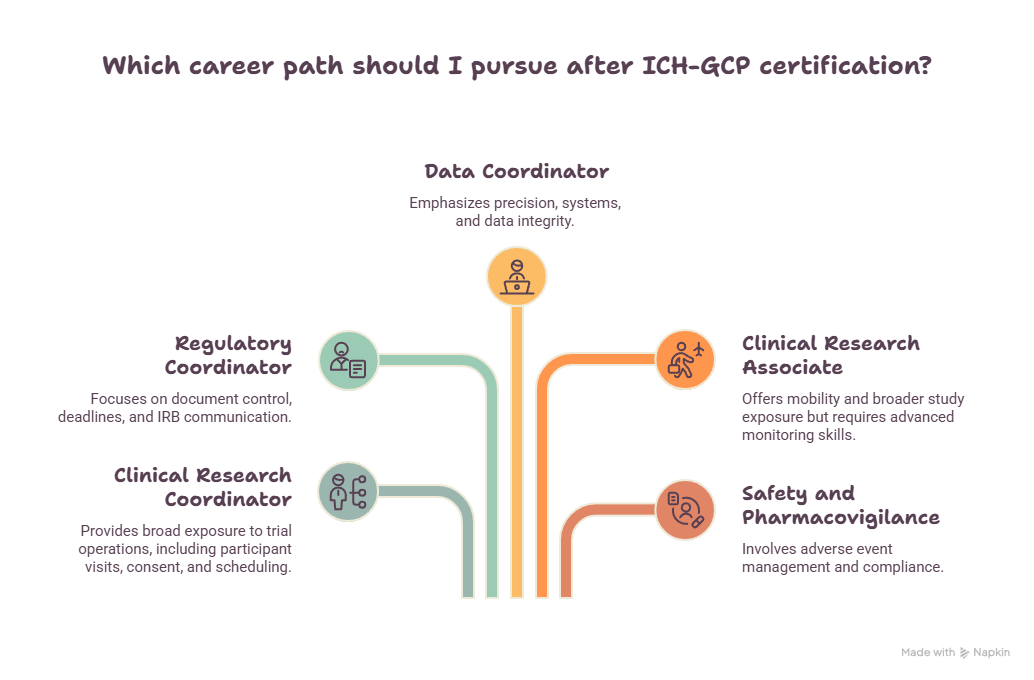
The best first career path after ICH-GCP certification is usually the role that lets you touch regulated trial operations quickly. Clinical Research Coordinator roles are often the strongest launchpad because they expose you to participant visits, consent, scheduling, source notes, EDC queries, sponsor communication, monitoring visits, and retention problems. Assistant CRC and research assistant roles can also be smart entry points when you need trial exposure before owning complex visits. A candidate who understands site monitoring visit expectations, patient retention pressure, CRC budget realities, and protocol deviation handling can interview with far more substance than someone who only says they are organized.
Philadelphia-area candidates can think broadly because large academic and health system environments often separate responsibilities into coordination, regulatory, data, finance, compliance, and study management functions. Pittsburgh-area candidates can also find major research infrastructure through UPMC and Pitt-connected clinical trial activity. UPMC Hillman Cancer Center says its researchers work with clinicians to move promising research into clinical trials, and Pitt’s Clinical Trials Office describes itself as a hub for coordinating clinical trials activity, compliance, and support for researchers and clinical staff. That kind of environment creates demand for people who understand trial startup, regulatory submissions, clinical trial timelines, and quality management.
Regulatory coordinator roles are excellent for candidates who like document control, deadlines, IRB communication, training evidence, essential documents, delegation logs, and amendment implementation. This pathway suits detail-driven applicants who may feel less drawn to direct patient visit coordination. ICH-GCP helps because regulatory teams must understand why documents exist, how version control protects participants, how training evidence supports delegation, and how approvals shape study conduct. Build this path with clinical trial amendments, IND application basics, trial sponsor responsibilities, and clinical research ethics resources.
Data coordinator and clinical data roles fit candidates who are comfortable with precision, systems, queries, reconciliations, and documentation traceability. These jobs reward people who can see how one inaccurate data point can distort eligibility, safety, endpoints, or database lock. ICH-GCP gives data candidates the quality language behind their work: attributable, legible, contemporaneous, original, accurate, complete, consistent, enduring, and available documentation. A strong data pathway should include clinical trial data review, data integrity responsibilities, trial technology innovations, and sample size or trial calculator literacy if you want to speak more confidently with study teams.
CRA roles are attractive because they offer mobility, broader study exposure, and sponsor/CRO visibility, yet they require more than basic GCP knowledge. A CRA needs to evaluate whether a site is protecting participants and producing reliable data. That means reading the protocol like a risk map, reviewing consent carefully, identifying repeat deviations, checking source-to-EDC consistency, escalating safety or compliance issues, and writing follow-up that leaves no ambiguity. Candidates moving from CRC to CRA should strengthen remote and on-site monitoring, risk-based monitoring mastery, investigator meeting strategy, and GCP monitoring techniques.
Safety and pharmacovigilance roles are another strong path for Pennsylvania candidates, especially those with healthcare, pharmacy, nursing, life sciences, or medical terminology exposure. These roles need judgment around adverse events, seriousness, expectedness, causality support, narratives, follow-up requests, reconciliation, signal detection, and inspection readiness. If you can explain how a site learns about an AE, how it is documented, when it escalates, and how safety teams process it, you sound far more credible. Build this path through pharmacovigilance safety monitoring, global PV compliance, PV audits and inspections, and adverse event reporting compliance.
5. The 30-60-90 Day Pennsylvania ICH-GCP Certification Plan
During days 1-30, focus on the foundation that every Pennsylvania research employer expects: ICH-GCP principles, informed consent, investigator responsibilities, protocol compliance, essential documents, source data, AE/SAE reporting, deviations, monitoring, computerized systems, and quality management. Your goal during this period is comprehension with recall under pressure. After each module, write one scenario question and answer it in plain operational language. For example: “A subject completed screening labs before consent was signed. What is the issue, who gets notified, how is it documented, and what prevention step follows?” Use GCP ethics, investigator responsibilities, SAE reporting procedures, and protocol deviation examples to build those answers.
By the end of the first month, create a one-page GCP command sheet. Include the rights and safety of participants, protocol adherence, qualified staff, adequate resources, documented training, consent requirements, source data reliability, timely safety reporting, essential document control, monitoring purpose, and CAPA thinking. This sheet becomes your interview prep document. It also stops you from sounding scattered when asked about GCP. Add practical references from GCP compliance self-assessment, clinical research ethics resources, clinical trial templates, and clinical trial patient education resources.
During days 31-60, convert your certificate into job evidence. Build a five-piece mini portfolio: a consent version-control checklist, a subject visit tracker, a mock source note, a deviation log with root cause and CAPA, and an AE escalation workflow. These samples should be simple, clean, and role-aware. The point is to show that you think in workflows. A hiring manager reviewing dozens of resumes may remember the candidate who can show a consent checklist and explain why version control prevents participant protection failures. Strengthen the portfolio with startup checklists, patient retention strategies, trial budget management, and project timeline management.
During this second month, rewrite your resume around risk control instead of task history. Replace generic statements with trial-relevant outcomes: “maintained accurate patient documentation,” “tracked follow-up requirements,” “coordinated time-sensitive records,” “supported compliant data entry,” “handled confidential health information,” “communicated with cross-functional teams,” and “resolved documentation discrepancies.” For healthcare workers, connect patient interaction to consent support and visit flow. For lab workers, connect specimen accuracy to protocol compliance. For admin workers, connect document control to regulatory files. For data workers, connect accuracy to EDC and query discipline. Use clinical research salary comparisons, clinical research communities, certificate comparisons, and career opportunity mapping to refine where you apply.
During days 61-90, apply with role-specific targeting. Create separate resume versions for CRC, assistant CRC, research assistant, regulatory coordinator, data coordinator, safety associate, and CRA bridge roles. For each posting, identify the hidden risk behind the requirement. “Recruitment” means screening quality and retention. “EDC” means source-backed data and query discipline. “Regulatory binder” means inspection-ready evidence. “Protocol compliance” means deviation prevention. “Monitoring visits” means action-item closure. “AE reporting” means participant safety and escalation. Build application language from handling protocol deviations, adverse event reporting compliance, monitoring visit mastery, and quality management strategies.
By day 90, you should be able to answer at least ten high-pressure interview questions with operational clarity. How would you handle an unsigned consent date? What would you do if a subject reports hospitalization? How would you respond to an EDC query when source is incomplete? What makes a deviation report useful? How do you protect participant confidentiality? How do you support monitoring visits? How do you manage protocol amendments? How do you track visit windows? How do you escalate safety concerns? How do you document training? Use clinical trial amendments, GCP monitoring techniques, clinical trial data review, and trial closeout procedures to keep your answers practical.
6. FAQs About Getting ICH-GCP Certified in Pennsylvania in 2026-27
-
Many Pennsylvania clinical research roles expect GCP awareness because research staff handle consent, eligibility, documentation, safety information, regulatory files, EDC entries, and sponsor communication. ICH-GCP certification gives you a structured way to prove that you understand regulated trial conduct before an employer trains you on site-specific systems. It is especially useful for entry-level CRC, research assistant, regulatory, data, and safety roles. Pair your certificate with Pennsylvania clinical research certification, site monitoring visit training, GCP compliance self-assessment, and clinical trial templates.
-
Strong first targets include Clinical Research Coordinator, Assistant Clinical Research Coordinator, Clinical Research Assistant, Regulatory Coordinator, Data Coordinator, Patient Recruitment Specialist, Safety Associate, and Clinical Trial Assistant. Choose the role based on your background: healthcare and patient-facing experience can fit CRC roles; admin strength can fit regulatory work; data accuracy can fit EDC-focused roles; pharmacy, nursing, or medical terminology can fit safety. Build each path with CRC patient retention strategies, regulatory affairs guidance, clinical trial data verification, and pharmacovigilance best practices.
-
ICH-GCP certification is a strong foundation for CRA work, but CRA roles usually require monitoring judgment, site communication, issue tracking, protocol interpretation, source review, consent verification, IP accountability, and follow-up letter discipline. A candidate moving from CRC to CRA should show how they understand site pain points and sponsor expectations. A direct-entry CRA candidate needs even stronger proof through scenarios, templates, and monitoring language. Strengthen your CRA pathway with remote and on-site monitoring, risk-based monitoring strategies, investigator meeting strategy, and GCP monitoring techniques.
-
Many candidates can become interview-ready in 30-90 days if they study scenarios, build a mini portfolio, and apply to roles that match their transferable skills. The certificate should be the starting point. Job readiness comes from being able to explain what you would do when consent is incomplete, a visit window is missed, a subject reports an SAE, source data conflicts with EDC, or a monitor identifies repeat issues. Use protocol deviation examples, SAE reporting procedures, startup activity checklists, and quality management strategies.
-
Place ICH-GCP certification in a certifications section, then prove it in your skills and bullets. Add terms such as informed consent support, protocol compliance, source documentation, EDC query response, adverse event escalation, regulatory file maintenance, delegation log awareness, and monitoring visit support when they honestly match your training or experience. Strong bullets should show controlled behavior under regulated conditions. Build resume language through clinical trial data integrity, adverse event reporting compliance, clinical trial budget management, and clinical research salary benchmarking.
-
The biggest mistake is treating certification as the whole strategy. Employers want proof that you can use GCP in live workflows. A certificate should lead to scenario practice, resume translation, portfolio samples, role targeting, and confident interview answers. Build a consent checklist, deviation example, visit tracker, mock source note, and AE escalation flow. Then apply with a role-specific resume. Use GCP self-assessment, clinical trial templates, clinical research communities, and free clinical research training resources.
