The Ultimate Guide to Getting Your Good Clinical Practice (ICH-GCP) Certification in Missouri: Everything You Need to Know in 2026-27
Missouri clinical research hiring in 2026-27 rewards candidates who can protect participants, prevent documentation errors, manage trial risk, and speak confidently about real site operations. ICH-GCP certification gives you that language, especially when paired with clinical research certification in Missouri, GCP compliance principles, investigator responsibilities under GCP, ethical conduct in clinical trials, and practical site monitoring visit preparation.
ICH E6(R3) reached Step 4 in 2025, FDA’s final E6(R3) GCP guidance was issued in September 2025, and NIH confirms that GCP training consistent with ICH E6(R3) meets NIH expectations.
1. What ICH-GCP Certification Means for Missouri Clinical Research Careers
ICH-GCP certification proves that you understand the ethical, scientific, and operational rules behind human subject research. In Missouri, that matters because clinical research employers need people who can support participant safety, follow protocols, maintain credible source documentation, recognize preventable deviations, and escalate safety issues before they become audit findings. A strong foundation in Good Clinical Practice, clinical trial safety monitoring, protocol deviation management, clinical trial amendments, and clinical trial sponsor responsibilities gives candidates more than a certificate line on a resume.
The real value of ICH-GCP certification appears during interviews and daily trial work. Hiring managers want to hear how you would protect informed consent quality, confirm eligibility, document adverse events, respond to EDC queries, prepare for monitoring visits, handle version-control issues, and communicate with investigators. That is why Missouri candidates should connect GCP training with risk-based monitoring strategies, clinical trial data review, GCP monitoring techniques, clinical trial data integrity, and quality management strategies.
The biggest career mistake is treating ICH-GCP as a quick compliance checkbox. Employers can sense the difference between someone who memorized terms and someone who understands why consent timing, source notes, delegation logs, safety follow-up, investigator oversight, and monitor communication matter. A strong candidate can explain what they would do when a participant reports a symptom late, a consent form version changes, a lab result is abnormal, or a monitor identifies repeated documentation gaps. Study SAE reporting procedures, handling protocol deviations for CRCs, remote and on-site monitoring, clinical trial templates, and clinical research ethics resources to build that confidence.
| Candidate Situation | Missouri Career Use Case | GCP Skill to Prove | Best CCRPS Resource to Pair With It |
|---|---|---|---|
| New graduate entering clinical research | Research assistant, clinical trial assistant, or entry-level site role | Consent flow, documentation discipline, participant protection | Missouri clinical research certification |
| Healthcare worker switching into trials | CRC, patient recruitment, hospital research support | Protocol adherence, visit windows, safety escalation | patient retention strategies |
| Aspiring Clinical Research Coordinator | Site operations roles in hospitals, private sites, or academic settings | Source documentation, delegation logs, query response | site monitoring visit preparation |
| Current CRC seeking promotion | Lead CRC, site manager, startup specialist | Deviation prevention, audit readiness, enrollment quality | handling protocol deviations |
| Aspiring CRA | Monitoring roles with CROs, sponsors, or regional trial networks | SDV, SDR, site communication, issue escalation | becoming a CRA in Missouri |
| Entry-level CRA candidate | Bridge from coordinator, CTA, or research assistant into monitoring | Risk review, monitoring notes, CAPA follow-up | risk-based monitoring mastery |
| Principal investigator support staff | Investigator office, academic site, private practice trial team | PI oversight, delegation, safety accountability | investigator responsibilities under GCP |
| Data coordinator | EDC support, query management, database lock preparation | ALCOA-C, source consistency, clean audit trail habits | clinical trial data review |
| Pharmacovigilance candidate | Safety associate, case processor, site safety liaison | AE/SAE seriousness, expectedness, timelines | pharmacovigilance best practices |
| Regulatory affairs beginner | IRB submissions, essential documents, startup packets | Document control, amendment tracking, version discipline | clinical trial amendments |
| Clinical trial assistant | TMF support, tracker maintenance, sponsor communication | Essential document completeness and inspection logic | clinical trial templates directory |
| Research nurse | Patient visits, IP administration support, safety observation | Consent protection, AE documentation, protocol visit conduct | adverse event reporting compliance |
| Study startup candidate | Feasibility, activation, IRB packet coordination | Startup sequencing, approvals, document readiness | startup checklist generator |
| Quality assurance candidate | Internal audits, SOP compliance, corrective action support | Root cause thinking, CAPA evidence, inspection readiness | clinical research quality management |
| Project management track candidate | Study coordination across timelines, vendors, and site deliverables | Milestone tracking, issue logs, risk prioritization | clinical trial timelines |
| Budget-facing site staff | Study finance support, invoice reconciliation, contract tracking | Visit-based cost awareness and compliance documentation | CRC budget management |
| Candidate targeting sponsor roles | Clinical operations associate, trial manager assistant, vendor support | Sponsor oversight, vendor accountability, trial quality systems | clinical trial sponsor roles |
| Candidate targeting oncology trials | High-complexity site roles with stricter safety and eligibility demands | Eligibility evidence, safety reporting, visit timing discipline | oncology clinical research resources |
| Candidate targeting device trials | Hospital-based research, surgical studies, device accountability | Protocol-specific training and procedure documentation | regulatory guidelines directory |
| Candidate with lab background | Specimen handling, central lab coordination, biosample tracking | Chain of custody, protocol lab manuals, deviation prevention | protocol deviation examples |
| Candidate with pharmacy background | Investigational product support and accountability | IP storage, dispensing records, temperature excursion escalation | GCP monitoring techniques |
| Remote clinical research candidate | Remote CTA, data review, site support, monitoring assistant roles | Remote documentation, EDC discipline, escalation notes | remote and on-site monitoring |
| Career changer from administration | Clinical trial assistant or research operations support | Tracker accuracy, meeting minutes, document version control | research assistant communication |
| Candidate applying to academic research teams | University-linked and investigator-led trial support | IRB awareness, consent ethics, participant rights | investigator-initiated trials |
| Candidate preparing for interviews | CRC, CTA, CRA, data, safety, and regulatory interviews | Scenario answers tied to GCP judgment | certificate programs compared |
| Candidate building long-term career strategy | Move from entry role to coordinator, CRA, PM, QA, or regulatory track | Role-specific proof, portfolio building, continuous compliance learning | clinical research salary tool |
2. Who Needs ICH-GCP Certification in Missouri and Which Path Should You Choose?
ICH-GCP certification is valuable for anyone who touches participant safety, trial conduct, study documentation, monitoring, regulatory submissions, clinical data, safety reporting, or sponsor oversight. That includes coordinators, research nurses, clinical trial assistants, data coordinators, CRAs, regulatory assistants, project managers, quality staff, pharmacovigilance associates, and investigators. A Missouri candidate preparing through clinical research certification in Missouri, CRA career planning in Missouri, research assistant communication skills, GCP compliance self-assessment, and free clinical research training resources should map certification to a target role.
For CRC-track candidates, the strongest path is GCP plus visit execution, patient communication, source documentation, retention, and deviation control. That means pairing certification with site monitoring visit preparation, effective patient retention, clinical trial budget management, handling protocol deviations, and adverse event reporting compliance. These skills prove that you can handle real site pressure: participants arriving late, labs missing collection windows, physicians signing notes after visits, monitors requesting clarification, and sponsors needing evidence quickly.
For CRA-track candidates, GCP should connect directly to monitoring logic. You need to explain how you evaluate source data, identify risks, communicate with site staff, document follow-up, escalate persistent issues, and judge whether a deviation reflects training failure, workflow failure, protocol ambiguity, or site capacity strain. Use risk-based monitoring strategies, remote and on-site monitoring, clinical trial data review, conducting investigator meetings, and CRA certification exam time management to turn certification into interview-ready proof.
For regulatory, safety, data, and project-management candidates, ICH-GCP certification should prove that you understand the full trial system. Regulatory assistants should focus on essential documents, amendments, IRB submissions, approval timing, and version control through clinical trial amendments, IND application basics, global regulatory compliance, regulatory guidelines worldwide, and clinical research ethics resources. Safety candidates should master AE/SAE documentation, seriousness, expectedness, causality, follow-up, and reporting timelines.
3. What Your ICH-GCP Training Should Actually Teach in 2026-27
Strong ICH-GCP training should teach judgment, documentation, and escalation. Knowing definitions helps on a quiz, while understanding how those definitions protect participants during rushed consent, complex eligibility, remote follow-up, safety calls, and monitoring visits helps in real work. Your training should make you comfortable with patient safety principles, investigator oversight, clinical trial safety monitoring, data integrity responsibilities, and quality management strategies.
In 2026-27, GCP learning must reflect modern trial realities. Missouri candidates may support hybrid visits, electronic consent, remote monitoring, ePRO tools, EDC queries, decentralized trial elements, telehealth check-ins, and vendor-managed systems. Your learning should cover technology while keeping the core rule intact: every system must support credible trial conduct and participant protection. Study virtual clinical trials, clinical trial technology innovations, interactive startup checklists, clinical trial sample size tools, and clinical trial cost estimation to understand how design, operations, and compliance connect.
The most valuable GCP training also teaches you how to think during imperfect situations. A participant reveals a symptom after the visit. A lab value arrives after the investigator leaves. A source note conflicts with the EDC entry. A consent form version changed last week. A monitor flags repeated late signatures. These moments expose weak training quickly. Build examples around SAE reporting procedures, protocol deviation corrective actions, GCP compliance self-assessment, clinical trial templates, and project close-out procedures.
What is your biggest ICH-GCP certification blocker in Missouri right now?
4. How to Turn Certification Into Job-Ready Proof
A certificate becomes powerful when you can explain what it trained you to prevent. Missouri employers want fewer avoidable errors, cleaner documentation, safer participant interactions, faster query resolution, stronger visit readiness, and staff who know when to escalate. After finishing ICH-GCP certification, create a one-page proof document with five mini examples: informed consent risk, eligibility risk, AE/SAE risk, protocol deviation risk, and data integrity risk. Build those examples using adverse event reporting, SAE reporting procedures, protocol deviation examples, clinical trial data integrity, and GCP monitoring skills.
Your resume should translate GCP into role language. For a CRC role, say you understand informed consent support, source documentation, visit windows, safety escalation, and monitoring visit readiness. For a CRA role, emphasize risk review, issue follow-up, site communication, source review, and action-item tracking. For a regulatory role, emphasize essential documents, IRB readiness, amendments, version control, and approval tracking. Use site monitoring visits, risk-based monitoring, clinical trial amendments, templates and SOP resources, and clinical research professional associations to strengthen that language.
Interview preparation should focus on scenario answers. Prepare concise responses for: “What would you do if a participant signed the wrong consent version?” “How would you respond if an SAE was reported late?” “How would you handle a repeated protocol deviation?” “What would you check before a monitoring visit?” “How would you explain GCP to a new site team member?” Every answer should show participant safety, documentation accuracy, protocol respect, and clear communication. Review ethical conduct, investigator responsibilities, quality management, clinical trial data review, and clinical research career opportunities before interviews.
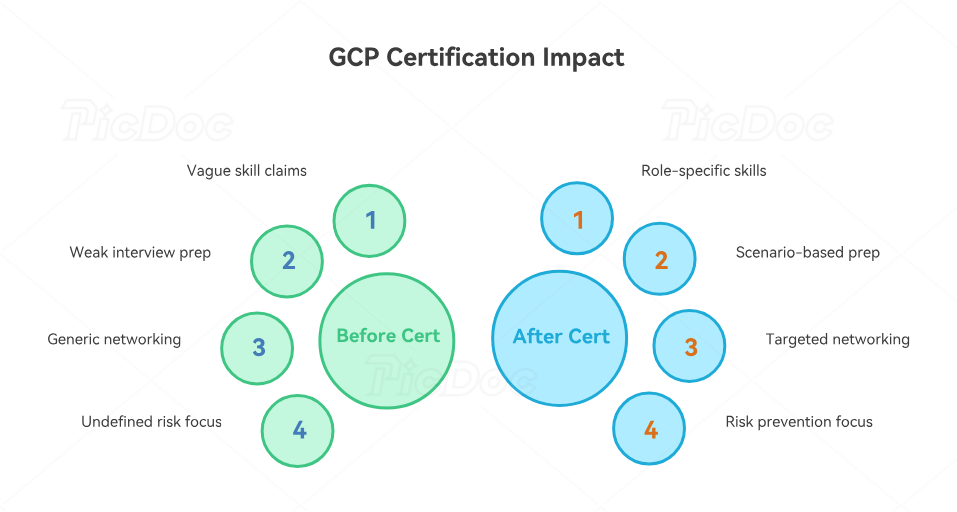
Your LinkedIn and networking strategy should also become more specific. Posting “GCP certified and open to work” creates weak signals. Posting a short lesson about preventing consent version errors, preparing for a monitor visit, responding to queries, organizing a deviation log, or documenting participant contact creates stronger professional credibility. Use online clinical research communities, clinical research professional associations, clinical research career opportunities, certificate program comparisons, and free webinars to build visible proof instead of relying only on applications.
5. Missouri Career Strategy: Where GCP Helps You Compete, Interview, and Grow
Missouri candidates should think in career clusters: site operations, monitoring, regulatory, safety, data, and project support. Site operations rewards people who can coordinate patient visits, keep documents clean, communicate with investigators, prepare for monitors, and prevent deviations. Monitoring rewards people who can see risk patterns across source data, EDC entries, consent records, drug accountability, and safety documentation. Regulatory and data roles reward precision, version control, audit trails, and calm follow-up. A strong pathway may combine Missouri clinical research certification, CRA training in Missouri, clinical trial startup tools, salary comparison tools, and clinical research communities.
The fastest growth comes from choosing one lane for the next 90 days. If your target is CRC, study visit flow, patient retention, protocol deviations, source documentation, and monitoring preparation. If your target is CRA, study monitoring reports, follow-up letters, risk-based review, escalation, and site management. If your target is regulatory, study document lists, IRB packets, consent versions, amendments, and approvals. If your target is pharmacovigilance, study AE/SAE logic, timelines, narratives, follow-up, and compliance. Build this plan through effective patient retention, remote monitoring mastery, regulatory affairs mastery, pharmacovigilance audits, and clinical trial project management.
The strongest Missouri candidates also build a small portfolio. That portfolio can include a sample delegation log explanation, a mock monitoring visit checklist, a query response example, a deviation root-cause summary, a safety reporting decision tree, and a short explanation of how GCP protects participants and data credibility. This helps hiring teams see your thinking before they take a chance on you. Support that portfolio with clinical trial templates, GCP compliance self-assessment, interactive startup checklists, clinical trial budget management, and quality management strategies.
A smart application strategy also avoids generic clinical research resumes. A CRC resume should highlight patient interaction, scheduling, documentation accuracy, EMR familiarity, protocol adherence, and escalation. A CRA resume should highlight monitoring logic, source review, site communication, action-item tracking, and risk identification. A regulatory resume should highlight IRB submissions, essential documents, version control, amendments, and tracker discipline. A safety resume should highlight AE/SAE documentation, timelines, seriousness, expectedness, and follow-up. Use CRA career guidance, clinical research certification Missouri guidance, pharmacovigilance best practices, clinical trial data review, and project close-out procedures to customize each version.
6. FAQs About Getting ICH-GCP Certified in Missouri
-
Many Missouri clinical research employers strongly prefer or require GCP training for roles involving participant interaction, trial documentation, monitoring, regulatory work, data review, or safety reporting. Even when a job posting uses flexible language, certification helps prove that you understand participant protection, protocol compliance, source documentation, AE/SAE escalation, and audit readiness. Pair it with clinical research certification in Missouri, ethical conduct in GCP, investigator responsibilities, and GCP compliance self-assessment.
-
The biggest benefit goes to candidates entering CRC, CRA, CTA, regulatory, data, safety, research nurse, and site operations roles. Career changers from healthcare, pharmacy, lab, public health, administration, and science backgrounds can use ICH-GCP certification to show clinical trial readiness. A strong plan connects CRA careers in Missouri, site monitoring visits, clinical trial data review, and pharmacovigilance best practices.
-
Many candidates can complete a focused ICH-GCP course quickly, while job readiness requires extra practice. Give yourself time to study consent, safety reporting, deviations, monitoring, source documentation, and inspection logic. After completion, spend another week building resume bullets and interview examples. Use protocol deviation corrective actions, SAE reporting procedures, clinical trial amendments, and clinical trial templates.
-
Study role-specific execution. CRC candidates should focus on visits, retention, source notes, and deviation prevention. CRA candidates should focus on monitoring, SDV/SDR, risk review, and escalation. Regulatory candidates should focus on IRB submissions, amendments, essential documents, and approval tracking. Safety candidates should focus on AE/SAE logic. Start with patient retention strategies, risk-based monitoring, regulatory guidelines worldwide, and adverse event reporting compliance.
-
Place it near your clinical research skills, then support it with proof bullets. Instead of listing only the certificate name, add role-relevant competencies such as informed consent support, source documentation, AE/SAE escalation, monitoring readiness, query management, protocol deviation prevention, and essential document awareness. Build stronger bullets from clinical trial data integrity, GCP monitoring techniques, quality management strategies, and clinical research salary planning.
-
You can compete more effectively when the certificate is paired with transferable proof. Healthcare, pharmacy, lab, administrative, public health, customer service, and documentation-heavy experience can translate well if you connect it to patient communication, accuracy, confidentiality, scheduling, compliance, and escalation. Strengthen your profile with clinical research certification Missouri guidance, research assistant communication strategies, free clinical research training resources, and clinical research career opportunities.
