The Ultimate Guide to Getting Your Good Clinical Practice (ICH-GCP) Certification in Connecticut: Everything You Need to Know in 2026-27
Getting ICH-GCP certified in Connecticut gives healthcare workers, coordinators, research assistants, CRAs, regulatory staff, and site leaders a practical way to prove they understand participant protection, protocol discipline, documentation quality, and sponsor expectations. In a state connected to hospital systems, academic medicine, biotech, pharma, and CRO activity, a strong clinical research certification in Connecticut should connect directly to GCP responsibilities, patient safety, site monitoring, and clinical trial data integrity.

1 Why ICH-GCP Certification Matters in Connecticut in 2026-27
Connecticut clinical research careers sit close to several pressure points at once: academic research expectations, sponsor-driven timelines, complex patient populations, specialty medicine, biotech partnerships, and cross-state competition from New York, Massachusetts, and Rhode Island. That makes ICH-GCP certification valuable when it helps a candidate show controlled judgment, clean documentation, safety awareness, and reliable trial conduct. The strongest learners pair Connecticut clinical research certification, CRA certification in Connecticut, clinical research certification in Massachusetts, clinical research certification in New York, and clinical research certification in Rhode Island with real operational examples.
The biggest mistake Connecticut candidates make is treating GCP as a certificate line instead of a work standard. A hiring manager can see “GCP certified” on dozens of resumes. The candidate who stands out can explain what happens when consent timing is wrong, an AE is discovered late, a primary endpoint source note is incomplete, a delegation log is outdated, a protocol amendment changes visit requirements, or a monitor finds repeat query issues. Those answers come from studying protocol deviations, SAE reporting, clinical trial amendments, GCP monitoring techniques, and quality management strategies.
The 2026-27 version of GCP readiness should also account for modern trial execution. Teams need people who understand risk-based thinking, electronic systems, remote review, hybrid trial methods, audit trails, data governance, and proportional quality controls. A certificate becomes more useful when the learner can connect it to risk-based monitoring, remote and on-site monitoring, virtual clinical trials, clinical trial technology innovations, and global regulatory guidelines.
2. What Connecticut Learners Should Look for in an ICH-GCP Certification
A strong ICH-GCP certification should teach the learner how to protect participants and preserve trial credibility through daily decisions. For Connecticut candidates, that means practical fluency in informed consent, protocol adherence, source documentation, AE capture, delegation, monitoring, essential documents, and data reliability. The course should prepare learners to explain what happens when a participant signs the wrong consent version, a lab is drawn outside the visit window, an SAE is found after hours, or a monitor identifies missing source for a key endpoint. Those scenarios connect directly to GCP principles, adverse event reporting, protocol deviation corrective actions, site monitoring visits, and clinical trial data review.
Look for training that turns regulations into workflows. A useful course should show how the protocol becomes a visit checklist, how the informed consent process becomes a source note, how an AE becomes a tracked safety event, how a deviation becomes root-cause analysis, and how a monitoring finding becomes corrective action. This matters because Connecticut learners may target hospital research offices, private sites, academic units, sponsor operations, CRO teams, or remote clinical trial support roles. A course gains real value when paired with clinical trial start-up tools, GCP compliance assessment, sponsor responsibility guidance, quality management strategies, and clinical trial timelines.
The best certification choice also depends on the role target. CRC candidates need strong participant-facing judgment, visit execution, retention thinking, and clean documentation. CRA candidates need monitoring logic, source review judgment, risk ranking, follow-up communication, and issue escalation. Regulatory candidates need version control, essential document tracking, IRB awareness, and audit readiness. Safety candidates need AE/SAE logic, narrative discipline, and reconciliation habits. Project candidates need milestone control, cross-functional communication, budget awareness, and quality oversight. These tracks can be strengthened through patient retention strategies, risk-based monitoring strategies, IND/NDA submission mastery, pharmacovigilance best practices, and clinical trial project management.
3. Connecticut Career Paths That Benefit Most from ICH-GCP Certification
Clinical research coordinator roles are one of the clearest uses of ICH-GCP certification in Connecticut. CRCs sit close to the participant, the investigator, the protocol, the source, the EDC, the monitor, and the sponsor. That role punishes vague training because one missed detail can affect consent validity, eligibility, safety, payment, endpoint quality, or database lock. A coordinator who understands site monitoring visit preparation, patient retention strategies, clinical trial budget management, handling protocol deviations, and clinical trial data integrity can make the certificate visible in daily performance.
CRA candidates should use ICH-GCP certification as the base layer for monitoring credibility. A CRA must recognize site risk, evaluate documentation, communicate findings, and push action without losing the site relationship. Connecticut candidates trying to move into regional, sponsor, CRO, or remote monitoring roles should practice how to describe SDV, SDR, critical data, issue classification, escalation, monitoring letters, and follow-up. That learning path should include CRA certification in Connecticut, remote and on-site monitoring mastery, risk-based monitoring, clinical trial data review, and conducting investigator meetings.
Regulatory, safety, data, and project roles also benefit from GCP certification because each function protects trial quality from a different angle. Regulatory staff protect approvals, versions, essential documents, and inspection readiness. Safety staff protect AE capture, reporting, narratives, follow-up, and reconciliation. Data staff protect query logic, audit trails, database quality, and endpoint reliability. Project staff protect timelines, budgets, cross-functional decisions, and sponsor communication. These career paths become stronger when candidates study regulatory affairs submissions, pharmacovigilance audits, clinical trial safety monitoring, project close-out procedures, and leadership in clinical trial management.
What is your biggest ICH-GCP certification blocker in Connecticut right now?
Choose one. Your answer points to the fastest career fix.
4. How to Choose the Right ICH-GCP Certification for Connecticut Roles
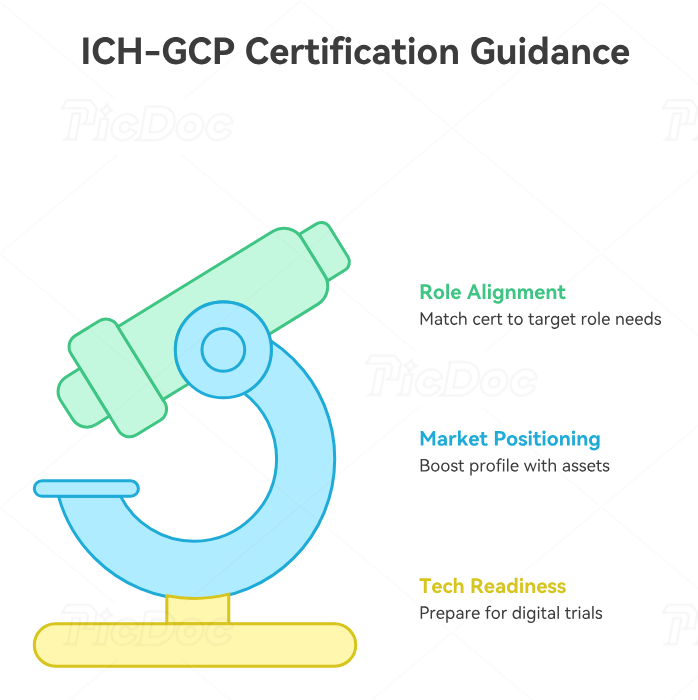
Choose an ICH-GCP certification by asking how well it prepares you for the actual role you want. A CRC-focused learner needs consent, scheduling, source notes, visit execution, retention, AE awareness, and deviation prevention. A CRA-focused learner needs monitoring logic, site risk evaluation, source review, follow-up letters, and escalation. A regulatory learner needs IRB-facing accuracy, essential document tracking, and version control. A safety learner needs AE/SAE reporting discipline. A project learner needs quality, budgets, timelines, and cross-functional communication. The right choice should support CRC site workflows, CRA monitoring skills, regulatory start-up control, safety monitoring, and trial project management.
Connecticut candidates should also think about market positioning. A basic certificate helps you meet expectations. A strong certificate plus role-specific proof helps you stand out. That proof can include mock source notes, a deviation/CAPA example, a regulatory binder index, a monitoring visit checklist, an AE escalation map, or a query-prioritization sheet. These assets let a hiring manager see how you think before you have years of formal trial experience. Build them with help from clinical trial templates, GCP compliance self-assessment, clinical trial sample size tools, clinical trial cost estimators, and clinical trial start-up checklists.
Certification should also prepare you for technology-aware trial work. Clinical research teams increasingly rely on EDC, CTMS, eTMF, eConsent, ePRO, remote monitoring portals, electronic logs, and hybrid visit models. The important skill is controlled use: knowing how access, audit trails, source review, version history, data transfers, and query trails affect trust in the trial. A learner who studies clinical trial technology innovations, virtual clinical trials, risk-based monitoring, global regulatory compliance, and quality management will sound more current in 2026-27 interviews.
5. A Practical 30-Day Connecticut ICH-GCP Study and Career Plan
Use days 1-7 to build the core GCP foundation. Study participant rights, informed consent, investigator oversight, IRB review, protocol compliance, privacy, source documentation, AE reporting, and essential documents. Write a one-page “GCP risk map” that lists what can go wrong during screening, consent, baseline, follow-up, safety reporting, and close-out. Connect this foundation to ethical conduct and patient safety, investigator responsibilities, adverse event reporting compliance, protocol deviation handling, and GCP compliance self-assessment.
Use days 8-14 to practice documentation. Create sample source notes for informed consent, screening, eligibility confirmation, AE follow-up, missed procedure, phone contact, and protocol deviation discovery. Build a simple regulatory binder index with protocol versions, training logs, delegation logs, IRB approvals, investigator documents, lab documents, correspondence, safety letters, and monitoring reports. This turns certification into visible proof. Support this week with clinical trial start-up activities, site monitoring preparation, clinical trial data review, clinical trial amendments, and project close-out procedures.
Use days 15-21 to specialize. CRC candidates should practice visit planning, patient retention, deviation prevention, and query response. CRA candidates should practice monitoring observations, follow-up letter wording, source verification logic, and issue escalation. Regulatory candidates should practice document tracking and version control. Safety candidates should practice AE narratives and follow-up. Project candidates should practice milestone tracking, budget awareness, and communication discipline. Use patient retention guidance, remote monitoring skills, pharmacovigilance best practices, budget management strategies, and trial timeline management.
Use days 22-30 to turn the certificate into Connecticut career leverage. Rewrite your resume with specific GCP evidence: informed consent support, source documentation, AE awareness, deviation tracking, regulatory binder maintenance, query response, monitoring readiness, protocol version control, and participant safety. Prepare five interview stories using issue, risk, action, documentation, and prevention. Then compare clinical research certificate programs, explore clinical research training resources, use clinical research career opportunity maps, check salary comparison tools, and build visibility through clinical research professional associations.
6. FAQs About ICH-GCP Certification in Connecticut
-
Many Connecticut clinical research roles expect GCP training because it proves the candidate understands participant protection, protocol compliance, safety reporting, data reliability, and investigator oversight. The requirement can vary by employer, sponsor, trial type, and funding source, so candidates should treat GCP as a baseline credibility tool. Strong preparation should include Connecticut clinical research certification, GCP investigator responsibilities, ethical conduct and patient safety, and site monitoring visit preparation.
-
Many learners can complete basic GCP training quickly, but career-ready understanding takes scenario practice. A strong 30-day plan gives you time to study principles, practice documentation, specialize by role, and prepare resume proof. The goal is to explain how you would handle late consent, missing source, unresolved queries, protocol deviations, and safety events. Use SAE reporting procedures, protocol deviation examples, clinical trial amendments, and data integrity responsibilities.
-
GCP certification helps, and CRC hiring usually rewards candidates who can show practical site-readiness. Build proof around consent support, screening, visit windows, source documentation, AE awareness, deviation tracking, query response, and monitoring preparation. A stronger candidate studies patient retention strategies, site monitoring visits, clinical trial budget management, and handling protocol deviations.
-
GCP certification is highly useful for CRA candidates because monitoring work depends on participant safety, protocol compliance, documentation quality, issue escalation, and data reliability. Connecticut CRA candidates should practice explaining SDV, SDR, risk-based monitoring, monitoring letters, CAPA follow-up, and site communication. Helpful next resources include CRA certification in Connecticut, risk-based monitoring, remote monitoring mastery, and clinical trial data review.
-
Healthcare workers should study where routine care and clinical trial conduct differ. Focus on informed consent timing, protocol-required procedures, visit windows, eligibility, documentation standards, AE capture, investigational product control, and sponsor communication. Clinical experience becomes more valuable when translated into GCP compliance, site operations oversight, clinical trial safety monitoring, and collaboration strategies for research assistants.
-
Use specific skill language instead of a plain certificate line. Add bullets for informed consent support, source documentation, AE awareness, deviation tracking, regulatory binder maintenance, query response, protocol version control, monitoring readiness, and participant safety. Entry-level candidates can add a mini portfolio with mock source notes, a deviation/CAPA example, a delegation log sample, and a monitoring readiness checklist. Build that proof with clinical trial templates, training resources, career opportunity mapping, and salary comparison tools.
