The Ultimate Guide to Getting Your Good Clinical Practice (ICH-GCP) Certification in Vermont: Everything You Need to Know in 2026–27
Good Clinical Practice certification has become a practical entry requirement for many Vermont professionals involved in clinical trials, human-subject research, study coordination, monitoring, data handling, and investigator oversight. Completing a course, however, provides limited value when its curriculum, renewal cycle, or regulatory focus fails to match the role you want.
This guide explains how to select credible ICH-GCP training, meet Vermont institutional expectations, prepare for ICH E6(R3), retain audit-ready evidence, and turn the credential into usable competence. It also connects GCP training with clinical research certification pathways, clinical research career opportunities, free research training resources, and clinical research professional associations.
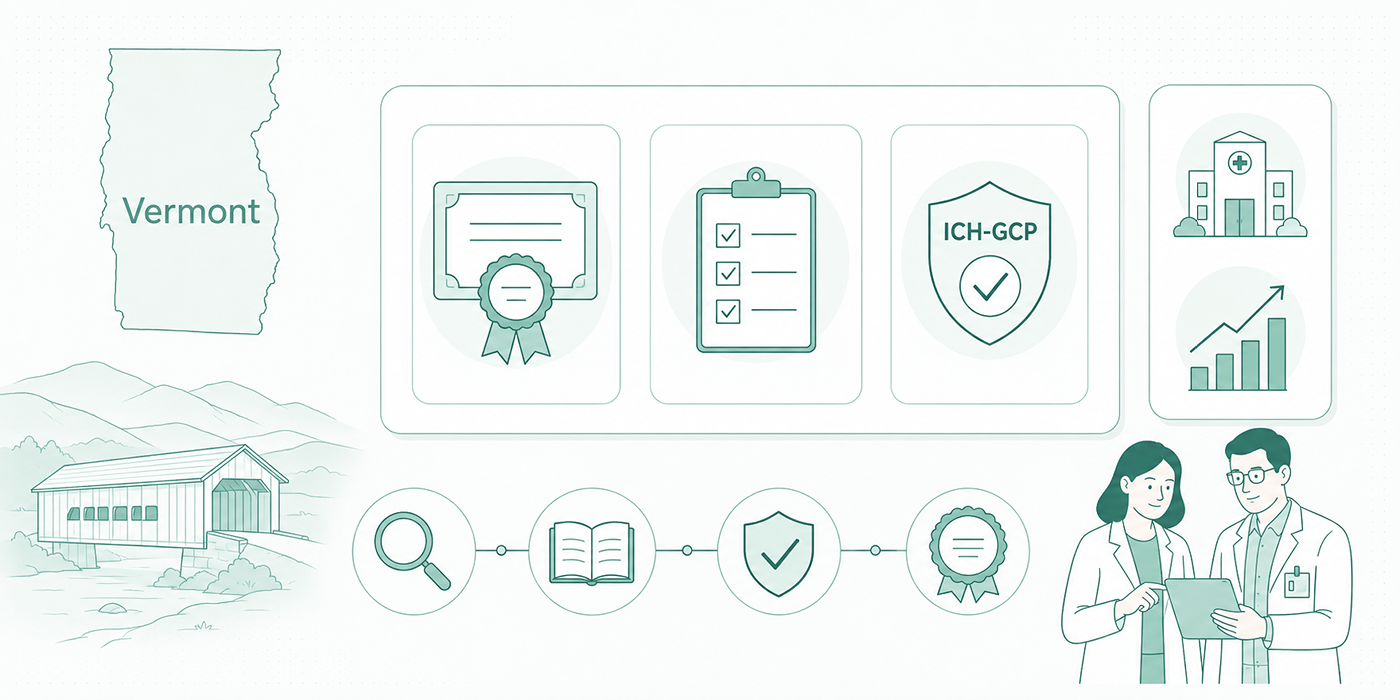
1. What ICH-GCP Certification Means in Vermont in 2026–27
An ICH-GCP certificate documents that you completed structured training in the ethical and scientific quality standards used to design, conduct, document, monitor, analyze, and report clinical trials. The credential supports onboarding and qualification reviews, while your actual responsibilities remain controlled by your education, experience, protocol duties, delegation, institutional policy, and applicable regulations.
This distinction protects candidates from one of the most expensive career mistakes in clinical research: assuming that a downloadable certificate automatically proves operational readiness. Employers may still test whether you can recognize a serious adverse event, protect informed consent, resolve a data query, document a deviation, maintain essential records, or escalate an immediate participant-safety concern. Building competence therefore requires connecting GCP principles with adverse-event reporting requirements, serious adverse event procedures, protocol deviation management, ethical conduct and participant safety, and clinical-trial data integrity.
The major change for 2026–27 is the transition toward ICH E6(R3). ICH adopted the E6(R3) Principles and Annex 1 in January 2025, and the FDA issued its final E6(R3) guidance in September 2025. The revision places greater emphasis on quality by design, proportionate risk management, reliable data, participant protection, fit-for-purpose systems, and thoughtful use of technology. ICH also adopted Annex 2 on June 3, 2026, covering additional considerations for trials using decentralized elements, pragmatic designs, and real-world data.
For Vermont learners, the practical consequence is clear: a course built entirely around memorizing E6(R2) section numbers may leave substantial gaps. Strong 2026–27 training should explain how E6(R3) affects risk-based monitoring strategies, remote and on-site monitoring, clinical-trial data review, quality management planning, and global regulatory compliance.
Vermont institutions can also impose requirements beyond a course provider’s general recommendations. The University of Vermont states that investigators and key personnel involved in the conduct, oversight, or management of human-subject clinical trials must complete GCP training irrespective of funding source. UVM Larner College of Medicine affiliates are required to complete GCP training even where a project falls outside the NIH clinical-trial definition. UVM requires refresher training every three years for key personnel who remain listed on an active clinical trial.
| Vermont ICH-GCP Certification Decision Matrix for 2026–27 | ||||
|---|---|---|---|---|
| Checkpoint | What to Verify | Why It Matters | Evidence to Retain | Common Failure |
| 1. Guideline version | Explicit ICH E6(R3) coverage | Aligns training with current quality principles | Curriculum outline and completion date | Taking an outdated E6(R2)-only course |
| 2. U.S. regulatory context | FDA-regulated trial content | Connects GCP with U.S. obligations | Module list and assessment results | Learning international principles without FDA application |
| 3. NIH compatibility | Course addresses NIH-funded clinical trials | Supports grant-funded research participation | Certificate and provider description | Assuming every short course satisfies local review |
| 4. Institutional acceptance | Employer or UVM-approved provider | Prevents rejected onboarding documentation | Written acceptance or training assignment | Paying before checking institutional rules |
| 5. Learner track | Drug, device, biologic, or behavioral focus | Matches your actual study environment | Track title shown on certificate | Selecting the shortest generic option |
| 6. Informed consent | Consent, assent, reconsent, and documentation | Protects participant rights and trial validity | Scenario assessment or competency record | Treating consent as a signature event |
| 7. Investigator duties | Investigator responsibilities under GCP | Clarifies oversight and accountability | Completed investigator module | Confusing delegation with transfer of responsibility |
| 8. Sponsor oversight | Sponsor roles and responsibilities | Explains monitoring and vendor governance | Sponsor-focused course content | Assuming outsourced work removes sponsor accountability |
| 9. IRB responsibilities | Initial review, amendments, continuing oversight | Prevents implementation before approval | IRB module record | Using sponsor approval as IRB authorization |
| 10. Protocol compliance | Handling protocol deviations | Supports consistent, defensible conduct | Deviation exercise or case study | Correcting records without preserving an audit trail |
| 11. Safety reporting | Clinical-trial safety monitoring | Improves recognition and escalation | Safety-module score | Waiting for certainty before escalating urgent information |
| 12. Data integrity | Attributable and traceable records | Preserves trustworthy trial conclusions | Data-integrity module completion | Backdating or undocumented overwriting |
| 13. Source documentation | Original records and certified copies | Supports verification and reconstruction | Documentation exercise | Creating source after data entry |
| 14. Electronic systems | Access controls, validation, audit trails, backups | Addresses modern technology risks | Systems module or SOP training | Sharing credentials or using uncontrolled tools |
| 15. Quality by design | Critical-to-quality factors identified early | Reflects a central E6(R3) expectation | Risk exercise or training record | Adding controls after avoidable failures occur |
| 16. Proportionate risk | Risk-based monitoring principles | Focuses resources on meaningful risks | Risk-assessment case study | Treating every error as equally important |
| 17. Monitoring | On-site and remote monitoring techniques | Connects principles with oversight practice | Monitoring training record | Viewing monitoring as document policing |
| 18. Essential records | Creation, filing, retention, and accessibility | Allows trial reconstruction during inspection | Records-management module | Filing documents without quality review |
| 19. Investigational product | Receipt, storage, dispensing, return, reconciliation | Protects participants and product accountability | Product-management module | Leaving temperature excursions unresolved |
| 20. Privacy | Minimum necessary access and secure disclosure | Reduces confidentiality and system risk | Privacy training alongside GCP | Assuming a GCP certificate replaces privacy training |
| 21. Vulnerable participants | Additional safeguards and consent considerations | Strengthens ethical enrollment decisions | Population-specific module | Using the same process for every population |
| 22. Inspection readiness | GCP compliance self-assessment | Finds weaknesses before an audit | Completed gap assessment | Preparing only after an inspection notice |
| 23. Assessment standard | Meaningful exam with documented passing criteria | Shows more than passive attendance | Score report | Choosing instant certificates with no assessment |
| 24. Certificate details | Name, provider, course, date, and unique record | Supports verification and onboarding | PDF plus verification link | Keeping only an email screenshot |
| 25. Renewal cycle | Institutional and sponsor expiration rules | Prevents training lapses during active studies | Calendar reminder and training log | Waiting for a coordinator to chase expiration |
| 26. Role-specific development | Clinical research certificate comparison | Builds beyond introductory compliance training | Development plan | Using one certificate as an entire career strategy |
| 27. Practical application | Clinical-trial templates and SOP resources | Translates theory into controlled workflows | Practice logs and sample exercises | Memorizing terminology without using it |
| 28. Career positioning | Clinical research salary and role research | Targets realistic roles and skill gaps | Role-specific résumé evidence | Applying broadly with a certificate-only résumé |
2. How to Choose the Right ICH-GCP Course for a Vermont Role
Start with the organization that will receive your certificate. A UVM employee, an independent job seeker, a site coordinator, a sponsor employee, and a professional working on an NIH-funded behavioral intervention may face different training assignments. Ask the hiring manager, principal investigator, research protections office, or trial manager which provider, learner track, and refresher course they accept. This single check can prevent wasted tuition and delayed protocol access.
NIH does not mandate one commercial GCP provider. Acceptable training may come through a class, academic program, course, or certification offered by a recognized clinical-research organization. NIH expects personnel involved in the conduct, oversight, or management of NIH-funded clinical trials to complete GCP training, retain documentation, and refresh the training at least every three years. NIH confirmed in April 2026 that training consistent with ICH E6(R3) meets its GCP requirement.
Use five filters before enrolling. First, verify that the curriculum names ICH E6(R3), explains Annex 1, and acknowledges emerging Annex 2 applications. Second, confirm that the course covers the trial type relevant to your target position. Third, examine whether it tests judgment through scenarios rather than rewarding rapid clicking. Fourth, verify that the certificate displays identifiable training information. Fifth, check how updates are handled when guidance changes.
A coordinator-oriented course should prepare you to support site-monitoring visits, patient-retention strategies, clinical-trial budget management, protocol deviation resolution, and accurate study documentation. A CRA candidate needs deeper preparation in clinical-trial data verification, monitoring plans, issue escalation, root-cause analysis, and corrective-action follow-up.
Principal investigators need training that addresses oversight, delegation, participant protection, safety review, resource adequacy, and control of study conduct. Those responsibilities should be studied alongside PI site-operations oversight, principal-investigator budget management, investigator-initiated trials, and clinical-trial data-integrity responsibilities.
Regulatory and pharmacovigilance professionals should prioritize courses that connect GCP with IND and NDA submissions, investigational new drug applications, pharmacovigilance audits and inspections, global pharmacovigilance compliance, and expedited safety reporting.
Free training can be appropriate when it satisfies the receiving institution’s requirements and provides usable documentation. Paid training becomes valuable when it adds structured instruction, updated R3 content, expert support, rigorous assessment, practical exercises, and career-relevant specialization. Price alone gives a weak signal. Evaluate the curriculum against the responsibilities you will perform and the evidence an employer will examine.
3. Step-by-Step Process for Earning and Documenting Your Certificate
Begin by defining your target environment. Write down the roles you plan to pursue, such as clinical research assistant, CRC, research nurse, CRA, regulatory specialist, data coordinator, project manager, or investigator. Review several job descriptions and mark every repeated requirement. This exposes whether you need foundational GCP, FDA-focused drug and device training, social and behavioral research training, human-subject protections, HIPAA education, biosafety training, or role-specific credentials.
Next, obtain written confirmation of the accepted course whenever you are already affiliated with a Vermont institution. UVM’s training structure includes FDA-focused, ICH-focused, and social and behavioral research options, with refresher routes attached to relevant tracks. UVM also indicates that required GCP training for key personnel on new protocols must be completed before submission, and protocol approval will remain unreleased until listed personnel satisfy the requirement.
Complete the course as an operational learner. For each module, create a brief application note answering three questions: what risk does this requirement control, who owns the action, and what record proves completion? When studying informed consent, connect the principle with screening logs, approved consent versions, signatures, dates, reconsent triggers, interpreter use, and documentation of the discussion. When studying safety, connect definitions with awareness dates, severity, seriousness, causality, expectedness, reporting routes, and escalation timelines.
This method produces far greater value than memorizing isolated definitions. It also prepares you for interviews built around scenarios such as missing consent signatures, use of an expired document, delayed safety escalation, unreported deviations, unauthorized system access, temperature excursions, or conflicting source and electronic case-report-form data. Reviewing clinical-trial amendments, GCP monitoring techniques, safety-monitoring best practices, research ethics resources, and clinical-trial start-up activities reinforces those connections.
After passing, download the certificate immediately and inspect it for your correct legal name, provider, course title, guideline version or track, completion date, expiration information, certificate number, and verification method. Save the PDF in at least two controlled locations. Keep a training log containing the course, provider, completion date, expected renewal date, file path, and role for which it was required.
Add a renewal reminder 120 days before the anticipated due date. Early review gives you time to verify whether the institution still accepts the same provider and whether updated E6(R3) or Annex 2 content has been introduced. A three-year maximum may apply under NIH and UVM expectations, while a sponsor, employer, protocol, or network can set an earlier cycle.
Finally, update your résumé with precise language. A strong entry identifies the course, provider, completion date, and current status. Pair the certificate with demonstrable knowledge of monitoring visit preparation, research-team communication, trial timeline management, project quality systems, and clinical-research career pathways.
What is your biggest Vermont ICH-GCP certification blocker right now?
Choose the closest answer to reveal your most useful next step.
4. How to Turn GCP Certification Into Vermont Job Readiness
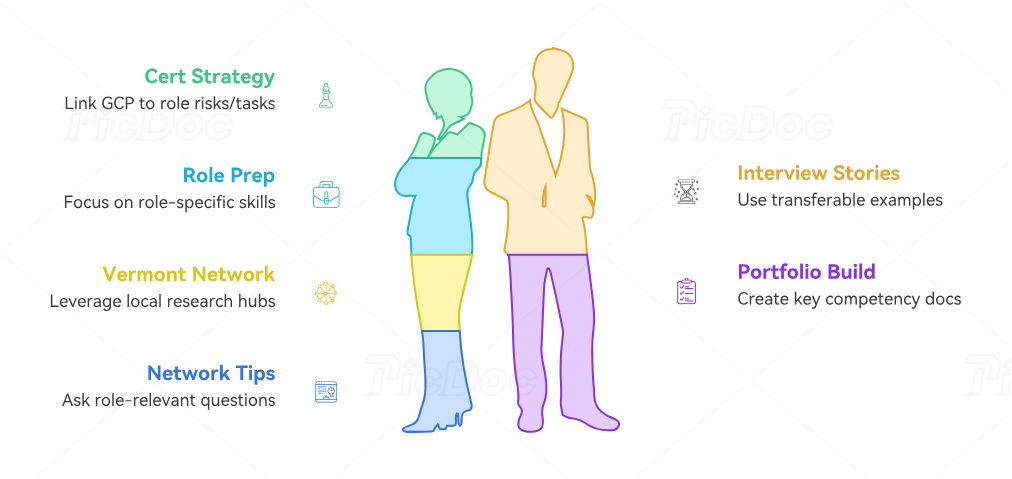
A certificate strengthens your candidacy when the rest of your application shows that you understand clinical-trial workflow. Entry-level candidates often bury GCP under a generic “certifications” heading and expect recruiters to infer competence. A stronger strategy connects training with the risks and tasks present in the target role
For a coordinator position, demonstrate familiarity with participant screening, consent coordination, visit windows, source documentation, investigational-product records, query resolution, safety escalation, essential documents, and monitor follow-up. Study patient-retention techniques, CRC deviation management, site-monitoring workflows, clinical-trial budget controls, and trial start-up checklists.
For a CRA path, develop language around site qualification, initiation, interim monitoring, close-out, source-data review, protocol compliance, action items, issue escalation, and risk signals. Use CRA monitoring mastery, investigator-meeting strategies, risk-based monitoring, clinical-data verification, and CRA certification exam time management to build that foundation.
Vermont’s concentrated research environment makes targeted networking especially valuable. The University of Vermont’s Office of Clinical Trials Research supports investigators with research logistics and helps attract clinical-trial activity, while the UVM Cancer Center Clinical Trials Office supports investigator-initiated, cooperative-group, and industry-sponsored oncology trials. These structures show why local candidates benefit from understanding both academic and industry trial operations.
Use networking conversations to learn how teams actually evaluate candidates. Ask which training appears on onboarding checklists, which documentation failures consume the most time, which systems new hires use, and which duties can be taught after hiring. Explore online clinical-research communities, professional research associations, clinical-research conferences, free webinars and training, and global career opportunities.
Prepare five interview stories even when you lack formal clinical-trial employment. Use examples from healthcare, laboratories, quality assurance, pharmacy, data management, academic research, or regulated operations. Each story should show that you protected a person, followed a controlled process, detected a discrepancy, escalated a risk, maintained confidentiality, or corrected an error transparently. Connect the story to GCP without exaggerating your authority.
Create a small competency portfolio containing your certificate, a redacted training log, a sample deviation analysis, an informed-consent version-control exercise, a mock safety-escalation map, and an essential-document checklist. Use templates for practice while respecting confidentiality and intellectual-property restrictions. The clinical-trial templates directory, GCP compliance assessment, clinical-research ethics directory, and patient-education resources can support structured practice.
5. Renewal, E6(R3) Readiness, and Costly Mistakes to Avoid
Treat renewal as a controlled professional obligation. Record the completion date, institutional due date, provider recommendation, sponsor requirement, and expected refresher date in one training tracker. Review the tracker quarterly when you work on active studies. Retain older certificates because they establish continuity of qualification and may be requested during sponsor review, audit preparation, or inspection reconstruction.
The three-year NIH refresher expectation serves as a maximum interval for staying current under that policy. UVM also requires GCP refresher training every three years for key personnel remaining on active clinical trials. A local sponsor, network, employer, protocol, or standard operating procedure can create an earlier deadline, so the controlling requirement should be verified rather than inferred from the date printed on a generic certificate.
Review course content before renewing. A valuable 2026–27 refresher should address participant protection, critical-to-quality factors, proportionate risk controls, computerized systems, data governance, sponsor oversight, service providers, remote processes, decentralized elements, and fit-for-purpose trial design. ICH E6(R3) treats quality as something designed into a trial and maintained through appropriate controls, making rote recertification a poor substitute for updated judgment.
Several mistakes repeatedly weaken otherwise promising candidates. One is choosing training before checking institutional acceptance. Another is listing “ICH certified” without naming the provider, course, and date. Others include allowing the certificate to lapse, confusing GCP with human-subject protection or privacy training, sharing confidential examples during interviews, and claiming operational experience gained only through online modules.
A further risk involves overreacting to every minor error while missing the issues capable of harming participants or undermining reliable results. E6(R3) encourages proportionate approaches. Develop this judgment through quality-management strategies, protocol deviation corrective actions, risk-based CRA monitoring, trial safety monitoring, and data-integrity oversight.
Avoid collecting disconnected certificates. Build a deliberate sequence: current GCP training, human-subject protection requirements, role-specific clinical-research education, practical exercises, supervised exposure, and advanced credentials once eligibility requirements are met. Compare clinical research certificate programs, explore clinical research master’s programs, review free professional-development resources, and assess clinical-research salary pathways before investing heavily.
6. Frequently Asked Questions About ICH-GCP Certification in Vermont
-
Requirements depend on the employer, institution, funding source, protocol, sponsor, and assigned duties. UVM requires GCP training for investigators and key personnel involved in the conduct, oversight, or management of human-subject clinical trials, and Larner College of Medicine affiliates face a broader institutional requirement. NIH-funded clinical-trial personnel responsible for conduct, management, or oversight are also expected to receive GCP training.
Candidates should review the position description and confirm local expectations. The broader Vermont clinical research certification guide, GCP self-assessment tool, research ethics directory, and career opportunities map can help define the surrounding requirements.
-
Course length varies according to provider, learner track, module depth, prior knowledge, and assessment design. Choose based on acceptance and curriculum quality rather than the shortest advertised completion time. A compressed course can still be useful when it covers the correct framework and tests applied understanding.
Reserve enough uninterrupted time to study informed consent, investigator duties, sponsor oversight, safety reporting, protocol compliance, data integrity, monitoring, and essential records. Reinforce the modules with adverse-event reporting guidance, investigator responsibility training, monitoring visit techniques, and protocol-deviation examples.
-
An older certificate may remain within an institution’s stated validity period, but acceptance depends on the receiving organization and the substance of the training. FDA finalized E6(R3) guidance in September 2025, and NIH confirmed that E6(R3)-consistent training satisfies its GCP requirement. ICH adopted Annex 2 in June 2026, increasing the value of updated content for professionals working with decentralized, pragmatic, or real-world-data designs.
Send the course title, completion date, and curriculum to the responsible training office. A refresher becomes especially valuable when your prior course lacks quality-by-design concepts, risk-based monitoring, remote trial oversight, or modern data-governance coverage.
-
NIH states that GCP training should be refreshed at least every three years. UVM requires key personnel who remain listed on active clinical trials to complete refresher training every three years. Employer, sponsor, network, or protocol requirements can establish a shorter interval.
Maintain a personal training tracker and begin verification several months before the earliest deadline. Include GCP alongside site start-up requirements, trial timeline management, inspection preparation, and project close-out procedures.
-
GCP training can improve entry-level readiness, particularly for research assistant, data-support, site-support, and junior coordinator pathways. Hiring decisions usually consider transferable experience, communication, documentation quality, regulatory awareness, technical skills, and evidence that you understand the workflow surrounding the certificate.
Build applied competence through research-assistant communication strategies, clinical-trial template practice, free training resources, professional research communities, and carefully targeted applications.
-
Choose the track assigned or accepted by the receiving institution. UVM identifies FDA-focused options for investigational drugs and medical devices, an ICH-focused route relevant to international research, and a social and behavioral research option. The appropriate selection follows the study type, institutional assignment, and job responsibilities.
A drug or device professional should also understand IND application requirements, clinical-trial sponsor responsibilities, investigational safety monitoring, and global regulatory guidelines.
