The Ultimate Guide to Getting Your Good Clinical Practice (ICH-GCP) Certification in Florida: Everything You Need to Know in 2026-27
Florida’s clinical research market rewards professionals who can step into trial work with judgment, documentation discipline, patient-safety awareness, and clean protocol habits. A strong Good Clinical Practice certification gives coordinators, CRAs, assistants, investigators, nurses, pharmacists, and career changers a practical way to prove they understand how compliant research actually runs. In 2026-27, the real advantage comes from using ICH-GCP training as a career signal, then connecting it to site operations, monitoring visits, patient safety, and role-specific execution.
1. What ICH-GCP Certification Actually Proves in Florida’s Clinical Research Job Market
An ICH-GCP certificate proves more than course completion when you can explain how it changes your behavior inside a study. Florida employers do not need another applicant who says they are “detail-oriented.” They need someone who understands investigator responsibilities, recognizes preventable protocol deviations, protects consent quality, supports clinical trial data integrity, and escalates safety concerns without waiting for a monitor to discover the problem.
In Florida, that matters because clinical research work can be spread across academic centers, private practices, hospital networks, community sites, specialty clinics, decentralized trial models, and sponsor-facing vendor roles. A candidate who completes clinical research certification in Florida and understands GCP monitoring techniques can speak more clearly in interviews than someone who only lists “GCP trained” on a resume. The difference shows when you can explain source documentation, informed consent, adverse event flow, ALCOA-C principles, delegation logs, essential documents, and site monitoring visit preparation without sounding memorized.
The painful truth is that many applicants finish a GCP course and still fail to convert it into interviews because they treat the certificate as the finish line. Hiring managers look for proof that training changed your judgment. A CRC candidate should connect GCP to patient retention strategies, visit windows, eligibility confirmation, and query prevention. A CRA candidate should connect it to risk-based monitoring, issue escalation, remote review, and sponsor communication. A regulatory candidate should connect it to IND/NDA submission awareness, amendments, IRB submissions, and inspection readiness.
The strongest way to use ICH-GCP certification in Florida is to translate every module into a workplace behavior. Patient protection becomes better consent conversations. Data integrity becomes cleaner source notes. Investigator oversight becomes stronger delegation hygiene. Safety reporting becomes faster recognition of AEs, SAEs, expectedness, severity, causality, and timelines through resources like serious adverse event reporting procedures and clinical trial safety monitoring.
| Florida Career Scenario | Best GCP Focus Area | What to Prove in Interviews | Common Failure Mode | Best CCRPS Internal Resource |
|---|---|---|---|---|
| Entry-level clinical research assistant | Essential documents, confidentiality, visit support, team communication | You can support a study without creating documentation or privacy risk. | Only saying you are organized without showing research workflow awareness. | Research assistant communication strategies |
| New CRC candidate at a Florida research site | Consent, eligibility, visit windows, source documentation | You understand how coordinator mistakes become deviations, queries, and audit findings. | Underestimating how quickly small scheduling errors create protocol risk. | Patient retention strategies for CRCs |
| CRA applicant targeting monitoring roles | SDV, SDR, issue escalation, follow-up letters, CAPA tracking | You can monitor risk instead of simply checking documents. | Reciting GCP definitions without showing monitoring judgment. | Risk-based monitoring strategies |
| Nurse moving into clinical trials | Patient safety, consent support, AE recognition, protocol adherence | You can translate patient-care instincts into protocol-controlled research work. | Assuming bedside experience automatically proves trial-readiness. | Clinical trial safety monitoring |
| Pharmacist entering investigational product support | IP accountability, blinding, storage logs, reconciliation | You understand how drug accountability protects subject safety and trial validity. | Missing how pharmacy records become monitor and inspection evidence. | IND application guide |
| Regulatory assistant in Florida | IRB submissions, version control, amendments, essential files | You can maintain clean regulatory flow across study changes. | Treating regulatory documents as paperwork instead of inspection proof. | Clinical trial amendments |
| Site manager or lead coordinator | Delegation logs, staff training, oversight, deviation prevention | You can prevent repeat errors across staff, visits, and documents. | Fixing issues informally without root-cause documentation. | Handling protocol deviations |
| Principal investigator preparing for sponsored trials | Investigator accountability, delegation, safety review, oversight | You know which duties can be delegated and which responsibilities remain with the PI. | Assuming sponsor or CRO monitoring replaces investigator oversight. | Investigator responsibilities under GCP |
| Medical assistant moving into CRC support | Vitals, specimen handling, visit documentation, patient flow | You can support visit execution while respecting protocol-specific requirements. | Using clinic habits that fall short of research documentation standards. | Site monitoring visit guide |
| Data coordinator or EDC support candidate | Queries, corrections, audit trails, source-to-EDC consistency | You understand why clean data depends on clean source. | Seeing query resolution as typing instead of data integrity work. | Clinical trial data review |
| Oncology site applicant | Complex eligibility, safety reporting, amendments, visit intensity | You can handle high-detail protocols without casual assumptions. | Missing how quickly oncology protocol changes affect consent and visits. | Oncology clinical research resources |
| Remote or hybrid trial support candidate | Remote documentation, privacy, decentralized workflows, digital source | You can protect compliance when visits happen outside traditional site walls. | Thinking remote work lowers GCP or documentation expectations. | Virtual clinical trials |
| Clinical trial project coordinator | Milestones, vendor communication, site follow-up, issue tracking | You can connect compliance requirements to timeline protection. | Managing dates without understanding site-level friction. | Clinical trial timelines |
| Quality assurance associate | CAPA, root cause, SOP alignment, inspection readiness | You can identify system gaps instead of blaming individuals. | Writing corrective actions that do not prevent recurrence. | Quality management strategies |
| Safety or pharmacovigilance candidate | AE/SAE recognition, causality, expectedness, reporting timelines | You can protect participants and meet reporting obligations. | Confusing clinical seriousness with regulatory seriousness. | SAE reporting procedures |
| Career changer from public health | Ethics, recruitment, participant communication, retention | You can apply population-health thinking without weakening protocol control. | Talking broadly about impact without showing operational readiness. | Patient education resources |
| International medical graduate in Florida | GCP fundamentals, U.S. site workflow, documentation, safety | You can adapt clinical knowledge to regulated trial operations. | Relying only on medical background while ignoring site execution. | Clinical research certification in Florida |
| Florida CRA trainee | Monitoring reports, action items, findings, follow-up communication | You can document issues clearly enough for sponsor action. | Writing vague findings that fail to create corrective movement. | Remote and on-site monitoring |
| Clinical research project manager | Oversight, risk tracking, vendor accountability, team escalation | You can protect timelines while preserving compliance quality. | Solving schedule pressure by accepting documentation shortcuts. | Clinical trial PM leadership |
| Budget or contracts support role | Protocol schedule, procedure mapping, invoice logic, visit design | You understand why budget errors often begin with protocol misreading. | Separating finance work from study conduct realities. | Clinical trial budget management |
| Clinical research student | Core GCP vocabulary, ethics, role mapping, study team structure | You can describe where you fit in a clinical trial team. | Collecting certificates without building a job-ready narrative. | Certificate programs compared |
| Site start-up assistant | Feasibility, activation, essential documents, start-up checklisting | You can help move a site from selected to study-ready. | Missing how start-up delays hurt recruitment and milestones. | Start-up checklist generator |
| Recruitment-focused trial role | Ethics, informed consent, participant expectations, retention risk | You can recruit without overpromising benefits or minimizing burden. | Using marketing habits that create consent-quality risk. | Clinical trial recruitment trends |
| Inspection-readiness support | TMF/ISF completeness, delegation, training evidence, logs | You can spot gaps before monitors, sponsors, or inspectors do. | Cleaning files late instead of maintaining readiness daily. | GCP compliance self-assessment |
| Florida professional targeting CRO or sponsor work | Cross-site quality, metrics, escalation, communication | You can think beyond one site and recognize pattern risk. | Presenting only site experience without sponsor-facing language. | Clinical research career opportunities map |
| Experienced healthcare worker rebuilding a resume | Role translation, GCP proof, workflow mapping, compliance language | You can convert healthcare experience into trial-specific competence. | Leaving hiring managers to guess how your background transfers. | Clinical research salary tool |
| Candidate comparing Florida with nearby markets | Local certification strategy, role positioning, market targeting | You can explain why Florida fits your target role and therapeutic area. | Applying everywhere with the same generic resume language. | Georgia clinical research certification |
| Candidate preparing for 2026-27 hiring cycles | Certification timing, resume refresh, scenario practice, outreach | You can show recent training plus role-specific application. | Completing training without updating LinkedIn, resume, or recruiter messaging. | Free clinical research training resources |
2. Who Needs ICH-GCP Certification in Florida in 2026-27?
ICH-GCP certification is most valuable for Florida professionals who touch study conduct, source data, patient communication, consent, safety reporting, investigational product handling, regulatory files, site readiness, monitoring, or study oversight. That includes CRCs, CRAs, research assistants, site managers, nurses, pharmacists, physicians, regulatory specialists, data coordinators, project coordinators, and healthcare workers moving into clinical research through clinical research certification pathways, CRA training resources, and Florida-focused certification planning.
For entry-level candidates, the certificate helps remove doubt. A hiring manager may still question your experience, but strong GCP training lets you speak about informed consent, privacy, adverse events, source documentation, and ethical conduct in clinical trials with more confidence. The best entry-level candidates use GCP as a bridge into practical topics like site monitoring visits, clinical trial start-up activities, and collaboration with research teams.
For CRCs, GCP certification strengthens the exact habits that keep studies alive: eligibility discipline, visit-window tracking, delegation awareness, source-note clarity, AE identification, and patient follow-up. Florida sites can lose time when coordinators treat protocol calendars as flexible suggestions, consent notes as routine paperwork, or sponsor queries as someone else’s problem. A serious CRC connects GCP to protocol deviation prevention, trial budget accuracy, patient retention, and GCP compliance self-assessment.
For CRAs and aspiring monitors, GCP becomes the language of oversight. A CRA should understand how site errors surface through source review, consent review, IP accountability, safety logs, and follow-up action items. A Florida CRA candidate who can discuss remote and on-site monitoring, clinical trial data review, risk-based monitoring strategy, and investigator meeting conduct will sound more prepared than someone who only repeats training terms.
For investigators and physicians, GCP certification protects accountability. Delegation can spread tasks across a team, but investigator oversight remains central. The PI must understand consent quality, protocol compliance, safety review, delegation logs, staff qualification, and sponsor communication. Strong investigators connect training to PI site oversight, data integrity responsibilities, budget responsibilities, and investigator-initiated trials.
3. How to Choose the Right ICH-GCP Certification Course Without Wasting Time
The right GCP course should teach decision-making, not just definitions. A weak course gives you slides, a quiz, and a certificate. A useful course helps you understand what to do when consent is incomplete, a participant misses a visit window, source notes conflict with EDC data, a lab value suggests a possible AE, a PI delegates a task incorrectly, or a monitor asks for documentation that your site never maintained. That is why GCP training should connect to adverse event reporting, clinical trial amendments, protocol deviation CAPA, and quality management.
A practical ICH-GCP program should cover ethics, IRB/IEC responsibilities, investigator duties, informed consent, essential documents, sponsor responsibilities, monitoring, data handling, safety reporting, protocol compliance, confidentiality, and inspection readiness. The deeper value comes from examples. For example, when a participant signs the wrong consent version, the issue touches clinical trial amendments, version control, IRB approval, deviation documentation, re-consent strategy, and monitor communication. When an SAE occurs, the problem touches SAE reporting procedures, sponsor timelines, PI assessment, source notes, and pharmacovigilance best practices.
Florida candidates should also choose training based on the role they want next. A CRC should pair GCP with site monitoring visit preparation, patient retention, and trial budget management. A CRA should pair it with monitoring visit mastery, data verification skills, and risk-based monitoring. A regulatory candidate should pair it with IND/NDA submission mastery, global regulatory compliance, and clinical research guidelines worldwide.
The most common mistake is choosing the shortest course, then presenting the certificate as if it proves readiness by itself. A better strategy is to finish GCP, build a one-page role map, and write five proof statements for your resume or interview. For example: “Completed GCP training with focus on informed consent, protocol compliance, adverse event escalation, and source-document accuracy.” Then attach that to a Florida-specific path through clinical research certification in Florida, career opportunity mapping, salary comparison, and professional association networking.
What is your biggest Florida ICH-GCP certification blocker right now?
Choose one. Your answer points to the fastest career fix.
4. Step-by-Step Plan to Get ICH-GCP Certified and Turn It Into Interviews
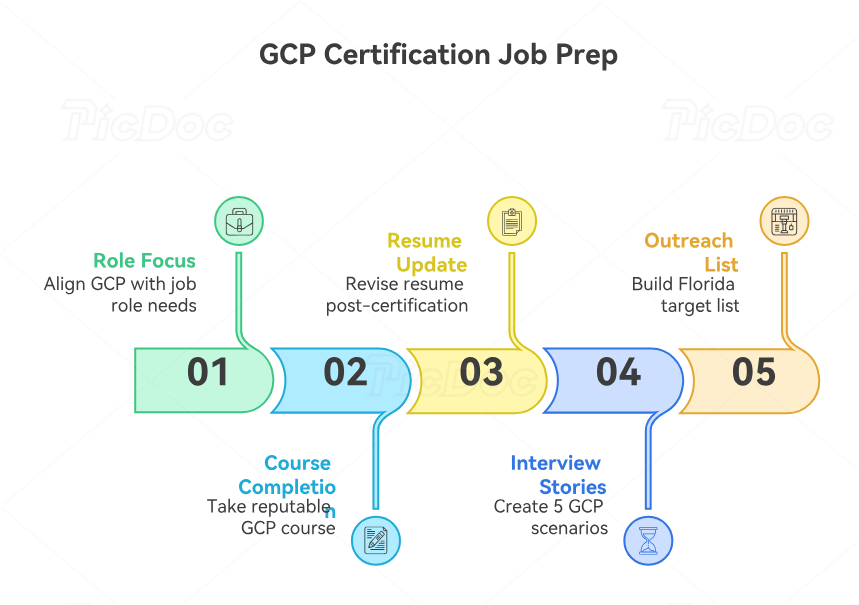
Start by defining the role you want, because the same GCP certificate should be framed differently for different jobs. A CRC candidate should focus on consent, visit execution, source notes, and patient communication. A CRA candidate should focus on monitoring findings, risk review, and follow-up. A regulatory candidate should focus on document control, IRB submissions, and clinical trial amendments. A safety candidate should focus on SAE reporting, pharmacovigilance audits, and safety monitoring workflows.
Next, complete a reputable GCP course and take notes in a workplace format. Create sections titled “What I would check,” “What I would document,” “Who I would escalate to,” and “What risk this prevents.” This turns training into interview language. When you study informed consent, connect it to participant understanding, version control, timing, signatures, and re-consent. When you study source data, connect it to data integrity, EDC queries, audit trails, and data review skills. When you study monitoring, connect it to GCP monitoring techniques and remote monitoring visits.
After certification, update your resume within 24 hours. Add the certificate under training, then add role-specific evidence under your summary and skills. Weak phrasing says, “GCP certified.” Strong phrasing says, “Trained in ICH-GCP principles covering informed consent, protocol compliance, AE/SAE awareness, source documentation, investigator oversight, and inspection readiness.” For Florida applications, pair that with local positioning through clinical research certification Florida guidance, CRA career pathways, certificate program comparisons, and salary research.
Then create five interview stories from GCP scenarios, even if they come from training simulations, shadowing, coursework, or healthcare experience. Prepare one story about consent quality, one about documentation accuracy, one about patient safety, one about protocol compliance, and one about communication with a study team. Use the structure: situation, risk, action, documentation, escalation, prevention. This helps you avoid vague answers and gives you practical bridges to protocol deviation examples, site operations oversight, quality management, and patient education resources.
Finally, build a targeted Florida outreach list. Look for site networks, academic research departments, specialty clinics, CROs, sponsor vendors, regulatory teams, and data/safety groups. Send messages that connect your GCP training to their pain points: enrollment delays, documentation errors, query backlogs, missed visit windows, consent version issues, and inspection readiness. Better outreach sounds like: “I recently completed ICH-GCP training and am targeting CRC support roles where I can help with source documentation, visit tracking, consent workflows, and query prevention.” That message pairs naturally with clinical research communities, professional associations, career opportunity maps, and free training resources.
5. Florida-Specific Career Strategy After ICH-GCP Certification
After certification, your next challenge is positioning. Florida clinical research applicants often lose momentum because they apply to every role with the same resume. A CRC resume should sound different from a CRA resume. A regulatory resume should sound different from a safety resume. A data resume should sound different from a site-startup resume. Use GCP as the foundation, then build a targeted profile around site monitoring, clinical trial start-up, regulatory guidelines, and trial technology trends.
If you are entry-level, target roles where GCP knowledge can reduce risk quickly: research assistant, clinical research assistant, regulatory assistant, site support specialist, data entry coordinator, patient recruitment coordinator, and CRC trainee. Your resume should translate any healthcare, admin, pharmacy, lab, public health, or patient-facing work into research-relevant behaviors. Scheduling becomes visit-window discipline. Documentation becomes source-note awareness. Patient communication becomes consent-support readiness. Compliance work becomes audit readiness. Connect those points to ethical patient safety principles, patient retention strategies, clinical trial templates, and GCP self-assessment tools.
If you already work in healthcare, avoid the mistake of assuming employers will automatically understand your transfer value. A nurse should explain how patient assessment supports AE recognition, consent questions, protocol adherence, and participant safety. A pharmacist should explain investigational product accountability, medication reconciliation, storage conditions, and protocol-specific dispensing. A medical assistant should explain vitals, specimen flow, visit documentation, and patient scheduling. Those connections become stronger when supported by SAE reporting guidance, pharmacovigilance best practices, clinical trial data integrity, and investigator responsibilities.
If you want CRA work, understand that GCP certification helps, but monitoring roles require proof of judgment. Hiring teams look for candidates who can identify site risk, write clear follow-up, recognize recurring issues, and communicate without creating defensiveness. Build proof through mock monitoring reports, site visit checklists, deviation reviews, and query-resolution examples. Study CRA monitoring visits, risk-based monitoring, clinical trial data verification, and investigator meeting strategy until your interview answers sound operational.
The best Florida strategy is simple: finish ICH-GCP certification, choose one target role, build role-specific proof, update resume language, practice scenario answers, and reach out to sites with a clear value proposition. A certificate opens the door when it is attached to practical readiness. It becomes stronger when it connects to Florida clinical research certification, clinical research salary planning, global career opportunities, and online clinical research communities.
6. FAQs About Getting Your ICH-GCP Certification in Florida
-
Many Florida clinical research roles strongly prefer or expect GCP training because it shows that you understand patient protection, protocol compliance, informed consent, documentation standards, and safety reporting. The certificate becomes more useful when you connect it to a target role, such as CRC, CRA, regulatory assistant, safety associate, data coordinator, or research assistant. Pair it with clinical research certification in Florida, GCP compliance tools, and site monitoring visit guidance.
-
Many GCP courses can be completed quickly, but the smarter move is to study slowly enough to understand workplace application. Give extra attention to informed consent, AE/SAE reporting, protocol deviations, investigator oversight, essential documents, and monitoring responsibilities. A fast certificate with weak understanding will fail during interviews. A practical certificate supported by protocol deviation examples, adverse event reporting guidance, and clinical trial safety monitoring creates stronger career value.
-
CRC, CRA, regulatory, safety, data, site management, research assistant, investigator, and project coordination roles all benefit from GCP certification. The value changes by role. CRCs use it for consent, visits, and source notes. CRAs use it for monitoring and issue escalation. Regulatory professionals use it for document control and submissions. Safety professionals use it for AE/SAE workflows. Build role-specific context through CRC strategies, CRA monitoring mastery, regulatory compliance, and data review skills.
-
Yes, especially when you translate your background into trial-relevant proof. Healthcare, pharmacy, nursing, public health, lab, administrative, and patient-service experience can support entry-level research applications when framed correctly. Show how your background connects to documentation, scheduling, confidentiality, patient communication, compliance, safety awareness, and team coordination. Strengthen your profile with research assistant communication strategies, clinical trial start-up checklists, and free clinical research training resources.
-
List it under certifications or training, then reinforce it in your summary and skills. Use applied language: “Trained in ICH-GCP principles including informed consent, source documentation, AE/SAE awareness, protocol compliance, investigator oversight, and inspection readiness.” For CRC roles, mention source documentation and visits. For CRA roles, mention monitoring and issue escalation. For regulatory roles, mention document control and amendments. Support that positioning with clinical research certificate comparisons, career opportunity mapping, and salary planning.
-
After GCP, study the workflows connected to your target role. CRCs should study patient retention, visit management, deviations, and monitoring visits. CRAs should study monitoring reports, data verification, risk-based monitoring, and investigator meetings. Regulatory professionals should study amendments, IND/NDA basics, essential documents, and inspection readiness. Safety candidates should study AE/SAE processing and pharmacovigilance audits. Strong next steps include patient retention strategies, risk-based monitoring, IND/NDA submissions, and pharmacovigilance audits.
