
Virginia offers a wide clinical research landscape that reaches from academic medical centers in Charlottesville and Richmond to health systems in Northern Virginia, Hampton Roads, and the Roanoke Valley. An ICH-GCP certificate can strengthen your entry into this market when you can also demonstrate knowledge of ethical clinical trial conduct, investigator responsibilities, adverse-event reporting, and clinical trial data integrity.
This guide explains how to choose current training, complete it efficiently, retain defensible documentation, and convert your certification into practical career value during 2026-27.
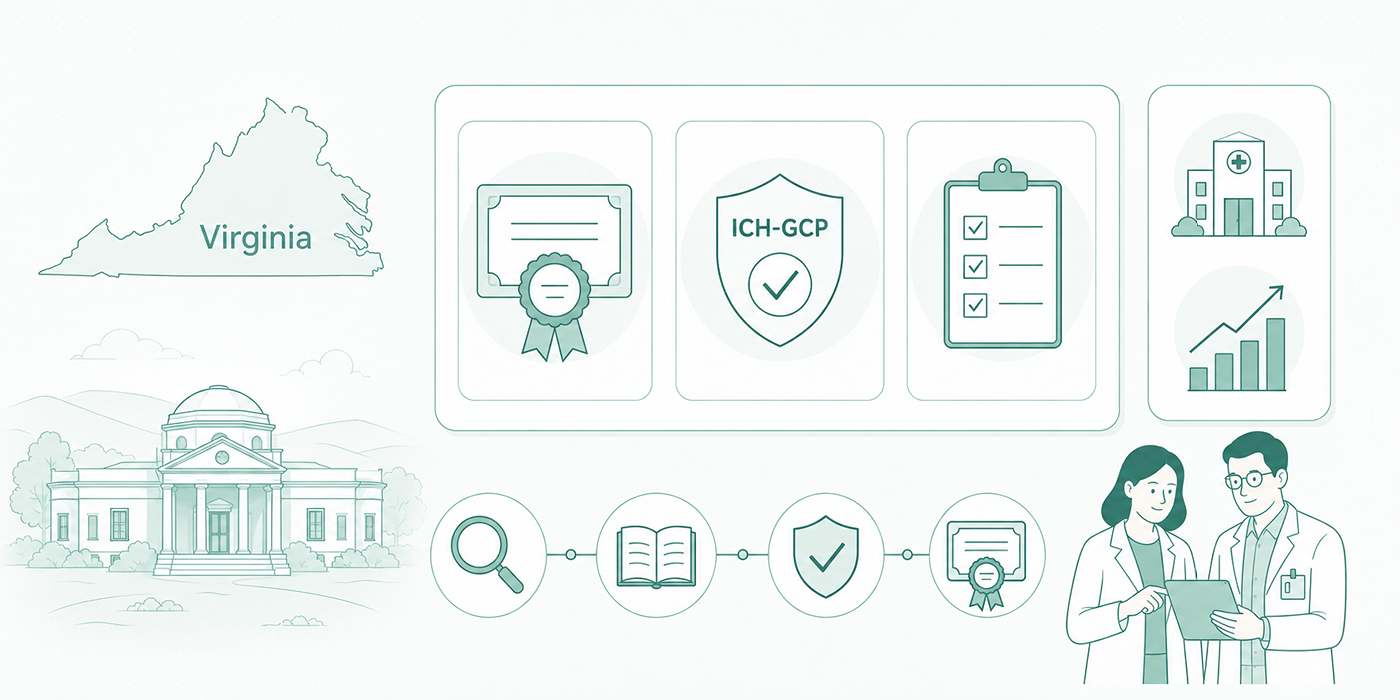
1. Why ICH-GCP Certification Matters in Virginia in 2026-27
Good Clinical Practice provides the ethical, scientific, and operational framework used to protect clinical trial participants and generate reliable results. It guides informed consent, protocol compliance, eligibility confirmation, safety surveillance, investigational-product control, data management, monitoring, sponsor oversight, computerized systems, and essential-document retention. A credible certification course should therefore prepare you to work through serious adverse-event reporting, protocol-deviation assessment, clinical trial amendments, and GCP monitoring activities.
The regulatory standard has advanced considerably. The FDA issued final ICH E6(R3) Good Clinical Practice guidance in September 2025, incorporating flexible, proportionate, risk-based approaches and modern trial technologies. ICH E6(R3) Annex 2 reached Step 4 in June 2026, extending the framework to additional trial designs, decentralized elements, pragmatic approaches, and varied data sources. A professional entering clinical research during 2026-27 needs direct familiarity with E6(R3), critical-to-quality factors, quality by design, data governance, computerized systems, and risk-proportionate controls.
Virginia’s research environment makes these competencies commercially relevant. The University of Virginia maintains clinical trial infrastructure supporting trial registration, record maintenance, results submission, monitoring, study systems, and multisite project management. Virginia Commonwealth University requires GCP training for personnel working on applicable clinical trials and maintains institutional resources covering trial operations, regulatory requirements, monitoring, and research systems.
Northern Virginia adds research opportunities through Inova, whose programs include studies of medications, treatments, therapeutic devices, oncology, cardiovascular disease, neuroscience, surgery, and other clinical areas. In Hampton Roads and other Virginia communities, Sentara provides scientific, regulatory, and administrative research support and reported managing approximately 200 clinical trials in late 2025. Carilion Clinic conducts drug, biologic, and device trials across 18 clinical areas in the Roanoke region.
This breadth creates pathways for clinical research assistants, coordinators, research nurses, regulatory specialists, data coordinators, project managers, monitors, pharmacovigilance professionals, investigators, and site-management personnel. Each role applies GCP differently. A coordinator may spend more time on participant-retention strategies, site-monitoring preparation, clinical trial budget management, and protocol-deviation handling. A CRA candidate requires deeper knowledge of risk-based monitoring, remote and on-site monitoring, clinical data verification, and investigator-meeting management.
The hardest problem appears when candidates expect the certificate to carry the entire application. Hiring teams still need evidence that you can recognize invalid consent, investigate an eligibility discrepancy, preserve an audit trail, escalate an SAE, reconcile study product, communicate a monitoring finding, and document corrective action. The following matrix converts GCP training into observable competencies that Virginia employers can evaluate.
Virginia ICH-GCP Certification and Career Readiness Matrix: 27 Competencies for 2026-27
| Competency | What You Must Understand | Evidence of Readiness | High-Risk Failure | CCRPS Resource |
|---|---|---|---|---|
| GCP principles | Connect participant rights, safety, reliable results, proportionality, and scientific quality. | Explain how one operational decision affects both safety and data reliability. | Reciting principles without applying them to trial scenarios. | GCP ethics and safety |
| Informed consent | Control versions, approval periods, signatures, dates, language, capacity, timing, and reconsent. | Complete a consent-quality review before study procedures. | Using an expired form or obtaining consent after a procedure. | Ethics resources |
| Eligibility confirmation | Verify every inclusion and exclusion criterion through attributable source evidence. | Create a documented eligibility checklist linked to source records. | Enrolling based on assumptions or incomplete medical records. | Site-operations oversight |
| Protocol interpretation | Translate protocol language into visits, windows, procedures, restrictions, and escalation triggers. | Build a study-specific visit worksheet. | Using a generic checklist that misses protocol-specific requirements. | Deviation prevention |
| Source documentation | Create attributable, contemporaneous, accurate, complete, legible, original, and enduring records. | Correct documentation while preserving the original entry and audit trail. | Backdating, overwriting, or adding unsupported information. | Data-integrity guidance |
| EDC entry | Transfer source data accurately within required timelines. | Demonstrate traceability from source records to database fields. | Estimating values when the source is missing or unclear. | Data-review skills |
| Query resolution | Investigate discrepancies and answer queries using defensible evidence. | Write a concise response supported by clarified source documentation. | Changing source data solely to match the EDC. | Monitoring techniques |
| Adverse events | Capture onset, severity, causality, outcome, action taken, treatment, and follow-up. | Reconcile event information across source, EDC, and safety records. | Delaying documentation until the next scheduled visit. | AE reporting compliance |
| Serious adverse events | Recognize seriousness criteria and follow sponsor, IRB, and regulatory reporting pathways. | Complete a simulated initial SAE notification and follow-up plan. | Waiting for complete hospital records before initial escalation. | SAE reporting procedures |
| Protocol deviations | Identify, document, assess, report, trend, correct, and prevent recurring deviations. | Produce a root-cause analysis and measurable CAPA. | Using “staff retrained” as the complete response. | CRC deviation guide |
| Protocol amendments | Coordinate approvals, training, documents, systems, procedures, and participant reconsent. | Create an amendment implementation tracker. | Applying amended procedures before required approval. | Amendment management |
| Investigational product | Control receipt, storage, temperature, dispensing, return, reconciliation, and destruction. | Reconcile the product from shipment through final disposition. | Leaving count differences or temperature excursions unresolved. | Investigator responsibilities |
| Delegation | Match duties with qualifications, training, authorization, and investigator supervision. | Compare the delegation log with duties actually performed. | Adding personnel retrospectively after work has begun. | Trial responsibilities |
| Training documentation | Maintain role, protocol, system, safety, amendment, and refresher training evidence. | Build a role-to-training requirements matrix. | Collecting certificates without confirming role relevance. | Training directory |
| IRB communication | Manage initial reviews, amendments, deviations, safety reports, continuing reviews, and closure. | Map each reportable event to the applicable IRB process. | Assuming sponsor notification fulfills IRB requirements. | Regulatory directory |
| Essential documents | Maintain current, complete, attributable, retrievable, and version-controlled records. | Perform a regulatory-binder or eTMF completeness review. | Bulk filing immediately before monitoring or inspection. | Trial templates |
| Computerized systems | Use controlled access, unique credentials, validated workflows, and protected audit trails. | Explain the attribution risk created by shared credentials. | Using undocumented workarounds after system problems. | Clinical trial technology |
| Privacy and confidentiality | Limit access, follow authorization terms, and use secure communication channels. | Identify privacy risks in recruitment and remote-trial workflows. | Sending identifiable information through unapproved channels. | Compliance resources |
| Monitoring readiness | Reconcile records, close open items, arrange access, and document follow-up. | Create a pre-monitoring readiness checklist. | Trying to repair months of documentation in one day. | Monitoring-visit guide |
| Risk-based quality | Identify critical-to-quality factors and apply proportionate controls. | Create a risk, control, owner, threshold, and indicator matrix. | Treating every process as equally critical. | Risk-based monitoring |
| CAPA | Separate immediate correction, root cause, corrective action, prevention, and effectiveness review. | Define an observable effectiveness measure. | Closing CAPA without confirming sustained improvement. | Quality management |
| Participant retention | Reduce avoidable burden while preserving voluntariness and reliable follow-up. | Design a participant-centered, protocol-compliant contact workflow. | Using inconsistent or overly forceful communication. | Retention strategies |
| Decentralized procedures | Control remote consent, telehealth, home visits, devices, samples, and direct shipments. | Map responsibilities across the site, sponsor, and vendors. | Leaving ownership unclear when a remote process fails. | Virtual clinical trials |
| Vendor oversight | Define responsibilities, evaluate performance, escalate failures, and retain oversight evidence. | Create a vendor performance and risk tracker. | Assuming transferred tasks eliminate oversight responsibility. | Sponsor oversight |
| Study start-up | Coordinate contracts, budgets, approvals, systems, documents, training, and activation. | Build a dependency-based activation plan. | Scheduling participants before every requirement is cleared. | Start-up checklist |
| Inspection readiness | Retrieve evidence efficiently, explain processes accurately, and manage commitments. | Complete a mock inspection interview and document request. | Guessing when the supporting record cannot be located. | Inspection techniques |
| Professional escalation | Communicate facts, impact, urgency, ownership, and the requested decision. | Write a concise compliance-escalation message. | Sending vague warnings that leave risk unowned. | Research communication |
2. How to Choose the Right ICH-GCP Certification Course in Virginia
Course selection should begin with a target position. A future clinical research assistant needs a foundation in participant communication, informed consent, privacy, source documentation, and escalation. A coordinator needs stronger operational preparation in screening, visit execution, safety documentation, investigational-product control, EDC entry, regulatory records, and sponsor communication. A CRA candidate should prioritize monitoring strategy, risk assessment, source-data review, issue classification, follow-up reports, and site management. Reviewing the Virginia clinical research certification guide, Maryland CRA career pathway, clinical research program comparison, and clinical research career map can help you select a realistic pathway.
A suitable 2026-27 course should identify ICH E6(R3) directly. The curriculum should explain participant protection, quality by design, critical-to-quality factors, proportionality, risk-based quality management, data governance, computerized systems, sponsor oversight, investigator responsibilities, and essential records. Annex 2 awareness also matters because modern studies may use telehealth, remote consent, wearable devices, home nursing, electronic patient-reported outcomes, local healthcare providers, real-world data, and direct-to-patient services. The FDA’s final E6(R3) guidance expressly embraces flexible, risk-based approaches and innovation in trial design, conduct, and technology.
A course built around definitions provides limited protection against real workplace failures. Scenario-based assessment creates greater value because it asks what should happen when a participant signs the wrong consent version, a screening procedure occurs too early, a hospitalization is reported after hours, eligibility evidence remains incomplete, or an EDC value conflicts with source. These scenarios require integrated knowledge of adverse-event compliance, protocol-deviation management, remote monitoring techniques, and clinical research quality management.
Employer acceptance requires attention before payment. Virginia institutions may require a specific CITI track, institutional affiliation, refresher course, human-subjects-protection module, or internal learning platform. UVA states that clinical research staff should complete Human Subjects Research Protection and Good Clinical Practices modules through CITI, while its broader training requirements use a three-year renewal cycle. VCU requires GCP training for applicable clinical trial personnel and requires its own CITI-based human-subjects coursework for engaged researchers.
External certification can strengthen your résumé and prepare you before hiring, while institutional onboarding may still be required after joining an organization. Confirm the accepted provider, required course track, guideline version, passing score, certificate format, and refresher interval. The free clinical research training directory, professional-association directory, GCP compliance self-assessment, and regulatory-guidelines directory can support this review.
The certificate should display your correct legal or professional name, provider, course title, completion date, and enough information for verification. Retain the learning objectives, syllabus, assessment result, completion email, guideline version, and provider contact details. This evidence may be requested during onboarding, sponsor qualification, site activation, monitoring, internal quality review, or inspection. NIH confirms that GCP training consistent with ICH E6(R3) satisfies its training expectation for NIH-funded clinical trials.
Your intended research setting should influence course depth. Oncology roles require attention to complex eligibility, disease assessments, investigational-product administration, dose modification, and safety escalation. Device studies introduce accountability, malfunctions, complaints, technical training, and device-specific documentation. Social and behavioral trials require intervention fidelity, privacy protection, remote interaction controls, and handling of sensitive information. Supporting your course with oncology research resources, investigational new drug guidance, clinical trial safety monitoring, and patient-education resources creates stronger role alignment.
3. How to Complete, Document, and Prove Your GCP Training
Begin by collecting approximately 20 Virginia job descriptions for one role family. Search Richmond, Charlottesville, Northern Virginia, Hampton Roads, Roanoke, and remote Virginia-based opportunities. Record the responsibilities, systems, therapeutic areas, education requirements, and experience thresholds that recur. A coordinator search may repeatedly surface informed consent, EDC entry, participant scheduling, specimen handling, safety documentation, regulatory maintenance, and monitoring preparation. A monitor search may emphasize travel, source review, issue escalation, site communication, report writing, risk assessment, and action-item tracking.
This job-description analysis prevents random course accumulation. Candidates often continue buying credentials while employers repeatedly identify the same practical weakness. A focused plan should connect your certification with clinical trial start-up, site-monitoring preparation, trial data verification, and research-team communication according to the target role.
During training, convert every lesson into six operational questions. Determine which decision the principle controls, which record proves compliance, which person owns the action, which event triggers escalation, which timeline applies, and what consequence could affect the participant or data. A lesson on safety reporting should help you distinguish event detection, adverse-event documentation, seriousness assessment, causality assessment, initial sponsor notification, IRB reporting, follow-up, and reconciliation. The SAE reporting procedures, pharmacovigilance best practices, global safety compliance guide, and pharmacovigilance inspection techniques can deepen this reasoning.
Apply the same method to consent, data, deviations, investigational products, and monitoring. For consent, examine version control, approval periods, signatures, dates, capacity, translated materials, witnesses, representatives, reconsent triggers, and procedure timing. For data, examine attribution, contemporaneous entry, certified copies, audit trails, corrections, access controls, and source-to-EDC traceability through the clinical data-integrity guide, data-review mastery guide, clinical trial technology report, and monitoring-techniques guide.
After completing the assessment, save the certificate with a filename that allows immediate identification, such as Surname_Firstname_ICH-GCP-E6R3_2026.pdf. Maintain a training log containing the provider, course title, version, completion date, score, certificate location, role relevance, and expected refresher date. Store the evidence securely in cloud storage and retain an accessible backup. NIH expects covered personnel to refresh GCP training at least every three years, while individual institutions and sponsors may require another schedule.
The next step is building proof of practical understanding. Create a consent-quality review, a protocol-deviation analysis, and a monitoring-readiness assessment. Your consent review should evaluate approval status, version, signatures, dates, procedure timing, reconsent requirements, filing, participant risk, and escalation. Your deviation analysis should identify the requirement affected, immediate correction, participant impact, root cause, corrective action, preventive control, reporting route, and effectiveness measure. Your monitoring review should address source completeness, consent forms, EDC status, safety reconciliation, investigational-product accountability, essential documents, outstanding queries, prior findings, and unresolved action items. The trial templates directory, deviation corrective-action guide, monitoring-visit guide, and quality-management strategies provide useful structures.
What is blocking your Virginia clinical research career right now?
Choose the problem costing you the most progress. Your answer will reveal the strongest next move.
4. How to Turn Your ICH-GCP Certificate Into a Virginia Clinical Research Job
Your résumé should identify the course with precision. Include the complete course name, provider, guideline version, and completion year in a visible certifications section. Then connect the training with abilities relevant to the vacancy. A coordinator résumé can emphasize consent review, screening support, source-documentation quality, participant scheduling, safety-event documentation, EDC entry, regulatory maintenance, and monitoring readiness. A CRA résumé can emphasize risk-based site oversight, remote and on-site visits, clinical data verification, and investigator-meeting execution
Virginia’s regional markets should be approached differently. Charlottesville offers pathways connected with UVA, its clinical trials infrastructure, cancer research programs, sponsor-investigator support, multicenter trial management, and research systems. Richmond includes VCU, VCU Health, academic research units, specialty programs, regulatory operations, and industry-sponsored studies. VCU’s clinical research infrastructure includes OnCore and institutional requirements involving clinical trial administration, monitoring, ClinicalTrials.gov responsibilities, and electronic trial-management tools.
Northern Virginia includes Inova research programs and access to the wider Washington metropolitan life-sciences market. Hampton Roads includes Sentara-affiliated research, specialty practices, hospitals, academic partnerships, device studies, and community-based programs. Roanoke offers opportunities through Carilion Clinic and connected academic and specialty research programs. UVA also launched a statewide clinical trials network in 2025 to expand trial access into additional Virginia communities, illustrating the gradual spread of research activity beyond traditional academic centers.
Applications become stronger when they explain the risk controlled by the role. A coordinator protects the study from missed windows, invalid consent, unsupported eligibility decisions, delayed safety reporting, incomplete source records, and unresolved participant follow-up. A regulatory specialist protects the study from expired approvals, incorrect versions, incomplete essential documents, unreported events, and poorly controlled submissions. A monitor identifies unreliable data, noncompliance, unresolved site problems, weak investigator oversight, and failures involving critical-to-quality processes. A project manager coordinates timelines, dependencies, vendors, ownership, quality indicators, and escalation through clinical trial timeline management, research-project quality strategies, clinical trial leadership, and project close-out procedures.
Transferable experience should be translated into these controls. Nursing and healthcare work can demonstrate patient communication, privacy awareness, medical terminology, documentation, and urgent escalation. Laboratory work can demonstrate specimen handling, chain of custody, controlled procedures, discrepancy management, and quality review. Pharmacy work can support medication knowledge, storage controls, reconciliation, and investigational-product accountability. Project administration can demonstrate scheduling, tracking, documentation, dependency management, and stakeholder communication. The résumé should connect each prior responsibility to the demands of the target research role.
Interview preparation should focus on failures that expose judgment. Practice responding to an outdated consent form, a procedure performed before consent, incomplete eligibility evidence, hospitalization reported after hours, mismatched source and EDC values, unreconciled investigational product, and repeated late documentation. A credible answer identifies immediate participant-safety needs, preserves the record, confirms the applicable requirement, escalates to the correct person, respects delegated authority, follows the reporting timeline, and documents corrective action. Use the GCP compliance assessment, adverse-event reporting guide, protocol-deviation guide, and site-operations oversight guide for scenario practice.
Networking conversations should also demonstrate preparation. Ask experienced professionals which documentation problems appear most often among new coordinators, which systems their teams use, which responsibilities require the longest training period, and how entry-level employees are evaluated during their first 90 days. These questions can produce usable career intelligence while showing that you understand daily trial operations. The clinical research communities directory, professional-association directory, free training directory, and clinical research salary tool can support your outreach.

5. Common Certification Mistakes and a 90-Day Virginia Career Plan
One costly mistake is purchasing a course without confirming its guideline version. Training built exclusively around E6(R2) may leave gaps involving E6(R3), critical-to-quality factors, proportionality, quality by design, computerized systems, modern data sources, and decentralized procedures. Another mistake is assuming every Virginia employer recognizes every course. Institutional policies may specify CITI affiliation, a biomedical or social-behavioral track, internal training, refresher timing, or sponsor-approved content.
Passive completion also creates problems. Memorizing terminology may help with simple quiz questions, while interviews and workplace decisions demand applied reasoning. A candidate should be able to explain what happens after a consent error, safety event, missing eligibility document, data discrepancy, product excursion, missed procedure, or monitoring finding. Build this competence through the ethical-conduct guide, investigator-responsibilities overview, sponsor-responsibilities guide, and clinical trial safety-monitoring resource.
Candidates also confuse GCP training with professional CRA or CRC certification. GCP training documents education in clinical trial quality and ethics. A role-based professional credential may evaluate broader occupational knowledge and may require clinical research experience, an examination, continuing education, and renewal. Compare available routes through the CCRPS, ACRP, and SOCRA comparison, CRA examination time-management guide, Virginia clinical research certification guide, and Maryland CRA career guide.
During the first 30 days, choose one role family, analyze approximately 20 Virginia job descriptions, and complete E6(R3)-aligned training. Record the systems, therapeutic areas, responsibilities, and experience requirements that repeatedly appear. Build your training evidence packet, schedule your expected renewal date, and complete the interactive GCP self-assessment, clinical research ethics directory, global regulatory directory, and clinical trial technology report.
During days 31 through 60, create your consent review, deviation analysis, and monitoring-readiness work samples. Rebuild your résumé around the selected role. Replace broad claims with concrete evidence. State that you reviewed a simulated consent packet for approval status, version, signatures, dates, procedure timing, reconsent, and filing. Describe how you assessed a deviation, identified the root cause, proposed CAPA, and defined an effectiveness measure. Support this work through the trial templates directory, deviation-management guide, monitoring-visit guide, and quality-management guide.
During days 61 through 90, divide your targets into academic centers, hospital research programs, independent research sites, specialty practices, CROs, sponsors, vendors, and remote employers. Tailor each résumé to the operational risks in the vacancy. Practice one scenario each day and prepare a concise explanation of your target role, E6(R3) training, portfolio evidence, and transferable experience. Expand your knowledge through the clinical trial start-up checklist, IND application guide, IND and NDA submissions guide, and remote monitoring guide.
Renewal should be managed from the completion date. NIH expects covered investigators and clinical trial personnel to refresh GCP education at least every three years. UVA also uses a three-year cycle for applicable CITI training, while other Virginia institutions, employers, sponsors, and protocols may establish their own requirements. Set reminders six months, three months, and 30 days before the expected expiration or renewal date.
6. Frequently Asked Questions About ICH-GCP Certification in Virginia
-
Requirements depend on the employer, institution, sponsor, funding source, study type, and assigned responsibilities. NIH expects investigators and staff involved in conducting, overseeing, or managing NIH-funded clinical trials to complete GCP training. UVA directs clinical research staff to complete Human Subjects Research Protection and GCP modules, while VCU requires GCP education for applicable clinical trial personnel.
Read the vacancy carefully and confirm accepted training before enrolling when you are targeting a particular organization. The Virginia certification guide, investigator GCP overview, clinical research ethics directory, and regulatory guidelines directory can help you understand related obligations.
-
Yes. The FDA finalized E6(R3) guidance in September 2025, and Annex 2 reached Step 4 in June 2026. A current course should cover critical-to-quality factors, proportionality, quality by design, risk-based approaches, computerized systems, data governance, decentralized activities, and modern data sources. NIH also confirmed in April 2026 that E6(R3)-consistent GCP training meets its requirement.
Build additional competence through risk-based monitoring strategies, virtual clinical trial guidance, clinical trial technology analysis, and clinical data-integrity guidance.
-
The organization relying on the training determines the operational validity period. NIH expects GCP refreshers at least every three years. UVA states that applicable CITI training follows a three-year completion cycle. An employer, sponsor, protocol, or research network may impose another interval or require earlier retraining after major regulatory, procedural, system, or role changes.
Maintain a training log containing the provider, course version, completion date, certificate location, and anticipated renewal date. Continue learning through the free clinical research training directory, adverse-event reporting guide, monitoring-skills guide, and quality-management resource.
-
Entry-level hiring becomes more realistic when certification is combined with transferable experience, target-role knowledge, and practical work samples. Healthcare, nursing, pharmacy, laboratory, quality, data, project administration, and participant-facing backgrounds can support an application when the résumé clearly translates those duties into research controls.
Demonstrate informed-consent awareness, documentation discipline, privacy protection, discrepancy detection, protocol-based work, and timely escalation. The research-assistant communication guide, patient-retention guide, site start-up checklist, and clinical research communities directory can support this transition.
-
ICH-GCP training documents education in clinical trial ethics, quality, responsibilities, and operational principles. CRA and CRC professional credentials may assess a larger role-specific body of knowledge and can involve experience eligibility, an examination, continuing education, and renewal requirements.
Compare pathways through the clinical research certification comparison, CRA exam preparation guide, Virginia clinical research guide, and professional-association directory.
-
Charlottesville and Richmond provide major academic and healthcare research environments through UVA and VCU. Northern Virginia includes Inova and access to the broader Washington-area life-sciences market. Hampton Roads offers hospital, specialty, community, and health-system research through organizations such as Sentara. Roanoke provides drug, biologic, device, oncology, cardiovascular, pediatric, and surgical research opportunities through Carilion Clinic.
Search statewide and include remote roles in monitoring, pharmacovigilance, data management, regulatory operations, project management, and study start-up. The clinical research career map, clinical research salary tool, global research-site directory, and online research communities directory can broaden your search.
