
The Ultimate Guide to Getting Your Good Clinical Practice (ICH-GCP) Certification in Montana: Everything You Need to Know in 2026-27
Montana clinical research careers reward people who can protect participants, document cleanly, and keep trials moving across hospital, academic, community, rural, and remote workflows. For candidates pursuing Good Clinical Practice training, clinical research certification in Montana, CRC site operations, CRA monitoring skills, and clinical trial compliance, ICH-GCP certification gives your resume a sharper signal than general healthcare interest.
1. Why ICH-GCP Certification Matters in Montana in 2026-27
Montana’s clinical research environment has a different pressure profile than dense coastal research markets. A trial team may be coordinating participants across long travel distances, community-based care settings, limited site staffing, rural recruitment barriers, telehealth touchpoints, specialty referrals, and strict documentation expectations from sponsors and CROs. That makes ICH-GCP certification especially valuable because it teaches the operating logic behind participant safety, informed consent, protocol compliance, essential documents, source records, adverse event reporting, monitoring, and inspection readiness. Candidates who combine ICH-GCP ethics, investigator responsibilities, protocol deviation management, SAE reporting procedures, and clinical trial data integrity can speak directly to employer risk.
The certificate matters most when you can translate it into job behavior. A hiring manager may ask how you would respond when a participant signs the wrong consent version, misses a visit window because of travel barriers, reports a new symptom during a phone call, has an eligibility lab outside range, or shows conflicting information between source notes and EDC. These questions expose shallow preparation quickly. A strong Montana applicant can explain what gets documented, who gets notified, how the impact is assessed, how recurrence is prevented, and how participant safety stays protected. Build that fluency through clinical trial amendments, CRC deviation handling, remote and onsite monitoring, clinical trial safety monitoring, and quality management strategy.
| Montana Career Scenario | What Your ICH-GCP Training Must Prove | Pain Point It Solves | Best CCRPS Resource Path |
|---|---|---|---|
| Entry-level CRC candidate in Billings, Missoula, Bozeman, or Great Falls | Consent flow, source documentation, visit tracking, participant protection | Resume sounds motivated without site-ready proof | CRC retention strategy + site visit readiness |
| Healthcare worker moving into clinical trials | Protocol-specific care, AE capture, escalation, documentation discipline | Clinical experience needs trial compliance translation | AE reporting + SAE procedures |
| Research assistant entering regulated studies | Human subject protection, delegation awareness, essential records | Academic research exposure feels too general | GCP ethics + investigator responsibilities |
| Rural site coordinator | Visit-window planning, remote communication, source completeness | Distance and scheduling create preventable deviations | trial timeline management + deviation prevention |
| Recruitment coordinator | Ethical outreach, consent timing, privacy, retention planning | Enrollment pressure can weaken compliance judgment | patient education resources + retention strategies |
| Clinical trial assistant | Document tracking, training logs, meeting follow-up, filing precision | CTA work breaks when invisible details drift | trial templates + investigator meetings |
| Regulatory coordinator | IRB records, amendments, essential documents, version control | Old forms and missing approvals create audit exposure | amendment handling + regulatory guidelines |
| Data coordinator | ALCOA-C habits, query resolution, source-to-EDC alignment | EDC fixes fail when source logic is weak | data review + data integrity |
| CRA applicant with site exposure | Monitoring judgment, SDR/SDV logic, finding escalation | Site experience needs sponsor-side vocabulary | risk-based monitoring + GCP monitoring |
| Remote CRA candidate | Remote source review, privacy awareness, issue follow-up | Remote monitoring magnifies unclear communication | remote monitoring + data verification |
| Oncology trial support candidate | Eligibility precision, lab timing, safety capture, visit complexity | Complex protocols expose weak tracking fast | oncology research ecosystem + safety monitoring |
| Neurology research candidate | Assessment consistency, visit windows, caregiver communication | Endpoint reliability depends on disciplined conduct | neurology trial sites + data integrity |
| Cardiology research candidate | Safety events, labs, device/procedure tracking, visit documentation | High-risk clinical signals require clean escalation | cardiovascular research + AE compliance |
| Public health graduate | Participant rights, trial conduct, protocol discipline | Population-health knowledge needs regulated trial proof | certificate comparison + free training resources |
| Career changer from operations or administration | Confidentiality, tracking, documentation, escalation discipline | Transferable skills need clinical research framing | professional associations + research communities |
| Pharmacovigilance entrant | AE/SAE definitions, timelines, seriousness, reconciliation support | Safety roles punish vague case language | PV best practices + PV compliance |
| Study startup assistant | Activation checklist, training evidence, approvals, document readiness | Delayed activation damages site-sponsor trust | startup checklist + SOP templates |
| Inspection-readiness support role | Audit trail thinking, CAPA support, training records, essential files | Teams discover gaps too late without routine QC | audit skills + quality management |
| Budget-facing coordinator | Schedule-of-assessments tracking, billable event support, documentation | Budget errors often begin as visit tracking errors | budget management + cost estimator |
| Principal investigator support staff | Delegation logs, PI oversight evidence, training documentation | PI accountability weakens when support records are thin | site oversight + PI responsibilities |
| Community clinic research staff | Participant communication, privacy, visit documentation, escalation | Lean teams need clearer role boundaries | research communication + GCP self-assessment |
| Decentralized or hybrid trial support | Remote consent awareness, eSource logic, vendor coordination, privacy | Digital workflows create hidden compliance gaps | virtual trials + trial technology |
| Clinical project assistant | Milestones, issue logs, site/vendor communication, quality follow-up | Project support becomes chaotic without GCP context | milestones + team leadership |
| Senior CRC pursuing lead role | Escalation, mentoring, deviation prevention, audit-ready habits | Promotion requires visible ownership of site risk | deviation handling + quality systems |
| Candidate expanding beyond Montana | Portable GCP vocabulary for regional, remote, sponsor, and CRO roles | Small-market job searches need wider positioning | Wyoming certification guide + Idaho certification guide |
| Candidate comparing certification options | Role fit, practical readiness, employer-facing skill proof | Wrong certificate choice wastes momentum | CCRPS vs ACRP vs SOCRA + salary comparison |
| Candidate planning a CRA pathway | Monitoring fundamentals, site communication, source review, escalation | CRA interviews expose weak scenario preparation | CRA exam strategy + CRA pathway guide |
2. Montana Career Paths That Benefit Most From ICH-GCP Certification
ICH-GCP certification supports Montana candidates across site, sponsor, CRO, academic, healthcare, and remote clinical research roles. A CRC candidate uses GCP to manage consent, visit windows, eligibility checks, source documentation, EDC queries, participant retention, and deviations. A CRA candidate uses it to review source records, evaluate site risk, write follow-up actions, and communicate findings without creating confusion. A regulatory candidate uses it to track essential documents, IRB submissions, amendments, approvals, and training evidence. A safety candidate uses it to recognize adverse events, seriousness, timelines, reconciliation needs, and documentation quality. Each path becomes stronger when paired with CRC retention strategy, risk-based monitoring, trial amendment control, pharmacovigilance best practices, and data integrity responsibilities.
Entry-level candidates in Montana should usually target roles where GCP knowledge can become visible fast: clinical research assistant, clinical trial assistant, site coordinator, CRC, regulatory assistant, data coordinator, recruitment coordinator, or patient-facing research support. These jobs reward organized people who understand how a protocol becomes a real visit, how a consent conversation becomes a compliant record, how a missed lab becomes a deviation question, and how a participant-reported symptom becomes a safety review. The strongest applicants prepare role-specific proof through site monitoring visit basics, clinical trial templates, interactive startup checklists, GCP self-assessment tools, and clinical research communities.
Montana also rewards candidates who can handle practical constraints calmly. A rural participant may need visit planning that accounts for weather, transportation, work schedules, caregiver support, and follow-up communication. A lean site may need one person who can help with screening logs, visit reminders, binder checks, source notes, query follow-up, and monitor requests. A remote sponsor role may need someone who can communicate clearly across time zones and document every action cleanly. That is why ICH-GCP certification should be presented alongside clinical research certification in Montana, global career opportunity mapping, clinical research professional associations, free clinical research webinars, and clinical research salary comparison.
3. How to Choose the Right ICH-GCP Certification for Montana Employers
A useful ICH-GCP certification should make you better at trial decisions, documentation choices, and interview scenarios. The course should cover the purpose of GCP, informed consent, ethics review, investigator duties, sponsor duties, monitoring, essential documents, quality management, protocol compliance, AE/SAE reporting, data integrity, confidentiality, and audit readiness. In 2026-27, strong candidates should also understand risk-based thinking, electronic systems, decentralized trial models, vendor oversight, and source-to-data traceability. Build your training stack with GCP monitoring techniques, clinical trial sponsor responsibilities, investigator-initiated trial guidance, quality management strategies, and clinical research regulatory guidelines.
Pick your course based on the job you want within the next 90 days. CRC-focused candidates should prioritize informed consent support, visit flow, source notes, participant education, retention, deviations, and EDC query awareness. CRA-focused candidates should prioritize site monitoring, SDR/SDV reasoning, remote review, issue escalation, follow-up letters, and risk signals. Regulatory-focused candidates should prioritize IRB documentation, amendments, training logs, version control, essential document filing, and inspection readiness. Safety-focused candidates should prioritize AE collection, SAE seriousness, causality wording, expectedness, timelines, and reconciliation. Pair that choice with handling protocol deviations, mastering remote monitoring, PV audits and inspections, clinical trial data review, and trial close-out procedures.
The certificate should also be easy to prove on paper. A weak resume says “GCP certified” and stops. A stronger resume says “ICH-GCP trained in informed consent support, participant safety, AE/SAE escalation, protocol deviation awareness, essential documents, source documentation, data integrity, and monitoring readiness.” A stronger interview adds examples: how you would correct a consent version issue, document a missed visit, handle a lab eligibility concern, support query resolution, or prepare for a monitor visit. This is how certification becomes career evidence. Strengthen that evidence with clinical trial sample size basics, trial budget management, trial cost estimation, patient education resources, and clinical research ethics resources.
What is your biggest Montana ICH-GCP certification blocker right now?
Choose one. Your result points to the fastest practical fix.
4. Step-by-Step Plan to Get ICH-GCP Certified in Montana
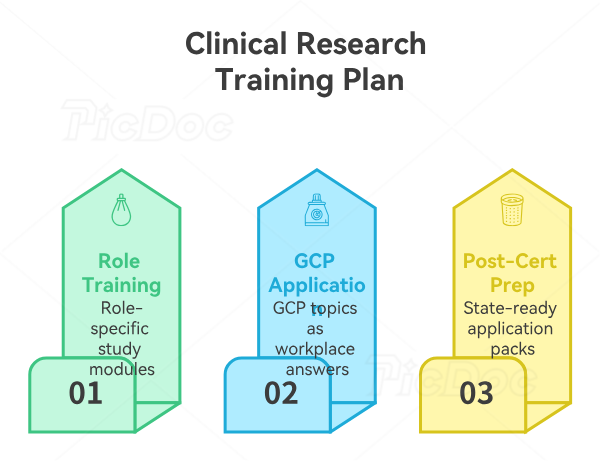
Start with a target role, then choose training around that role. A CRC candidate should study consent, visit schedules, participant education, retention, source notes, deviations, and query awareness. A CRA candidate should study monitoring plans, source review, risk signals, site communication, follow-up letters, and escalation. A regulatory candidate should study essential documents, IRB workflows, amendments, training logs, and inspection readiness. A safety candidate should study AE/SAE logic, seriousness, timelines, causality language, and reconciliation. This role-first plan makes each module useful for interviews. Use site monitoring visit guidance, risk-based monitoring mastery, clinical trial amendment guidance, GCP monitoring techniques, and essential trial templates while completing certification.
During the course, turn every major GCP topic into a workplace answer. For informed consent, write how you would verify the current version, confirm timing, support participant understanding, check signatures, and document the process. For protocol deviations, write how you would capture what happened, assess participant impact, notify the right parties, document corrective action, and reduce recurrence. For safety reporting, write how you would collect symptom details, identify seriousness, escalate within expectations, and preserve source clarity. For data integrity, write how you would handle source-to-EDC conflicts and query resolution. Reinforce those examples with SAE reporting procedures, protocol deviation corrective actions, AE compliance guidance, data review skills, and clinical research ethics resources.
After certification, create a Montana-ready application pack. Include a resume update, role-specific summary, GCP skills section, five scenario answers, and a short outreach message for research teams. Your resume should mention informed consent, participant safety, source documentation, AE/SAE awareness, protocol deviation documentation, essential documents, data integrity, and monitoring readiness. Your scenario answers should cover common pain points: missed visit windows, travel-related scheduling issues, remote follow-up, consent version control, eligibility concerns, and query resolution. Build your pack with clinical research certification in Montana, clinical research certification in North Dakota, clinical research certification in South Dakota, clinical research certification in Colorado, and clinical research certification in Washington.
5. How to Turn ICH-GCP Certification Into Interviews, Promotions, and Stronger Montana Opportunities
The strongest way to use ICH-GCP certification is to connect it to trial problems employers already feel. For site roles, show that you can reduce preventable deviations, improve source documentation, support cleaner consent records, help participants stay on schedule, and respond appropriately to monitor requests. For CRA-track roles, show that you can identify risk signals, communicate findings clearly, follow up without ambiguity, and understand why data credibility depends on site behavior. For regulatory roles, show that you can protect version control, training evidence, IRB records, and essential documents. Support these claims with quality management strategies, startup activity checklists, trial data review, budget management essentials, and trial close-out procedures.
For interviews, prepare answers that show calm judgment under pressure. Explain what you would do if a participant calls with a new symptom after a study drug visit, if a rural participant cannot make a scheduled assessment, if source records lack enough detail to support an EDC entry, if an updated consent form has been approved yet the old version remains in use, or if a monitor identifies repeated late entries. Each answer should include documentation, escalation, impact assessment, corrective action, and prevention. That structure proves practical GCP thinking. Build sharper answers through protocol deviation examples, clinical trial safety monitoring, remote monitoring guidance, clinical trial sponsor responsibilities, and investigator meeting strategies.
For promotions, choose one operational pain point and become the person who reduces it. If the site struggles with late queries, improve source clarity. If participants miss visits, build better reminder and contingency workflows. If deviations repeat, create a prevention checklist. If monitors keep requesting missing documents, clean the training log and binder process. If recruitment is slow, improve patient education and retention touchpoints. The certificate opens the door, while visible problem-solving creates trust. Continue building through patient retention strategies, trial timeline management, leadership and team management, project close-out procedures, and clinical research salary comparison.
6. FAQs About ICH-GCP Certification in Montana
-
Yes. ICH-GCP certification helps entry-level Montana candidates show they understand participant safety, informed consent, source documentation, protocol compliance, deviations, adverse event reporting, and inspection readiness. It becomes strongest when the candidate can explain real site scenarios. CRC applicants should add site visit readiness, patient retention strategy, and CRC deviation handling. CRA-track candidates should add risk-based monitoring and remote monitoring skills.
-
Strong first targets include clinical research coordinator, clinical research assistant, clinical trial assistant, regulatory assistant, data coordinator, recruitment coordinator, patient-facing research support, and site operations assistant. Candidates with healthcare, data, regulatory, monitoring, or safety experience can also pursue stronger CRA-track, quality, pharmacovigilance, or project support roles. Build your search around clinical research certification in Montana, research communities, professional associations, and global career mapping.
-
A strong course should cover ICH-GCP principles, informed consent, ethics review, investigator responsibilities, sponsor responsibilities, monitoring, essential documents, protocol adherence, AE/SAE reporting, data integrity, confidentiality, quality management, and inspection readiness. For 2026-27, it should also help you understand risk-based oversight, electronic systems, remote monitoring, decentralized workflows, and data governance. Reinforce your course with GCP ethics, investigator duties, data integrity guidance, and quality management.
-
List it under certifications, then reinforce it in your skills section and role summary. A strong line can say: “ICH-GCP trained in informed consent support, participant safety, source documentation, protocol deviation awareness, AE/SAE escalation, essential documents, data integrity, and monitoring readiness.” Add proof through a mock deviation log, visit checklist, source review exercise, or schedule-of-assessments tracker. Useful support resources include trial templates, startup checklists, AE reporting, and SAE reporting.
-
ICH-GCP certification can support a CRA pathway, especially when paired with site experience, source documentation knowledge, EDC familiarity, communication skills, and monitoring scenario practice. Many candidates first build credibility through CRC, CTA, regulatory, data, recruitment, or site operations roles. To become more competitive for CRA-track opportunities, study clinical trial data review, risk-based monitoring, onsite and remote monitoring, investigator meetings, and CRA exam time management.
-
Many GCP courses can be completed quickly, yet career readiness takes additional practice. After finishing the certificate, spend time turning the material into resume bullets, interview stories, role-specific examples, and outreach language. The strongest candidates can explain consent timing, eligibility review, visit-window problems, source notes, EDC queries, AE escalation, deviations, amendments, and monitoring findings. Use interactive GCP self-assessment, protocol deviation examples, trial amendment guidance, and monitoring techniques.
